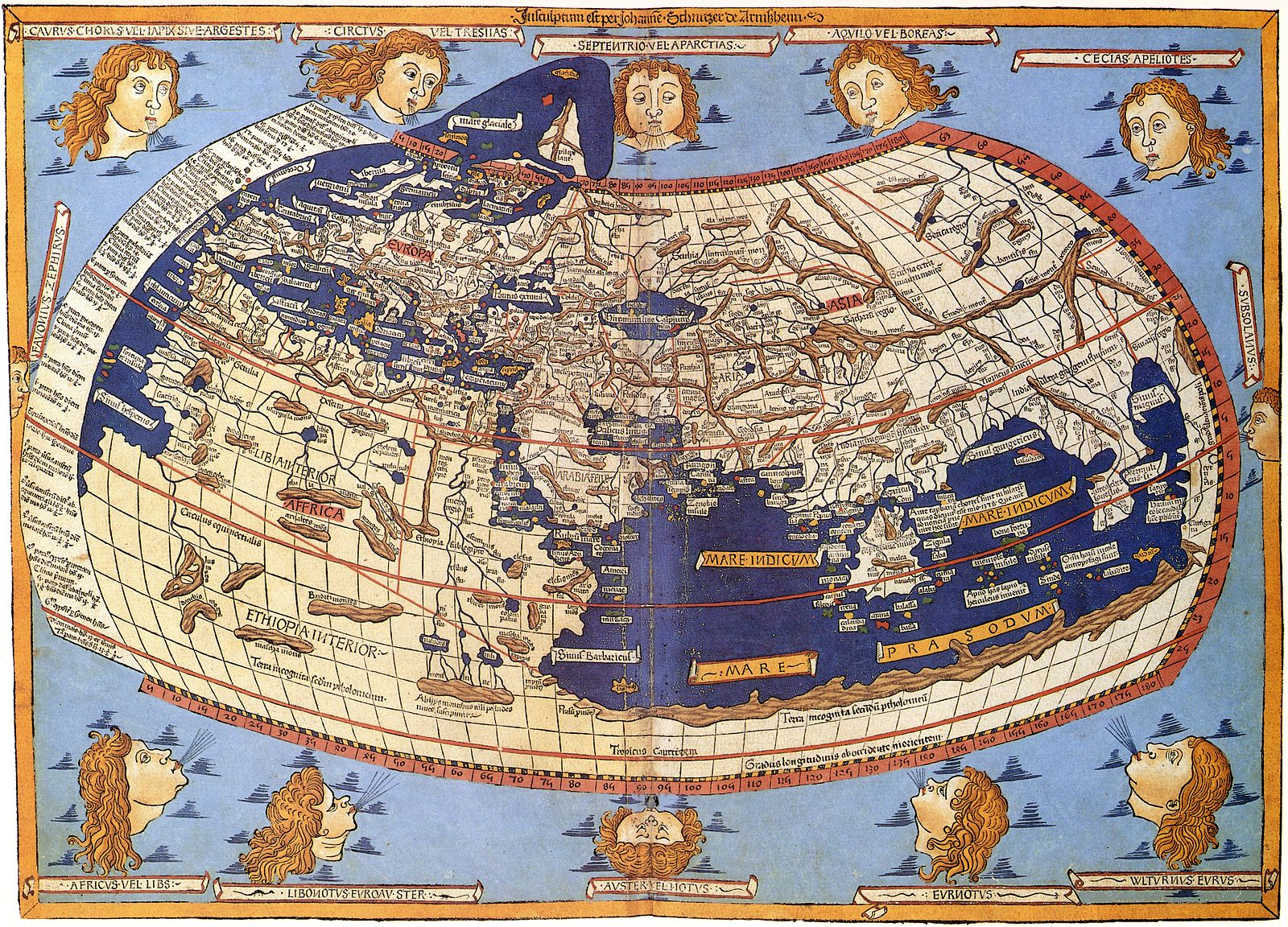
Nick Danforth explains how north ended up at the top of maps:
There is nothing inevitable or intrinsically correct — not in geographic, cartographic or even philosophical terms — about the north being represented as up, because up on a map is a human construction, not a natural one. Some of the very earliest Egyptian maps show the south as up, presumably equating the Nile’s northward flow with the force of gravity. And there was a long stretch in the medieval era when most European maps were drawn with the east on the top. … In the same period, Arab map makers often drew maps with the south facing up, possibly because this was how the Chinese did it.
So who was primarily responsible for the flip?
The north’s position was ultimately secured by the beginning of the 16th century, thanks to Ptolemy, with another European discovery that, like the New World, others had known about for quite some time. Ptolemy was a Hellenic cartographer from Egypt whose work in the second century A.D. laid out a systematic approach to mapping the world, complete with intersecting lines of longitude and latitude on a half-eaten-doughnut-shaped projection that reflected the curvature of the earth. The cartographers who made the first big, beautiful maps of the entire world, Old and New — men like Gerardus Mercator, Henricus Martellus Germanus and Martin Waldseemuller — were obsessed with Ptolemy. They turned out copies of Ptolemy’s Geography on the newly invented printing press, put his portrait in the corners of their maps and used his writings to fill in places they had never been, even as their own discoveries were revealing the limitations of his work. For reasons that have been lost to history, Ptolemy put the north up.
Previous Dish on north-south cartography in The West Wing here. Money quote:
When the top of the map is given to the Northern hemisphere and the bottom is given to the Southern, then people will tend to adopt top and bottom attitudes.
(Image of map from the 15th century depicting Ptolemy’s description of the Ecumene via Wikimedia Commons)
 The Dish
