History Is Written By The Sober

Stanton Peele blames the Temperance movement for expurgating our Founding Fathers’ prolific drinking habits from American history:

It is impossible for Americans to accept the extent to which the Colonial period—including our most sacred political events—was suffused with alcohol. Protestant churches had wine with communion, the standard beverage at meals was beer or cider, and alcohol was served even at political gatherings. Alcohol was consumed at meetings of the Virginian and other state legislatures and, most of all, at the Constitutional Convention.

Indeed, we still have available the list of beverages served at a 1787 farewell party in Philadelphia for George Washington just days before the framers signed off on the Constitution. According to the bill preserved from the evening, the 55 attendees drank 54 bottles of Madeira, 60 bottles of claret, eight of whiskey, 22 of porter, eight of hard cider, 12 of beer, and seven bowls of alcoholic punch.

That’s more than two bottles of fruit of the vine, plus a number of shots and a lot of punch and beer, for every delegate. That seems humanly impossible to modern Americans. But, you see, across the country during the Colonial era, the average American consumed many times as much beverage alcohol as contemporary Americans do. Getting drunk—but not losing control—was simply socially accepted.

A Friendlier Face For Big Brother

For a fresh take on what security cameras should look like, Rob Walker points to a project for Dutch Railways by the Amsterdam-based firm Fabrique, which “resulted in a form of security camera that expects to be seen”:

“The goal was to reduce the Big Brother feeling,” [Fabrique creative director Jeroen] van dish_fabriquecam Erp told me, straightaway. Dutch Railways (or NS), had done some research on “what kind of emotions were or weren’t evoked” by its camera system. “People knew there were cameras,” he continued, but they didn’t always know where they were (since the cameras were mounted to see, without much thought to being seen). And when they did spot one, they didn’t necessarily feel great about it. According to the data van Erp gave me, research found that while 68% of subjects agreed that the cameras they saw made them “feel safe,” an alarming 34% also said the objects inspired “a ‘big brother’ feeling.” (And a mere 9% found the things  “beautiful,” which is actually a surprisingly high number, to me.)

“So we said: Let’s try to change attitudes, with design,” van Erp said. … Rounded edges, bright colors, a more organic sense of living “eye”-ness: The upshot was a camera that’s comfortable being visible. The cameras were also deployed in a more determinedly visible way, acknowledging that people should see them. …

The data van Erup gave me suggests that the public … responded positively to these cameras. The percentage who called the object “beautiful” leapt to 80%; those reporting Big Brother vibe dropped to 12%. And the obviously critical safe-feeling response rose a bit — to 71%.

(Image of security camera by Fabrique)

Chutzpah Watch

Bill Kristol’s latest column is close to self-parody:

Kiev is ablaze. Syria is a killing field. The Iranian mullahs aren’t giving up their nuclear weapons capability, and other regimes in the Middle East are preparing to acquire their own. Al Qaeda is making gains and is probably stronger than ever. China and Russia throw their weight around, while our allies shudder and squabble.

Why is this happening? Because the United States is in retreat. What is the Obama administration’s response to these events? Further retreat.

PM Carpenter calls the editorial “a magnificent send-up to flamboyant despair and rhetorical folderol”:

Regional history needn’t be consulted, complexities needn’t be pondered, alternatives needn’t be explored. All trouble spots can be explained by America’s “retreat” in confronting what Kristol obliquely calls the world’s “barbarians”–a perilous legacy, he warns us as well, which is at our gates: “Rome fell not to the majestic Hannibal but to groups of unimpressive barbarians.” You might think Rome fell because of a bloated military complex that had extended its imperial borders beyond both affordability and defensibility–by which point those “unimpressive barbarians” were indeed remarkably impressive–but you would only be committing the error of consulting history.

Michael Brendan Dougherty adds:

[T]he idea that America is in retreat is hysterical gibberish. It can only be made plausible if one takes the immediate years after 2001 as the normal state of American foreign policy, or if you consider the emergence of any regional power (whether it be Iran or Russia) a dire threat. The U.S. still maintains 20 large foreign military bases around the globe, including some 70,000 troops stationed throughout Europe. Any diminishment of our war footing initiated by the Obama administration over his last years in office will leave America far and away the largest military force on the globe, better equipped and more easily deployed than any of its rivals.

Larison piles on:

It is absurd to pin these events on American “retreat,” since for the most part this isn’t even happening. So-called U.S. “retreat” didn’t cause any of these things, and all of them would probably still be happening whether the U.S. was “retreating” or “advancing.” The U.S. is responsible for the effects of its own actions and policies, and to a lesser extent the actions of its allies and clients that it supports, but it isn’t responsible for what authoritarian and illiberal regimes do inside their own countries, and for the most part it can’t be held responsible for how other major powers behave.

Chart Of The Day

Midterms Local

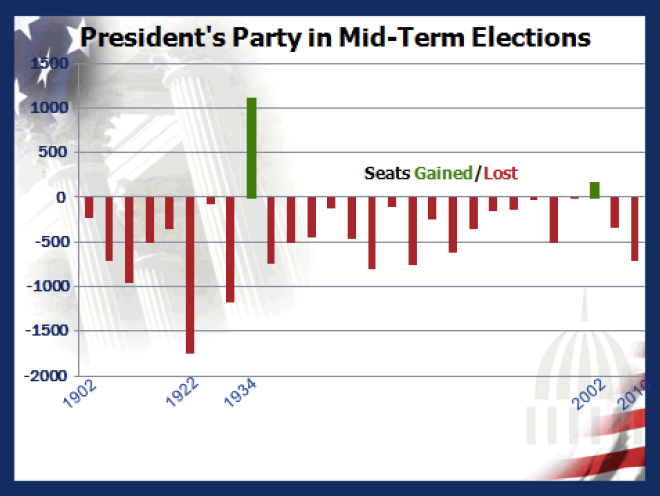
Cillizza looks at how the midterms might impact state legislators:

It turns out that the six-year itch is even more devastating at the state legislative level, which, as we documented in a post late last week is a critical piece of the political and policy equation for both parties nationally.  Check out this chart, courtesy of the National Conference of State Legislators, to grasp just how daunting the history of second term, midterm elections are for the president’s party at the state legislative level.

When Press Is The Best Protection

Masha Gessen feels that the American gay rights movement failed the Russian LGBT activists who protested during the games:

These brave Russian activists came out to protest because they thought that the eyes of the world were fixed on them that day and that their American activist allies in Sochi would support them by word and deed, staging their own protests and ensuring that the thousands of international correspondents in Sochi would hear of their protest and the treatment they faced. They were wrong. Their American allies watched the opening ceremony, socialized with Team U.S.A., and visited the famed Sochi gay bar. Their American allies failed them.

Why the lack of publicity matters:

First and foremost, working with LGBTQ activists in Russia has to involve ensuring that their names and their individual arrests and court hearings are well-publicized in the Western media. It also means ensuring that their fines are paid: The point of those extremely high fines is to open the way for further prosecution for nonpayment. Only if Russian authorities know that the world is watching the specific individuals they are targeting will the LGBT activists on the ground be relatively safe—which is to say, alive and unlikely to face long prison sentences in the near future.

The Imperfect Science Of Justice

Balko brings us the latest on Shaken Baby Syndrome:

New research suggests that most humans aren’t capable of shaking an infant hard enough to produce the symptoms in SBS. It usually takes an accompanying blow to the head. And in about half to two-thirds of the 200 or so SBS cases prosecuted each year in the U.S., there are no outward signs of physical injury. Indeed, this is the reason SBS is such a convenient diagnosis. It allows prosecutors to charge a suspected abuser despite no outward signs of abuse. But we now know that other causes can produce these symptoms, which means that some percentage of the people convicted in SBS cases are going to prison for murders that may have never happened.

He contrasts this SBS research with DNA testing:

The blood or semen or hair either matches the defendant, or it doesn’t. It will show that either the defendant raped or murdered the victim, or that someone else did. Things get murkier when the question isn’t who committed the crime, but if a crime was committed at all. The new research into SBS doesn’t state definitively that without external injuries, a child couldn’t have died from shaking. It suggests only that there are other possibilities—that shaking wasn’t the only possible cause of death. It isn’t an advance in science that will produce dispositive exonorations. It’s an advance that merely calls prior convictions into question.

Back To The Futurism

States_of_Mind-_The_Farewells_by_Umberto_Boccioni,_1911

Vivien Greene, curator of the Guggenheim’s new exhibit on the Italian Futurists, explains how F.T. Marinetti and his compatriots violate our ideas about the avant-garde:

This is sort of a scholarly debate, but I think for many people the definition of avant-garde means it follows the idea of the scholar named Bürger, and to be avant-garde means you have to be of the left. So if you break out of that mold—it’s hard to think of an avant-garde that was on the right. And I think with Futurism you have that, because in every other way, they’re satisfying our ideas of what is avant-garde: they’re new, they’re disruptive, and as they continue to develop into the ’20s and ’30s, they are reinventing themselves. It’s not as though they’re painting the same thing over and over again. They evolve while still keeping in mind the basic tenets of what is Futurist: dynamism, simultaneity, speed, technology, the machines. They embrace new things; they’re not at all static. Innovation is very important to the ideas of the avant-garde.

The Economist suggests that the movement’s fascist associates were one reason the Futurists have never had a major retrospective in the US:

Marinetti, a showman who liked to call himself “the caffeine of Europe” for the energy he put into promoting the futurist movement, was an early fan of Benito Mussolini and took part in the founding of the fascist movement in 1919. Marinetti wanted futurism to be Italian fascism’s official art movement. But the dictator refused, preferring to bestow his favours on different art movements at different times. The two men blew hot and cold about one another. Yet when Mussolini fell from power in 1943 and Hitler named him the head of the puppet Italian republic of Salò, the founder of futurism was one of the first to offer his support. Marinetti died just five months before Mussolini was executed, their lives seemingly forever linked.

In a largely complimentary review, Peter Schjeldahl calls Italian Futurism “the most neglected canonical movement in modern art – because it is also the most embarrassing”:

An avant-garde so clownish, in its grandiose posturing, and so sinister, in its political embrace of Italian Fascism, has been easy to shrug off, but the [Guggenheim] show makes a powerful case for second thoughts. It arrays some superb paintings and sculptures, the best of them by Umberto Boccioni, whose death in the First World War, at the age of 33, deprived the movement of its one great artist. And marvels of graphic and architectural invention reward a stroll up the Guggenheim’s ramp.

(Boccioni’s States of Mind II: The Farewells, 1911, via Wikimedia Commons)

Old MacDonald Had An iPhone

Jonathan Dent considers the rise of the farmer selfie, or “felfie”:

The champions of the felfie, the farmers themselves, see this as a much-needed opportunity (in the words of Will Wilson, curator of farmingselfies.com) ‘to put a face to the farmers who work hard to put food on your table,’ while Rob Campbell, writing in the Western Daily Press on January 9, saw the trend as having the potential to connect a scattered farming population with one another, as well as with the outside world. …  The popularity of the felfie, though, seems to be at least as much rooted in the seemingly inexhaustible needs of an increasingly urban society, creating its connections and consuming its information about the outside world through the internet and social media, to share, and stare raptly at photographs of the animals we encounter all too rarely in everyday life. While for many, selfie represented the self-regarding, insular tendencies of modern (online) life, the felfie seems to embody a desire to look beyond the screen to the greener world that city dwellers have been yearning for since the days of Hesiod, Theocritus, and Virgil.

The Dish’s favorite sheep farmer would surely approve.

A Hollow Victory In Mexico’s Drug War?

On Saturday, Joaquín “El Chapo” Guzmán, head of Mexico’s Sinaloa cartel, was captured after a 13-year manhunt. Daniel Hernández profiles the infamous kingpin:

[In 1993, Guzmán] was sentenced to 20 years in a maximum-security prison, but in 2001 he managed to escape, cartoonishly, in a laundry cart. Guzmán expanded his reach by trafficking marijuana, heroin, and cocaine into the United States, Europe, and Australia. He is said to exert control over most of western Mexico, parts of Guatemala, and trafficking ports in West Africa. While his nickname means “Shorty,” there’s nothing diminutive about El Chapo’s stature in the illicit drug world. Forbes has regularly named him in its lists of richest and “most powerful” people.

Juan Carlos Hidalgo asks the obvious question:

Without a doubt, Guzmán’s capture is a huge success for [Mexican president] Enrique Peña Nieto. In the last seven months, the leaders of Mexico’s top three drug cartels (Zetas, Gulf and Sinaloa) were arrested without a single shot being fired. So, are we on the verge of wining the war on drugs? That all depends on what the ultimate goal is.

Is it taking down drug kingpins or stopping the flow of drugs into the United States? If it’s the latter, the war is far from over. A report from the Office of Intelligence and Operations Coordination of the U.S. Custom and Border Protection agency looked at drug seizure data from January 2009 to January 2010 and matched it with the arrests or deaths of drug operatives (11 druglords in total). It found that “there is no perceptible pattern that correlates either a decrease or increase in drug seizures due to the removal of key DTO [drug trafficking organization] personnel.”

Keegan Hamilton warns that Guzmán’s arrest might actually make matters worse:

Each time a kingpin falls, bloody internecine conflict inevitably follows. When the Gulf Cartel boss Osiel Cárdenas Guillén ended up in Colorado’s infamous “supermax” federal penitentiary after his arrest in 2003 (a fate that may await El Chapo—federal prosecutors have already announced that they will seek his extradition), it paved the way for the Los Zetas cartel to commence its reign of terror across Mexico. The current situation in the Mexican state of Michoacán—where peasants have formed heavily armed militias to fight back against corrupt police and extortionist gangs—stems from the fragmentation of the La Familia cartel after the rumored death of its leader, Nazario “El Chayo” Moreno.

Even with El Chapo behind bars, the Sinaloa Cartel remains the most powerful drug-trafficking organization in Mexico, if not the world. Its operatives have been arrested in Africa, Asia, Europe, South America, the Caribbean, and, of course, the United States. The cartel may have lost its CEO, but its board of directors remains intact.

Mark Guarino highlights Sinaloa’s US distribution operation, based out of Chicago:

The city, centrally located, has become a hub for distributing drugs to other cities across the country, and its sizable Mexican population (both legal and illegal) provides the cartel with ready access to foot soldiers. For those reasons, the US Attorney’s Office in Chicago indicted Guzman in absentia in August 2009 for conspiring to transport drugs across international borders, and the US has prosecuted key figures in the cartel’s US operations here. The Chicago Crime Commission named Guzman public enemy No. 1, a designation previously given to a crime boss from another era, Al Capone.

Keating adds that Mexico’s much-touted drop in violence under Peña Nieto’s leadership is misleading:

According to the government’s statistics, the 18 percent drop in murders in 2013 was accompanied by a 35 percent increase in kidnapping. And Molly Molloy, a research librarian and a specialist on Latin America and the U.S.-Mexico border at the New Mexico State University Library, argues that the declining murder rate is the result of the country’s statistical agencies classifying fewer killings as “intentional homicides,” coupled with the fact that “the epicenters of extreme violence have dispersed around the country, making it more difficult to know how many people are dying.” She argues that there’s no evidence to suggest the total number of murders has declined at all, though different regions have seen changes in the level of violence.