An anti-fracking campaigner wears a hessian mask as he stands in the doorway to his tent in Barton, England on February 24, 2014. Plans to evict activists, who have been camped outside the Barton Moss gas fracking exploration facility, have been put on hold whilst their lawyers make a legal challenge in the courts. Up to 60 campaigners have been on the site in Barton Moss Road since November and are waiting anxiously for the next court hearing on March 6, 2014. By Christopher Furlong/Getty Images.
Month: February 2014
Do Children Have A Right To Die? Ctd
A reader feels that Belgium is moving in the right direction to legalize euthanasia for terminally-ill kids:
I don’t see why we should force a child to suffer when death is imminent in the short term, the child wants to die, the parents consent, and the doctors are in agreement. I think people in the US need to be much more rational and realistic about these things. The reality is that with the advances in modern medicine, we are also condemning people to longer suffering before we allow them to die. Now that we have the power to postpone death almost indefinitely, we should wield that power wisely and humanely.
But another is skeptical:
The problem with the “guidelines” is that they slowly but inevitably widen. In the Netherlands, you can now obtain assisted suicide when you suffer from normal geriatric conditions like hearing/sight loss/fatigue, or mental health issues such as depression. And these guidelines also have to work in conjunction with a patient’s right to refuse a particular treatment. So you have a situation where a depressed person can be a suicidal (a symptom of their condition) and refuse therapy or medication because it is their right to do so, and then can opt for assisted suicide because their suffering is unbearable to them (to mention nothing of the informed consent issues around such patients). And the Netherlands have already used their euthanasia laws to euthanize babies born with severe spina bifida, despite the fact that such children could live long and fruitful lives with modern pain-reduction treatments.
It’s much harder to close the gate once it’s open. I’d prefer any country use its resources to improve pain management rather than bring in these laws.
A Dutch reader unloads:
How dare this reader judge the fate of these babies.
Let me first protest with the phrasing of the reader. The Netherlands – as a country – did not use their laws. The Netherlands – as a country – democratically passed complex laws with the intent of limiting the suffering of patients. The parents of those babies made a heart-wrenching choice. And who better to have the freedom of deciding the fate of their babies than the parents? These decision are not taken lightly. This is not an easy process.
Again, how dare that reader evaluate the life of those babies, while he knows nothing else than an ethics paper describing the legal path the parents chose. As a Dutch citizen, I get pretty pissed when foreigners denigrate our thoughtful laws to bylines. The legal framework of all these laws is incredibly thoughtful and thorough. These are good processes. They offer choices and freedom. Nobody is being forced to do anything at all. The only way you can object is if you just object by principle to whatever is allowed. But you should realize then that you are letting your freedom of religion limit the freedoms of others.
(And now a little rant – maybe not appropriate, but it gots to get out)
It pisses me off even more when supposedly freedom-loving Americans criticize our laws. A couple of reminders:
– We were the first country to recognize the US as an independent nation.
– We were the first to realize that everybody deserves the freedom to marry whom they choose. We have a lower divorce rate than the US.
– We were the first not to go bonkers on pot. We have considerably lower drug use rates than the US.
– We were pretty early on with a very balanced abortion law that works and does not allow partial birth abortion.
– We have a lower abortion rate as well as a lower teen-pregnancy rate.
– We were one of the first with a decent euthanasia law. The US has a hysterical debate about death panels.(end rant)
By the way, the minister who enacted many of our laws, Els Borst, was found dead laying next to her car recently. Police is investigating and hold all options open.
More reader feedback on our unfiltered Facebook page.
“The Epitome Of Glamour”
Katherine Rundell finds it on the tightrope:
I first taught myself to tightrope walk in high heels because I once saw a woman do it in a circus tent with silver curtains. She wore a black cocktail dress, tattoo sleeves and stiletto boots. She had the kind of confidence you expect in army generals and minor prophets. She carried no pole. It wasn’t in her interest to make it look easy, and she made it look the best and most tempting level of difficult; somewhere below war, marriage and religion but above everything else. To provide razzle-dazzle and manufacture tension two circus hands had scattered broken glass on the ground underneath the wire, but it wasn’t necessary; we hadn’t come for the danger, but to see something vertiginous and counter-intuitive performed with insouciance by a beautiful woman. …
These recklessly, riotously brave people, I think, do us a service: they show us humans have something vertiginous and tenacious in our blood.
Using The Budget For Target Practice
In the recent White House budget, Obama dropped “chained CPI” – reductions to social security benefits that were supposed to be part of a grand bargain on deficit reduction. Stan Collender puts the move in context:
The reports said that the Social Security plan was dropped because the administration realized it made no sense to propose something that (1) was not going to be well received by Democrats, (2) would not generate bipartisan cooperation from Republicans, (3) would likely cost Democrats votes (and maybe seats) in November and (4) had no chance whatsoever of being enacted. There was no grand budget bargain in the offing so why bother.
But the decision to drop the Social Security plan actually has additional implications that were not covered. It demonstrates that the president’s budget — I’m talking about any president and not just the current one — has become a liability and no longer has much positive value as far as the fiscal policy debate is concerned.
He thinks that president’s budget has become useless since the “president’s proposals have stopped being the place where discussions begin and instead just give Congress something to criticize and reject out-of-hand.” Chait thinks Republicans are losing the budgetary long game:
What I genuinely don’t grasp is the calculation from the long-term perspective of the conservative movement.
While I don’t come close to sharing their bug-eyed fear about the scope of the long-term deficit, I do agree that at some point, a fiscal correction will probably be needed. Now here is an important political-economic reality undergirding this long game. It’s politically feasible to cut future retirement benefits, but it’s not feasible to cut current retirement benefits (as even Republican hard-liners agree.) The longer any such correction is postponed, the longer current benefits are locked in. Every year a deal is delayed, the harder it gets to cut spending, and thus the easier it gets to raise taxes. Bolstering this reality is a simple political dynamic: cutting retirement benefits is wildly unpopular. If forced to choose, people would overwhelmingly prefer to raise taxes.
Paul Van de Water is glad the chained CPI is gone for now:
Since Social Security benefits are modest, and since most beneficiaries have little other income, no one should propose a cut in benefits casually. We’ve said time and again that the chained CPI is worth considering only if two crucial conditions are met:
• First, measures to protect the very old and low-income people must be an essential part of the chained CPI; the Administration included these features in last year’s proposal.
• Second, even with such protections, the chained CPI must be part of a larger budget package that shrinks long-term deficits significantly and does so in a fair and balanced manner by including measures that raise significant revenue in a progressive manner.
This second condition remains well out of reach.
James Pethokoukis is also glad, for different reasons:
Now the demise of this idea is no great loss. Two big problems (beyond Obama’s progressive base hating it): first, this new inflation measure would do a poor job of accurately reflecting prices changes for seniors. Second, switching to chained CPI would be a big long-term, middle-class tax hike. By also lowering annual inflation adjustments to the tax code, chained CPI would, as AEI’s Andrew Biggs has noted, “reduce the value of credits and deductions and push a greater share of workers’ incomes into the higher tax brackets. Result: higher taxes, and particularly so on low and middle class households.”
Erick Erickson Has A Point
The right-wing pundit, who supported the Kansas discrimination bill, feels that his side’s position is being distorted:
If a Christian owns a bakery or a florist shop or a photography shop or a diner, a Christian should no more be allowed to deny
service to a gay person than to a black person. It is against the tenets of 2000 years of orthodox Christian faith, no matter how poorly some Christians have practiced their faith over two millennia.
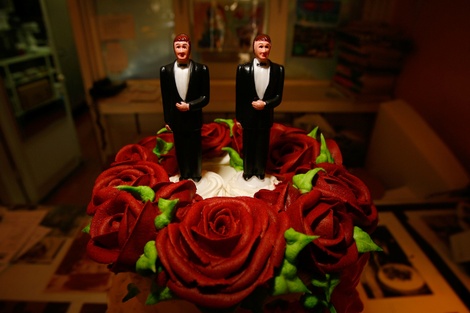
And honestly, I don’t know that I know anyone who disagrees with any of this. The disagreement comes on one issue only — should a Christian provide goods and services to a gay wedding. That’s it. We’re not talking about serving a meal at a restaurant. We’re not talking about baking a cake for a birthday party. We’re talking about a wedding, which millions of Christians view as a sacrament of the faith and other, mostly Protestant Christians, view as a relationship ordained by God to reflect a holy relationship.
This slope is only slippery if you grease it with hypotheticals not in play.
But the wording of the bills in question – from Kansas to Arizona – is a veritable, icy piste for widespread religious discrimination. And that’s for an obvious reason. If legislatures were to craft bills specifically allowing discrimination only in the case of services for weddings for gay couples, as Erickson says he wants, it would seem not only bizarre but obviously unconstitutional – clearly targeting a named minority for legal discrimination. So they had to broaden it, and in broadening it, came careening into their own double standards. Allow a religious exemption for interacting with gays, and you beg the question: why not other types of sinners? If the principle is not violating sincere religious belief, then discriminating against the divorced or those who use contraception would naturally follow. I’ve yet to read an argument about these laws that shows they cannot have that broad effect.
But here’s where Erick has a point:
It boggles my mind to think any Christian should want the government to force their [pro-gay] view of Christianity on another believer.
That’s my feeling too. I would never want to coerce any fundamentalist to provide services for my wedding – or anything else for that matter – if it made them in any way uncomfortable. The idea of suing these businesses to force them to provide services they are clearly uncomfortable providing is anathema to me. I think it should be repellent to the gay rights movement as well.
The truth is: we’re winning this argument. We’ve made the compelling moral case that gay citizens should be treated no differently by their government than straight citizens. And the world has shifted dramatically in our direction. Inevitably, many fundamentalist Christians and Orthodox Jews and many Muslims feel threatened and bewildered by such change and feel that it inchoately affects their religious convictions. I think they’re mistaken – but we’re not talking logic here. We’re talking religious conviction. My view is that in a free and live-and-let-live society, we should give them space. As long as our government is not discriminating against us, we should be tolerant of prejudice as long as it does not truly hurt us. And finding another florist may be a bother, and even upsetting, as one reader expressed so well. But we can surely handle it. And should.
Leave the fundamentalists and bigots alone. In any marketplace in a diverse society, they will suffer economically by refusing and alienating some customers, their families and their friends. By all means stop patronizing them in both senses of the word. Let them embrace discrimination and lose revenue. Let us let them be in the name of their freedom – and ours’.
What If Ukraine Splits? Ctd
People continue mourning the fallen at #Euromaidan today in #Kyiv @ukrpravda_news more pics at http://t.co/tUTwljJYJO pic.twitter.com/3rHj7gSn7o
— Euromaidan PR (@EuromaidanPR) February 24, 2014
Alexander Motyl calls the country’s east-west divide a false binary that doesn’t explain the conflict as neatly as some Western commentators would like:
The real divide in Ukraine is not between East and West, but between the democratic forces on the one hand and the Party of Regions on the other. The latter is strongest in the southeast, mostly because its cadres (who are mostly former communists) have controlled the region’s information networks and economic resources since Soviet times and continue to do so to this day. Their domination since Ukraine’s independence rests on their having constructed alliances with organized crime and the country’s oligarchs, in particular with Ukraine’s richest tycoon, Rinat Akhmetov. They have enormous financial resources at their disposal, control the local media, and quash — or have quashed — all challengers to their hegemony. Their rule has been compared, not inaccurately, to that of the mafia. Ukrainians in the southeast tend to vote for them, less because they’re enamored of Yanukovych (they are not), and more because they have no alternatives and, due to the Region Party’s control of the media, see no alternatives.
But Christian Caryl says neglecting the divide is “wishful thinking”:
To emphasize these complexities is not — as some would claim – to deny Ukraine’s viability as a state. Nor does it imply that Ukraine ought to be carved up into constituent units.
Ukraine is perfectly capable of continuing its existence as a state if it can find an institutional framework that will take its political diversity into account — instead of lurching from one crisis to the next as it has over the past 15 years.
Ukraine’s regional differences do, however, mean that we should take the possibility of civil conflict seriously. Reporters in Kiev have already described the rise of quasi-military “self-defense units” among the protesters. What has gone largely unremarked is the rise of similar paramilitary groups in the East. As this map by political observer Sergii Gorbachev shows, Yanukovych’s political machine has been busily standing up “militia units” throughout the East, sometimes with overt ties to local gangland structures. Here, for example, is a Russian-language interview with one ex-convict who’s setting up his own pro-Yanukovych militia in the Eastern city of Kharkov. He won’t say how many members the new group has, but he’s quite open about its aims: “I’m preparing my population and my people for war.”
Adam Taylor points to Crimea, where loyalties are distinctly Russian, as a potential breakaway region:
From the 18th century on, the region was part of Russia, but that changed in 1954, when the Supreme Soviet of the Soviet Union passed it from the Russian Soviet Federative Socialist Republic to the Ukrainian Soviet Socialist Republic, a decision that is still controversial in some circles. Today the peninsula might still be a part of Ukraine, but in many ways it is separate from the rest of the country: It has its own legislature and constitution, for example, and it’s still very Russian: Some 60 percent of the population is ethnically Russian, with the rest being Ukrainian or Crimean Tatars.
It appears that some members of this Russian community have regarded the events in Kiev with a mixture horror and opportunism: The chaos in Ukraine could finally be the region’s chance to turn back to Moscow.
Max Fisher, who has pushed a structural explanation of the conflict, argues that both competing narratives have some merit:
The structural storyline, of an identity crisis fueled by history and demographics, appeals for its neatness and its comprehensive breadth. But it tends to rankle people, and not without reason, who see it as explaining away the bravery and idealism of the protesters, or forgiving the very real abuses of Yanukovych.
The more human narrative, of regular Ukrainians pushed to the breaking point by an abusive government they can no longer tolerate, is much more emotionally satisfying. Anyone can relate to it. It appeals especially to Americans, who feel an immediate affection for any pro-democracy movement, particularly one that expresses a desire to reject Russia and embrace the West. Still, this story ignores the 30 percent of Ukrainians who wanted to reject the E.U. deal for a Russia-led trade union, and it ignores the pro-Russia attitudes in the eastern half of the country. It almost seems to tell pro-Russia Ukrainians that they don’t count, which can feel a bit Russophobic.
Mental Health Break
Speed skating meets Mario Kart:
The Bellwether State
Ohio is pro-legal pot and pro-marriage equality:
Ohio voters also support 51 – 44 percent allowing adults to legally possess small amounts of marijuana for personal use, the independent Quinnipiac University poll finds. Ohio voters support same sex marriage 50 – 44 percent.
And here is the generational challenge for the GOP:
Voters 18 to 29 years old support personal marijuana use 72 – 25 percent, while voters over 65 years old are opposed 65 – 31 percent. … Voters 18 to 29 years old support same sex marriage 71 – 28 percent, while voters over 65 years old are opposed 59 – 33 percent.
How do you hold onto your elderly base and maintain some electoral viability for the future? Apart from changing the subject or refusing to talk about it?
The Sublime Genius Of Harold Ramis
Don’t miss this Tad Friend classic profile – released to the public for the next 24 hours on Byliner, on the news of Ramis’ untimely death. On a day in which insecure egos seem collapsing of their own narcissism, it’s worth recalling the calm, glib, hilariously assured sense of himself that gave Ramis his edge. Money quote:
Crude as Animal House was, it was also rambunctiously optimistic. By setting the film in the early sixties, the writers tapped the source of their earliest ideals. “Our generation’s revolutionary energy had slipped away after Kent State and the rise of the violent fringe of the Weather Underground,” Ramis says. “We revived it.” They revived it by making their obvious outsiders into not so obvious insiders. “Woody Allen had defined the American nebbish as a loser,” Ramis adds. “But we felt instinctively that our outsiders weren’t losers. They may not achieve anything in the traditional sense—they may not even be smart—but they’re countercultural heroes. The movie went on after the credits to tell you that these were your future leaders, while the guys from the ‘good’ frat would be raped in prison and fragged by their own troops.”
Yglesias Award Nominee
“There are several possible explanations for why Republicans would not denounce Nugent and his statement in unqualified terms. One is that they aren’t all that offended by what Nugent said. A second is Nugent is on their “team” and therefore needs to be treated with kid gloves. A third explanation is that they fear that in denouncing Nugent they will upset elements of the GOP base. Any of these explanations is an indictment,” – Pete Wehner, Commentary.