“Careless Whisper” gets a ’30s jazz remix:
Month: February 2014
Little Kids Are Slimming Down, Ctd
Zachary Goldfarb examines the racial disparities in the JAMA study:
We’re celebrating the fact that for all kids ages 2 to 5 childhood obesity has declined from 13.9 percent to 8.4 percent over 10 years. Yet, 11.3 percent of black children ages 2 to 5 and 16.7 percent of Hispanic children that age are obese. Just 3.5 percent of white children ages 2 to 5 are obese.
Why the disparity? Income certainly plays a central role, though this study didn’t look at that factor. Researchers have other ideas, including the fact that black and Hispanic children eat solid foods earlier than doctors recommend, watch more television, have a higher intake of sugar-sweetened and fast foods and have mothers who face higher levels of maternal depression. It’s not a hopeless situation – breastfeeding by black and Hispanic children has increased, and government programs are fighting the disparity — but the gaps are vast.
Meanwhile, Razib Khan casts doubt on the study. A reader joins him:
In your post about the JAMA study about kids slimming down, the caveats loom large.
In a nutshell, in the minds of the authors themselves, the results of this study are sufficiently shaky that they are reporting only a modest decrease. According to the authors’ own statistics, the data is sufficiently noisy that such a decrease isn’t particularly surprising [1] even if the observation were the only one they examined. However, there is an even more disturbing shortcoming of the study’s conclusion about kids, one which the authors again acknowledge [2]. While it may be at most mildly surprising to observe that large of a change if you only made one observation, if you made a lot of observations, you’d be terribly surprised if a handful weren’t that extreme by chance alone. Surprisingly, JAMA allowed this overhyped conclusion based on an unsurprising and marginal result to be published. Predictably, it has generated headlines around the web. While predictable, this is very frustrating to scientists like me.
[1] In their paper, they write:
There was a significant decrease in obesity among 2- to 5-year-old children (from 13.9% to 8.4%; P = .03) […]
In statistical parlance, they observed a p-value of 0.03 or 3%. This means that, even if there were no true change in rates obesity, noise alone could underly an apparent decrease of this magnitude 3% of the time. In biomedical studies, the most speculative and lax standard for calling a result “statistically significant” is conventionally set at 5%. There is nothing magical about 5%, but it comports with our sense of “not very likely”. Suffice it to say that most scientists consider 5% significance to hardly worth mentioning. See here, here, and here for how physicists deal with the issue of “statistical significance”.
[2] The authors admit:
In the current analysis, trend tests were conducted on different age groups. When multiple statistical tests are undertaken, by chance some tests will be statistically significant (eg, 5% of the time using α of .05). In some cases, adjustments are made to account for these multiple comparisons, and a P value lower than .05 is used to determine statistical significance. In the current analysis, adjustments were not made for multiple comparisons, but the P value is presented.
Why this didn’t undermine the whole argument in the minds of the reviewers and/or editors of JAMA is beyond me. As a reviewer, I certainly would have been been extremely skeptical of one or a handful of marginally statistically significant results, especially when the 3% result is the one generating the biggest headlines. That 3% is virtually indistinguishable from a 6% result result that wouldn’t have generated headlines.
But nevertheless, Paul Campos feels that the JAMA findings are “consistent with broader international trends”:
As Michael Gard notes in his recent book The End of the Obesity Epidemic, data from all over the world indicate that, over the past ten to 15 years, obesity rates have leveled off or declined among adults and children. This is an awkward development for obesity fear-mongers, who as Gard and others have pointed out, have repeatedly claimed that within another generation or two the entire population of some nations, most notably the United States, would be fat.
The claim that obesity is an epidemic phenomenon, and that its prevalence was on the way to approaching 100 percent, has always been crucial to the other claims of the anti-fat industry, most notably that today’s children will have shorter lifespans than their parents, and that obesity is as great a threat to public health as global warming. There has never been any real evidence for these claims: life expectancy continues to rise, overall health continues to improve, and today’s young people are healthier than their parents were at the same age. Faced with these inconvenient facts, the obesity police have always argued that, while it’s true we’re not seeing the supposedly devastating effects of a heavier population at the moment, we will surely see these effects if present trends continue.
The Miraculous Muscleheads Of Hollywood
So this is what you get from the New York Times when explaining how leading men in big budget movies look like a different species today compared with twenty years ago:
Almost any actor, even some of Hollywood’s most scrawny, can be physically transformed for the part if he’s willing to put in the hard work. The studios know this, which is why any inexpensive unknown can be chosen. The cast for “300,” including a post-“Phantom of the Opera” Butler and the relative newcomer Fassbender, were put on a brutal program with Mark Twight, a trainer whose workouts incorporated medicine balls, kettlebells and rings to emphasize the athleticism of the Spartans.
Did anyone fact-check that? Obviously not. So let’s rephrase with some hope of being vaguely close to the truth: almost any actor can be physically transformed for the part if he’s willing to put in the hard work and embrace a sophisticated steroid and nutrition regimen. The idea that the massive chiseled physiques in most action movies are simply a function of hard training doesn’t even pass the laugh-test. At one point, the reporter gingerly stumbles onto the bleeding obvious:
A number of trainers and actors told me that steroids were out there and that everybody had a good idea of who was on them — though nobody is willing to name names. But as trainers like Twight make obvious, the Hollywood fitness mechanism is brutal and advanced enough to make any performance-enhancing drug seem primitive by comparison.
Er, no. No training regime makes steroids look “primitive”.
First off, the steroids are far from primitive. They’re as sophisticated as the training methods. And it’s emphatically not either-or. Given the staggering physiques of almost all male action stars today, both drugs and training are obviously necessary. No one gets to look like Arnold without steroids, just as Arnold didn’t get to look like Arnold without steroids.
Second, just ask yourself: the piece reports a furious competition between hundreds of aspiring young male actors in an industry producing fewer movies with the baseline for action stars being a massive, muscled, chiseled and ripped torso. Did it occur to Alex French that a highly competitive environment in which steroids can mean the difference between miserable anonymity and staggering success is almost a textbook setting for a roid race? Of course it is. And of course every action movie Hollywood creates today is a paean to the power of pharmaceuticals.
Look, I’m not complaining. 300 is a gay porn movie from the gods. But please don’t try and convince me it’s really just the creatine and the kettle-bells.
Religious Liberty Or Anti-Gay Animus? Ctd
In the aftermath of Arizona, Dominic Holden is going with animus:
[S]ome are mewling that lawsuits aren’t the way to win the war of public opinion, that we should be fighting bigger battles. One of my friends said we should consider public accommodations to be necessities, like hospital visitation or lunch, but not flowers. But this isn’t about flowers. It’s about the Christian right seeing how far they can push this envelope. The line between trivial product and necessary service is an impossibly broad gray area. But if you believe same-sex marriage is a right, then consider the products and services that society defines as essential to that wedding. It’s not a seat on the bus or a seat at the lunch counter—but it’s just as important.
Dan Savage says he’s somewhere between Holden’s position and mine:
But here’s a suggestion for all the hatey, butt-sore, anti-gay bakers in Arizona: start an organization—The Arizona Association of Homophobic Bakers—and publicly identify yourselves as homophobic
bakers. Put up a website with a list of bakeries that don’t want to do business with LGBT people. Put signs in your windows that clearly state that gay and lesbian customers are not welcome and will be turned away. As Anderson Cooper pointed out earlier this week, gays and lesbians are not covered by existing anti-discrimination law in Arizona. So it’s perfectly legal right now for bakers—and florists and caterers and photographers—to discriminate against LGBT customers. …
The homophobic bakers of Arizona will do no such thing of course. Because hater bakers know that putting “We Don’t Serve Gay People” signs in their windows will not only cost them our business—business they don’t want—but also the business of our straight friends, family members, and neighbors. Business they do want. And they’ll also lose the business of fair-minded straight people who think discrimination is wrong. And they’ll lose the business of straight people who worry about where this kind of selective, hypocritical, faith-rationalized discrimination could ultimately lead.
… like discrimination against the divorced. Meanwhile, now that Arizona is out of the headlines, David Cohen takes stock of equal protection laws around the country:
[T]he numbers are quite staggering.
Twenty-one states prohibit discrimination based on sexual orientation in employment; 21 prohibit discrimination in public accommodations; 21 prohibit it in housing; 26 in hospital visitation; and only 13 in education. (All stats courtesy of the Human Rights Campaign.) These numbers indicate that there are huge gaps in anti-discrimination laws in this country, especially considering that an even smaller number of states also protect against discrimination based on gender identity.
What’s most amazing about these numbers is that polls show overwhelming support for anti-discrimination laws. To most people, it’s as simple as Gov. Brewer put it on Wednesday: Nondiscrimination is a “core American and Arizona value.” And yet, the law has not yet caught up with public opinion.
The reason is simple: Republican refusal to consider any protections for gay people, and won’t bring ENDA to the floor of the House. They don’t really have an argument, since they’ve long since conceded the core question of whether firing someone merely because they’re gay should be legal. Just listen to Jan Brewer or Mitt Romney. They just know that any positive legislation for gay citizens would be anathema to their base. So they claim (implausibly) that there’s no problem for gays in employment. Which is why their base’s recent loud insistence that they should too be able to actively discriminate on religious grounds is one more excruciating twist of the incoherence. Benen sifts through more public opinion surveyed this week by the Public Religion Research Institute:
[H]ere’s the kicker: “Three-quarters (75%) of Americans incorrectly believe it is currently illegal under federal law to fire or refuse to hire someone because they are gay, lesbian, bisexual, or transgender.” This matters, of course, because three-quarters of the country is wrong. Under federal law, employers can legally fire employees if they’re gay, or even if they think the employees are gay. Some states prohibit this kind of discrimination, but most don’t.
Among those that don’t:
In late January, weeks before Kansas’ and Arizona’s odious anti-gay segregation bills drew fury across the country, the Mississippi state Senate quietly passed its own viciously homophobic “religious liberty” measure to virtually no fanfare. The bill, which is nearly identical to Arizona’s, would have the same effect as its now-notorious counterparts, allowing any private business to turn away gays at the door. But unlike Kansas’ and Arizona’s bills, which drew fierce Democratic opposition, the Mississippi measure passed with unanimous bipartisan support.
Yes, you read that right: Every single voting member of the state Senate, Republican and Democrat, supported a bill that would effectively allow segregation of gay and straight people throughout Mississippi.
But it was mercifully ditched yesterday. The import of what survives is unclear. Meanwhile, it’s worth recalling that this kind of legislation is not just being introduced in the red states:
Legislators in the Hawaii House introduced the “Religious Freedom Restoration Act” on Jan. 23. It features the language: “No individual, sole proprietor, or small business shall be required to take any of the following actions if doing so would cause the individual, sole proprietor, or small business to violate their sincerely held religious belief: (1) Provide any facility, good, or service that assists or promotes the solemnization or celebration of any marriage, or provide counseling or other services that facilitate the formation or perpetuation of any marriage; (2) Provide benefits to any spouse of an employee; or (3) Provide housing, lodging, or similar accommodation to any couple.” It was referred to the House Judiciary Committee on Jan. 27.
(Photo by Justin Sullivan/Getty Images)
Dave Camp vs The Tax Code, Ctd
Yuval Levin rightly thinks the Camp plan, detailed here and here, sets a new standard for conservative tax reform:
That this proposal has come from the chairman of the House Ways and Means Committee means it will inform future tax-reform proposals on the right. That it proposes specific, concrete changes to a large number of tax expenditures as ways of counterbalancing the effects of lower rates means it can open the path to an actual process of negotiation and legislation. Too many of our tax debates in recent years have taken place in the abstract.
And that it appears to hold middle-class families harmless (by increasing the tax burdens of some wealthier Americans while actually improving their work incentives at the margin) is important because many conservative tax proposals in recent years have funded rate reductions by increasing tax burdens in the middle. Republicans certainly can’t win on taxes if they increase the cost of living in the middle class.
Reihan especially likes that the plan eliminates the deduction for state and local taxes:
In theory, this will end the implicit subsidy of the residents of high-tax states by the residents of low-tax states, and it might also make the residents of high-tax states more attuned to the state and local tax burden.
Another view is that in the absence of the state and local tax deduction, state and local governments might under-invest in the human capital of their residents, and this in turn will shrink the tax base in future years. Coupling the elimination of the state and local tax deduction with a substantial increase in the child tax credit is an excellent way to address this concern.
But Ramesh wishes for an even bigger child tax credit:
Camp missed an opportunity to rectify one serious public-policy problem in a way that would appeal to a lot of middle-class voters. Federal policy has a bias against children, and especially against large families. By expanding the child tax credit to $1,500 per child from $1,000, Camp’s plan would reduce that bias, but only very modestly. A bigger expansion would’ve required Camp to modify other elements of his plan so that it would continue to raise as much revenue as the current code: He might have had to refrain from abolishing the alternative minimum tax, for example. It would have been a better policy, and it would have been easier to make the case for it to middle-class voters.
And Ryan Ellis criticizes the proposal for raising taxes on capital:
Under tax law, when a business buys a piece of equipment or real property, they generally cannot deduct that property in the first year (small firms have an exception to this). Rather, they are forced to deduct the expense in pieces over several to many years in a process called “depreciation.” Ideally, all business inputs would be expensed the first year, but the tax code is not an ideal document.
The Camp draft makes the depreciation bug even worse than current law. They move to a slower system of depreciation where business assets must be depreciated over a longer time period and at a slower rate. … There’s also a sin of omission on capital. The tax rate on capital gains and dividends is basically kept the same at about 24 percent … .
But crunching the numbers, Joseph Rosenberg concludes that businesses would see their overall tax burden reduced:
Add it all up and the Camp proposal would raise more revenue from businesses in the ten-year window than under current law. But does he really raise their tax burdens?
Probably not. The largest revenue raisers in the budget window are provisions that affect the timing—rather than the level—of deductions, and the temporary transition tax on deferred foreign profits. The timing changes raise more revenue during the transition than in the long-run (when higher deductions from past investments partially offset lower deductions for current investments) and revenue from the transition tax will rapidly disappear beyond 2024. Combined with the phased-in corporate rate cut and other international tax changes, this suggests that, on balance, businesses will be winners from this proposal.
Philip Klein says the GOP should go after payroll taxes:
In 2012, combined payroll taxes cost more than income taxes for nearly 80 percent of middle-income Americans, according to TPC analysis, and 63 percent of all taxpayers. And this was in a year in which the rate was temporarily reduced by 2 percent as part of a short-term stimulus agreement.
Payroll taxes distort economic activity. Not only do they reduce Americans’ paychecks, but they also increase the cost to businesses of hiring and maintaining workers, thus increasing unemployment. Because traditional payroll taxes apply to only the first $113,700 of earnings, they eat up a larger percentage of the paychecks for middle-income Americans.
Should Obama embrace the Camp plan? Zachary Goldfarb thinks so:
The funny thing is the Camp tax reform proposal is a bit of mirror image to Obama’s own budget proposals — compromise offers that try to reach the other side halfway. The Camp proposal is very much in the Obama mold.
Ahead of the 2014 mid-terms, though, Obama and the Democrats are going to blow Camp’s proposal off. And that probably makes the most sense politically. But practically speaking, Camp has offered a proposal Obama probably could work with.
I don’t see why Obama has to wait. He finally has a Republican legislative proposal that is a clear basis for a solid compromise in an area long overdue for reform. Why not grasp it with both hands, prove that gridlock is not permanent, and aim for a Reagan-style bipartisan deal that can help empower economic growth?
Shorter Peggy Noonan
“I, the proposed accused, think that, well, I mean, you know, well the day in question was not a good day for me, all right? But I put it to you that I don’t see how any day could have been good the way this bloody country’s run. Well, you know, I was just trying to do my best, trying to get from A to B, do a little shopping. I was trying to take control of my life, you know, only to find that it’s actually controlled for me by petty bureaucracy and bits of bloody paper – ignorant bloody petty rules and laws that just obstruct every tiny little action until you’ve committed a crime without even knowing it!
I mean, you know, why can’t life just be made a little easier for everybody, eh? … I mean, there has to be more to life than just being safe… Yes, Yes!… Why, oh why, do we pay taxes, hmmm? I mean, just to have bloody parking restrictions – and BUGGERY-UGLY traffic wardens, and BOLLOCKY-pedestrian-BLOODY-crossings?… and those BASTARD railings outside shops windows, making it so difficult, so you can’t even get in them! I mean, I know they’re there to stop stupid people running into the street and killing themselves! But we’re not all stupid! We don’t all need nurse-maiding. I mean, why not just have a Stupidity Tax? Just tax the stupid people!” – Edina Monsoon, Absolutely Fabulous, from Series 2 (1994), episode #11, “Poor”. For context, see here.
Should AGs Ignore Laws They Don’t Like? Ctd
A reader thinks that’s the wrong question:
The header of your post about Eric Holder’s speech to state attorneys general on the issue of defending unconstitutional laws is quite misleading. In addition to saying that an attorney general can demur from defending an unconstitutional law, Holder said that action should be extremely rare. He was not talking about laws that AGs don’t like, but laws that they can find no straight-faced way of defending. It is part of an age-old doctrine in which government attorneys have been known to “confess error” – for example, in an appeal from a lower court decision that was clearly erroneous. Assigning special counsel does not solve the problem. The issue is not that the particular AG does not think the law is unconstitutional, but as the highest legal officer of the state, he holds the opinion that the law cannot be defended under well-established constitutional law. The stand-in would be the AG’s representative.
The issue of defending laws that outlaw same-sex marriage may be too much of a yet unsettled legal issue to justify failing to defend such a law, but imagine if a legislature passed a law similar to the one passed in Uganda. Would anybody question an AG’s refusal to defend such a law?
Another is on the same page:
No, of course an AG should not refuse to enforce a law he does not like simply because he does not like it. But as for the actual question, whether an AG should enforce a law he thinks might very well be unconstitutional, there is no right answer except that the AG has to do what he thinks is the better execution of his sworn duty.
Like pretty much every other official elected to statewide office in this country, an AG takes an oath to support the laws and Constitution of the United States and the laws and constitution of his state. The US Constitution is supreme to a state’s laws; where they conflict, state law loses. It’s an AG’s job to say when he thinks the supremacy of the Constitution has won the day and to protect the state, to the extent he can, from liability for having violated the Constitution. That duty is no different from a corporate lawyer’s job to advise his client what it can and cannot do within the law. An AG who blindly defends a law that he believes in unconstitutional is not protecting his client; he’s doing one of the worst things a lawyer can do: he’s telling his client what it wants to hear.
Another addresses the issue in depth:
As a voter in Virginia, one of those who “hired” Mark Herring to be the lawyer for the state of Virginia, I have no problem with his decision not to defend the commonwealth’s constitutional ban on gay marriage. While I found the comments you presented interesting and thoughtful, there are a few things they did not address.
First, I’ve spent my career as a government attorney. While I represent my agency and am bound to defend its actions zealously, I not only have to follow the rules of professional responsibility and ethics that apply to all attorneys, but also consider the public interest and basic fairness in a way that a private attorney, who is representing only private interests, is not. Just because a government agency can do something does not always mean that it should do it, and that attorneys should, without question, defend it. I think the state AGs who are not defending their states’ gay marriage bans are, in part, following the obligation to be more than just a hired gun. Moreover, to the degree the state has an interest in the ban being defended, parties with standing, such as the state General Assembly, are representing that interest.
Second, state AGs are not, in most states, hired; they are elected. I voted for Mark Herring – knowing full well that he supports gay marriage – so I feel that he is, in fact, properly representing the interests of the constituency he is charged to serve as state AG. A client can change his mind, and the people of Virginia, who are the real clients here, have. The homophobic bigots who pushed this amendment think they represent the people, but the people have abandoned them. I have no problem with my elected AG doing the same.
Third, this is a very unusual situation. The sea change on gay marriage that has emerged over the last several years is one of the great cultural and political shifts in our nation’s history. It is now clear that the bans on gay marriage voted on in many states during the first decade of this century were the last gasp of those opposed to gay marriage, who wanted bans on gay marriage in state constitutions to make it more difficult for ordinary voter and legislative majorities to overturn gay marriage. Indeed, the constitutional prohibitions on gay marriage that exist in a number of states do not play the usual role of constitutional provisions – establishing protections for minorities that can be overcome by transitory majorities – but instead establish publicly sanctioned discrimination against a minority that a growing majority of citizens would now like to eliminate. This is not just a once-in-a-lifetime event; it is a once-in-a-century event. AG Herring himself voted for the ban as a member of the state senate. There are few people who understand as well how rapidly views on this issue have evolved over the last several years. There are very clear limiting principles in play here. No need to worry about a dictatorship of the AGs who refuse to defend laws they don’t “like.”
Fourth, while it is true that there is no Supreme Court decision on point – and there could hardly be any case to defend if there were binding precedent that clearly defined gay marriage bans as unconstitutional. The inexorable logic of the Windsor decision, ironically aided and abetted by Justice Scalia’s over the top dissent, is pointing in one direction. I was living in Virginia in 2006, know one of the sponsors of the ban on gay marriage, and fully understand – as you do much better than I – the bigotry and discriminatory intent behind that and these other state constitutional amendments. In fact, it is entirely possible that the sheer number of these referendums and the animus behind them exposed to the vast majority of straight Americans, who may not have thought that much about their impact on real people. Over time, I think straight Americans who voted against gay marriage came to see that they were aiding and abetting bullies and hurting real people. While it took a while, the basic sense of fair play and decency of the majority was aroused and they have no come to realize that bans on gay marriage, even if they received majority voter support several years, were a mistake.
When you make a mistake, you admit it and try to make amends for it. I view what Mark Herring has done as exactly that. He shouldn’t do it that often, but if ever there was a case for a lawyer not defending his client, this is it.
Read This Post In Under 20 Seconds
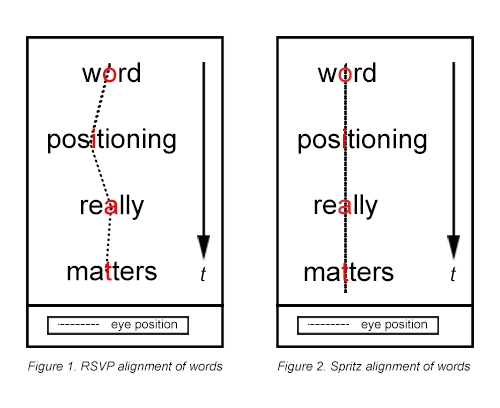
Meghan Neal reviews Spritz, text-streaming technology designed to double or triple your reading speed on a smartphone screen:
The idea is that traditional reading—scanning a big block of text—takes up too much space on such tiny screens, and is limited by the inefficiency of having to move your eyeball from word to word and line to line. The Spritz app rethinks this by streaming the content one word at a time and highlighting specific letters in red with a marker line above them to tell you exactly where to keep your focused fixed to avoid the precious time lost by having to move your eyeballs around. …
I tried the feature out and frankly it gave me a headache; also, if you look away for a minute you’ll miss whole sentences, so that’s problematic. But, supposedly, it works. The average adult reading level is just below 300 words per minute, and Spritz claims it can get users easily up to 500 wpm and eventually, depending on your skill, up to 1,000 wpm. I mean, who doesn’t want to be able to do that? And it’s not the same as skimming; the company also claims that comprehension actually increased in beta trials.
(Image via Spritz)
A Lot Of Optic Nerve
In the latest revelation from the Snowden docs, Ackerman and James Ball report that Britain’s GCHQ, with help from the NSA, snooped on millions of Yahoo webcam chats between 2008 and 2010 under a program called Optic Nerve:
Yahoo reacted furiously to the webcam interception when approached by the Guardian. The company denied any prior knowledge of the program, accusing the agencies of “a whole new level of violation of our users’ privacy“.
GCHQ does not have the technical means to make sure no images of UK or US citizens are collected and stored by the system, and there are no restrictions under UK law to prevent Americans’ images being accessed by British analysts without an individual warrant.
Here is the, er, money quote:
Sexually explicit webcam material proved to be a particular problem for GCHQ, as one document delicately put it: “Unfortunately … it would appear that a surprising number of people use webcam conversations to show intimate parts of their body to the other person. Also, the fact that the Yahoo software allows more than one person to view a webcam stream without necessarily sending a reciprocal stream means that it appears sometimes to be used for broadcasting pornography.”
Imagine that. John Aravosis wonders how, exactly, this program was supposed to help catch terrorists:
Of course, there are a few problems here. First of which, one could also search this system for anyone and everyone they wanted to blackmail or destroy. Got a political opponent who’s being difficult? See if you can find a Web chat between him and his mistress.
There’s also the question of how well facial recognition is going to work on sexually-oriented Web chat. The spy document notes that, “the best images are ones where the person is facing the camera with their face upright.” Faces are not always available in such chats.
Especially when other body parts are the primary focus. And Mano Singham notes, “We already knew that NSA operatives were using their snooping powers to spy on their lovers, an operation known as LOVEINT.” But Willard Foxton feels too much is being made of this and other Snowden leaks:
The volume of data collection is what’s scary – but if you read the whole Guardian article, GCHQ come across as an agency terrified of legal consequences. For example “the program saved one image every five minutes from the users’ feeds, partly to comply with human rights legislation.” While the story is disturbing, the agency hardly seems to be the surveillance juggernaut of Glenn Greenwald’s fantasies.
This goes to the heart of the problem with all the Snowden leaks – what we are getting is often a technological perspective of what could be possible, not an operational perspective on what is legally allowed. When Snowden said that if he had wanted to he could have tapped Barack Obama’s phone, he was right; but he failed to mention that if he had done so, he’d have been sent to jail.
Charlie Stross chimes in:
I am still trying to get my head around the implications that the British government’s equivalent of the NSA probably holds the world’s largest collection of pornographic videos, that the stash is probably contaminated with seriously illegal material, and their own personnel can in principle be charged and convicted of a strict liability offence if they try to do their job. It does, however, suggest to me that the savvy Al Qaida conspirators of the next decade will hold their covert meetings in the nude, on Yahoo! video chat, while furiously masturbating.
Dissents Of The Day
A reader quotes me:
As for the case for allowing fundamentalists to discriminate against anyone associated with what they regard as sin, I’m much more sympathetic. I favor maximal liberty in these cases. The idea that you should respond to a hurtful refusal to bake a wedding cake by suing the bakers is a real stretch to me. Yes, they may simply be homophobic, rather than attached to a coherent religious worldview. But so what? There are plenty of non-homophobic bakers in Arizona. If we decide that our only response to discrimination is a lawsuit, we gays are ratcheting up a culture war we would do better to leave alone. We run the risk of becoming just as intolerant as the anti-gay bigots, if we seek to coerce people into tolerance.
Do you also believe that businesses should be allowed to refuse people service based on their race? If not, please explain why you think that is different.
The public accommodations issue with respect to race is mercifully settled. And it’s pretty much settled with respect to gays, as the collapse of the Arizona bill demonstrates. My point was to note that even if such discrimination should be illegal, it isn’t always advisable, as a prudential matter, to sue. I favor a less drastic approach, and a gentler one. Not just because I think that will help the cause of civil rights in public opinion, but because I think we’re already winning that fight, and can afford some elective magnanimity.
Another reader:
I understand the point you are trying to make about leaving bigoted bakers to their own hated. It is probably a good sign that in Arizona and the US, a gay couple will find any number of bakers or photographers for their wedding. But in 1965 Mississippi, it would have been a brave white hardware store owner who let a black carpenter in the front door and then sold him nails. As long as the bigots are a discredited and a declining minority, ignoring them may be the best option. When they ARE the majority and hold the positions of economic/political and social power, then they can’t be ignored but must be confronted. That was the history of the civil rights movement.
From an Arizonan:
Yes, there are thousands of bakeries here – but NOT in many of our small towns and rural areas. The same with photographers, florists, etc. If you live in Patagonia or Cottonwood or Greer or Alpine – it’s not so easy.
Another elaborates on that point:
So, someone is driving through Arizona on I-40 or US-93 or some other road with very little on it and runs low on gas.
They pull up to the only gas station for 30 miles and are refused service because they are gay and you have no problems with that? Or, it is late at night, and they are getting very tired and falling asleep at the wheel and they pull up to the only hotel for 30 miles and are denied the right to a room because they are gay, and you are OK with that? What about a grocer in a small town who denies a gay person travelling through, or recently relocated there to buy food?
I realize a cake is not the same as those examples above, but when exactly are you OK with bigots being bigots, and to whom are you OK with them being bigots to? If I changed gay to black, would you still be OK with a hotel turning away people at night? Would you be OK with being refused buying gasoline in the desert? Or buying food?
I think living in that insular little bubble that is Washington DC is blinding you to real world issues that are out there, when someone can’t go just two blocks to find a business that will deal with them and can handle the fact that gay people exist in the world.
Another takes it a step further:
I agree with you that it’s wrong to sue someone who refuses to bake a cake because of their religious beliefs. You make a fine argument in favor of common decency. But there’s a more serious side to Arizona’s s.b. 1062. Consider the tragedy of Tyra Hunter, denied emergency care because the EMT’s didn’t like transsexuals.
Sure, if a gay couple is turned down for a wedding cake, it needn’t be a big deal. But what if a gay couple is turned down for a home mortgage? What if a condo homeowners association board of directors disapproves of its openly-gay residents? I admire your scrupulous fairness to s.b. 1062’s supporters, but let’s not forget, that bill had a dark side.
Another takes issue with me conflating the Arizona bill with the Boy Scouts excluding gay leaders:
Freedom of private association and privately held belief in this country is not in question. Start a club with no gays allowed, a networking group, or a social institution? Fine. Private. Freedom of association applies. Start a business that serves the public, and receives incorporation from our government? Subject to rules and regulations of our government, including non-discrimination against protected classes.
I didn’t mean to draw an exact parallel because my reader’s distinction is right. I was, rather, channeling the spirit of Big Gay Al.
Unfiltered feedback from more readers at our Facebook page.
 The Dish