A Hillbilly Hemingway

Breece D’J Pancake’s short story “Trilobites” was one of the first the Dish highlighted for our Saturday feature. Jon Michaud declares that it’s “high time for a Pancake revival,” praising the writer’s depictions of hard-scrabble life in West Virginia in The Stories of Breece D’J Pancake:

While deeply tied to the details of its Appalachian setting, the book offers a broader portrait of the personal and societal wreckage left behind by mass industrialization. Grim, work-related deaths and ailments abound in Pancake’s fiction: lungs bleed from coal dust; mine gas turns a man “blue as jeans”; another is killed by fragments of metal lodged in his brain. When I heard the news, last month, of the chemical spill that left three hundred thousand West Virginians without usable water for a week, I thought immediately of this sentence from “The Scrapper”: “He could see where the wives had planted flowers, but the plants were all dead or dying from the constant shower of coal dust.” Nearly all of Pancake’s stories share a unity of time, taking place in a matter of hours or days, but they are set against an ever-present awareness of geological time, of the epochs and eras that preceded the present moment. His fictions combine the intimacy and specificity of a Vermeer portrait with the grandeur and fierceness of a Bierstadt panoramic.

These bleak qualities may make Pancake’s stories timely, but it is their compressed artistry and distilled feeling that make them timeless. I read the book with no foreknowledge of Pancake’s work or life—always a welcome experience. On my first pass through, I was reminded of an astonishing variety of other writers. Thematically and structurally, the book owed a lot to “Dubliners” and “Winesburg, Ohio,” but, stylistically, Pancake was fully formed, an uncanny hybrid of dirty realism and Southern gothic. A whole world I didn’t know about was opened up for me. After finishing the book, I would have happily gone spelunking in the library basement for more of Pancake’s work, but there was none. This is Pancake’s only book, originally published in 1979, three years after his death, at the age of twenty-seven, from a self-inflicted gunshot wound. Like the pedestalled feet of a ruined statue, these twelve stories can only hint at the body of work that might have been produced had he lived.

Faces Of The Day

Screen shot 2014-02-13 at 1.11.16 PM

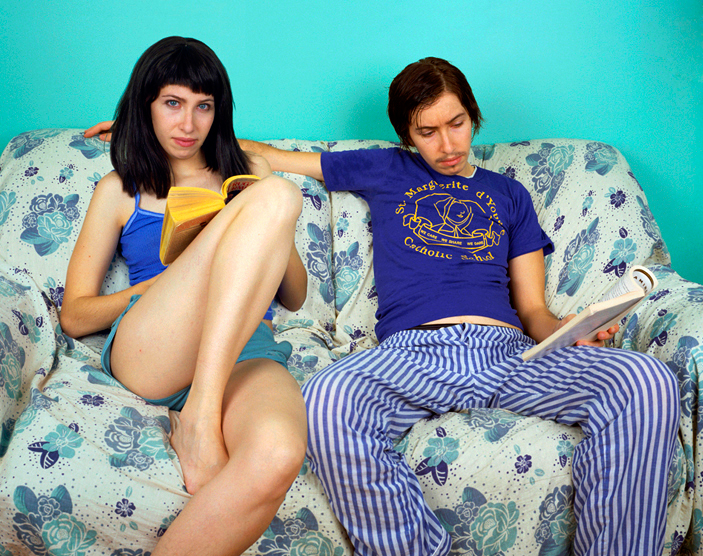
Canadian photographer J.J. Levine explores gender through domestic photographs of “couples”—really, just one person dressed as a man and a woman:

For the series “Alone Time,” Levine recreated and photographed typical domestic environments that play with gender stereotypes. As a twist, he used only one model to play both the male and female characters in the image. The result, Levine said, “challenges the normative idea that gender presentation is stable or constant. Rather, gender expression can be fluid and multiple.”

Each image was shot at the home of the model, often one of Levine’s friends. Levine set up lights, rearranged furniture, and styled the model as both male and female. Each shot took upward of a day to finish and was shot on film. Negatives were then processed and scanned, followed by a lengthy layering and collage process.

More photos from the series here.

(Photo by J.J. Levine)

A Short Story For Saturday

The intriguing opening lines of George Saunders’s “Sea Oak“:

At Six Mr. Frendt comes on the P.A. and shouts, “Welcome to Joysticks!” Then he announces Shirts Off. We take off our flightjackets and fold them up. We take off our shirts and fold them up. Our scarves we leave on. Thomas Kirster’s our beautiful boy. He’s got long muscles and bright-blue eyes. The minute his shirt comes off two fat ladies hustle up the aisle and stick some money in his pants and ask will he be their Pilot. He says sure. He brings their salads. He brings their soups. My phone rings and the caller tells me to come see her in the Spitfire mock-up. Does she want me to be her Pilot? I’m hoping. Inside the Spitfire is Margie, who says she’s been diagnosed with Chronic Shyness Syndrome, then hands me an Instamatic and offers me ten bucks for a close-up of Thomas’s tush.

Do I do it? Yes I do.

Keep reading here. For more, check out Saunders’s latest collection of stories, Tenth of December. Previous SSFSs here.

The View From Your Window Contest

vfyw_2-22

You have until noon on Tuesday to guess it. City and/or state first, then country. Please put the location in the subject heading, along with any description within the email. If no one guesses the exact location, proximity counts.  Be sure to email entries to contest@andrewsullivan.com. Winner gets a free The View From Your Window book or two free gift subscriptions to the Dish. Have at it.

How Do The Blind See Race?

After seeing the movie Ray, Professor Osagie K. Obasogie found himself “struck by the way in which Mr. Charles’s lack of vision did not seem to diminish his racial sensibilities” that Obasogie researched racial awareness in the blind community. In an interview, he discusses the resulting book, Blinded By Sight:

Henry Louis Gates, Jr.: Your research has revealed some of the ways in which blind white people and blind black people first learn how to “see” race conceptually. What were some of the major differences you found in how these two groups experienced race?

Osagie K. Obasogie: The differences track rather closely to the different way that race is experienced by sighted whites and blacks. For example, both sighted and blind White respondents tend to see race as something that other people have, i.e. race is something that minorities experience while being White is thought to be “raceless” and remains the default norm. On the other hand, sighted and blind minorities tend to have a much deeper personal connection to issues of race.

One thing of interest that came out of the interviews is that several blind White people that I spoke with used their physical disability to analogize to the social disabilities associated with being a racial minority. These respondents would describe experiences in which other people discriminated against them because of their blindness and then assert that these experiences gave them insight into what it is like to be Black or any other minority. It’s interesting how some blind White respondents were able to see connections between their discriminatory experiences and other marginalized groups to create a sense of solidarity in how society can develop stereotypes and treat people unfairly. But it’s also interesting to note that none of the blind respondents of color analogized between race and disability in this manner; they viewed their discriminatory experiences connected to race and disability as being largely distinct. So, this perception that being blind provides insight to what it’s like to be Black may very well be a unique way in which Whiteness plays out in the White blind community.

In an excerpt from his book, Obasogie elaborates:

After conducting over a hundred interviews with blind individuals—people who have never seen anything, let alone the physical traits that typically serve as visual markers for racial difference—one consistent theme resonates throughout the data. Blind people understand and experience race like everyone else: visually. That is, when asked what race is, blind respondents largely define race by visually salient physical cues such as skin color, facial features, and other visual characteristics. But what stands out in particular is not only blind people’s visual understanding of race, but that this visual understanding shapes how they live their lives; daily choices, experiences, and interactions such as where to live and whom to date are meditated by visual understandings of race in the blind community as much as they are among those who are sighted. Despite their physical inability to engage with race on the very visual terms that are thought to define its salience and social significance, blind people’s understanding and experience with race is not unlike that of sighted individuals.

Update from a reader:

No thread titled “How Do The Blind See Race?” is complete without a link to Dave Chapelle’s amazing skit about the black, blind, white supremacist:

This embed is invalid

Comic genius.

Going Greek

As part of a lengthy investigation into fraternity culture, Caitlin Flanagan talked to Douglas Fierberg, “the best plaintiff’s attorney in the country when it comes to fraternity-related litigation”:

“Until proven otherwise,” Fierberg told me in April of fraternities, “they all are very risky organizations for young people to be involved in.” He maintains that fraternities “are part of an industry that has tremendous risk and a tremendous history of rape, serious injury, and death, and the vast majority share common risk-management policies that are fundamentally flawed. Most of them are awash in alcohol. And most if not all of them are bereft of any meaningful adult supervision.” As for the risk-management policies themselves: “They are primarily designed to take the nationals’ fingerprints off the injury and deaths, and I don’t believe that they offer any meaningful provisions.” The fraternity system, he argues, is “the largest industry in this country directly involved in the provision of alcohol to underage people.” The crisis-management plans reveal that in “the foreseeable future” there may be “the death or serious injury” of a healthy young person at a fraternity function.

Flanagan also consulted Fierberg’s adversary, Peter Smithhisler, the CEO of the North-American Interfraternity Conference and “senior fraternity man ne plus ultra“:

One way you become a man, Smithhisler suggests, is by taking responsibility for your own mistakes, no matter how small or how large they might be. If a young man wants to join a fraternity to gain extensive drinking experience, he’s making a very bad choice. “A policy is a policy is a policy,” he said of the six-beer rule: either follow it, get out of the fraternity, or prepare to face the consequences if you get caught. Unspoken but inherent in this larger philosophy is the idea that it is in a young man’s nature to court danger and to behave in a foolhardy manner; the fraternity experience is intended to help tame the baser passions, to channel protean energies into productive endeavors such as service, sport, and career preparation.

Tales From The Encrypted

Though Luke Harding took precautions while writing The Snowden Files: The Inside Story of the World’s Most Wanted Man, he supposedly found himself confronting a mysterious, intrusive cyber-censor:

By September the book was going well – 30,000 words done. A Christmas deadline loomed. I was writing a chapter on the NSA’s close, and largely hidden, relationship with Silicon Valley. I wrote that Snowden’s revelations had damaged US tech companies and their bottom line. Something odd happened. The paragraph I had just written began to self-delete. The cursor moved rapidly from the left, gobbling text. I watched my words vanish. When I tried to close my OpenOffice file the keyboard began flashing and bleeping.

Over the next few weeks these incidents of remote deletion happened several times. There was no fixed pattern but it tended to occur when I wrote disparagingly of the NSA. All authors expect criticism. But criticism before publication by an anonymous, divine third party is something novel. I began to leave notes for my secret reader. I tried to be polite, but irritation crept in. Once I wrote: “Good morning. I don’t mind you reading my manuscript – you’re doing so already – but I’d be grateful if you don’t delete it. Thank you.” There was no reply. A month later the mysterious reader – him, her, they? – abruptly disappeared. …

In idle moments I wonder who might have been my surreptitious editor. An aggrieved analyst at the NSA’s Fort Meade spy city? GCHQ? A Russian hacker? Someone else intent on mischief? Whoever you are, what did you think of my book? I’d genuinely like to know.

Update from a reader:

Luke Harding’s story of remote censorship reeks of dishonesty. If I was writing something and someone showed that they had access to my computer I’d immediately, physically disconnect it from the internet and then back up my work before wiping it and putting a clean install of the OS back on it. After that I’d certainly continue my work unconnected from the internet. That Mr. Harding claims to have put up with this for an extended period of time shows he’s either a moron or a fabulist.

David Blair gave Harding’s book a two-star review, saying the prose “lapses into the breathless style of an airport blockbuster”:

Harding’s story crackles with verve, but complexity and nuance are banished. In particular, the real dilemmas of intelligence work are ignored. If GCHQ and the NSA share everything, they risk Snowden-style breaches. If they restore pre-9/11 restrictions, then vital information that might prevent attacks is bottled up. If the agencies store data, they are accused of threatening privacy; if they do not, then the communications of terrorists simply vanish. Harding considers none of this; only when Snowden flies to Russia does he voice any unease.

Reviewing the book earlier this month, Michiko Kakutani was less harsh (NYT):

Portions of “The Snowden Files” seem particularly aimed at a British audience, focusing at length on the surveillance activities of the GCHQ and its eager-to-please relationship with its wealthy American counterpart. But the book still gives readers, who have not been following the Snowden story closely, a succinct overview of the momentous events of the past year. And if it leans toward dramatizing everything in thrillerlike terms, the book also manages to leave readers with an acute understanding of the serious issues involved: the N.S.A.’s surveillance activities and voluminous collection of data, and the consequences that this sifting of bigger and bigger haystacks for tiny needles has had on the public and its right to privacy.

Extracts from The Snowden Files are here and here.

The History Of Animal Names

This embed is invalid


Stephen Messenger provides a lesson:

[B]y the 8th century BC in ancient Greece, animals with names began to be recorded in literature. The most famous example perhaps is Odysseus’ faithful hound Argos, whose name means “swift foot,” in Homer’s Odyssey. Other classical texts reveal names of horses, bulls, cows, and even elephants owned by hellenistic kings. In Ancient Rome, personal names for animals abound, given to trusty dogs, horses, and others, and were often chosen from mythology — suggesting that by then animals held a lofty place in the lives of their owners. These non-humans were no longer just animals. Indeed, they were our friends.

Frank Abbott, in his book Society & Politics in Ancient Rome, writes of ancient epitaphs found written in honor of pets. One dog, named Patricus, received this tribute from his grieving owner, revealing a rare early sentiment of love for an animal:

“My eyes were wet with tears, our little dog, when I bore thee (to the grave)… So, Patricus, never again shall thou give me a thousand kisses. Never canst thou be contentedly in my lap. In sadness have I buried thee, and thou deservist. In a resting place of marble, I have put thee for all time by the side of my shade. In thy qualities, sagacious thou wert like a human being. Ah, me! What a loved companion have we lost!”

(“Dogs of NYC” map by WNYC)

Facebook’s Spending Spree

Felix Salmon links Zuckerberg’s decision to acquire WhatsApp back to its “stroke-of-genius” decision to go public in 2011 and conquer the mobile market through acquisitions:

Zuckerberg knew, circa Facebook’s IPO, that his company was not good at mobile: it didn’t have the problem solved. And he knew that asking his existing corps of engineers to turn their attention to mobile would probably not work. But the good news was that he was now running a public company, with lots of cash, and a highly-valued acquisition currency in the form of Facebook stock. …

Facebook bought Instagram for $1 billion in 2012 not because the product was particularly great, but because the product was insanely popular. The same when he offered $3 billion for Snapchat. Sometimes, lightning strikes. And while Facebook is happy writing its own mobile apps in the hope that lightning will strike them, it knows better than to count on such a thing happening. If you want to be certain that hundreds of millions of people are using your mobile products, the only way to do that is to buy mobile products which hundreds of millions of people are using.

Peter Yared sees another rationale for Facebook buying WhatsApp. Tapping into people’s mobile contacts:

Facebook had already acquired the ability to have a unilateral, aspirational follow capability akin to Twitter with its Instagram acquisition. WhatsApp offers a social network of 450 million users that are intimately connected with each other by phone numbers. With this acquisition, Facebook now controls the intersection of all three kinds of social graphs: casual acquaintances, aspirational following, and intimate relationships. And that’s worth quite a premium.

Meanwhile, Timothy Lee worries that the culture of acquisition might stifle creativity:

It’s always hard to prove what might have been. But it’s helpful to imagine what the world would be like if Google had been acquired by Yahoo in 2002. Suppose that Yahoo had pledged to allow Google to operate independently from its parent company, continuing to build the world’s greatest search engine. There’s every reason to think that in this parallel universe, Google would dominate the search business as much as it does in our own.

But it’s hard to imagine Google’s founders being able to pursue the wide range of new products that the Mountain View giant has pursued over the last decade. Yahoo already had a mail client in 2004, so Yahoo probably would have vetoed the creation of Gmail. Similarly, Yahoo management would have been reluctant for Google to release Google Maps to compete with Yahoo Maps.

How Scientific Is Astrology? Ctd

Hubble view of star-forming region S106

A reader face-palms:

I know you try to give a fair hearing to all reasonable sides, but come on! Now you’re posting astrology apologetics? The first writer provides nothing more than an elaborate appeal to authority – but they are educated and really smart! – the second puts forward an irrelevant pet theory about the weather, and the third is straight-out personal anecdote and confirmation bias interpreted through science-y sounding words. Defending your preferred superstitious woo by distancing yourself from the more egregious practitioners’ claims, as the first does with newspaper horoscopes, may be an effective PR tactic, but it doesn’t replace the need for actual evidence through methodologically sound testing.

Another writes, half-jokingly, “I’m a professional astronomer, and my union card comes with a rider that says I must bash astrology so as to keep the purity of astronomy”:

One of your readers said that there is a “high level of professionalism in the field” of astrology. I don’t really have a problem with things like astrology, alchemy, and tarot being used as a tools for inspiration; however one gets to creativity is one’s own muse. Telling other people that astrology can help them understand their world they are living in, though, is usually a sign that someone hopes to make money, probably off of you. I’d call it metaphor, disguised as a technology; practitioners since Ptolemy have used technical difficulty to give a gloss of credibility to charlatanism.

Another reader:

So your Professional Scientist’s supportive theory on astrology is based on weather, particularly amount of daily light and temperature, for the birth months on the Zodiac. I sure hope the science that employs him isn’t climatology. Two words for him: hemisphere and latitude. Once you take those two things into account, any reliability on a birth month tied to daily light and temperature is blown away. A Leo birthday in the Northern Hemisphere gets warm summer days. In the Southern, not so much. A Capricorn born above the 49th parallel gets those short colder days and long dark nights, but even for one born in the same hemisphere but just farther south, the days are still nice and long – and even warmer as the equator nears. Don’t even get started on the higher parallel Capricorns in the Southern Hemisphere. That little tilt-of-the-axis thing destroys any “weather-related” planetary or cosmic commonality for birth month experience, even at the “sort of” level the scientist postulates.

Another makes an crucial point:

Some readers seem to be failing to make a distinction between “how scientific” astrology is and “how useful” it is – both important and interesting questions, but which are also frequently confused in theistic arguments.

As for how scientific, we pretty much have to say not at all. Astrology shares a lot in common with old-school psychotherapy/analysis in that regard. Both appeal to an intense human compulsion to put things in narrative context, to spot patterns (regardless of whether they appear by chance), and of course, to be self-involved. There’s also a tendency of the general public to be confused about what makes something “scientific” – complex-looking diagrams like the one attached to one of your reader emails seem to convince people that something valid must be going on.

But as for how useful astrology is, it’s definitely not as open-and-shut a question. Getting that level of therapeutic attention, spiritual introspection/mindfulness training, and possible perspective adjustment – to say nothing of entertainment – could well be a net benefit in people’s lives.

Kevin Drum, who’s been following the reader thread, offers an illustrative story:

A friend of mine at work – very smart, very grounded, very educated – was also very deeply into astrology. It was mostly a subject of good-natured banter in the office, and she knew perfectly well that almost none of us were believers. Including me, of course. But then I saw her at work a couple of times, and came to the same conclusion as Sullivan’s e-mailer. She was, basically, a good counselor. She was empathetic, a good listener, and provided pretty good advice. It so happened that she used astrology as a way of organizing her thoughts, but as near as I could tell, that was just incidental. She believed it, and it gave her a useful framework to work from, but it didn’t really mean anything beyond that. She would have been a good counselor whether she was reading star charts, reading palms, or reading out of the DSM-5. Astrology gave her confidence, and that in turn gave her clients confidence. Regardless of whether it was true, that fact made it useful.

Another reader offers, “It would be interesting to see the intersection (particularly amongst the young) between the non-belief in traditional religion or God and giving credence to astrology”:

Could this be an example of the religious impulse being displaced or transferred into something else? Both astrology and religion (Christianity or whatever) require some belief in a patently irrational set of assumptions that allow for reality to be better understood. But where religion stresses faith and a greater mystery, practices like astrology and tarot operate as a kind of “answered prayer” with direct consequences on the present and the future at some metaphysical level. In short, pure magical thinking. It’s this displaced impulse that’s interesting – I see in a lot of my friends a rejection of religion in any traditional form, yet a deep yearning for some sort of greater meaning. When it’s the wonders of nature, that’s one thing. But when it’s astrology, or aliens have visited, or, at its worst, the conspiracy theory du jour, it’s rather disturbing. To me it implies a deep failure of recognizing the hard facts of reality and a simultaneous failure of imagination.

More readers debate the topic on our Facebook page. The above image was highlighted by Sara Barnes:

With the use of a relatively simple photography technique, Italian artist Haari Tesla has reduced the cosmos to a microscopic level. Her series, Illuminated Code From Space, is experimentation in tilt-shift manipulation. By digitally adjusting the depth of field, contrast, and adding a gradient, Tesla has managed to transform photos of nebulae, galaxies, and supernovae into microorganisms. It’s incredible to look at these images and realize that they are actually photos of the largest place we know, rather than of something so small it can’t be seen with the naked eye.

Check out more of Tesla’s work on her website and Behance page.