Your Moment Of Pun

161

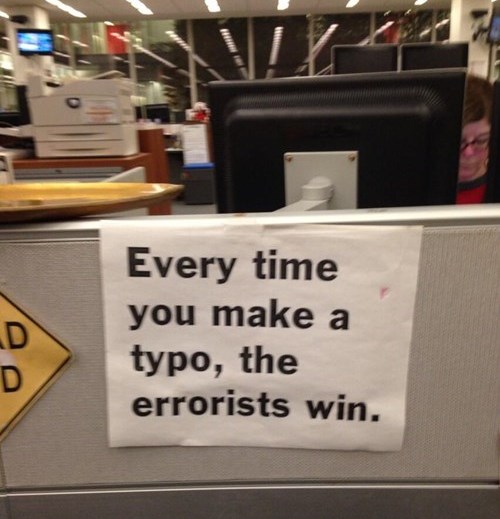
A reader passes along the above image:

Your previous reader wrote with regard to Cheney:

I’m no theologian, but an assumption that one is evil – because we are all inherently fallen – makes it one’s job as a human being to meditate on the evil (or, if you prefer the term, “error”) permanently inherent in oneself.

So basically the premise is that torturing prisoners is bad policy for fighting against errorists?

(Sorry, I couldn’t help myself.)

Taking Bud All The Way The Bank

Jordan Weissmann parses the government memo released Friday:

The new guidelines, released by the Justice and Treasury Departments, essentially give banks an assurance that, as long as they play by the right rules and file the right paperwork, they probably won’t be prosecuted for letting your local pot shop open a checking account. Emphasis on probably.  … Without question, this does mark a huge step forward for the industry. But one has to wonder how many banks will be interested in creating a paper trail registering all of their marijuana-related dealings. The Justice Department’s memo doesn’t provide immunity from prosecution. That might be fine so long as marijuana-tolerant Democrats control federal law enforcement. But what happens the next time a Republican wins office?

Alex Altman is unsure much will change:

Despite the government’s attempt to help the market operate, it is not clear that the memos are a long-term solution to the cash dilemma. The banking lobby has said repeatedly that financial institutions will require greater certainty than the yellow light the government gave Friday to transact freely with cannabis companies. Robert Rowe, a lawyer for the American Bankers Association, told TIME last month that “it would take an act of Congress” for banks to assume the risk.

J.D. Tuccille’s two cents:

Jacob Sullum already predicted that this memo won’t be very reassuring to banks. This is, after all, the same administration that suggested it would “de-prioritize” marijuana prosecutions and then did nothing of the sort. Trusting their business, and freedom, to non-binding guidance from an administration has only grudgingly ceded any ground on the drug war may just be a step too far for bankers.

Comwarnercablecast, Ctd

70717869_countries_with_high_speed_broadband

Looking at Comcast’s move to take over Time Warner Cable, Felix Salmon worries more about monopolizing broadband than cable:

[T]he US has something approaching a national broadband crisis on its hands. In comparison with the rest of the developed world, the US has slower broadband speeds and higher broadband prices than just about anybody. When you do find exceptions, they always turn out to be cases of a very clear monopoly: Carlos Slim more or less owns broadband in Mexico, for instance, while a company called Southern Cross controls all of the bandwidth into New Zealand.

Drum agrees that broadband is the real story:

What’s more, as Michael Hiltzik points out, broadband is a direct competitor to cable in the streaming video market, and having a single company with a monopoly position in both is just begging for trouble. Comcast will almost certainly be willing to make promises of net neutrality in order to win approval for its merger with Time-Warner, but those promises will be short-lived. The truth is that if this deal were allowed to go through under any circumstances, it would probably deal a serious blow to our ability to use the internet the way we want, not the way Comcast wants us to.

Meanwhile, John Cassidy asks, “Does Comcast own Washington?”

In the past fifteen years, since it became the biggest cable company in the country, Comcast has invested a lot of time and effort in currying influence with the right people. Brian Roberts, Comcast’s chief executive, is a member of the President’s Council on Jobs and Competitiveness, which was set up in 2011, and, according to the New York Times, he played golf with the President on Martha’s Vineyard. In 2000, Roberts served on the host committee for the Republican National Convention, in Philadelphia, but he and Comcast have been big givers to the Democrats since Obama took office. Roberts was even one of the donors to President Obama’s 2013 inauguration.

Meghan Neal has more on the cable giant’s lobbying operation:

Last year, the company spent more than $18 million to lobby Congress on issues like cable laws and net neutrality, and donated $1.7 million to the reelection campaigns of key lawmakers, according to data from Open Secrets. That includes Rep. Greg Walden, chairman of the subcommittee on communications and technology, which has jurisdiction over the FCC. In 2012 Comcast gave $854,000 to members of that subcommittee alone, according to figures dug up by Maplight.

(Chart from the BBC)

A Union Vote With The Company’s Blessing … Fails

Over the weekend, workers at the Chattanooga VW plant decided against joining the UAW, in a narrow 53/47 vote. (The Dish rounded up pre-vote analysis here.) Rich Yeselson, who predicted the split perfectly, explains why the vote failed:

Because most workers weren’t particularly looking for a union to address problems they didn’t believe they had with the company in the first place — because VW was drafted into a cooperative relationship by the UAW, rather than seen as an galvanizing adversary — they didn’t think that the (literally) foreign concept of works council presented much of value proposition for them that would be worth one to two percent of their income in dues payments. As the very shrewd labor historian Erik Loomis wrote, in a sharp campaign post-mortem, “the usual union victory results from dissatisfied workers organizing with demands. That really wasn’t the case here.”

Rich Lowry blames the UAW’s political machinations:

After the UAW did so much to chase automaking out of Detroit with unsustainable labor costs and ridiculous work rules, it is no wonder that workforces haven’t welcomed it into the South, where right-to-work states have become alluring destinations for foreign car companies.

For the longest time, the business model of the UAW has been to take its members’ dues and funnel them to friendly Democratic politicians. Unless it breaks into the South, the union knows it’s all but doomed. It may feel this institutional imperative keenly, but workers in good manufacturing jobs who owe nothing to this self-serving dinosaur from the 20th century don’t. They can be forgiven for wondering which side the union is on.

DePillis disputes some of the anti-UAW campaigners’ claims about unions:

Are unionized companies now less productive than their non-union competitors? Well, that might have been the case through the mid-2000s, as the Detroit Three’s workforces aged and the cost of generous pensions mounted (and the companies weren’t doing themselves any favors, having misjudged the market for lighter and more fuel efficient vehicles). But according to data gathered by Oliver Wyman analyst Ron Harbour, the American automakers had nearly caught up to Toyota and the rest by 2008 through lean production processes and buyouts of older workers. Restructuring, a new product mix, and revived demand got them the rest of the way there; Michigan plants are now by and large running at peak capacity.

Kilgore calls the interference of GOP politicians a “travesty”:

I’m a little rusty on my labor law, but I’m reasonably sure that any employer who issued the sorts of threats made by Republican politicians in Tennessee (including Sen. Bob Corker, Gov. Bill Haslam, and a variety of state legislators, backed by national conservative figures like Grove Norquist) against a unionization effort would have been in blatant violation of the NLRA. … So addicted are Tennessee Republicans to the “race to the bottom” approach to economic development that they are willing to risk the good will of an existing employer in their zeal to make sure their own people are kept in as submissive a position as possible.

But Edward Niedermeyer pushes back against the liberal narrative that the vote was the result of “a right-wing movement to destroy worker representation”:

The Chattanooga rejection of the UAW was exactly that: the rejection of a single union that failed to make a persuasive case to the Tennessee workers and, despite profiting immensely from the Federal bailouts of General Motors and Chrysler, is in dire straits after deciding to reward long-time members at the expense of new backers. In fact, the 712-626 vote can be seen as showing solid support for worker representation and for a German-style “works council” that VW management, too, backs. Rather, what what shot down was mandatory unionization as a prerequisite for those works councils — something the UAW insists is required under the federal labor law.

Things Get Much Worse In Uganda

President Yoweri Museveni will sign Uganda’s “kill the gays” bill:

This is a reversal for Museveni, who had written to members of parliament after the legislation passed in December that he had come to believe that homosexuality was a biological “abnormality” and not something that should be criminalized. He had also told Western human rights activists that he would reject the bill during a meeting last month. … The deciding factor may have been that a panel of party members with medical backgrounds Museveni convened to study the cause of homosexuality presented a report concluding homosexuality is not an inborn trait. Museveni had told lawmakers he would sign the bill if “I have got confirmation from scientists that this condition is not genetic.”

The “good news” is that it looks like gays won’t face the death penalty: just life imprisonment. Burroway suspects that politics are behind the decision:

Speaker Kadaga, who is among the bill’s earliest supporters, reportedly has presidential aspirations and sees pushing Anti-Homosexuality Bill as a convenient populist move.

Her pushing the bill through Parliament set up an interesting dynamic ahead of the annual NRM Caucus in January where Museveni had planned to line up support for his bid for re-election in 2016 to add another 5-year term to what will be thirty years in office. At least one of his ministers had threatened to resign if Museveni were to return the bill to Parliament, a development that would complicate his party’s coronation.

The editor of the Observer, a Ugandan publication, agrees that the vote was political. But he thinks the law could be overturned in court:

The Observer Editor Richard M Kavuma believes the president may have been guided by political calculations. Because he was keen to win over MPs on key issues such as denying suspects bail on certain offences, Kavuma said, the president may have decided to sign the popular bill as a concession. “But it is also true that some of the president’s people may challenge the legislation in court and given Uganda’s largely progressive Constitution, they may get the bill declared unconstitutional,” Kavuma said. “That way the president comes out looking good to his anti-gay electorate, while the judges will take the flak from Uganda’s generally Christian conservative population.”

Sponsored Content Watch

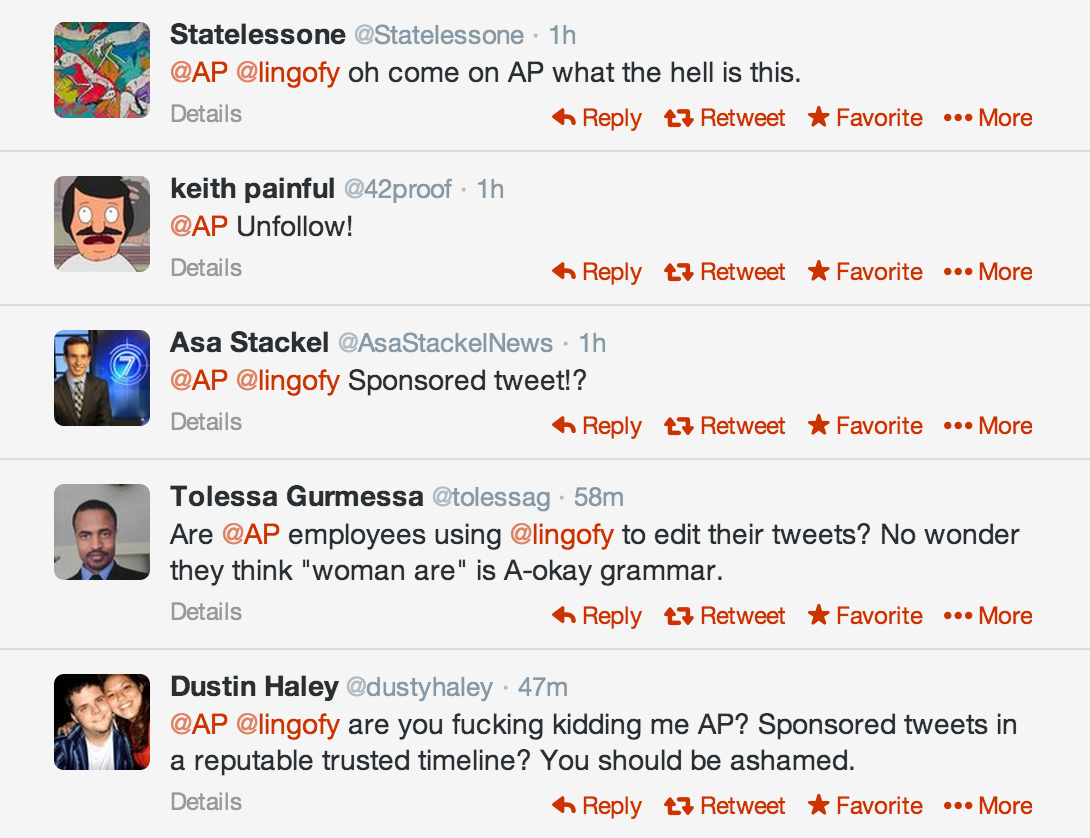
From the reader who flagged the tweet:

I can’t tell whether it’s serious, but I can tell that people are seriously pissed:

Screen Shot 2014-02-18 at 12.26.43 PM

But the beat will go on … and the press won’t write about it.

Sorry, Clapper, You Lied To Us

I’ve long been ambivalent about the NSA’s massive spying program. In many ways, I think it is one of the least objectionable of various counter-terrorism measures. It doesn’t require us to invade and occupy other countries, capture or kill innocent civilians, torture prisoners, or engage in endless melodramas with men like Karzai. The trouble is: such a program relies to a great extent on trust and consent in a democracy, and our government has made both close to impossible.

They lied to us, to put it bluntly. James Clapper lied directly to the Congress. And he keeps lying. Does anyone believe for a second his new excuse for brazenly deceiving the public he is supposed to serve? He’s all contrite now and claiming that the massive NSA program should have been disclosed early on after 9/11. Fine. But his credibility is effectively over. If an official has lied directly to the public before, he can do so again. And, as Ed Morrissey notes,

Clapper still defends the 215 program as both constitutional and effective, even though the administration’s own select panel concluded the opposite on both points after its investigation. Another group reached the same conclusion about the effectiveness of the 215 program last month.

The only reason Clapper is still in his job is because the president wants him there. No other conceivable defense is possible.

And the obloquy directed at Snowden and, to a lesser extent, the journalists who aided him, is thereby rendered moot. No one can deny that Snowden exposed something our democracy needs to know about, as Clapper now acknowledges. That makes it a text-book case of whistle-blowing, however unwisely Snowden has acted since. And that’s why the journalistic community, despite misgivings, has rightly rallied behind Greenwald, Poitras, MacAskill and Gellman who helped break the stories. The Polk Award is a big deal – and Pulitzers may follow.

I guess what I’m saying is that whatever the ethical questions about the leak of highly classified material, the US government has behaved so mendaciously, secretly and covertly that the question about Snowden is basically over. You can try to smear him and others. But you can no longer deny that they exposed government lies about matters of serious constitutional import.

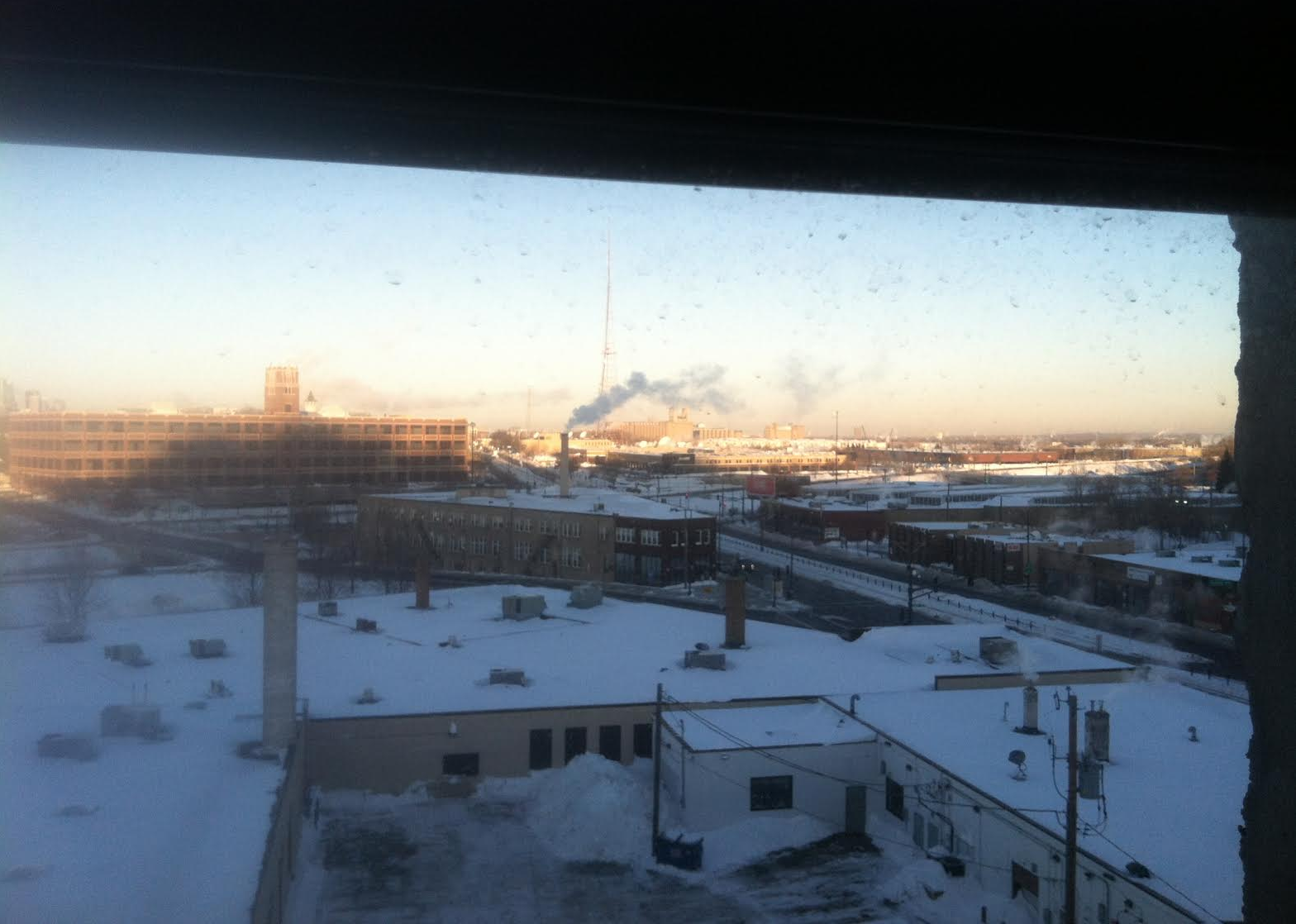
The View From Your Window Contest: Winner #192

vfyw_2-15

A reader writes:

First-time guesser, and I know this will not be a winning entry, but I figure I ought to throw my hat in the ring. The dumpster in the foreground looks American, but seeing as 49 out of 50 states (something I overheard, not sure of veracity) currently have snow, the only thing that could narrow it down would be the large lattice style radio tower in the background. Since I have two-year-old twins, I don’t have hours to spend on Google Maps. There is a list of lattice style radio towers on Wikipedia, however, and in light of Michael Sam’s recent announcement and your tendency to have thematic locations in the contest, I’m going to guess Kansas City, Missouri.

Another:

Once a “Winter Wonderland” (it’s Michigan’s state motto), this depressing shot has to be of one of the many bleak cities in the auto-industry decimated region of lower Michigan. Completely flat landscape, old Sears Roebuck building, little outdoor activity … might be Lansing, Dearborn, Battle Creek. Let’s go with Flint.

Another:

This was a really tough one. The extended weekend made it even harder (this is a Monday/Tuesday activity for me). Using the satellite dishes and the little bit of skyline in the upper left-hand corner, you know it’s a few miles northeast of a major city. Given the state of disrepair, I was leaning toward Detroit, but I can’t find any close-in industrial areas. Anyways, with the style of the triangle building and a strange feeling that I’ve seen that warehouse before, I’m going to guess Baltimore.

Another:

This is a wild guess. Today is the one-year anniversary of the meteor strike in Chelyabinsk, and it would be like you to feature them in the VFYW contest. But I have no idea how to find the building. I can’t find a large radio tower in Chelyabinsk in Google Earth. But yeah, that’s totally Chelyabinsk.

Another adds, “How frustrating is it that we can map the cosmic background radiation of the observable universe but we couldn’t see a huge meteor coming at us from the direction of the sun until it was streaking through our freaking atmosphere?” Another reader:

Omigod, omigod, omigod! This is Atlanta during one of the recent ClusterFlakes. It was taken in the the Old Fourth Ward, towards the former Sears warehouse (which became City Hall East and is now being redeveloped into lofts). The building on an angle is The Masquerade, a music venue, and next to that you can make out the Beltline, the amazing rails-to-trails (actually concrete bike and walking paths) that will someday ring the inner city.

The first ClusterFlake, three weeks ago, shut the city down for three days, but not on purpose. For the next storm, which occurred last week, the state leaders decided the best response was to shut the city down again for three days, but they mostly skipped the fun camping-in-your-car part this time.

Another:

Ah, some snowy big city in Yankeedom.  Atlanta, maybe?  (Finally the country is united.) But seriously, looks like somewhere on the southeast side of Chicago.

It is in the Midwest. Another gets the right city:

Holy crap I know this!!

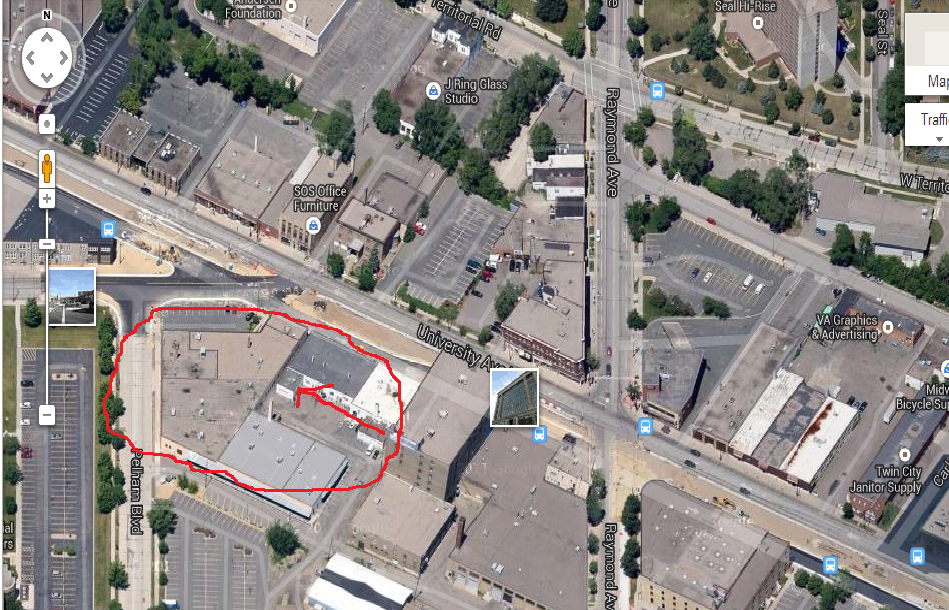
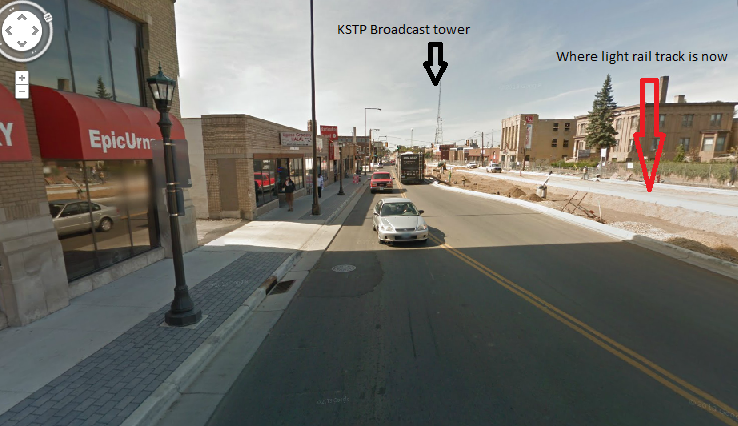
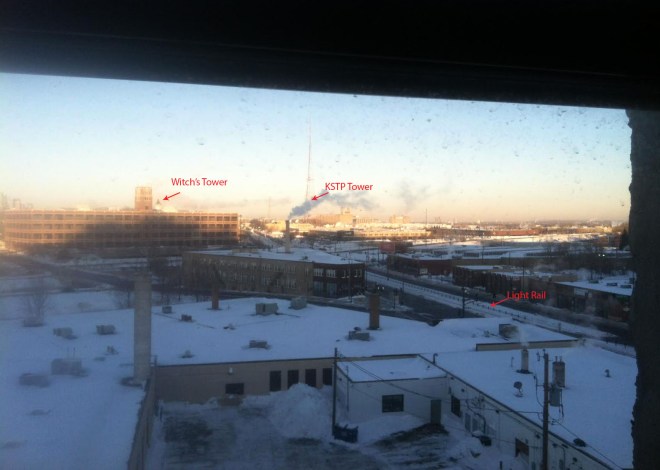
I don’t care enough to look it up to the exact cubic meter or whatever those people do, but this is in St. Paul, Minnesota (just at the Minneapolis/St. Paul city line, actually). It’s on the south side of University Avenue, between Raymond and Pelham, looking west. This picture was probably taken from the new condos being built there. You can see our new light rail transit track headed down the middle of University – it’s supposed to open in July. I work in a building just one block east of this. I wonder how many of my colleagues and friends will write in?

Clearly this picture was chosen because the winning goal in the USA-Russia hockey game today was scored by Minnesotan T.J. Oshie, right?

Well duh; everyone knows Oshie is from Warroad, MN. Another reader:

When I opened the picture my reaction was: “Hmmmm.  Not much to go on … wait that’s the Witch’s towerHat Tower. Oh, I live here.”  Well, I don’t live there as in inside the tower, but I do live in Minneapolis, so that landmark (the cone shaped tower partially obscured by the large building in the foreground) is instantly recognizable.  The photo is taken mere yards across the border into St. Paul looking west toward Minneapolis’ Prospect Park Neighborhood and the University of Minnesota.  I believe the photo is taken from the Chittenden and Eastman Building, which has been redeveloped into the C&E Lofts. The address is 2410 University Ave, St Paul, MN 55114.

I’ve won recently, so I won’t spend any time trying to guess which precise window.  But here’s some fun trivia: The Witch’s Hat Tower is rumored to be the inspiration for Bob Dylan’s song “All Along The Watchtower.”

Another sends the above image of the tower. Another reader:

When I was a toddler growing up in Twin Cities, we used to drive by that white tower. I never knew its name, but my folks would tease me that an old hag lived up there, peering out from under the dark “hat” to surveil the traffic for naughty children. I would crouch under the back seat of our Oldsmobile station wagon until the tower was well out of sight. I’m not sure they understood how disturbing that little story was to a 5 year old, but it has stuck with me for over 35 years!

Another with local ties:

I interned on the campaign of the late Paul Wellstone across the street from this location in the summer of 2002. I will never forget that neighborhood. Now I sit in Austin, Texas getting occasionally homesick for St. Paul – this view brought me home again, if only for a few minutes. Thanks for sharing it.

Another:

The street that runs diagonally across the right side of the photo is University Avenue – there’s a new light rail line that goes down the street that will be open in a few months. There’s also a low office building near the center of the photo that was the campaign headquarters for Al Franken’s Senate campaign in 2008.

Another turns back to the building in question:

Chittenden Eastman bldg.Before

The Chittenden and Eastman Building, a furniture showroom and manufactory, was built in 1917 in a part of Saint Paul zoned for industry. One of its last tenants, Nelson Office Supply, displayed desks and office furniture; long after that enterprise closed, its sign lingered on. In the ’60s and ’70s, the industry moved to the suburbs, and the low rents and warehouse space attracted artists, musicians and poets.

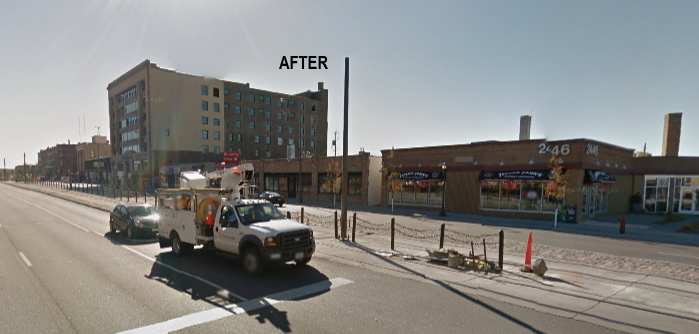
Over the past two years, University Avenue (the main drag in the center of your VFYW photo) has been under construction. A light-rail system has been installed (“the central corridor”) to join Saint Paul and Minneapolis, and a number of rundown warehouses along the route – the Chittenden & Eastman building among them – have been converted to apartments. In one of the attached photos [seen above], you can see the old building and the ripped up street. The second photo – just one google click from the previous one – shows the Chittenden & Eastman with a new lease on life as C&E Lofts, with many, many new windows:

C&E historic Lofts-after

Another leaves the exact location to chance:

VFYW is always so intimidating so I usually just glance at the picture and wait until the winner post, but this time I actually recognized the area! All of it, the Green Line LRT, the tv/radio tower, the witch hat water tower, the cool shaped building, and downtown Minneapolis to the far left. It has to be University Avenue in St. Paul where it intersects with 280. I sent an email to my brother to confirm, but he tells me that I need more than a guess. With his help we narrowed it down to C&E Lofts at 2410 University Ave. St. Paul, MN. His guess is apt. 410, mine, apt. 510. In true sibling fashion we flipped a coin. Apt. 410 it is!

510 actually!  Two readers guessed the right apartment number:
VFYW pic

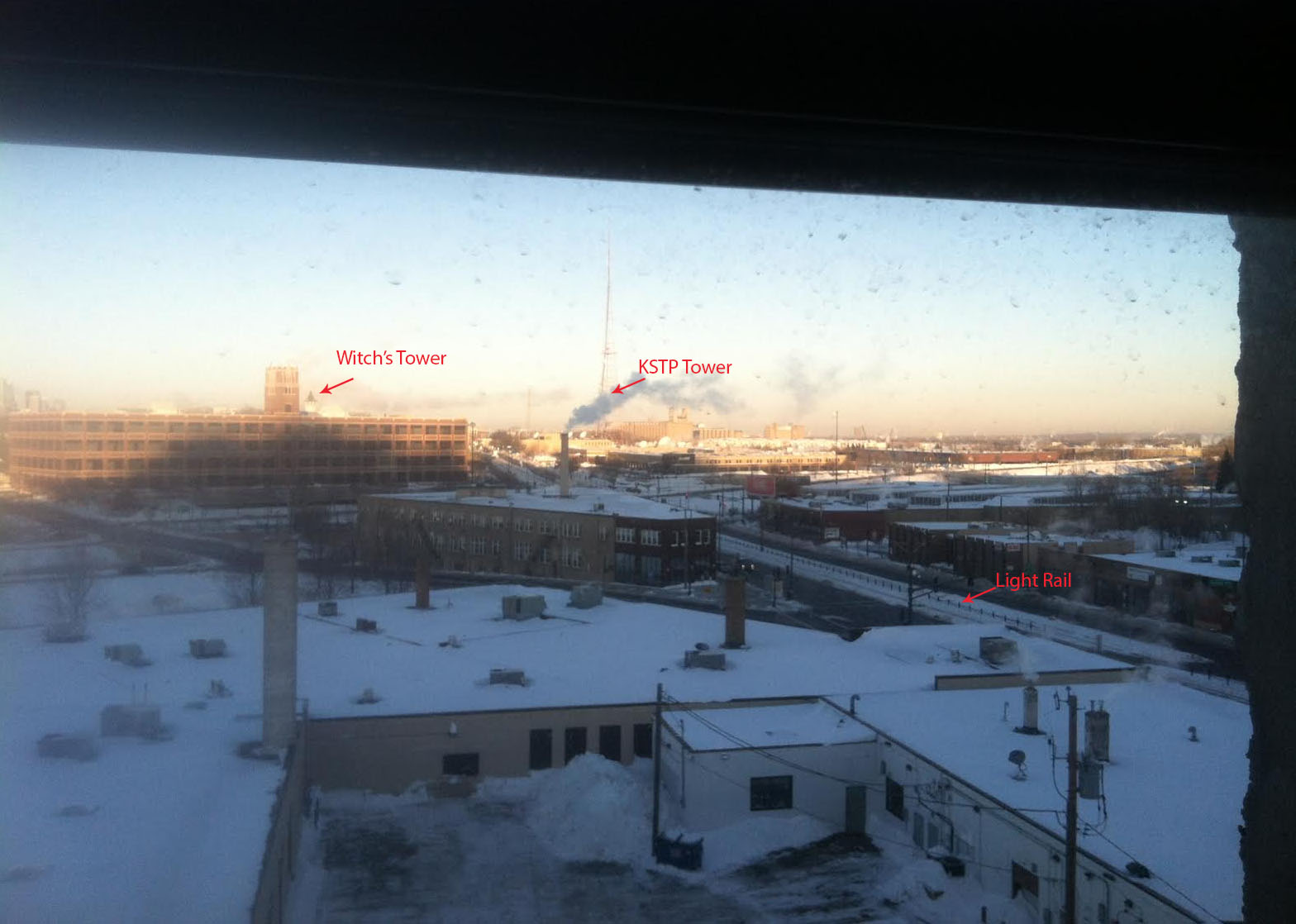
Normally I spend about 5 minutes on the VFYW contest and give up, but when I saw this week’s contest I knew it had to be the Twin Cities. The sky, the huge pile of snow in the parking lot, the steam coming off the smoke stacks … it all screamed MSP, my hometown. Next, I noticed the dividers on the street that are part of the new light rail system. That probably places it on University Ave. Aha! That radio tower is KSTP, and the real give-away is the Witch’s tower that sites atop a hill blocks from the house where I grew up. Now I know it’s at the intersection of University and Franklin, and a couple reference points clearly show it’s the C&E Lofts building at 2410 University Ave. Specifically, it’s from the southern-most window:

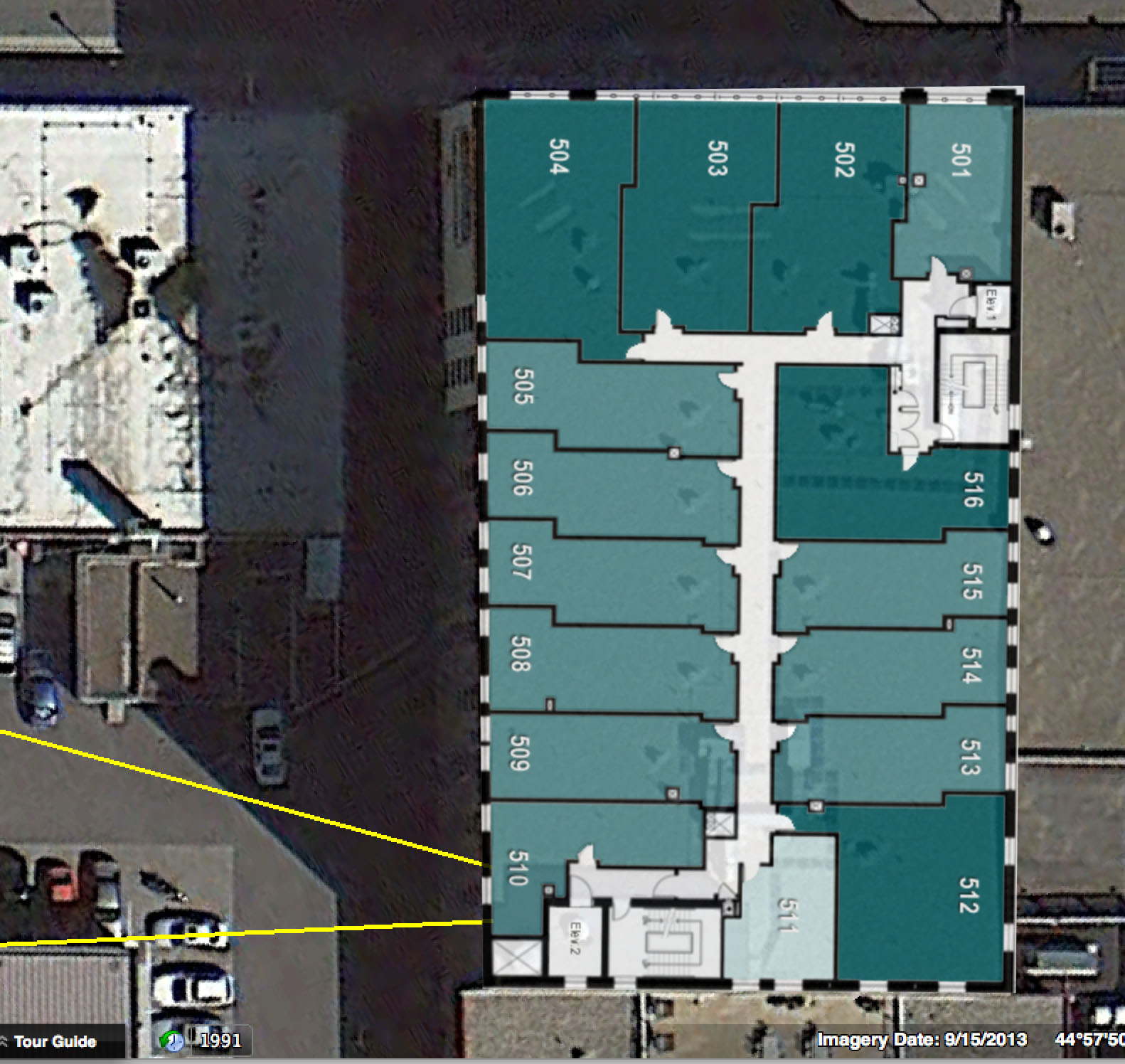
Floorplan

The only question, then, is which floor? At first I assumed it was the top level, but after referencing Street View I’m reasonably certain it’s the 5th floor. The window, then, is the kitchen window (as opposed to the living room) in unit 510. You can’t get much more specific than that.

Indeed you can’t, but to break the tie this week, we had to check how many previous contests the two 510 guessers have entered. The above reader was a first-time player, but the following reader has played once before, so he’s the winner this week:

Every Saturday my wife and I check out the view from your window contest and list off a guess, that is at minimum 500 miles, if not a continent or two away. This week, due to a change in our routine, I didn’t pull up the post until Sunday evening. My first impression was “just like it is here (in the Minneapolis/St. Paul area) snowy and it looks cold.” While it has been cold throughout the country, the only word to describe it here this season is brutal. Then I saw the light rail line in the middle of the street and thought that it looked like the new divider that they were putting in the for the new Green Line light rail between Minneapolis and St. Paul. From there it all fell into place.

Back in graduate school at the University of Minnesota, I took a bus that went down that very street every day between the Minneapolis and St. Paul campuses. I used to see the unusual triangle shaped building and used to think it was an incredibly odd shape for a building. Directly ahead in the view you can faintly see the broadcast tower for KSTP television (local channel 5). On the very upper left edge you can see some of the skyscrapers of Minneapolis, poking above the red Court International building of 2550 University Avenue.

unnamed1

The building is the Chittenden and Eastman company building located at 2410 University Ave West in St Paul. The building’s history is as follows: The building was erected by M. Burg and Sons as a furniture showroom and warehouse. In 1927 they were joined by another furniture manufacturer, the Chittenden & Eastman Company. In the 1950s the building became widely known as the Chittenden & Eastman Building. Over time the C & E Building has been home to other furniture stores and offices. Beginning in 2011 the building was converted into apartments.

I have attached a Google street view photo of the front of the building from the summer which shows the light rail track construction underway:

VFYW2(1)

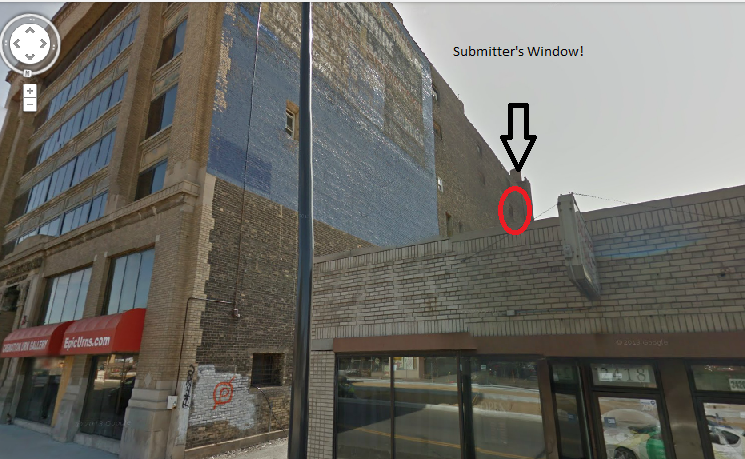
To get the view that you see in the photo, the window would need to be in the back corner (SW corner) of the building. The windows from that unit would face NW towards Minneapolis. To get the unit and angle I was able to find a floor plan of the building on the C&E Loft’s website. From everything I can tell, the location is unit 510

An exterior photo of the building with the submitter’s window is circled:

VFYW3(1)

Hopefully from everything I’ve written, I’ll be the winner! I have read from week to week of all the people who can get this, and it astounds me. At least I can now say I’ve gotten the location once! Thanks for the great blog and the weekly contest, and don’t worry, I’m a subscriber and I’ve renewed!

(Archive)
How Much Is Hillary Clinton Like Claire Underwood?

There seem to be two major responses to the Washington Free Beacon’s enterprising investigation into the Diane Blair documents at the Clinton library University of Arkansas Special Collections library. The first is: up and at ’em! She’s a candidate for president (well she hasn’t ruled it out); her record in public life is obviously germane; what’s the problem? The second is: can we not revisit the entire 1990s? It was bad enough at the time. And please, give the Clintons a break after all these years. Byron York makes the first case; Frank Bruni makes the second.

York wins by a mile, it seems to me. When you’re electing a president, obviously his or her character under pressure is an important thing to understand. Many candidates – like Obama, for example – have such a slim record in public life (and such an apparently impeccable private life) that the details can be a little sparse. Nonetheless, we know about his pot-smoking, his intimate family background (not least because he wrote his own book about them), his marriage, his friendships, his religious affiliations, and on and on. Now think of what we learned (and didn’t!) about a former half-term governor’s improbable rise. When you come to someone like Hillary Clinton, who’s been in the halls of power for two interminable decades, the record is much deeper and wider. It is not somehow prying into someone’s zone of legitimate privacy to note the following, as York does, in order to counter the hagiography that has emerged in the last decade or so:

New voters also need to learn about Mrs. Clinton’s checkered history as a lawyer and the game of hide-and-seek she played with federal prosecutors who subpoenaed her old billing records as part of the Whitewater investigation. After two years of defying subpoenas and not producing the records, she suddenly claimed that they had been in a closet in the White House residence all along.

Add to that Clinton’s amazing $100,000 windfall in cattle futures and the shenanigans in the White House travel office, and you’re dealing with completely legit questions about ethics in public life. The benefit of time passing is that these maneuvers can be seen more dispassionately, and dismissed as ancient news, if appropriate. I can’t imagine, for example, that cattle futures will figure prominently in the 2016 campaign. And Clinton’s stonewalling the largely-debunked Whitewater “scandal” may well burnish her rep for steeliness, rather than make her seem conniving.

But what about the Lewinsky mess, which was obviously not her doing, which derailed her husband’s second term, and in which she was much more sinned against than sinning? I don’t believe it should be a prominent feature of the campaign – and trying to shoehorn it into the debate, as Rand Paul has been doing, is bound to boomerang. Forcing a spouse to relive her husband’s infidelity and dishonesty and even perjury crosses a line in civility Americans are rightly sensitive to. But the trouble is – this wasn’t an entirely private matter – you can’t erase impeachment from history –  and the Clintons, in any case, have a strong story to tell about Republican over-reach. There is, moreover, a completely legitimate question to be drawn from the episode: What does it tell us about Hillary Clinton’s political character?

It tells us that she is one cool customer. Claire Underwood has a doppelganger. Here’s the money quote for me from the WFB piece:

In her conversations with Blair, the first lady gave her husband credit for trying to end the affair with Lewinsky, and said he did not take advantage of his White House intern. “It was a lapse, but she says to his credit he tried to break it off, tried to pull away, tried to manage someone who was clearly a ‘narcissistic loony toon’; but it was beyond control,” wrote Blair. “HRC insists, no matter what people say, it was gross inappropriate behavior but it was consensual (was not a power relationship) and was not sex within any real meaning (standup, liedown, oral, etc.) of the term.”

So for Clinton, there is no power dynamic at work in a female intern having an affair with the president of the United States. I’d love to see her make that case in other sexual harassment cases. And for Hillary, Bill Clinton was not lying when he said that he did not have sex with Lewinsky. On the question of Bill’s honesty, Hillary thinks he was always telling the truth. As for feminism, Hillary Clinton had more sympathy for Bob Packwood than for the countless women he grotesquely harassed and groped:

In a Dec. 3, 1993, diary entry, Blair recounted a conversation with the first lady about “Packwood”—a reference to then-Sen. Bob Packwood, an influential Republican on health care embroiled in a sexual harassment scandal. “HC tired of all those whiney women, and she needs him on health care,” wrote Blair.

If a Republican male candidate were on record calling the victims of Bob Packwood’s depravity “whiney women”, I have a feeling the Democrats would be using that quote quite expansively in any campaign. Then there’s the campaign to smear any women who might have had sexual relations with Bill:

In a confidential Feb. 16, 1992, memo entitled “Possible Investigation Needs,” Clinton campaign staff proposed ways to suppress and discredit stories about the then-Arkansas governor’s affairs. Campaign operatives Loretta Lynch and Nancy McFadden wrote the memo, addressed to campaign manager David Wilhelm. The first item on the itinerary discussed “GF,” a reference to Gennifer Flowers, the actress and adult model who had recently disclosed her 12-year affair with Bill Clinton. “Exposing GF: completely as a fraud, liar and possible criminal to stop this story and related stories, prevent future non-related stories and expose press inaction and manipulation,” said the memo.

Now of course Hillary knew full well of her husband’s long affair with Gennifer Flowers. But that didn’t stop her from trying to smear her as a “fraud, liar and possible criminal.” And that, it seems to me, speaks to a level of political calculation that is well worth considering in a future president. And it can work both ways. I suspect many partisan Democrats – after Obama’s civil, patient attempt to negotiate with a deranged GOP – will long for a president who will wage war on the right, take no prisoners, and generally Claire-Underwood the opposition. Maybe many independents will like that as well. But you cannot make that case while simultaneously portraying Clinton as a feminist icon. If someone describes the victims of sexual harassment as “whiney women,” if she buys Bill Clinton as a victim who told the truth in the Lewinsky scandal, and if she is capable of knowingly destroying the reputation of a woman who could disrupt her pursuit of power, then she is not, I’m afraid, a feminist icon. She is something a lot more formidable and cynical than that.