Becoming A Moral Minority

Reviewing a number of recent books on the state of American Christianity, especially John Dickerson’s The Great Evangelical Recession, Jim Hinch tracks the decline of conservative religion:

[T]he chief problem facing conservatives is not simply demographic or cultural change in America but rather conservatism itself — a particular approach to Christian theology and practice that worked well for churches during a certain period in American history but now has become a serious impediment. That approach combined (selective) biblical literalism with American religious nationalism to produce a Christian worldview that was strong enough to withstand the cultural upheavals of the 1960s but flexible enough to embrace the Reagan-era turn toward free-market capitalism and cultural individualism. Conservatives already have begun shedding parts of this mix, as evidenced by evangelicals’ pivot on immigration reform. Biblical literalism, though, and its accompanying inflexibility on sexual issues, has proven harder to change. And therein lies the problem.

One of the biggest problems for conservative Christians? How they read the Bible:

[R]igid literalism makes it extremely difficult for conservatives to change course, even when compelling arguments are raised against their particular biblical interpretations. One of young people’s chief complaints about present-day Christianity, polls show, is that the faith is antiscience. Christianity itself is not antiscience, and many scientists (including Francis Collins, the current director of the National Institutes of Health) are practicing Christians. But biblical literalists are antiscience, and their inability to let go of the idea that Scripture trumps scientific evidence constitutes a needlessly self-inflicted wound.

In an interview about his book from last year, Dickerson explained data on how many evangelical Christians there are in the United States. You might be surprised by what he found:

The bottom line is that we are a much smaller movement than many of us have believed – certainly not a majority of the United States, and, I believe, a gradually declining minority. Many of us attend growing churches that are attracting folks from other churches, so we have the perception that “the Church” is growing, when she’s really just shuffling. Meanwhile, as we play musical churches, the broader population is growing.

The exact size of evangelicalism is probably impossible to calculate. Sociologically, the movement is broad and motley and scattered. Culturally, the terms “born again” and “evangelical” now mean different things to different Americans. … On this question of the actual size of the evangelical church, I discovered that four separate, credentialed researchers have recently used four separate methods to count U.S. evangelicals, in four completely independent studies. Interestingly, they all concluded that evangelical Christians are between 7 and 8.9 percent of the U.S. population.
A Morning-After Mishap

John Strong’s dialogue-free short film Guilty follows a man who wakes up to an embarrassing accident:

[Strong’s] playful narrative revolving around one man’s distraught attempts to hide a bedwetting incident feels like the perfect example of a storyteller playing with the flexible boundaries the medium allows. In an on-screen world, where apocalyptic events, super-heroes and monsters rule, a man trying to clear up urine doesn’t exactly rank highly in terms of drama and it’s to the director’s credit that he really ramps up the theatrics in his film. Treating his protagonists attempts to clean soaked sheets like a stealthy ninja attack, Guilty is riddled with moments where as a viewer you feel so close to, and engaged with, the on-screen actions you don’t dare breathe too loud (or inhale too deeply). As the film’s simple concept unwinds and you’re dragged deeper into the “cover-up”, a buzzing phone and a stirring sleeper suddenly feels as dramatic as any apocalyptic event ever has. It might not be the end of world as such, but it feels like it could be the end of this one man’s world.

You’ve Got Sexts

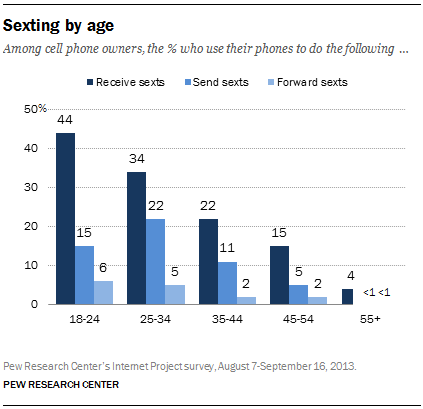
A new Pew study indicates that the prevalence sexting is rapidly rising:

In previous surveys, those in their mid-twenties through mid-thirties were dish_sextingchart the most likely to both send and receive sexts. For the first time, however, those ages 18-24 are the most likely of any age group to say they receive sexts (44%). This represents a significant increase from 2012, when 26% of those 18-24 said they received sexts. … Sexting … is not just for daters. Adults in marriages or committed relationships are just as likely to say they have sent sexually suggestive texts as single individuals. Some 9% of those in a  relationship have sent sexts, along with 10% of those not in a relationship.

The trend shows little signs of stopping:

Karen McDevitt, a communications lecturer at Wayne State University who specializes in new media, says she expects the sexting phenomenon to continue growing and attributed its increased popularity to the widespread availability of devices like smartphones. “The technology is in your hand,” McDevitt says, “I truly believe it’s just accessibility that makes the difference.”

Amanda Hess zooms out:

Could we be entering an era where using technology for titillation doesn’t mean opening ourselves up to exploitation?

In 2003, New Jersey made it a felony to distribute sexual photos of another person without his or her permission, but it took a decade for the campaign against nonconsensual pornography to begin to gain traction around the world. Last year, California made forwarding a sext without consent a misdemeanor crime. Steubenville, Ohio, football player Trent Mays was convicted in juvenile court of raping a 16-year-old girl but also of distributing images of the assault after the fact; his text messaging doubled his sentence from one year to two. Just last month, American revenge-porn king Hunter Moore was busted by the feds for allegedly hacking into email accounts to steal sexual photos, and Israeli legislators passed a bill banning the dissemination of sexualized images without the subject’s explicit consent. There, distributors now face five years in prison. …

[L]ooking at Pew’s new numbers … it’s increasingly clear that dialing up sexual experiences doesn’t come with the expectation that those experiences will migrate to a group text. Most people who receive sexts don’t share them with the class, and it’s not stupid to expect your sexting partners to keep your privates private. It’s simply humane.

The Future Of Film

A NSFW art exhibition explores Oculus Rift, the virtual reality headset:

Adi Robertson elaborates:

Long-running performance art installation The Machine to be Another is a literal, perhaps radical take on the Oculus Rift’s promise to let you simulate being anywhere or anyone. In what the artists call the “gender swap” experiment, two people stand in a room, each wearing a Rift headset. They agree on and synchronize their movements, rubbing hands over stomachs or taking off shoes. But while they feel their own bodies, they “see” out of each other’s eyes. … [T]he video … is an artistic example of how something like Sex with Glass can be done right.

Meanwhile, Hugh Hancock considers how virtual reality (VR) will come to be incorporated into mainstream movies:

There’s been a lot of research into “VR Sickness” recently, and the news isn’t good for movies-in-VR.

It turns out that one of the major causes of VR sickness is rapid or unexpected movement outwith the user’s control. Users seem to be able to cope provided there’s an obvious visual reason for the movement, but otherwise, movement you can’t control sends you right off to talk to Huey on the big porcelain telephone.

So, for a filmmaker, that means no tracking shots, certainly no rapid flythroughs, and worst of all – no cuts. Cuts – film editing as a whole – are one of the most fundemental tools of movie storytelling, and removing them sends us back in time to the dawn of cinema, before Eisenstein, back to 1910 and the Kuleshov Effect.

He suggests filmmakers seeking to embody the viewer in their narratives look to VR porn:

So far, all reasonably workable VR porn adopts a “breaking the fourth wall” approach, either by having performers perform to the viewer and treat him/her as a voyeur, or more dramatically by placing the viewer straight into the scene with his/her viewpoint positioned where one of the actors’ heads can be assumed to be. This ties in with both Oculus VR’s best practise document, which recommends giving the VR participant a visible body in the virtual space, and some of the more successful game experiences in VR.

Previous Dish on virtual reality here and here.

Who Says Bigger Is Better?

Research reveals a link between straight men’s socioeconomic status and the breast size they prefer on their partners:

[T]he present results indicate that men in relatively low socioeconomic sites rate larger breast sizes as more physically attractive than do their counterparts in moderate socioeconomic sites, who in turn rate a larger breast size as more attractive than individuals in a high socioeconomic site. In broad terms, these results are consistent with previous studies showing that there is an inverse relationship between socioeconomic status and breast and body size judgements. These results provide preliminary evidence that breast size may act as an indicator of calorific storage and that men in environments characterised by relative resource insecurity perceive larger breast sizes as more attractive than their counterparts in higher socioeconomic contexts.

Researchers also evaluated how hunger affected judgment:

[H]ungry men rated a significantly larger female breast size as physically attractive than did satiated men. Although the effect size of this difference was small-to-moderate, it nevertheless suggests that there are significant differences in the attractiveness ratings based on breast size between hungry and satiated men. In addition, the results of this study corroborate previous work showing that hungry men rate a significantly heavier female body size as attractive …. Moreover, these results are in line with the findings of Study 1: in both studies, it appears to be the case that men who experience relative resource insecurity show a preference for a larger breast size than do men who experience resource security.

(Hat tip: Hazlitt)

Face Of The Day

batman

Freya Jobbins creates sculptures our of discarded toy parts:

The Johannesberg-born artist takes her inspiration from an ecletic range of sources including the Toy Story trilogy, controversial anatomist Gunther Von Hagen, Guiseppe Archimboldo and his fruit and vegetable paintings, and various other artists. Her creations are also inspired by a keen interest in Greek mythology. Freya takes miscellaneous parts of discarded dolls and toys to create the bizarre faces, heads and busts. Each piece of plastic is painstakingly carved and glued layer over layer to add depth to each sculpture.

As well as her plastic sculptures, Freya, who moved to Australia at the age of nine and grew up in Sydney, also makes prints. She said: ‘The plastic toy assemblages, disturbing to some, I see as my humorous side and my printmaking is what I consider more my voice.’

(Photo by Freya Jobbins. Hat tip: Colossal)

A Poet’s Love For Death

Diane Mehta praises the “death poems” of Stevie Smith, noting, “Any longing that might have gone to a man Smith instead projects onto death”:

If you’re a thinking, feeling poet, you’re going to wonder what the meaning of life is, and it might depress you a little. And if, like Smith, you start off with a religious feeling and then discard it, even if you keep the spiritual dialogue up—which she did, as a practicing Anglican—you’re going to run into some sort of spiritual chasm. (It was the same for Eliot and Auden, though they chose salvation while Smith, disillusioned, was deeply ambivalent about the existence of the afterlife.) On top of that, if you give up romantic intimacy and become an old maid, well, your longing will need to deposit itself somewhere over the course of a lifetime. So Smith longs for death. “Tender Only to One,” a kind of love letter, says it straight:

Tender only to one,
Last petal’s latest breath
Cries out aloud
From the icy shroud
His name, his name is Death.

Centuries ago, “loving” death by way of exploration and religious feeling was much more in style. In a 1957 letter to Anna Kallin, a colleague at the BBC Radio, Smith explained that she was including a lecture, “The Necessity of Not Believing,” in which she showed how she was religious when young, then wasn’t at all, and then became “conscientiously anti-religious” because it was immoral to believe. Her description of the lecture is a sound description of Smith herself: “It is not at all whimsical, as some asses seem to think I am, but serious, yet not aggressive, & fairly cheerful though with melancholy patches.”

Speed Reads

Julie Bosman reports (NYT) that book publishers are now “encouraging a kind of binge reading, releasing new works by a single author at an accelerated pace”:

The practice of spacing an author’s books at least one year apart is gradually being discarded as publishers appeal to the same “must-know-now” impulse that drives binge viewing of shows like “House of Cards” and “Breaking Bad.”

Michelle Dean hopes binge-reading isn’t the new binge-watching:

The kind of trance that reading induces is qualitatively different from the experience of sitting down and watching 12 hours of television. This is true even if the television is really good, I think. It just uses a different part of your brain.

I’m aware that in a way I’m just quibbling with a label, with marketing, by saying I don’t think that “binge reading” is silly. But I just really, really don’t think this is a viable business model for imaginative work. Practically speaking, writing a “binge read” would mean writing entire epics on spec, all at once, before selling them. It also means that the slow accumulation of fans that something like Game of Thrones enjoyed would be a thing of the past. I don’t know: there’s just something about this whole idea that strikes me as the product of an industry feeling like the culture is accelerating away from it.

Gracy Olmstead considers the implications for libraries:

This scheme is an interesting study in venues and audiences. While Netflix may inspire the development, a book is different from a TV series, and a library different from an instant-watch website. With the caveat that writers’ style and quality should not suffer (due to the pressure of speed), it’s not a bad thing to release books in quick succession. It seems a wise and marketable scheme. But while all-at-once rollout may foster book buys, it may favor online sales over library or bookstore visits. If you want to buy the next book in your teen vampire series, will you wait for your local library to buy the latest copy—or will you grab the Kindle edition from Amazon? Netflix has drawn audiences away from the traditional television by offering endless hours of entertainment without the hassle. An onslaught of binge-targeted titles may have a similar effect on libraries.

An Obit In Kansas

A reader alerted me to it, in the wake of the Kansas House of Representatives passing a law that would allow widespread discrimination against any gay or straight people who could even faintly be connected to a wedding or even commitment ceremony. The obit is for a pillar of the local community:

Bruce G. “Butch” Neis was born March 15, 1953 in Lawrence, KS the son of Samuel G. Jr. and Elizabeth Kindig Neis. He was a farmer, a welder and owned Bruce Neis Trucking. He was a lifetime member of the Eudora Township Volunteer Fire Department. He also was a member of Eudora Emergency Medical Services for 22 years and a 14-year sponsor of the All-Night After Prom Party at Eudora High School.

Among his survivors are

two sons; Richard B. Neis (spouse Carrie) of Eudora, KS, Aaron M. Neis (partner, Thaddeus Winter) of Honolulu, HI … and two brothers; Samuel D. Neis (spouse Bill Spinney) New Bedford, MA, Russell D. Neis (spouse Tina) …

My italics.

You know why the Christianists will lose? Because they are insisting that a man like Neis disown his partnered gay son and his married gay brother. Happily the far right does not seem to have succeeded in tearing this particular family apart. Update from a reader:

A footnote to your post: The Lawrence Journal-World, on whose website that obit appeared, will not, as a matter of corporate policy mandated by its extremely right-wing ownership, run notices of same-sex marriages. However, their obituaries run exactly as submitted by funeral homes, with no editing, so the mention of the man’s sons’ partnerships slipped through. And in fact, the obit you linked to actually is on a third-party site, Legacy.com, which handles online obituaries for the Journal-World (and many other newspaper websites). So it evaded the newspaper’s own editorial/advertising policies against honoring gay life events. Sadly, there’s still quite a ways to go in acceptance of gays in Kansas – even in Lawrence, by far the most liberal and open community in the state.