Crafting A Condolence Letter

Saul Austerlitz considers it:

A condolence letter is a strange hybrid of forms. It is for the mourner, but about the deceased. It is formal, but emotional. It gestures simultaneously at the past, the present and the future. It seeks to provide solace while acknowledging that there is no genuine solace to be provided. It follows a rigorous order while retaining an open-ended flexibility. … A good condolence letter requires balance, demanding an “I” capable of turning its attention away from itself, and toward a missing other. It is about what death requires of all of us who are left behind, and often finds us incapable of providing: compassion. A condolence letter is an act of self-erasure. It is also an acknowledgment of failure. We provide comfort, but never enough; we pay tribute, but never fulsomely enough; we remember, but not deeply enough. We fail. We can only offer condolences, because we are unsure if they will be taken. All we can do is make the attempt.

A Poem For Thursday

From “far memory, a poem in seven parts” by Lucille Clifton:

my knees recall the pockets
worn into the stone floor,
my hands, tracing against the wall
their original name, remember
the cold brush of brick, and the smell
of the brick powdery and wet
and the light finding its way in
through the high bars.

and also the sisters singing
at matins, their sweet music
the voice of the universe at peace
and the candles their light the light
at the beginning of creation
and the wonderful simplicity of prayer
smooth along the wooden beads
and certainly attended.

(Reprinted from Angles of Ascent, A Norton Anthology of Contemporary African American Poetry, edited by Charles Henry Rowell © 2013 by Charles Henry Rowell. Used by kind permission of BOA Editions, Ltd. Video of the poet Sharon Olds reading from the work of Clifton last November, during a Poetry Society of American event honoring iconic black poets)

Can The Embargo Be Broken?

Keating ponders a new poll on the Cuba embargo:

A majority of Americans, and even a majority of Cuban-Americans in Florida (who also supported Barack Obama over Mitt Romney in the last election), may now oppose the embargo, but older voters with visceral personal experience of Castro’s Cuba feel more strongly about it.

The number of people whose votes and donations are determined by their support for the embargo may be dwindling, but it’s probably still greater than the number whose vote and donations are determined by opposition to it. Still, the numbers indicate the downside isn’t as bad as it once was. The reactions to Obama’s handshake with Raúl Castro turned out to be fairly mild. Could something more dramatic be coming?

Greg Weeks doubts it. He argues that it “simply does not matter what a majority of Americans support if they do not really care about it”:

The tiny minority of Americans of oppose normalization care about it very deeply. On a list of priorities it would be high; for some, number one. Therefore they will fight very hard, expend considerable political capital, and spend a lot of money to make sure the embargo and other similar policies remain firmly in place.

Larison chimes in:

The good news is that support for the utterly useless embargo of Cuba has been getting steadily weaker over time, and there is good reason to assume that it will continue to wane until the embargo is finally lifted. Even though this will happen many decades later than it should have, it is encouraging to know that there is some limit to how long such senseless policies can endure. The embargo is a good example of the kind of needlessly harmful policies the U.S. can pursue when it allows its dealings with another country to be shaped almost entirely by ideological and emotional factors. It is also a monument to our government’s remarkable inability to abandon some failed policies decades after their futility has become obvious.

The Felon’s Franchise

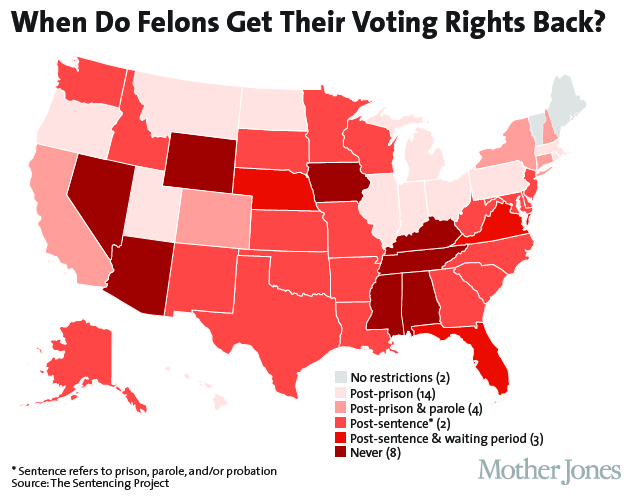
felons-01_0

Attorney General Eric Holder is urging states to overturn laws that bar people convicted of felonies from voting. How many Americans do these laws affect? Quite a few:

Nearly 6 million Americans are barred from voting due to felony disenfranchisement laws. Moreover, the bulk of disenfranchised felons—75 percent—are no longer in prison. Approximately 2.6 million of those remain disenfranchised despite having completed all parts of their sentence (prison time, parole, probation) because they live in states that bar felons from the polls for life. …

Felony disenfranchisement disproportionately affects people of color. Black men are incarcerated at a much higher rate than the rest of the population. According to the Urban Institute, 11.4 percent of African American men aged 20 to 34 were in prison in 2008, compared with just 1.8 percent of white men. One out of every 13 black Americans of voting age can’t vote due to criminal disenfranchisement laws, a number much higher than for any other demographic. This ratio is more stark in Florida, Kentucky, and Virginia, where more than 1 in 5 black adults is barred from the polls. Overall, 2.2 million black Americans have lost the right to vote because of felony disenfranchisement laws.

Roger Clegg brings up the usual objections:

[Holder] conveniently ignores the reason for felon disenfranchisement, namely that if you aren’t willing to follow the law, then you can hardly claim a role in making the law for everyone else, which is what you do when you vote. We have certain minimum, objective standards of responsibility, trustworthiness, and commitment to our laws that we require of people before they are entrusted with a role in the solemn enterprise of self-government. And so we don’t allow everyone to vote: not children, not noncitizens, not the mentally incompetent, and not people who have been convicted of committing serious crimes against their fellow citizens.

But Kevin Drum thinks restoring their rights is pretty fundamental to democracy:

I believe the right to vote is on the same level as free speech and fair trials. And no one suggests that released felons should be denied either of those. In fact, they can’t be, because those rights are enshrined in the Constitution. Voting would be on that list too if it weren’t for an accident of history: namely that we adopted democracy a long time ago, when the mere fact of voting at all was a revolutionary idea, let alone the idea of letting everyone vote. But that accident doesn’t make the right to vote any less important.

A probationary period of some kind is probably reasonable. But once you’re released from prison and you’ve finished your parole, you’re assumed to have paid your debt to society. That means you’re innocent until proven guilty, and competent to protect your political interests in the voting booth unless proven otherwise. No free society should assume anything different.

Meanwhile, Rick Hasen notes how resistant conservatives are to early voting, which would also expand the franchise:

[C]onservative critics of early voting runs don’t just mistrust early voters; they mistrust voters in general. As I explained here, there is a fundamental divide between liberals and conservatives about what voting is for: Conservatives see voting as about choosing the “best” candidate or “best” policies (meaning limits on who can vote, when, and how might make the most sense), and liberals see it as about the allocation of power among political equals. Cutting back on early voting fits with the conservative idea of choosing the “best” candidate by restraining voters from making supposed rash decisions, rather than relying on them to make choices consistent with their interests.

Beinart points out the contradiction between the GOP’s desire to attract more black votes and its efforts to restrict voting:

Do the Republicans pushing these restrictions really want to keep blacks from voting? Not exactly. The more likely explanation is that they want to keep Democrats from voting. As the Republican majority leader of the Pennsylvania state legislature said in 2012, the requirement for voter ID “is gonna allow Governor Romney to win the state of Pennsylvania.”

The problem, of course, is that limiting Democratic voting means limiting African-American voting. And in a country that for much of its history denied African Americans the right to vote, pushing laws that make it harder for African Americans to exercise that right touches the rawest of nerves. As long as many African Americans feel the GOP doesn’t want them to vote, it’s unlikely anything the GOP says to African Americans is going to have much positive impact.
Marriage Equality Update

The Dish covered the debate in Indiana over whether to add an initiative for a constitutional banning marriage for gays to the ballot this fall. I was optimistic, given some Republican opposition to the idea; one of our Indiana readers wasn’t. Today, the inability of the state House and Senate to agree on the wording of the measure means it will be shelved for the foreseeable future. Another day, another win.

Liberalism vs Religious Liberty?

The case of the Little Sisters of the Poor with respect to Obamacare is a fascinating one. Here’s a rather aggressive column by Linda Greenhouse dismissing their worries. Here’s an excellent rebuttal by Ramesh Ponnuru. His key point is about the nuns’ refusal to sign the form that triggers the ACA’s procedures for religious exemptions:

Page 2 declares that the form is the “instrument” that triggers the requirement that a third-party administrator provide contraceptive coverage. The nuns don’t want to take any action that (they believe) involves them in facilitating immoral acts, which includes causing other people to perform immoral acts. Signing the form would (in their view) do that. Note, by the way, that houses of worship, which are truly exempt from the administration’s contraceptive mandate, do not have to sign any such form to get that exemption. That fact makes a hash both of Greenhouse’s claim that the Little Sisters of the Poor are “exempt from the mandate” and her (and the administration’s) claim that certification is the only way to prevent the exemption process from sliding into “chaos.”

I confess I hadn’t seen it that way before. The mere act of delegating the authority to approve of contraceptive coverage to a third party is itself an act of complicity in something the nuns oppose for religious reasons. The current compromise – before the case reaches the Superme Court – is the following:

The Little Sisters must “inform the Secretary of Health and Human Services in writing that they are non-profit organizations that hold themselves out as religious and have religious objections to providing coverage for contraceptive services,” the court’s unsigned and apparently unanimous Jan. 24 order said. But they “need not use the form prescribed by the government and need not send copies to third-party administrators.”

If the key is signing a form that requires active complicity in a system the Little Sisters object to, and if a letter merely stating their objection to the contraceptive coverage can suffice, then this seems like more than a temporary solution. This may be splitting hairs – but allowing for religious freedom in a secular society can often come down to splitting hairs. And what concerns me is less the details of this particular case than the general liberal contempt for the genuine moral quandaries religious organizations may face. Greenhouse’s column is a prima facie case of this.

So too, I might add, is the brusque and smug liberal assumption that religious objections to marriage equality are somehow as illegitimate as defenses of slavery. Please.

There is a deep theological narrative and argument behind Christianity’s and Judaism’s and Islam’s anathematization of homosexuality that cannot be reduced to bigotry. I think it’s mistaken, but I sure don’t think it’s mere prejudice. In the Catholic tradition, Humanae Vitae – with which I strongly disagree – is nonetheless a coherent view of the role of sex and procreation in human life. Its “natural law” has never fully addressed the reality of homosexual orientation – but that is partly because the entire concept is so new in the context of the history of the great monotheisms. I think it should be engaged respectfully on these grounds. But it is emphatically not mere bigotry; and many of us have grounded our own defense of civil gay equality without the need to disqualify large swathes of conscientious religious folks from polite company.

What does border on bigotry, to my mind, is the kind of casual dismissal of sincerely held religious beliefs you see in Greenhouse’s piece or in Isaac Chotiner’s rebuke to Damon Linker. You can pro-gay and for religious freedom. And it is vital that the gay rights movement is not co-opted once again by the illiberal left’s contempt for people of faith.

Is It Always Wrong To Lie?

Yes, according to Sam Harris in his latest book. Clancy Martin isn’t so sure:

Lies can inflict terrible harm. Lies by the government, for instance, can lead to moral bankruptcy and ruin (I’m thinking of Bush’s assertion that Iraq had weapons of mass destruction). But Harris oversimplifies both the act and the morality of lying. Merely sorting out what should count as a lie is notoriously difficult. Saint Augustine pointed out, back in the fourth century in his treatise On Lying, that there are at least eight different kinds of lies, and each type may have a different moral valence. (Compare Bush’s self-deceptive lie about WMDs with Clinton’s bold-faced “I did not have sexual relations with that woman.”) Real life requires more nuance about truthfulness and lying than you find in Harris’s all-or-nothing approach.

More on that “nuance”:

[A]s evolutionary biologist Robert Trivers has argued, deceit is fundamental to animal communication, “and this ought, in turn, to select for a degree of self-deception, rendering some facts and motives unconscious so as not to betray—by the subtle signs of self-knowledge—the deception being practiced.” In order to communicate, we lie to one another and to ourselves. Deception, communication, and trust are all interwoven—and truthfulness, rather than being the rule, starts to look like the exception. After all, mightn’t that be precisely why we place such a premium on the truth?

In an interview just after the book was released, Harris had this to say about “white lies” – such as when you respond to the dreaded question, “Do I look fat in this dress?”:

[M]any people view that question as really not a question. What is really being asked is, “Tell me that you love me” or “Tell me that you think I’m beautiful.” If you believe you’re actually in that situation where there’s a subtext that you’re supposed to respond to, well, it’s not a lie to do that.

But in many situations there is a question being asked here, and information is useful.  It could be that one dress looks much better than the other. What is more flattering to her? It could be that your wife wants to lose weight. You want her to lose weight. You think she would be happier if she lost weight. There’s a conversation about weight that, if you’re always eliding this inconvenient fact, no one is ever forced to realize that both of you are noticing something that actually can be changed.

Harris’ fundamentalist opposition to lying also sparked one of our most popular reader threads last year, “Always Tell Kids The Truth?

Jailed For Teaching Public Knowledge

Joshua Swain captions the above video:

Last September, Chad Dixon was sentenced to 8 months in a federal prison for teaching clients counter-measures for polygraph tests. Federal prosecutors charged Dixon with obstructing justice—they view his business as undermining an important tool used to check the credibility of government employees and prosecute criminals.

The information Dixon was selling wasn’t new. Books on beating polygraphs have been around since the machines were invented. So why is the federal government cracking down now?

Justin Peters explored this issue back when Dixon was sentenced:

Polygraph countermeasures are not state secrets, and countermeasure instructors are not evil geniuses. Indeed, Chad Dixon was a Little League coach with no law enforcement background who got into polygraph consulting because he couldn’t get hired as an electrical contractor. According to the Washington Post, Dixon told the judge that “I was so dead set in my mind that this machine was bogus and I think this mind set made me feel that what I was doing wasn’t illegal and wasn’t that bad.” Well, it was illegal, apparently. But that doesn’t mean the whole thing isn’t bogus all the same.

Christianists On The Left? Ctd

Finally, some readers are rallying to my position:

I’m glad you’re devoting space and perspective to North Carolina’s Moral Monday protests, which have left me deeply conflicted. I spent 14 years of my adult life in NC, living in one of its most conservative counties when the state voted for Obama in 2008 and in one of its most liberal counties as state politics veered sharply to the right in 2013. Last month I relocated to Chicago, in part because I couldn’t see a way forward for such a divided state where both sides talk completely past one another.

The passion and goals of the Moral Monday protesters are admirable. I agree with 95 percent of their views. But I want to push back against some of your reader responses. Living in rural NC, I met and befriended many voters who helped elect the current slate of GOP political leaders. These are not folks who shun the poor, the sick, or the uneducated. They simply have (mostly misguided) views on supporting underprivileged groups through limited government action, views that often are unrelated to their faith. Beginning with the premise that these views are sinful, morally bankrupt, and anti-Christian immediately alienates and offends before there is a chance to persuade.

And persuasion is necessary. The GOP’s hold on the legislature is a function of redistricting in 2010 that isolated liberal portions of the state. Daily Kos did a fantastic breakdown of the district demographics here and here. The short version is that Democrats dominate the districts they win, usually against no GOP opposition. But in most districts the GOP has a relatively small advantage. The key to a more sane state government is convincing a handful of non-fundamentalist Republicans (and there are plenty of those in this state) from the rural or semi-urban districts that their party’s platform has been ineffective in helping the sick and poor in their own communities. Casting moral judgement on these voters from afar in Raleigh does not further this cause.

Another makes a vital point:

I haven’t seen demographics brought up yet in this discussion. Young people are increasingly identifying as non-religious, agnostic, or atheist. I live in North Carolina and I listen to conservative talk radio in the car while travelling to/from work. A lot of what is discussed makes sense to me logically, but inevitably, they take a right turn into morality and the Bible and I instantly tune out. I don’t believe I am alone. I think this is the biggest problem the right faces, and it may spell the end of the Republican party if they don’t change tack.

If the left wants to “Bible-up” their message in hopes of capturing religiously conservative older voters, they have to realize that they’re going to lose a large percentage of their younger non-religious audience and will end up in the same position as the right.

Look: I understand if your politics is leftist and you live in a very religious state, you might feel the need to use religious arguments to advance your cause. But be aware of the precedent you’re setting, and the danger of fighting the last war and not the current one.