The Final Debt Ceiling Battle?

Chait believes the “clean” vote in the House yesterday marks the end of an era:

We have probably seen the last, final gasp of debt ceiling extortion. In 2011, Republicans used the threat of default to pry unrequited spending cuts from Obama. Then Obama wised up and refused to pay any more ransoms. Republicans tried to go through the drama twice more — last winter, when they settled for “making” Senate Democrats pass a budget, which they planned to do anyway. And then last fall, when they combined their debt ceiling hostage demands with a government shutdown. This time, Republicans tried halfheartedly to attach the debt limit to some kind of popular change Democrats wanted, but didn’t even bother threatening not to lift the debt ceiling if they failed.

Now we can go back to regular gridlock.

Allahpundit’s not so sure:

Is this the end of Republican debt-ceiling brinksmanship, once and for all? In theory, the leadership might feel bolder next year after the midterms have passed; in practice, there’s simply no reason to believe that Boehner or McConnell will ever allow Treasury to hit the ceiling. They’ll always swallow hard and let Democrats pass a clean debt-limit hike instead. Better to abandon this method of negotiation than keep farking that chicken with phony standoffs whose outcome is a fait accompli.

Greg Sargent credits the Democrats for avoiding another crisis:

The crucial point about this outcome . . . is that it will be the direct result of the decision by Dems — in the last two debt limit fights — to refuse to negotiate with Republicans.

That was a major course correction on Obama’s part in which he learned in office from failure. After getting badly burned in the 2011 debt limit showdown — which left us saddled with the austerity that continues to hold back the recovery — Obama recognized what many of his supporters were pleading with him for years to recognize: There was no way to enter into a conventional negotiation with House Republicans.

Ed O’Keefe counts the “no” votes:

There were several notable Republican “no” votes, including the fourth-ranking Republican, Conference Chairman Cathy McMorris Rodgers (R-Wash.), House Budget Committee Chairman Paul Ryan (R-Wis.), Rep. Lynn Jenkins (R-Kan.), a leadership lieutenant, and Rep. Tom Cole (R-Okla.), a close Boehner ally. Rep. Tom Latham (R-Iowa), another retiring member and close friend of Boehner, was absent Tuesday and didn’t vote.

Democrats, meanwhile, demonstrated incredible unity. Just two members — Reps. John Barrow (D-Ga.) and Jim Matheson (D-Utah) voted no. Initially, Rep. Mike McIntyre (D-N.C.), a moderate who is retiring, also voted no, but eventually switched his vote. Barrow faces the most difficult reelection race of any Democrat this year, while Matheson is also retiring but expected to someday seek statewide office.

Benen wonders why the House Republicans picked this fight “knowing in advance failure was inevitable”:

Not to put too fine a point on this, but it’s generally the job of the Speaker of the House to steer clear of legislative icebergs. Boehner has a responsibility to see the challenges ahead and lead his chamber towards a responsible course. If he had the influence and leadership skills generally associated with House Speakers, Boehner never would have allowed this misguided hostage gambit to begin in the first place.

But the Speaker allowed it to unfold anyway, and both he and his party ended up with nothing to show for it except another round of public humiliation.

But, as Weigel recalls, Boehner never wanted this fight:

Really, he didn’t—though he saw it coming. At the end of 2010, as it became clear that Republicans would run the House of Representatives, people started to wonder whether the new members would agree to raise the debt limit. Boehner, in a December 2010 interview with The New Yorker, acknowledged that they’d have to. “For people who’ve never been in politics it’s going to be one of those growing moments,” he said. “It’s going to be difficult, I’m certainly well aware of that. But we’ll have to find a way to help educate members and help people understand the serious problem that would exist if we didn’t do it.”

The Tea Party PACs are already demanding the speaker’s head:

“A clean debt ceiling is a complete capitulation on the Speaker’s part and demonstrates that he has lost the ability to lead the House of Representatives, let alone his own party. Speaker Boehner has failed in his duty to represent the people and as a result, it is time for him to go… Fire the Speaker,” said Tea Party Patriots co-founder Jenny Beth Martin in a statement before the vote. The statement linked to a petition to “Fire the Speaker,” and the group’s Twitter account has been tweeting since the vote asking people to call Boehner and tell him to “resign.”

For Bernstein, this episode illustrates how little power the Tea Partiers have in the legislature:

The truth is that the Tea Party votes in the House have never been relevant to any must-pass legislation. After all, the real radical position is to oppose raising the debt limit regardless of what’s attached, and in the long run the radicals were never going to vote for whatever final deal emerged, even if it gave them some of what they wanted. See, for example, the Budget Control Act in 2011, which failed to win the votes of 66 Tea Party-leaning House Republicans.

The lesson of the shutdown for both moderates and mainstream conservatives in the House (and something they should have realized before the shutdown) was that many of them eventually were going to have to split from the radicals because, at the end of the day, something would have to pass, and they (along with Senate Democrats and President Barack Obama) would have to go along with it.

Kilgore thinks this chain of events reflects poorly on Boehner:

Boehner’s many defenders in the MSM will probably say he went through this doomed exercise in order to teach his troops a lesson, and/or to give conservatives every opportunity to come up with a workable debt limit formula. But when a party leader can’t be sure of getting 10% of his conference to back him on critical legislation, the “lesson” would seem to be that the leader just ain’t leading any more.

Chris Cillizza sums it up:

This, as has become clear over the past year or so, is Boehner’s fate as Speaker: To lead a group of Republicans who do not want to be led.

Will Congress Get Anything Big Done?

Pareene isn’t holding his breath:

It has become incredibly difficult even to pass the recurring omnibus bills — like the farm bill, which took a few years to make it through the House, and the transportation bill, which will likely cause Congress to melt down in acrimony and dysfunction once again later this fall — that Congress uses to keep the government funded and operating. The idea that new initiatives and major reforms might be possible with this Congress is just fantasy.

Beutler agrees:

Republicans have basically foreclosed on doing anything proactive. They can’t do immigration reform because Obama is a lawless tyrant it badly divides their members. They won’t pass the Employment Non Discrimination Act because trial lawyers it badly divides their members. They won’t extend emergency unemployment compensation because it’s unpaid for it badly divides their members. They probably won’t even patch the Voting Rights Act because ACORN it badly divides their members.

This is not a party ready for government. It’s a hot mess.

The Struggles Of Michael Sam

The NYT profile is quite something. And what you glean from it is that, for Sam growing up, his sexual orientation was the least of his troubles:

Life had hardly been kind to him or his family. Michael Sr. and his mother, JoAnn Sam, were separated after having eight children. He went to North Texas to work as a trucker. She tried to keep what was left of her family together. A sister drowned when she was 2, before Michael was born, when another child accidentally knocked her off a fishing pier. Another brother, Russell, was 15 when he was shot and killed trying to break into a home, in what his father said was part of a gang initiation. Another brother, Julian, has not been heard from since he left for work one day in 1998; his family believes he is dead. Two others are in jail.

One of the more frustrating things about being gay can be the assumption that your sexual orientation must have been the toughest thing about your childhood or adolescence. And so the gay identity – attached with every good intention – can erase the complicated identities of Missouri v Mississippiactual gay people, whose lives are shaped, like those of straight people, by all the slings and arrows of general fortune. For some of us, being gay was a minor variation in the symphony of our childhood and adolescence, compared with all the other things going on. And for some of us, being gay wasn’t a trap, it was also a form of liberation. It wasn’t the problem we had to solve; it was the solace that made those problems surmountable.

You see that in Sam’s life – the clear importance of his friendships in sustaining him, the camaraderie of his fellow gays at the local gay bar, and the overwhelming role of football in giving him a way out of his deeply challenging background. It seems to me that Sam’s real breakthrough is therefore not just in being a gay potential NFL player, but in showing how, for a new generation, being gay need not be the defining issue of life, and yet can also be a liberating gift.

This is not a life made tragic by homosexuality. It is a life empowered by it.

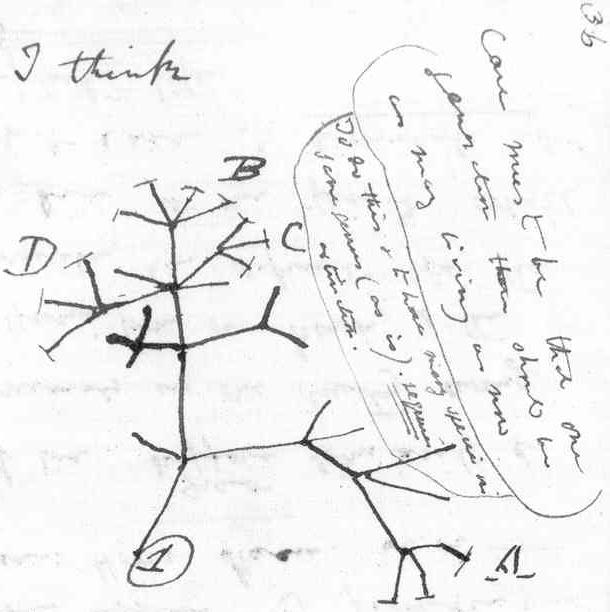
Happy Darwin Day!

Darwins_first_tree

Today is the famed naturalist’s 205th birthday, and Ian Chant is ready to celebrate:

[Darwin Day] is a day to be thankful for innovative thinkers, brave scientists of all stripes, and yes, evolution in general, because frankly, we take our opposable thumbs for granted 364 days of the year, and respect should be paid. If you’re looking for something to do in your neck of the woods to celebrate among like-minded lovers of evolution, the International Darwin Day Foundation has a guide to events at colleges, libraries and museums around the world that will be celebrating the life and work of Charles Darwin in the coming days.

Science-lovers around the world are hosting lectures, discussions, and exotic entertainments such as “phylum feasts” (dinners with a variety of species represented on the menu) in honor of the man. But perhaps the best way to pay tribute is with sober skepticism, like this professor of evolutionary ecology:

I’d be disappointed if this celebration of all things Darwinian began and ended with the great naturalist, because I think a focus on the person tends to undersell the science … The beauty of an idea like natural selection is that it is true, whether or not you choose to believe it. It is true, even if nobody has yet had the idea or written it down. If Darwin hadn’t done so, Alfred Russell Wallace’s version might have swayed the Victorians. Or perhaps a version discovered some 50 years later.

Humanity owes a great debt to Darwin, and the history of science followed the course that it did because of him. But he isn’t the reason for the season; science does not need deities and messiahs. Darwin was merely the guy who figured it all out first.

And what I admire about Darwin is not just his evident human-ness, nor his openness to new ideas, nor his magnificent beard, but his equally skeptical view of religion, which some of his contemporary followers would do well to note:

It seems to me absurd to doubt that a man may be an ardent Theist & an evolutionist.— You are right about Kingsley. Asa Gray, the eminent botanist, is another case in point— What my own views may be is a question of no consequence to any one except myself.— But as you ask, I may state that my judgment often fluctuates. Moreover whether a man deserves to be called a theist depends on the definition of the term: which is much too large a subject for a note. In my most extreme fluctuations I have never been an atheist in the sense of denying the existence of a God.— I think that generally (& more and more so as I grow older) but not always, that an agnostic would be the most correct description of my state of mind.

(Illustration: part of a page from Darwin’s notebooks around July 1837 showing his first sketch of an evolutionary tree.)

America’s Favorite Food

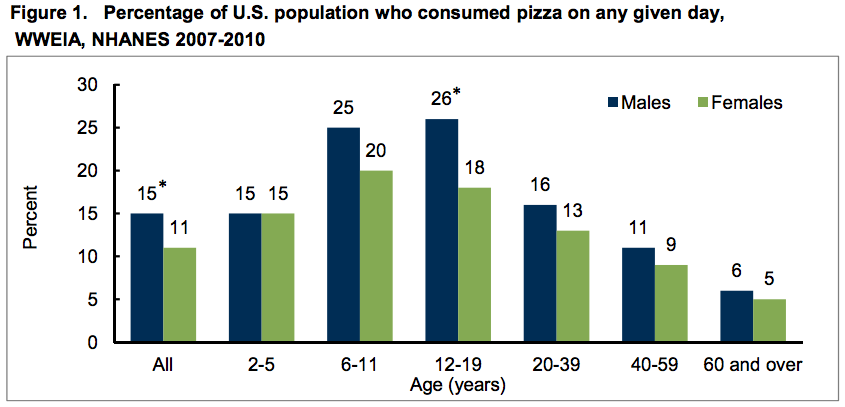
Pizza Consumption

Pizza:

On any given day, about 13 percent of Americans eat pizza, according to a new report from the Department of Agriculture. One in six guys between the ages of two and 39 ate it for breakfast, lunch, or dinner today. In part due to this obsession, per capita consumption of cheese is up 41 percent since 1995.

Plumer looks at how the government subsidizes this habit:

The USDA runs a “dairy checkoff program,” which levies a small fee on milk (15 cents for every hundredweight of milk sold or used in dairy products) and raised some $202 million in 2011. The agency then uses that money to promote products like milk and cheese. And, as it turns out, pizza.

The USDA claims its checkoff program has been well worth it: For every $1 that the agency spends on increasing cheese demand, it estimates that farmers get $4.43 in additional revenue. But the results have been mixed. Milk consumption has declined in recent decades, while cheese consumption has soared

What’s The Best Way To Get Clean?

Maia Szalavitz profiles Dr. Lance Dodes, who considers the primacy of 12-step programs like Alcoholics Anonymous an impediment to more scientifically supported methods of addiction recovery:

Dodes shows that much of the research that undergirds AA is a conflicted mess that confuses correlation with causation. It’s true that people with alcoholism who choose to attend AA regularly drink less than those who do not—but it’s not proven that making people attend works better than other options, including doing nothing.

In fact, some studies find that people mandated into AA do worse than those who are simply left alone. … Contrary to popular belief, most people recover from their addictions without any treatment—professional or self-help—regardless of whether the drug involved is alcohol, crack, methamphetamine, heroin, or cigarettes. One of the largest studies of recovery ever conducted found that, of those who had qualified for a diagnosis of alcoholism in the past year, only 25 percent still met the criteria for the disorder a year later. Despite this 75 percent recovery rate, only a quarter had gotten any type of help, including AA, and as many were now drinking in a low-risk manner as were abstinent.

Last week, Dish readers offered impassioned defenses of the AA/NA approach. Another reader, who got sober without a 12-step program, pushes back:

Your reader’s contention that AA “works 100 percent of the time for people who are 100-percent committed to the program, while they maintain that level of commitment” is utter and total horseshit. AA’s effectiveness in promoting sobriety is hotly debated, but it’s far, far less than 100 percent, and blaming addicts for the failures of AA and related programs is delusional and cruel. Maybe all those dead friends and acquaintances should tip the reader that AA may not be a wonderfully successful treatment, as is often claimed.

I don’t believe that a full-blown addiction currently be “cured” in most instances, but it is certainly treatable. And that treatment needs to be personalized. Access to qualified medical professionals in developing a treatment plan is a necessity for most addicts. If AA meeting attendance provides some value or is appealing to the patient, then fine, but using a church basement full of old drunks as the first line of treatment in 2014 is just an appallingly bad idea. There is wisdom to be gained in the AA rooms but addicts have too many interrelated issues for a group of strangers to fully address.

I have just over ten months of complete sobriety, and my life is seriously better because I’m clean. It didn’t happen because I “bottomed out” or had some spiritual awakening. It happened because three years ago I owned the fuck up to my disease and started to address it as such. I didn’t get a good draw in this round of the genetic lottery but there are people who drew far worse maladies than “ethanol turns me into an asshole.”

Another:

From my experience, you would have a hard time convincing me AA helps anyone. My housemate was mandated to go to AA after getting a DUI. He says he was told at AA meetings that smoking and eating sugary foods would help him control his alcohol cravings. He now starts every day with two cigarettes, coffee and a pop tart. He smokes a pack of cigarettes a day (I saw all the empty cartons when I took out the recycling last week), and eats candy, ice cream and other sweets for breakfast, lunch and dinner, and snacks in between. He would often come back from meetings with package of cinnamon rolls or some other sugary sweet that a fellow AA attendee encouraged him to try. Our panty is now full of pop tarts, candy, cookies and other sweets, and our freezer has five cartons of ice cream in it. He has easily put on 30 pounds in the last year. I fail to see how hanging out and learning of people with bad lifestyles and bad personal habits is going to help anyone. Surely there must be a better way.

Update from an earlier emailer:

Well, since you’ve published my letter and one of your other readers has decided to attack me for it, I feel it’s only fair to respond. Clearly, this individual isn’t reading what I wrote: “AA works 100 percent of the time for people who are 100 percent committed to the program, while they maintain that level of commitment.” Someone who relapses is, by definition, committed to getting drunk over getting sober. It’s not delusional and cruel to point that out; it’s an empirical fact. If I go out and drink right now, it’s because I chose to abandon the program that lifts the desire to drink from me – but only lifts it conditionally, as I work the program and as I focus myself on spiritual recovery, and stops working when I stop doing those things. I’d retort that what’s delusional and cruel is to tell someone whom that program is keeping alive that they don’t need it anymore, especially if their use of the program isn’t adversely affecting you in the slightest.

I’m an alcoholic. I’m not supposed to be sober. I’m supposed to be drunk. Science and my own proclivities indicate I should be drunk right now. But when I go into a church basement and talk with a bunch of other drunks, a miracle happens – a miracle that science has never explained in any study I’ve read. The desire to drink is lifted from me.

Sociological studies of AA’s effectiveness have nothing to do with the fact that it works 100 percent of the time for people who work it 100 percent of the time. I don’t understand why your reader has so much difficulty understanding that, although given the eyeball-popping, vituperous rage of his or her response, I suspect an underlying bitterness toward recovery programs. No one is forcing AA on anyone (except for courts). If your reader found an easier, softer way, good for them. Me, I’d be dead doing it their way. So why do they begrudge me my success?

Recent Dish on AA and its alternatives here and here.

Why Does Marijuana Give You The Munchies?

Victoria Turk highlights the latest research:

new study published in Nature Neuroscience offers an answer: THC, marijuana’s active ingredient, acts on certain receptors in the brain related to your sense of smell. It essentially makes you smell food more, which increases your appetite, and leads you to eat more. That’s what seems to happen in fasted mice, at least.

Joseph Stromberg’s takeaway:

THC—and, by consequence, marijuana—does much of its work by manipulating the same pathways that the brain uses to normally regulate the senses. But perhaps most interesting is that the new study hints at a compelling metaphor for the way THC manipulates this natural system:

it mimics sensations felt when we’re deprived of food. As a final test, the researchers forced some mice to fast for 24 hours, and found that this drove up levels of natural cannabinoids in the olfactory lobe. Not surprisingly, these starved mice showed greater scent sensitivity and ate much more too.

Most intriguing, the genetically engineered mice with olfactory lobes that lacked cannabinoid receptors did not show increased scent sensitivity or appetite even when they were starved. This indicates that both THC and the natural cannabinoids that result from starvation are acting on the same neural pathway to allow us to smell and taste with greater sensitivity, and thus eat more. In other words, THC appears to give us the munchies by convincing our brains that we’re starving.

This discovery could have applications in medicine:

If the findings hold true in humans, they could yield novel approaches to treating eating disorders, by manipulating the link between smell and appetite in our brains. New obesity treatments could be possible, by interfering with cannabinoid signaling to reduce people’s hunger drive. (The drug company Sanofi-Aventis introduced just such a cannabinoid-blocking drug for obese patients in 2006, according to New Scientist, but it was withdrawn because it sometimes produced severe anxiety and depression.) Conversely, a drug could enhance cannabinoid signaling for people who suffer from appetite loss, such as cancer patients.

Digital Stakeouts Are Dirt Cheap

In the United States v. Jones “five Supreme Court justices held that a man’s reasonable expectation of privacy was breached after police tracked his movements on public roads for 28 days using a GPS device.” The case has spurred research on surveillance more broadly:

Using the Jones ruling as a baseline, [Kevin] Bankston and [Ashkan] Soltani calculated and compared the costs of different location tracking methods used by police. Traditional surveillance methods like covert foot and car pursuits cost $250 and $275, respectively, per hour per target, according to their estimates. Another common method, which the Supreme Court has approved, involves two agents tracking a suspect’s movements from their police vehicle through a radio-based transmitter affixed to a target’s car or slipped in his bag at a cost of $105 to $113 per hour.

Newer surveillance technologies were significantly cheaper, they found.

The total price tag of tracking a suspect using a GPS device, similar to the one in Jones, for instance, came out to $10 an hour over one day, $1.43 per hour over a week and $0.36 per hour over a month. Another relatively new technique, obtaining a suspect’s location through his or her cellphone signal with the carrier’s assistance, yielded similar results. As of August 2009, fees for obtaining cellphone location data from carriers ranged from $0.04 to $4.17 per hour for one month of surveillance. After tabulating their results, Bankston and Soltani concluded that the total cost of using a GPS device to track a suspect over 28 days (the method rejected in Jones) was roughly 300 times less expensive than the same tracking using a transmitter (technology approved by the Supreme Court) and 775 times less expensive than using the five-car pursuit method (also approved). Meanwhile, the cost of using transmitter-surveillance technology was only 2.5 times less expensive than undercover car pursuit.