Wired To Be Immoral?

Jason Brennan ponders the limits of morality:

My worry here is that ought implies can, and it may well be that people can’t bring themselves to do certain things. Agency isn’t all or nothing. Just as some people might compulsively engage in certain behaviors that they cannot control, so many of us might have an equivalent inability to do certain things that morality might otherwise require. It’s not just that we are unwilling to these things, but that we are unable to be willing to do these things.

Of course, people are different. [Philosopher] Peter Singer is willing to give more to charity (not as much as he says he should, though) than most people, including me. But that doesn’t show that everyone could give as much as Singer. Everyone’s psychology is a bit different. Perhaps Singer is a few standard deviations to the right of the curve when it comes to psychological ability to give to others. Perhaps some other people quite literally cannot will to give. For them to give 50% of their income to charity is physically impossible, because their brains just don’t work that way. You might as well ask them to jump to the moon.

Roth’s Rejection Of Religion

In an interview, Phillip Roth explains why he refuses to label himself an “American-Jewish writer”:

[Q]: Many consider you the preeminent Jewish American writer. You told one interviewer, however, “The epithet ‘American Jewish writer’ has no meaning for me. If I’m not an American, I’m nothing.” You seem to be so much both. Can you say a little more about your rejection of that description?

[A]: ”An American-Jewish writer” is an inaccurate if not also a sentimental description, and entirely misses the point. The novelist’s obsession, moment by moment, is with language: finding the right next word. For me, as for Cheever, DeLillo, Erdrich, Oates, Stone, Styron and Updike, the right next word is an American-English word. I flow or I don’t flow in American English. I get it right or I get it wrong in American English. Even if I wrote in Hebrew or Yiddish I would not be a Jewish writer. I would be a Hebrew writer or a Yiddish writer. … If I don’t measure up as an American writer, at least leave me to my delusion.

“Our Unlived Lives”

Ethan Richardson reviews Adam Phillips’ Missing Out: In Praise of the Unlived Life:

Missing Out is about classic, fork-in-the-road questions of identity. When Robert Frost took “the road less traveled” and Jesus called us through the “narrow gate,” Phillips looks back at the roads untraveled, at what we missed, and describes human identity as a constant looking back upon the lives we have chosen not to live–or the lives that we have failed to live–or the lives that, much to our frustration, have always eluded us. For Phillips, we are as much a measure of the selves we aren’t as the self we happen to be facing in the mirror today. What about the one we used to love, or the one we picture ourselves loving someday? What about the job we longed for and never got? Or the job we got, but it could be in ten years? As he says, “We share our lives with the people we have failed to be.”

A long quote from the book’s introduction:

There is always what will turn out to be the life we led, and the life that accompanied it, the parallel life (or lives) that never actually happened, that we lived in our minds, the wished-for life (or lives):

the risks untaken and the opportunities avoided or unprovided. We refer to them as our unlived lives because somewhere we believe that they were open to us; but for some reason–and we might spend a great deal of our lived lives trying to find and give the reason–they were not possible. And what was not possible all too easily becomes the story of our lives. Indeed, our lived lives might become a protracted mourning for, or an endless tantrum about, the lives we were unable to live. But the exemptions we suffer, whether forced or chosen, make us who we are. As we know more now than ever before about the kinds of lives it is possible to live–and affluence has allowed more people than ever before to think of their lives in terms of choices and options–we are always haunted by the myth of our potential, of what we might have it in ourselves to be or do. So when we are not thinking, like the characters in Randall Jarrell’s poem, that “The ways we miss our lives is life,” we are grieving or regretting or resenting our failure to be ourselves as we imagine we could be.

Mental Health Break

A hypnotic transforming sculpture:

The thought behind the work:

Walking City is a slowly evolving video sculpture. The language of materials and patterns seen in radical architecture transform as the nomadic city walks endlessly, adapting to the environments she encounters.

Suzanne LaBarre provides more background:

The title is a nod to The Walking City, a futurist concept first introduced by British architect Ron Herron in the 1960s. Herron anticipated the increasingly mobile nature of contemporary life and proposed an infrastructure of mobile, robotic structures that would move freely and create a society of nomadic cities.

The Intricacies Of Addiction

Surveying reactions to Phillip Seymour Hoffman’s death by heroin, Vaughan Bell notices that “many people find it hard to think of addiction as being anything except either a choice or a loss of free will.” The truth of drug addiction, he says, is not so black-and-white:

You are not forced to inject heroin by your brain or by the drug. You do not become an H-zombie or a mindless smack-taking robot. You remain in control of your actions. But that does not mean that it’s a simple ‘choice’ to do something different, as if it was like choosing one brand of soft drink over another, or like deciding between going to the cinema or staying at home. Addiction has a massive effect on people’s choices but not so much by altering the control of actions but by changing the value and consequences of those actions.

If that’s not clear, try thinking of it like this. You probably have full mechanical control over your speech: you can talk when you want and you can stay silent when you want. Most people would say you have free will to speak or to not speak. But try not speaking for a month and see what the consequences are. Strained relationship? Lost job maybe? Friends who ditch you? You are free to choose your actions but you are not free to choose your outcomes. For heroin addicts, the situation is similar.

Jacob Bacharach, whose brother died of an opiate overdose, is repulsed by pundits blurring the line between Hoffman’s art and his addiction:

I don’t suggest that we turn away from the circumstances of death—the opposite of pornography is a prudish sterility that’s equally awful. But if George Clooney died of prostate cancer, would we take the occasion to make it a reflection on the type of roles he chose?

It is one thing to learn to gaze without flinching at the cause of a man’s death, another entirely to treat his illness as a mere foible of his eccentric genius. Hoffman had a family. They knew, or they did not know, the extent and late stage of his disease, but what consolation is it to them, or to anyone who knew him, for a stranger to offer his sickness as a slick metaphor for his professional artistry, a cheap window-dressing on his soul? An actor’s art is doubtlessly informed by his person and his inner being, and Hoffman doubtlessly drew on his own sense and memory of darkness in performing it, but he was a great actor not because of his addiction, but in spite of it, and he did not die because he was a genius, but because he was a man—all of us have our end, but none of us deserves it.

Previous Dish on Hoffman’s death and heroin here, here, and here.

Christianity In China

Alex Jürgen Thumm clarifies its role:

Misconceptions abound about China, and that’s no less the case when it comes to the dish_chinachristianity country’s Christian population. Many assume a Communist country that is officially atheist would allow no religion. (Mao Zedong once said “religion is poison.”) But religious freedom is guaranteed in the 1978 constitution — or at least what the government considers “normal religious activity,” occurring in government-sanctioned places of worship serving one of the five official faiths: Buddhism, Taoism, Islam, Protestantism and Catholicism. Religion is on the rise in China, with one-third of people claiming an affiliation. To all my Chinese friends’ surprise, there are as many as 130 million Christians in China; the only countries with more are the United States and Brazil. Churchgoers in China outnumber those in all of Europe.

In an interview, religion scholar Richard Madsen discusses the country’s growing Catholic population:

The Catholic Church has not spread as quickly in China as evangelical Christianity. There are about twelve to fourteen million Catholics, which in absolute terms isn’t insignificant, although it’s just 1 percent of the population. That pretty much tracks the population increase since 1949. In 1949 there were three million Catholics and now there are twelve million. The national population has about quadrupled so it’s about right. One of the strengths of the Catholic Church is it’s been tied to community and family, but it’s also a weakness too. It’s harder for outsiders to come into it. And the dependency on clergy also inhibits it. So for things like that it’s growing more slowly. And naturally you have the split of the official Catholic Church in China from the Vatican, which has created a schism between the official Church and the underground church [which is more loyal to Rome].

Does all this mean that Christianity has failed in China?

It hasn’t failed. What does success mean for a religion? Taking over the country? Or is it just becoming an accepted part of the plurality of understandings, and permanent in a sustainable way? You can definitely argue that it’s like that for Christianity in China today. We’re seeing new ways for people to find meaning in their lives. It’s definitely changing and broadening. Christianity is part of it.

(Image of priests in a procession on Palm Sunday, in a 7th- or 8th-century wall painting from a Nestorian church in China, Tang Dynasty, via Wikimedia Commons)

Memoirs Of An Amnesiac

In her book I Forgot to Remember, Su Meck describes life after a severe head injury that left her with no memories of her life before the age of 22.  Laura Miller praises the book, calling it “unnervingly honest, straightforward to a degree that makes every other memoir I’ve read seem evasive, self-conscious and preening”:

It is utterly free of signs that Meck wants her reader to think of the book in a particular way or to view her as a certain type of person. It’s a story told without a moral or the urging to take away any pat life lesson (beyond the realization that a loved one who’s been hit on the head might be more affected by it than he or she seems). Indeed, it makes sense that someone like Meck, whose grip on her own identity is hard-won, would care so implacably about telling the truth, even when that truth makes it difficult to leave a good impression.

This extraordinary quality becomes all the more marked as “I Forgot to Remember” unfolds and Su learns that neither [her husband] Jim nor her own past is what she’s been told. Her accounts of the intimate life of her marriage take on an arresting, even brutal forthrightness: “I have always loved Jim, and I have never loved Jim. In a way, Jim was assigned to me. I never really had a say, which sounds incredibly cruel, but that’s essentially the way it is.” And then later, “I can’t say that I love Jim in the conventional sense that most married couples love each other. I have no idea what it feels like to ‘fall in love’ with another person. I seriously doubt I will ever fall in love, and I am totally okay with that.”

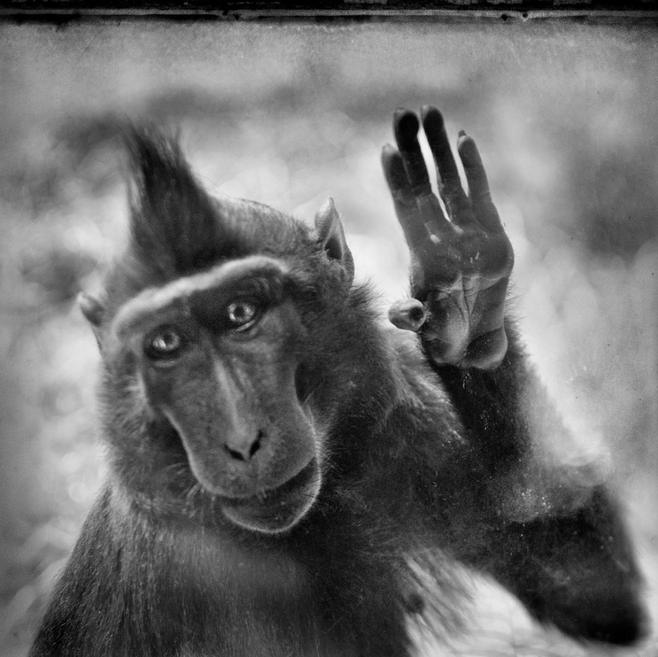
Face Of The Day

Screen shot 2014-01-31 at 11.43.33 AM

For her series “Behind Glass,” Anne Berry photographs primates through the glass separation barrier:

“They’re looking at us like we’re looking at them,” Berry said.

Her title not only means the obvious, that the animals are behind enclosure windows, but also draws a metaphor to how humans separate themselves from nature. People like to observe the natural world but want to segregate wild animals in contained preservations or zoos.

“I want people to say, what are we doing to the habitats?” Berry said.

More images from the series here.

(Photograph by Anne Berry)

Quote For The Day

“For quite a few people, there is something upsetting about the 100%-with-no-exceptions forgiveness that Jesus talked about. It is a feature that upsets conservatives. But it also upsets liberals. There is something in it to offend everybody. Except the person who needs it at the time.

What proves hard to swallow is the absolute character of it. Christ’s forgiveness includes the worst offenders you can think of, but it also includes the pussycats of life – there aren’t many pussycats, but there are a few – who have done nothing wrong or worthy of blame. It is a blanket forgiveness that puts a straight red line through the past. I write ‘red line’ because the Old Story says that Christ’s blood was shed in place of my blood. Dylan captured this on his 2012 album ‘Tempest’: ‘I pay in blood/But not my own.’ It seems obvious that this is unfair. It seems to put ‘The Good, the Bad and the Ugly’ (1966) all under the same protection. There is no distinction.

A familiar rationalization for Christ’s universal forgiveness goes like this: ‘Well, yes, it is for everybody, but you have to ask for it. The offender can’t receive it until he or she asks for it. Each person, good, bad, or a little bit of both, has to do his part. It won’t do you any good if you don’t first come forward and take it.’ That is a rationalization in service of explaining away the ‘full-service’, 24/7 gas station that Christ’s message actually is for all the cars on the road.

Can anyone really rationalize what Christ was saying when he said that people should be forgiven 490 times per action per person?” – Paul F.M. Zahl, in PZ’s Panopticon: An Off-the-Wall Guide To World Religion.