
St. Barts, 9.19 am
St. Barts, 9.19 am
Vaughan Bell highlights a study finding that “taking revenge is rare, but when it happens, it is not only remarkably unsatisfying but counter-productive in terms of dispelling the desire for retribution”:
Empirical research by Crombag, Rassin, and Horselenberg (2003) showed that most people do not actually take revenge but merely have thoughts, feelings, and fantasies about it (see also Crombag, 2003). … [T]he group of people who took revenge even after a period of time still struggled with more vengeful feelings than the people who did not take revenge. Although 58% experienced satisfaction and 16% experienced triumph, only 19% reported their vengeful feelings to be completely gone, compared with 40% of the people who did not take revenge.
This year, women’s ski jumping debuts as an official Olympic sport. Tony Manfred notes that the “gender disparity that exists in some other sports doesn’t in exist ski jumping”:
Let’s use this season’s World Cup event in Lillehammer as an example. The men and women both jumped on the same hill on the same day in the same conditions. The men, on average, were slightly better than women in both the distance metric and the style metric. But the difference is so small as to make the two groups fairly comparable. In addition, several female jumpers outscored the majority of male jumpers. On average, the top-20 male finishers were only a little bit better than the top-20 female finishers. The men jumped 0.85 meters further, earned 2.35 more style points from the judges, and scored 6.18 more points than their female counterparts overall.
Ian Crouch suggests that such competitive male and female scoring could lead to more mixed-gender events at future Olympics:
Why shouldn’t there be mixed curling or bobsled teams? The Summer Games already have men and women competing against each other in the equestrian events; why not reintegrate some sailing events (which fielded mixed-gender teams until 1988, when women’s categories were added) or else add team golf, archery, or shooting? Such events would not only be fresh and entertaining spectacles but an expression of the “principle of equality of men and women” as demanded in the Olympic Charter.
Amanda Schaffer provides details on the rise of whooping cough in the US:
Early on, the whooping-cough vaccine was considered an unambiguous success story. Over time, though, scientists—as well as crusading vaccine skeptics—raised concerns about the shots’ side effects, which could include high fever and, occasionally, seizures. In the late nineteen-nineties, the U.S. switched to a new formulation, made not from dead, whole cells of bacteria (as the original had been) but from selected components of the bug that would trigger an immune response more safely. Unfortunately, though, the effectiveness of the updated vaccine waned far faster than the old version had, and faster than researchers had expected. This is probably the main reason that whooping cough has surged recently in older children: those who received the newer vaccine as babies became vulnerable again as the doses that they received between ages four and six, and the boosters that they received between eleven and twelve, wore off. (Parents who refuse to vaccinate their children undoubtedly make the problem worse.)
Higher levels of circulating disease, including among people who had received the shots, meant that the bacteria may have had, in essence, a chance to sniff around.

David Rosenberg sums up a series by Rubén Plasencia Canino:
While the power of the gaze is often admired in portraiture, there is still a mystery, or perhaps a fear, of trying to capture the gaze of the blind. In January 2013, photographer Rubén Plasencia Canino had an idea of photographing blind people, focusing specifically on their gaze, for a project he titled “Obscure.” To begin the project, he connected with ONCE, Spain’s national organization for the blind that helps create social benefits for blind and visually impaired people around the world. ONCE agreed to help out, and for two months Plasencia worked on a project he said was challenging but also one that “opened my eyes, and my heart, to a whole new world of sensations.” Plasencia said the project that forces the viewer to look directly into the eyes of the blind is similar to having an open book in front of you. “It’s an open window that looks out onto an unknown world,” he said via email. “If you look just a bit deeper, you can discover countless stories.”
A reader with 20 years of development experience urges us to expand the terms of the debate:
The fact is, Bill Gates and William Easterly are both right – to a point. In health, aid has made enormous difference on many fronts, not least of all HIV. The rapid resurgence of drug-resistant TB is incredibly scary, and aid’s role is essential. That said, you can find lots of waste and programs that don’t improve things, at least for very long.
Still, the debate really misses the point. This is a rich time in the development world, where people are asking very hard questions about what works and doesn’t work, rather than merely defending aid money. There are, of course, the randomnistas using randomized controlled trials to test whether development projects have caused quantifiable change. And thinkers like Owen Barder are among many promoting complex, adaptive approaches to projects (based on the evolutionary idea that each community/organism succeeds by trial and error and making adaptations suitable for its circumstances) in reaction to linear, command-and-control,”best practices” (logframe) approaches of aid donors. Others are looking at whether just giving cash to poor people is effective, and under what circumstances. I‘m just scratching the surface, but the “Is aid good or bad?” debate is stale.
For the short documentary Pockets, director James Lees asked Londoners to reveal their cargo to the camera. Natalie Rose Obank praises the film’s style:
The sound edit … plays quite a nice part to the film. The music itself is quite light-hearted but noticeable. It creates an atmosphere for the audiences, just as to the setting of the work – where these people are, just out on a street. The background atmos track is plain and simple, this doesn’t distract the view from the main purpose of the film, which is what each person in the shot presents. In the edit, I noticed that throughout, the interviews don’t always show a full face, but focus on a particular feature of that person (if it’s important) sometimes it would jump cut from a standard documentary set up and then only show the side of a face. … [I]t almost gives the audience a surprise as the styles of shots change. It keeps the film interesting throughout and also promotes people’s individuality.
(Hat tip: Aeon Film)
Robert Farley sees one major lesson:
As the centenary of World War I approaches, several commentators have argued that the emerging multipolar power structure of East Asia is coming to resemble that of Europe prior to 1914. Setting aside the wisdom of the political comparison for a moment, there is one way in which the comparison is apt. Just as real knowledge of modern, high-intensity warfare was limited in 1914, the emerging great powers of Asia have little experience with the forms of warfare they are planning to use.
Although most of the European powers had experience with colonial wars, they did not have the space or time to work out the implications of the technologies that would eventually characterize World War I (the machine gun, the dreadnought, the submarine, and the airplane). The degree to which military commanders of 1914 were surprised by these technologies has been wildly overstated, but the armies and navies had not developed the tactic, hands-get-dirty experience of how to fight in a new technological environment.
It bears repeating that we have very little sense of what contemporary air and naval warfare between peer or near peer competitors will look like. This is true not only of land warfare (the US invasion of Iraq in 2003 is probably the best model we have, but isn’t very helpful) but also of naval and air warfare. And in particular, the emerging East Asian powers lack recent combat experience. China last fought a land war in 1980, a naval conflict in 1974. The Japanese military has not engaged in combat since 1945. The Indian military is in better shape because of its anti-guerrilla efforts and constant sparing with Pakistan, but still has little recent experience with major combat.
Phoebe Day Danziger reflects on terminating a pregnancy because her unborn son had severe medical problems. She writes, “it was clear to me that what we were dealing with was choosing an end-of-life care plan for our son”:
Sometimes I wish I had chosen to continue the pregnancy for purely selfish reasons. Had we not aborted, our son’s birth would have been noted, his death would have been marked, and our deep
and long-lasting grief would have been acknowledged and validated. Instead, we chose to give our baby what we felt was the most humane, comfortable, and loving end-of-life experience we felt we could facilitate, a cause that on its face is championed even in the most introductory ethics discussions among new medical students.
Because of the choice we made to end his life, our son never got the chance to gaze up at his parents, to see who it was that had been talking and singing to him all along. He never got the chance to fall asleep in our arms, bundled and cozy, pink lips and fuzzy hair like a duckling, smelling of milk and baby, the very best smell in the world. Neither, however, did he have to suffocate to death at birth, his small body gasping to fill his woefully hypoplastic lungs. He did not have to feel pain shooting throughout his abdomen, grossly distended with urinary ascites. He did not have to experience one minute away from the warmth and love of my body. We chose, instead, for him to be born straight into peace.
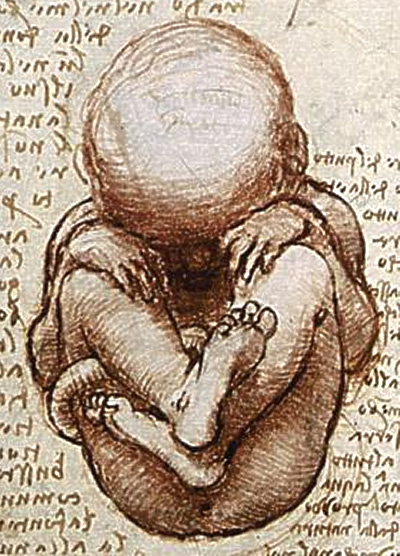
The Dish’s thread on late-term abortions is here. Drawing by Leonardo da Vinci from Wikipedia Commons.

Why Circassians are none too happy about the Olympics this year:
The Circassians are an umbrella designation for many ethnic groups from the eastern coast of the Black Sea. In the first half of the nineteenth century, they waged a war against Russia’s expansion into the North Caucasus, which they lost. The Russian Empire annexed their territories, and then either ‘encouraged’ them to emigrate or simply expelled them outright. Nearly 90% of Circassians went into exile. Tsar Alexander II, known as the Liberator (of Russian peasants), proclaimed victory over the Circassian ‘rebels’ in 1864.
The date of 1864 makes 2014 the 150th anniversary of the Circassian expulsion. From the Sochi coast, ships loaded with Circassian refugees set sail for the Ottoman Empire. Circassians died in thousands on the journey, of hunger and disease. The triumphant parade of Russian troops, marking the end of the war, took place on May 21, 1864 in Krasnaya Polyana, site of the Sochi Winter Olympics.
Keating looks at the actions of the Circassian diaspora:
Today there are about 3 million to 5 million Circassians living abroad and about 700,000 in the Caucasus. The post-Soviet Russian government has been slow to recognize the extent of what happened to the group and has strongly resisted attempts to label it as genocide—the anti-Russian government of nearby Georgia did so in 2011— portraying Circassian nationalism as merely an outgrowth of the region’s Islamic radicalism. The global community commemorates Circassian Genocide Memorial Day every May 21.
However, the decision to hold the games in the symbolically important city of Sochi has focused new attention on the issue, with Circassian activists in New Jersey launching an international campaign against the “genocide Olympics.” The group has been protesting since Vancouver, and one of its pamphlets informs athletes that they’ll be “skiing on mass graves.” It’s possible that local activists may attempt to stage some sort of opposition at the games themselves, though the authorities have been coming down hard on protests of all kinds.
But the international protests haven’t gotten much attention:
[T]he only high-profile ally the Circassians have won is Doku Umarov, leader of the Islamist insurgence that has grown out of Chechnya’s shattered independence bid, and whose allies recently blew themselves up in the city of Volgograd. “They plan to stage the Olympic Games on the bones of the many, many Muslims who died and are buried on our territory along the Black Sea. We, the Mujahedeen, must not allow this to happen,” Umarov was quoted on his website as saying last summer.
The Circassians could do without such support, since they reject violence and activists’ long-term goal is to regain their homeland. It’s an ambitious aim, a kind of Caucasus Zionism, but the activists think it is feasible. “It might not be easy for the immigrants who are going to the Caucasus, that first generation, but their children are going to be fine. It’ll just be like when my parents came to the U.S.,” said Tamara Barsik, a Circassian-American who lives in New Jersey.
In the meantime, they’ll have to watch the Sochi Olympics on television, like everyone else.
(Photo: Circassians commemorate the banishment of the Circassians from Russia in Taksim, Istanbul. From Wikimedia Commons)
 The Dish

