Going On A Trip And Never Coming Back, Ctd

Reacting to some criticism of 12-step programs, a reader writes movingly in support of AA and NA:

For both of my brothers and myself, 12-step recovery programs have literally been the difference between life and death. My younger brother had recently switched from heroin to crack cocaine by the time he entered the Fellowships of NA and AA; my entire family was quite sure that if a drug overdose didn’t kill him, some of the people to whom he owed money would see to it themselves. Eight years later, he has a wife, a lovely daughter, and a college degree, all thanks to working a 12-step program.

As for me, my drug of choice was alcohol.

I had chronic liver pains by age 26, and my hands shook so badly my mother thought I had Parkinson’s Disease. I needed at least 12 beers a day to feel normal, and a minimum of 24 to make myself forget that I just wanted to crawl into a hole and die. And even then I wasn’t miserable enough, and needed two more years of research into self-inflicted anguish before I’d reached as low of a bottom as I cared to discover. Seven years later, I am clean, sober, healthy, very successful in my chosen profession, and working a decent program.

Can I throw all of that away? Could I or my brothers or anyone else in a 12-step program pick up tomorrow? Absolutely. Drugs and alcohol are everywhere in this country, and plenty of people are eager to sell me my suicide on the installment plan. But relapse is a conscious choice by the individual, not a failing of the program. AA (my program) works 100 percent of the time for people who are 100-percent committed to the program, while they maintain that level of commitment. (The only exception being those who are “constitutionally incapable of being honest with themselves.” I interpret this to mean those with severe underlying mental ailments such as antisocial personality disorder. You certainly encounter them in the rooms of AA meetings, but you also find them everywhere else in society.)

6833492899_df050ec4b7_n 2The problem is that the disease never goes away; it is only in remission. It constantly informs an addict or alcoholic that he’s not really addicted, that his success in life proves it was only youthful excess or poor surroundings or bad luck or anyone’s fault other than his, that science can and will “cure” him like it has “cured” so many others. The disease speaks from the depths of the person’s own sickness, so the script may vary, but the objective never changes – to get the recovering addict alone and despairing, outside of their program, cutting themselves off from their friends in recovery and in a position where they’d rather resume the full course of their misery than stay in the half-measure misery of white-knuckle, program-less sobriety.

(I will never know why Philip Seymour Hoffman relapsed, but I’ve met people with even more time in recovery than he had who have relapsed and died – or, who almost relapsed, but said a prayer instead and returned to the rooms to talk about it. Was the program a failure if one of my friends chose to stick with it, and one decided to abandon it?)

If I speak of this in harsh terms, it’s because it hits close to home for me. Recovery programs are not social clubs or straw-man scapegoats for snake-oil salesmen touting miracle drugs and secularized rehab. Recovery programs are a triage ward where the successful do what the other survivors do and the failures stop doing those things; by four years in recovery I lost count of the number of acquaintances who’d gone back out and died out there, and I knew three friends who joined them in the morgue. This is the program that keeps me alive in those dark nights and reminds me there’s a dawn.

Another reader, an Episcopalian deacon who is also a recovering alcoholic, was struck by Sacha Scoblic’s statement, “AA is an incredible program and a true American achievement for the millions of addicts around the world who desperately needed help when absolutely no one else was offering it”:

Think about that – ”absolutely no one else was offering it.” I’m a Christian, and enough of a believer in the institutional church that I’m willing to don robes and a stole Sunday by Sunday and hold a chalice full of “the Blood of Christ, the cup of salvation” to the lips of adults and children who approach the altar for the gifts of grace. And yet I am a member of a church that offered “absolutely no help” to alcoholics in Bill Wilson’s day, and even today relegates me and my alcoholic companions to basement meetings. In fact, the (well-meaning) parish I serve is no better than a landlord to the AA group that meets weekly in the bowels of their building complex. They’re no better than the yacht club across town that lets its space for the morning meeting I attend. They’re a good landlord, but too often it stops there.

The Church doesn’t talk enough about addiction. We Episcopalians sometimes joke about our heritage as drinkers: for us, the light-bulb joke is about booze (it takes three Episcopalians: one to screw in the bulb, one to mix the martinis, and one to complain that the old light bulb is better … har har). We are better than this, and I hasten to add that I would not be sober without the support of a few good Episcopalians who say their prayers and befriend me with courage, love, and insight. I’m not bitter. But I often feel discouraged that churches can and should do more.

Anyone who claims the identity “Christian” – anyone who follows Jesus of Nazareth, who befriended people everyone else had abandoned – should do more. Let’s let my alcoholic friends know that there is life for them on the main floor of the church, too.

Previous Dish on Hoffman and 12-step programs herehere, here, here, and here.

(Photo of an AA “anniversary coin” marking 13 years of sobriety by Flickr user MTSOfan)
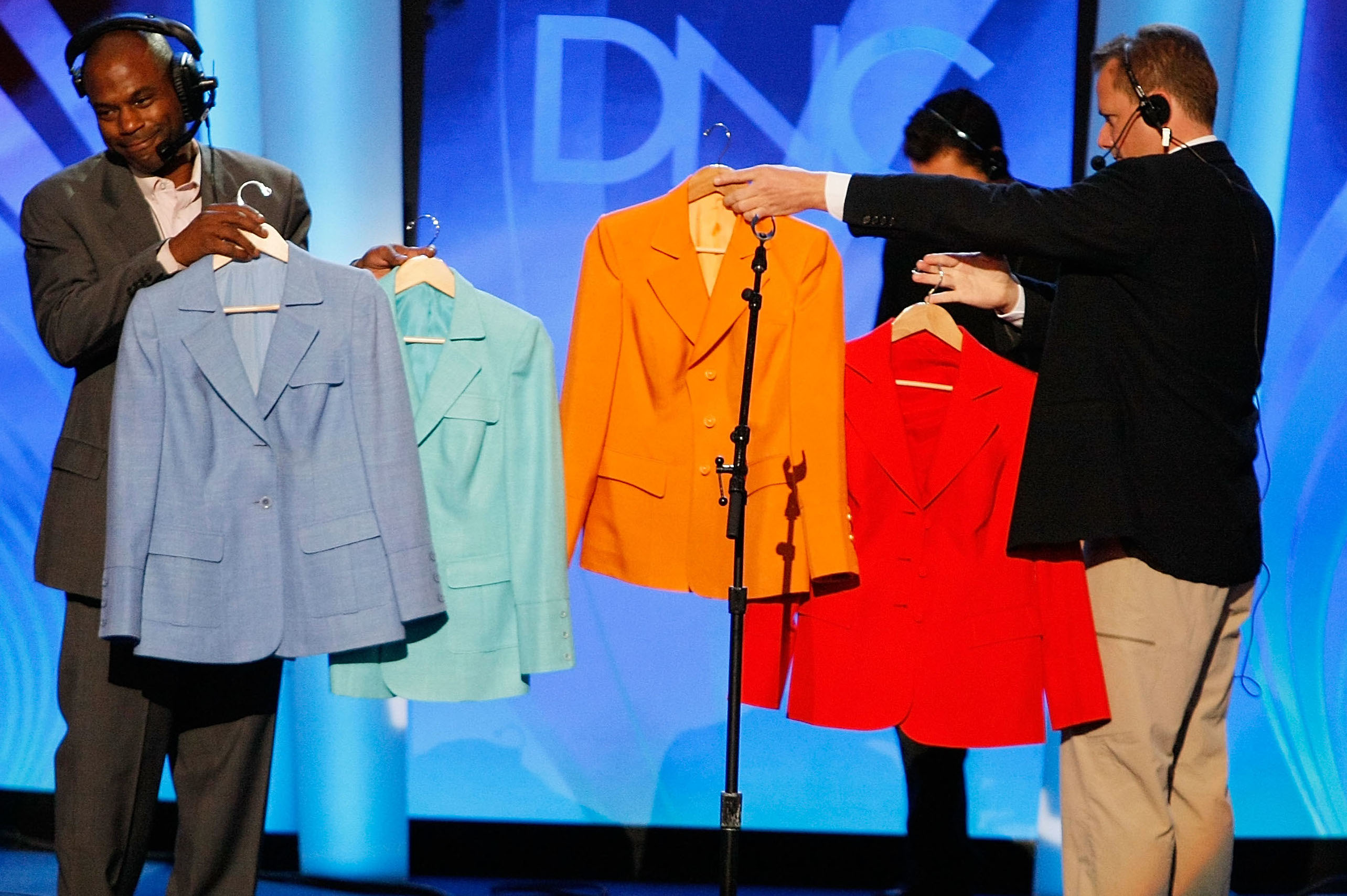
The Pantsuit Doesn’t Need To Be Vetted

2008 Democratic National Convention: Day 2

Alyssa hates the scrutiny Hillary Clinton’s wardrobe choices receive:

The expectations are contradictory and impossible: women like Clinton are simultaneously supposed to not care about their appearance while looking impeccable at all times, not to care a whit about fashion but to have a sense of what clothes make their bodies look simultaneously attractive and appropriate to whatever occasion they’re dressing for.

If they hire stylists to make these decisions for them, freeing up their attention for, say, policy, they’re elitists. If they pick out their clothes themselves, they’re frivolous. If they try to be fashionable, they’re trying too hard, or failing to dress their ages. If they settle on a uniform, they’re dowdy and unimaginative. Sometimes, it seems like the only option that would satisfy everyone’s demands about her wardrobe is for Hillary Rodham Clinton presented herself as a disembodied floating head. But even then, we’d be stuck with a national conversation that’s now in its third decade: Hillary Rodham Clinton’s Hair, What Does It Mean?

(Photo: Wardrobe pieces are checked against stage lighting before the start of day two of the Democratic National Convention (DNC) at the Pepsi Center August 26, 2008 in Denver, Colorado. By Mark Wilson/Getty Images)

Immigration Reform Rises From The Dead? Ctd

A reader raises some fundamental questions about the debate:

I am from India and I did everything by the book to ensure I got my permanent resident card. I waited the requisite five years after getting my PR and today filled out my naturalization application. It is a very happy day for me, one I have looked forward to for a while.

Tell me the immigration system – with its huge backlog of applications and long wait times – is messed up, and I will agree wholeheartedly. But I fail to understand why amnesty for illegal immigrants is assumed to be a force for the good. Why should we reward people for breaking the law? And why is it so unacceptable to ask immigrants to learn English? Doesn’t it make it easier for immigrants to understand the laws and signboards in a new country? Generations of Chinese, Korean, Indian, Italian – and, well, you get the picture – immigrants have learned English before and acclimatized. What’s special about the circumstances of immigrants now that we have to set the bar so low for them?

I am not being facetious or Fox News-y. I apologize if I come across like that. But these are genuine questions that I would really like to see discussed.

The Derp Ceiling

The House Republicans still want their pound of flesh for lifting the debt ceiling, but can’t seem to agree on what that flesh should be:

On Thursday, however, two ideas gained traction, with dozens of Republicans predicting that versions of the pitches could hit the floor next week once House members return to Washington. At the top of the list: a proposal to link a one-year extension of the debt ceiling to a restoration of recently cut military benefits. Another popular option is tying the “doc fix,” which would alter the way doctors are reimbursed for Medicare treatments, to an extension. Changes to the federal budget that would reduce fraud or mandatory spending levels also have been mentioned.

Danny Vinik explains the most popular option:

House leadership is considering undoing the changes that the budget agreement made to the cost-of-living-adjustment (COLA) for military pensions. Of course, doing that costs money – you didn’t think that Republican debt ceiling extortion actually had something to do with the deficit, did you?

So, how are they going to offset the cost? Nothing has been settled on, but Politico’s Jake Sherman and Burgess Everett report that they may use a budget gimmick known as “pension smoothing” to do so. Pension smoothing allows companies to underfund their pensions in the next few years, boosting their profits, and thus increasing government revenues. Thus, the Congressional Budget Office (CBO) shows this as reducing the deficit over the next decade. But beyond that, it increases the deficit, because those firms eventually have to make those pensions contributions, reducing their future profits and therefore government revenue as well.

Kilgore notices that fiscal restraint is no longer the point:

After years of linking the debt limit vote to proposed spending cuts (or mechanisms for forcing spending cuts, from sequestration to a constitutional balanced budget amendment), now suddenly you have Boehner talking about demanding increased spending in exchange for votes to accommodate more public debt. Whatever else this represents, it shows Boehner being more interested in registering a “win” for his conference than in making a coherent argument for reducing both spending and debt.

How Allahpundit sees the GOP’s game:

Reid also took a hardline “no negotiations” approach during the shutdown, you’ll recall, rejecting a bunch of House bills that would have restored funding for discrete parts of the government but not for ObamaCare. Fund everything or we’ll fund nothing, he insisted. The sole exception: He passed a bill right before the shutdown began to keep money flowing to the military so that troops wouldn’t miss a paycheck. Boehner’s counting on the same thing happening now.

Bernstein blames the GOP’s radicals for obstructing responsible policymaking:

Instead of “forcing” Democrats to accept something they oppose, Boehner now is seeking to use something many Democrats want. That’s what a normal party does: use marginal legislative leverage to attempt to win marginal gains. Of course, Democrats could still hold out for a clean debt limit increase, or they could pile on their own matching demands (say, the minimum wage, or restoring recently-passed cuts in food stamps, or any other Democratic priority that’s popular). Normal parties would then negotiate their way to a win-win deal, because policy doesn’t have to be zero-sum.

But that wouldn’t satisfy Republican demands for extortion for the sake of extortion.

Chotiner isn’t too worried:

[E]ven if Obama were to fold, there is something else that has rendered the debt ceiling hostage racket useless. John Boehner, who quite obviously does not want to rely on the good graces of Kevin Costner, has shown that he won’t let the country default. Not only is Obama unwilling to pay the ransom, then, but Boehner is unwilling to harm the economy. It’s sort of like when someone gets kidnapped in a PG-rated movie: you know nothing too bad will be allowed to occur.

The Next Marijuana Freak Out

Hash Oil

It could be over cannabis concentrates:

Dabbing certainly appears on the surface to be dangerous: Kids are freebasing marijuana! It looks like they’re smoking crack! But it’s important to remember that there’s no evidence that it’s possible to overdose on pot. (Compared to say, acetaminophen, overdoses of which killed more than 1,500 Americans during the past decade.) So you can smoke the strongest dab imaginable—or even, if you’re a showboat, smoke 50 dabs in a row—and science says it won’t kill you. It will just get you really, really high.

But just because something won’t poison you the way alcohol can doesn’t mean it can’t lead you to do something stupid enough that will kill you. And there seem to be enough disconcerting variables associated with dabbing culture—a production process laden with volatile chemicals; a highly concentrated, easily transportable final product; and incredibly stoned kids with blowtorches—it seems only a matter of time until somebody in the scene does something very stupid and possibly fatal.

(Photo by Flickr user Symic)

Whither Now, Pussy Riot?

Miriam Elder examines how the changing political landscape in Russia and sudden international renown have changed Pussy Riot and the lives of its two most famous members, Nadezhda Tolokonnikova and Maria Alyokhina:

Nadya and Masha entered prison at the height of a promising era. Moscow had risen up against Vladimir Putin. Protest was alive; change appeared to be around the corner. Pussy Riot took this further than anyone, adopting striking visuals and a form of protest Russia had rarely seen. Wearing bright clothes and masks, they would storm sites — Red Square, churches, fashion
800px-Pussy_Riot_-_Denis_Bochkarev_5
runways — and shout and dance around while someone filmed. Though often referred to as a band, they never actually played instruments during these guerrilla performances. They never had plans to put out an album — that would be against their anti-capitalist ethos, they said. Their arrest signaled the beginning of the end. But they don’t seem to have realized this. In the two years since they were arrested, a small handful of opposition activists have issued reports on corruption, environmental catastrophe, and decline in freedoms, upping their output in the lead-up to the Sochi Olympics. It lands in a void.

“I don’t know where this apathy comes from,” Nadya told me the day before the Barclays Center show, standing in fresh slush outside the the U.S. mission to the United Nations, where they held a closed-door meeting with envoy Samantha Power. Usually, Nadya speaks in slogans, short and clipped statements full of unflagging determination, always on, playing the part of the professional revolutionary. Now she was confused. In prison they fought the system — writing endless complaint letters, going on hunger strikes, trying to publicize the horrific conditions within. “If you’re apathetic in jail, that’s it, that’s the end.” Masha added: “There’s some apathy in society, we have to admit. [Putin] achieved that. Our task is to turn that around.”

There is no such disinterest abroad. Abroad, Masha and Nadya are rock stars. They are surrounded by hangers-on and handlers. At home, they are opposition activists and wacky performance artists. At home, things are more complicated.

(Photo: Pussy Riot – Denis Bochkarev, 2012. Via Wiki.)


Is Obamacare Really Universal Healthcare?

The CBO report (pdf) estimates (p. 107) that, as of 2024, that 25 million non-elderly Americans will get health insurance thanks to Obamacare. But about 31 million, or one in nine, non-elderly residents of the US will remain without insurance in 2024. Of these, 30 percent are undocumented immigrants, 20 percent are eligible for Medicaid but will choose not to enroll, 5 percent will be ineligible for Medicaid because their state has chosen not to expand coverage, and 45 percent will choose not to purchase insurance through their employer or on the individual market.

Lanhee Chen thinks a narrow goal of covering more people is misguided and that health care reform should focus instead on lowering costs:

This is where the Republican alternatives have a distinct advantage. Analysts across the political spectrum recognize that the existing (essentially unlimited) tax preference for employer-sponsored health insurance drives up health-care utilization and costs. It also creates a cost disadvantage for anyone seeking to purchase health insurance independent of an employer. By and large, people aren’t buying health insurance today; they’re buying pre-paid health care with relatively few limits on the services they can obtain.

Reform of the existing tax treatment of health insurance is an important step toward reducing costs and avoiding the rationing and service limits that afflict the health-care systems of many other countries. The Affordable Care Act does little to address the tax treatment of health insurance and other dynamics that push up health-care costs.

Meanwhile, Byron York casts doubt on the number of people Obamacare claims to have insured:

This week, the health consulting firm Avalere found that only 1 to 2 million of the 6.3 million who signed up for Medicaid were new enrollees brought into the program by Obamacare. The rest were people who were eligible and would have signed up for Medicaid irrespective of Obamacare, in addition to people who were already on Medicaid but were renewing their status.

The Game Putin Is Playing

Putin Greets IOC Members In Sochi

Remnick explains Putin’s Olympic motivations:

The theme of these Games is simple: this is Putin’s pop-culture reassertion of Russia, a worldwide media-saturated insistence on its modern power and capacities, all done with a flash and a reach that no diplomatic summit could ever match. Dissident Russian voices such as Alexei Navalny, Masha Gessen, and the members of Pussy Riot all call these “Putin’s Games”; they talk of a pharaoh intent on building, and displaying, his pyramids. In fact, minus the tone of derision, when you talk to Russian officials close to Putin, the explanation for his motives is not so different. The level of risk may be greater than anyone quite imagined in 2007, but Putin wants to show that his country is capable of doing more than sucking oil and gas out of the ground and building a new Dubai in Russia. Putin, obviously, is no democrat. Not remotely. He is not interested in the contemporary requirements of human rights. He is not interested in empowering a real legislature or ceding true independence to the courts. Democracy is not his interest. Stability and development—those are his themes, first and last.

Amy Bass thinks it’s impossible to avoid politics at the Olympics:

Inherently contradictory, the Olympics get to transcend everything until they don’t. It is naive to think that sport is above politics, that any kind of level playing field exists, or that sport allows the world to put its problems on hold. The narrative of peaceful competition is disrupted time and again, because the Olympics are inherently political, in ways that are overt, such as the black power protest by Americans Tommie Smith and John Carlos in Mexico City in 1968, and nuanced, such as Czech gymnast Vera Cáslavská lowering her gaze when the Soviet anthem played during her medal ceremonies at the same Games.

(Photo: International Olympic Committee President Thomas Bach (L) is greeted by Russian President Vladimir Putin at a welcoming event for IOC members ahead of the 2014 Winter Olympics at the Rus Hotel on February 4, 2014 in Sochi, Russia. Putin has arrived in Sochi to participate in the openings of the Winter Olympics. (Photo by Sasha Mordovets/Getty Images)

Is Boehner Backpedaling On Immigration Reform?

Cillizza analyzes Boehner’s statement yesterday that “There’s widespread doubt about whether this administration can be trusted to enforce our laws”:

Making President Obama the issue is never a bad thing for a Republican Speaker who wants to keep his job. If the narrow window to pass immigration reform closes entirely sometime between now and November, Boehner has now created a perfect political scapegoat on which to blame things. Look, President Obama never was willing to build the relationships with my members I told him he needed to, Boehner will now be able to tell both his conference and conservative Republican activists across the country. And, those folks are already more than willing to believe that narrative.

Immigration reform isn’t dead — yet. But Boehner’s assessment of its chances on Thursday are what sharp political minds have known all along: It’s a triple bank shot (or a Triple Lindy). Possible, but far from likely.

Weigel chides the media for making too much of the statement. Allahpundit thinks it makes more sense for the speaker to pursue reform after the elections:

Here’s the question: If he could get more of a Republican buy-in next year, why shouldn’t he wait? Matt Lewis argued the other day that amnesty opponents will always gin up some sort of excuse related to the timing to keep kicking the immigration-reform can down the road, but I simply can’t believe party leaders and their business backers will send the GOP nominee into battle in 2016 without arming him with some sort of amnesty to show Latino voters. It might be a limited one like DREAM, but something’s going to happen. Even Raul Labrador, who said this week that pushing immigration now could cost Boehner his gavel, says immigration is “one of the first things we should do” in 2015 once it controls the Senate again.

Sargent’s view:

[T]here’s just no reason to assume reform will be any easier for Republicans next year than it is right now, and there are multiple scenarios in which it could be harder next year. And if it doesn’t get done in 2015, Republicans will be heading into the next presidential election having failed to embrace reform yet again — after yet another contentious debate marked by who knows what sort of rhetoric — making relations with Latinos still worse, as demographic reality marches on.

Jay Newton-Small thinks immigration reform will stall. Among her reasons:

Most Republicans want to wait to pass immigration reform until next year, after the midterm elections. The problem with that scenario is that the 2016 presidential race will heat up the minute the midterms are over. And while Democrats have every incentive to push for a deal now, they could lose a powerful wedge issue at the polls in 2016 if they pass a deal next year. Sure, Obama probably would like to see something get done to burnish his legacy. But Democrats may argue that they could get a better deal in 2017, especially if they lose the Senate in November.

Larison sees a lose-lose scenario for Republicans:

Republicans stand to gain nothing if they help Obama achieve one of his legislative goals. Meanwhile, their “compromise” position of favoring legalization without citizenship so reeks of cynicism that it won’t be appealing to anyone outside the party. Indeed, favoring legalization without the possibility of citizenship is in some respects the most insulting position one can take, since it provides amnesty for those here illegally while keeping them as a non-citizen underclass that will continue to compete with American labor.