If you thought Republican candidates would not use the untrue “Obamacare costs 2 million jobs” canard, well, where have you been lately?
Month: February 2014
Clinton Fatigue?
Drum is worried about it. I’m already exhausted. Masket is unconcerned:
Is there any evidence that voters “get tired” of politicians? I don’t want to get into the whole literature on what governs presidential elections, but the simple answer is no. Candidates tend to
do better if the economy is growing while their party holds the White House (or if the economy is drowning while the other party holds it). Prolonged wars can hurt their party, as can perceived ideological extremism. But overexposure?
The big case here would be Ronald Reagan, who did his first film in 1937, 43 years before getting elected president. (Okay, maybe he wasn’t “in the public eye” until “Knute Rockne All American” in 1940, but still.) But Drum discounts Reagan’s film career, so maybe we shouldn’t start the clock until Reagan begins doing his conservative speeches for General Electric in the late 1950s. That’s still over two decades before becoming president. His record warning about the dangers of Medicare was recorded in 1961. And keep in mind that in 1984, after being in the public eye for nearly half a century, Reagan won one of the biggest Electoral College landslides in history.

But before he got the nomination, he’d never been the Establishment front-runner with a 50 point lead over his nearest rival. The problem for Clinton is that a) she’s not a very compelling public speaker or shrewd campaigner (she was handed the New York Senate seat on a nepotistic platter and got creamed by an upstart in 2008); b) she has close to no record of substantive achievements at any point, as First Lady, Senator and secretary of state; and more critically c) she is perched on an impossibly high pedestal which all but cries out for someone to knock her off it – either in the primaries or the general.
I think she may be the weakest and the strongest candidate for 2016. I don’t think that’s a great combination for a campaign.
(Photo by Getty)
Abuse We Don’t Want To Believe, Ctd
The Dylan Farrow letter got Ann Friedman thinking about men’s anxiety over false sexual assault accusations:
My friend Adam Serwer once made the astute observation that most white people “can only relate to racial discrimination in the abstract. What white people can relate to is the fear of being unjustly accused of racism.” The lesson translates to cases of sexual assault and harassment. Those of us who have been forced to personally cope with powerful men behaving badly are certain that the accusers in these situations are worth listening to. “These are not stories we tell for fun, attention or revenge,” tweeted Lena Dunham. There are many women like us working in media, but we’re outnumbered — or definitely outranked — by men who are inclined to relate to the experience of being accused.
Natalie Shure explains why young victims of sex crimes have the deck stacked against them:
[T]here is something inherently imbalanced about a child abuse case. The very secrecy that makes the truth “unknowable” is an instrument of the crime.
With no witnesses or credible legal evidence, the “he said/she said” conundrum prevails. The assailant knows this, and he can use it to his advantage. As soon as children make allegations, they enter a world filled with adult concepts—ideas they themselves don’t entirely understand. In order to even tell their stories, they have to learn a new language, putting vague, undefined feelings into unfamiliar words. The whole drama plays out in a grown-up context, which means the grown-up always has the upper hand. Neutrality never even has a chance.
Dahlia Lithwick urges the jurors of the court of public opinion to stop pretending we can arrive at any meaningful conclusions:
Recognize that dressing your personal opinions up in fancy talk of “burdens of proof” and “presumptions of innocence” helps clarify almost nothing and confuses a great deal. Mob justice often has all the trappings of an unbiased search for truth, but it’s actually just an (understandable) outpouring of rage and blame. We have statutes of limitation, not to punish complaining witnesses but because the legal system recognizes that memories and evidence are degraded over time, even as umbrage on both side burns brighter than ever.
Investigative journalism is one thing. But the Court of Public Opinion is what we used to call villagers with flaming torches. It has no rules, no arbiter, no mechanism at all for separating truth from lies. It allows everything into evidence and has no mechanism to separate facts about the case from the experiences and political leanings of the millions of us who are all acting as witnesses, judges, and jurors. So go ahead and tweet your truth or publicly shame someone who is tweeting hers, but don’t believe for an instant that this is how complicated factual disputes get resolved or that this will change hearts and minds about our woefully anti-woman, anti-victim culture.
Dahlia is, of course, right. The fact that Woody Allen was exonerated by the serious clinical investigation into the claims of child abuse at the time is the best factual evidence we are likely to get – apart from the obvious anguish of Dylan Farrow. There is no reconciling of these two things. There is just the weighing of them both in our own minds. For my part, because the experience of being abused is more traumatizing than being accused (though both are traumatic), I tend to insist on taking any victim’s account seriously. Especially when it seems they have nothing to gain by it but the venting of extreme pain.
Chart Of The Day

Anup Kaphle checks in on Iraq:
You can see that violence has spiked considerably since the war’s formal end and the withdrawal of U.S. combat troops.
Last month, 992 people were killed in Iraq, according to numbers recorded by AFP, as the country struggles to contain deadly attacks by Sunni militants. Iraqi ministries of health and defense put the death toll even higher, saying that at least 1,013 people were killed in January, including 795 civilians, 122 soldiers and 96 policemen.
That makes January the deadliest month for Iraq since April 2008, when nearly 1,100 people were killed as the country was still rising from the ashes of a brutal sectarian war.
Can Immigration Destroy The GOP?
Ann Coulter fears so:
For at least a century, there’s never been a period when a majority of immigrants weren’t Democrats. At the current accelerated rate of immigration — 1.1 million new immigrants every year — Republicans will be a fringe party in about a decade.
Michael Brendan Dougherty disputes this logic:
Although Coulter is right that immigrants have gravitated to the Democrats, the descendants of the 19th century great wave voted overwhelmingly for Nixon and Reagan. Many of them have come to view themselves as true conservatives, even if a century earlier America’s true conservatives wanted to ship their great grandparents back to Europe. … The relationship between the composition of the American people and the ideals adopted by the parties that seek to represent portions of them is complex. We cannot predict how the addition of new immigrants will pressure and cleave the Democratic coalition. But, in general, our two political parties have accumulated so much inherited power, including the power to change, that it is difficult to imagine either of them ever being mortally wounded.
The View From Your Window

Winchester, Massachusetts, 9.43 am
When Mental Health Care Is A Luxury
Lauren Kirchner explains that, even when services like counseling or medication are available, former inmates with mental health issues often do not seek them out. When researcher Amy Wilson asked inmates leaving jail about what they would need, 70 percent said “housing,” 59 percent said “money,” and only 23 percent said “mental health treatment”:
Getting on (or getting back on) public assistance was often vital in a successful re-entry, Wilson says. Public assistance registration is a long and onerous process, for anyone: it can include long waits in crowded offices, criminal checks, substance abuse evaluations, and medical appointments. For people suffering from serious mental illness, who have just gotten out of jail, perhaps having lost any forms of government identification that they may have had, this is especially daunting.
So people with mental illness don’t just need help with treatment for their conditions, Wilson found. They need much more practical help, first, in handling the basics. Wilson suggests, for instance, offering temporary cash and food-coupon assistance, right on the day of release, to fill what she calls the “resource gap” between jail and public assistance.
Hop On The Bus, Gus
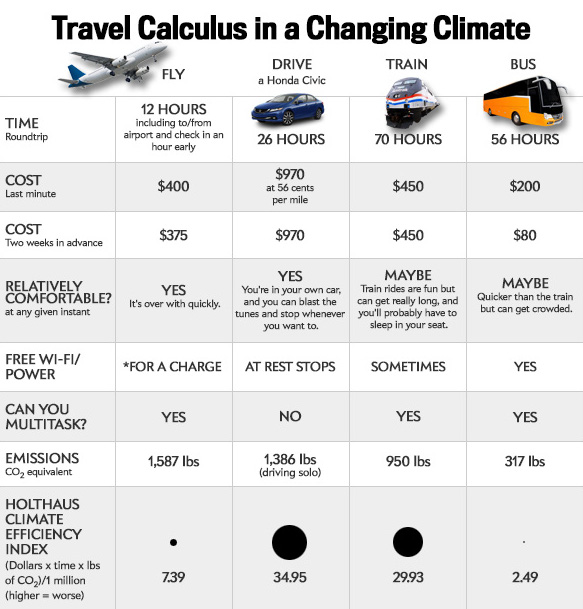
Eric Holthaus, who has vowed never to fly again so as to reduce his carbon footprint, took a bus from Wisconsin to Georgia in order to attend a conference. Why he thinks buses are the way to go:
From both a climate and financial standpoint, there’s a clear case to take the bus. From a butt-numbness standard, the bus isn’t quite there yet in the United States. However, the rise of limited-stop intercity operators like Megabus is helping the United States to quickly catch up to the rest of the world in terms of frequency and comfort on long-haul bus rides. In Chile, a spread-out country that has embraced long-distance buses, you can easily and cheaply snag a first-class quality experience with meals, Internet, live TV, and a lay-flat bed in every seat.
Buses are the most climate-friendly mode of transportation per passenger mile next to walking or riding a bike. This makes sense: There’s no need to accelerate hundreds of tons of aluminum to nearly the speed of sound, or to push thousands of tons of steel along 19th-century rail routes. Even a Prius is dragging along lots of extra weight just to move you down the road, especially if you’re solo, as most car trips are.
Socialized Law?
Noam Scheiber makes the case:
The idea would be roughly as follows: in criminal cases, we decide what the accused should be able to spend to defend themselves against a given charge—securities fraud, grand theft, manslaughter, etc. No one can spend more, even if she has the money, and those who can’t afford the limit would receive a subsidy for the full amount beyond what they would have spent on their own (say, beyond a certain percentage of their annual salary or net worth). In civil cases, we decide what the plaintiff should be able to spend to pursue an award of a particular amount, or to pursue a particular kind of claim, and what the defendant should be able to spend in response. The same subsidies would apply.
Posner calls the idea a “massive, unworkable nightmare”:
Suppose someone is charged with manslaughter after driving her car into a pedestrian and killing him. Suppose the government-set price for a manslaughter defense is $20,000. She uses most of her money to buy an excellent lawyer but nonetheless the jury convicts. She has some money left over for an appeal but in the meantime some new evidence emerges that the victim was at fault, or the prosecutor engaged in misconduct. Should she use the money to pay a lawyer to make a motion for a new trial? Save it for sentencing? Use it for appeal? One could complicate the regulatory scheme further by giving people the power to apply for new “grants” from the government for additional legal representation as unpredictable developments occur. But this would invite still more tactical behavior by clever lawyers skilled in gaming systems like Scheiber’s.
Kilgore is similarly unimpressed:
If it gets the buzz it’s intended to attract, perhaps Scheiber’s piece could stimulate some much-needed interest in the decline of subsidized legal services for the poor, one of the less-discussed victims of austerian budget policies. Or maybe it could help boost the already promising rise of bipartisan criminal justice reform initiatives, noting that unequal legal representation is one of the reasons we have prisons stuffed with poor people who are in many cases status offenders. But unless conservatives get excited about it as the Next Big Threat, I don’t think “socialized law” has much of an immediate future.
Facing The Boeremusiek
Trevor Sacks offers a primer on boeremusiek, a type of Afrikaner dance music “brought by the European to Africa and that the South African, in his isolation in remote districts and farms, kept up as part of his own culture”:
Boeremusiek usually has no vocals, and its central instrument is the crunchy, droning concertina, an originally European free-reed instrument replete with bellows—much like an accordion, but smaller and perhaps cuter. As with some forms of American folk music, guitar, banjo, occasionally violin, and bass or cello accompany it. It could be considered the bluegrass of South Africa, although perhaps it’s closer in sound to Cajun music, or polka mixed with Parisian cafe kitsch.
(Video: performance of “Sonop Vastrap”)
 The Dish