Space Elevators?

space_elevator

Meghan Neal highlights a report from last year that says they’re not so crazy after all:

What made people stop laughing? Nanotech. Carbon nanotubes were developed in the 90s and promised to be the uber-strong, light, flexible supermaterial needed to build the kind of 62,000-mile cable that could transport humans into space. By the end of the 90s, NASA had released its report on the technological progress: “Space Elevators: An Advanced Earth-Space Infrastructure for the New Millennium.”

This month’s [International Academy of Astronautics (IAA)] report gives something of an update. “The materials currently being tested in the laboratory have surpassed that level and promise a tether that can withstand the environmental and operational stresses necessary,” it states. “Will it end up being carbon nanotubes, or boron nitrite materials, or something else?”

Nanomaterials are strong and light enough, but the rub is that scientists can’t get them to scale yet. Luckily, billions of dollars are being poured into this area of research. The report predicts a suitable material will be ready by the 2020s.

Good news for Newt’s moon base.

(Illustration: Space elevator by Dean Ellis from Omni, July 1981)

Apathetic Atheism vs New Atheism, Ctd

A reader writes:

First, thank you for giving atheists a say in your conversations about religion. One of your readers referred to atheists like me as “dickheads” because he gets tired of us constantly talking about our disbelief in gods. Okay, I’ll happily join the ranks of feminists who were dickheads about getting the vote, African Americans who were dickheads in the pursuit of equal rights, and those dickhead gays who demand respect and the same rights as heterosexuals.  I only want my government to respect my right to not believe the existence of a god, to remain neutral when it comes to religion, to not push Christianity as a national religion, or give special privileges to religions.  I want a social climate where atheists are not stigmatized.

A number of friends and relatives have told me in private that they, too, don’t believe in the existence of gods but either cannot or prefer not to make that public.  I want that to end someday.  I want to see a day when people believe or don’t believe because it makes sense to them, not because everyone else believes it, or that’s what’s expected of them.

I speak out so that our leaders understand there are atheists out there who feel just as strongly about our belief as they do about their religion.  I never want another person to experience what happened to me a few years ago.

When my wife’s sister collapsed and died suddenly, her whole family was devastated. At the funeral they were still reeling. My wife’s family is devoutly Catholic and she never told them that I was an atheist (she’s accepted it).  During the Catholic service honoring her sister’s life, the priest spoke highly of her sister’s service and devotion to the church, that she is now in a better place with Jesus, and how Great our Lord Jesus is. To reinforce this, he exhorted everyone who believes in the love of Jesus to stand up. My wife and I were seated near the front of the church and I quickly had to decide what to do. I chose not to stand. Everyone saw this and it just added to the pain of the moment for my wife. (I might add that I am not the same race as her family, which added to the awkwardness.)

I want religious leaders to understand that exhortations like this can embarrass those who aren’t Christians, and in some cases it can break up families and marriages.  If the priest had just asked those who believe to say “Amen” few if any would have noticed those who said nothing.  This has left a lasting scar on my marriage and my relationship with my wife’s family.

I honestly don’t care if people believe in a God or not.  I never talk about people’s religion or try to convince them there is no God unless they bring my atheism up first. I’m only a dickhead when people force their religious beliefs on me or on my government.  I want people to understand that there are a lot of atheists out there, that we are sane, moral citizens with rights we are willing to stand up for.

Another atheist:

I don’t think New Atheists are any more militant or angry than other minority advocacy groups, but I can freely admit that there is some actual anger, and that there are some pretty legit reasons for it. There is a large segment of the population that believes that an atheist is inherently immoral because humans are incapable of having a moral compass without divine belief. There is the mirror belief, even among agnostics, that being religious is somehow an indicator of higher ethical standards. Given history, a lot of atheists find this annoying, dismaying, and at times infuriating. Does not every minority encounter and react to these sorts of morally superior arguments and broad based but inaccurate characterizations and assumptions? Why is the bar for anger and militancy set so low when discussing the godless? And I have not even touched on religion’s extraordinary influence on the culture wars and politics, which Thomas Wells makes only the briefest mention of before dismissing it.

Lastly, regarding your reader who analogized atheism to his dislike for soccer, questioning the appropriateness of him constantly berating his friends and relatives if they ever watch the sport: Know what I do at the half-dozen events per month that involve someone telling us to bow our heads in prayer? I remain quietly respectful, as all atheists I know would do. Know what I do if someone asks me about my religion or what church I attend? I tell them I am an atheist. See the difference? The only time it may get a little tense is if I am baselessly accused of immorality, hatred of god, willful disobedience to what I “know must be true”, or encounter the justification of a preferred public policy decision because “its in the Bible.” You tell me who is being the dick in such a conversation.

One more:

Great thread, thanks. Let’s say the New Atheists are indeed “dickheads” and “contrarians,” as your writer argues. That’s even more of a reason to speak out, and do so with grace and kindness.  One of the best compliments I ever received was from a Christian co-worker after she found out about my atheist activism, saying that my kindness disproved the stereotype of the amoral atheist.

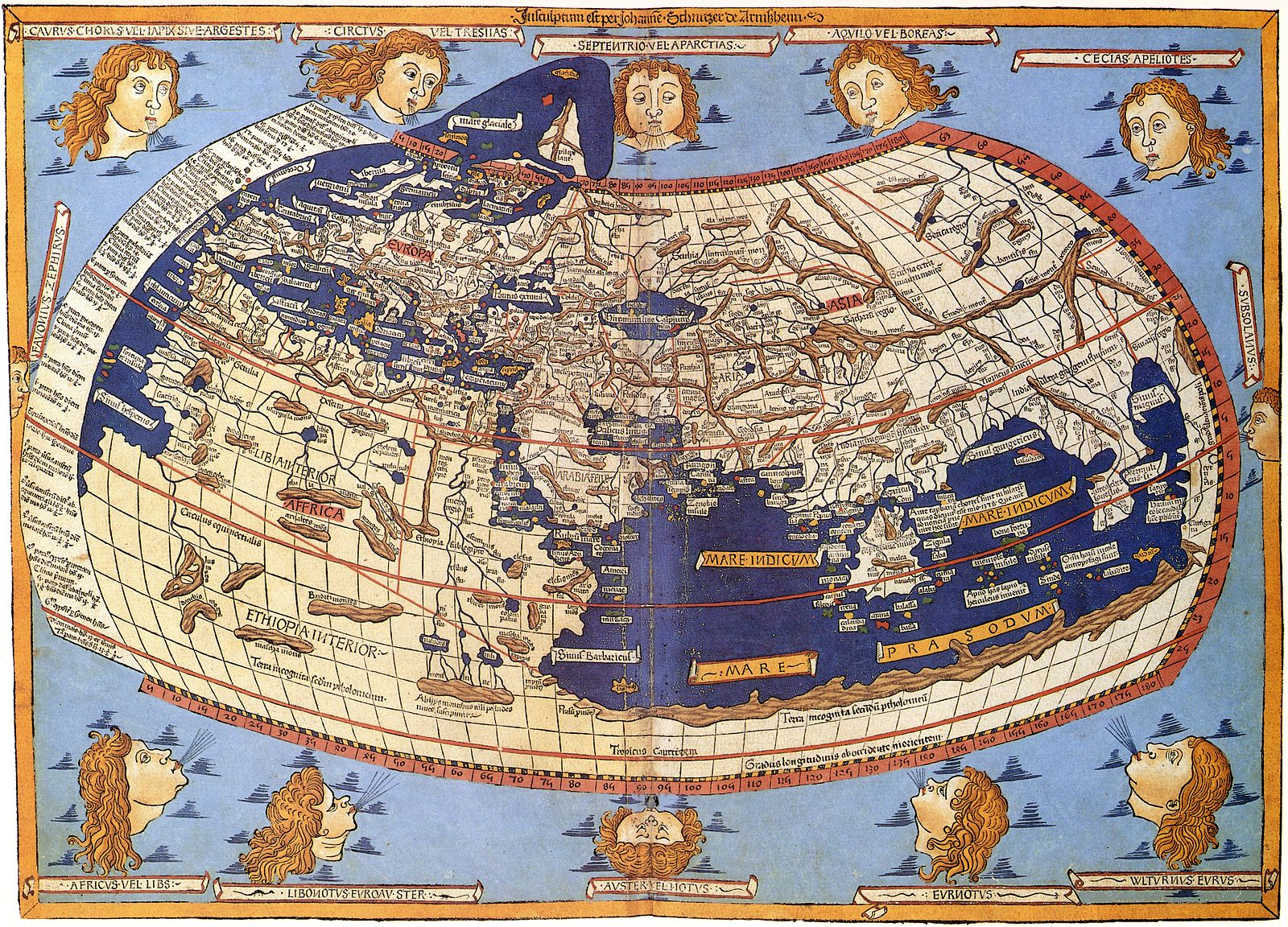
Why North Is Up And South Is Down

dish_ptolemy

Nick Danforth explains how north ended up at the top of maps:

There is nothing inevitable or intrinsically correct — not in geographic, cartographic or even philosophical terms — about the north being represented as up, because up on a map is a human construction, not a natural one. Some of the very earliest Egyptian maps show the south as up, presumably equating the Nile’s northward flow with the force of gravity. And there was a long stretch in the medieval era when most European maps were drawn with the east on the top. … In the same period, Arab map makers often drew maps with the south facing up, possibly because this was how the Chinese did it.

So who was primarily responsible for the flip?

The north’s position was ultimately secured by the beginning of the 16th century, thanks to Ptolemy, with another European discovery that, like the New World, others had known about for quite some time. Ptolemy was a Hellenic cartographer from Egypt whose work in the second century A.D. laid out a systematic approach to mapping the world, complete with intersecting lines of longitude and latitude on a half-eaten-doughnut-shaped projection that reflected the curvature of the earth. The cartographers who made the first big, beautiful maps of the entire world, Old and New — men like Gerardus MercatorHenricus Martellus Germanus and Martin Waldseemuller — were obsessed with Ptolemy. They turned out copies of Ptolemy’s Geography on the newly invented printing press, put his portrait in the corners of their maps and used his writings to fill in places they had never been, even as their own discoveries were revealing the limitations of his work. For reasons that have been lost to history, Ptolemy put the north up.

Previous Dish on north-south cartography in The West Wing here. Money quote:

When the top of the map is given to the Northern hemisphere and the bottom is given to the Southern, then people will tend to adopt top and bottom attitudes.

(Image of map from the 15th century depicting Ptolemy’s description of the Ecumene via Wikimedia Commons)

The Stimulus Next Time

John Cassidy insists that Obama’s stimulus isn’t the last one we’ll see:

Ultimately, the policy lessons that will be drawn from the Great Recession and its aftermath are that the stimulus worked (albeit not quite as well as some of its designers envisaged) and that Keynesian pump-priming is the only sensible response to a slump. The next time that the U.S. economy falls into a severe recession, regardless of which party controls the White House, Congress will vote through another stimulus, and a sizable one at that. …

Keynesian policies survive because they work in a crisis—not perfectly, but better than the alternatives. To argue that they have no future, you have to believe that the American political system is in such a decrepit state, so weakened by anti-government fever, that it can no longer process this reality, and can no longer correct itself.

The Vanilla Icing Of Rap, Ctd

A reader quotes another:

I’m not saying the white boy you posted doesn’t have skills, but the alphabet rapping concept, including progressive acceleration, was done a long time ago by Blackalcious [see above]. I’m more okay with white boys having their place in hip hop if they bring their own perspective and style to the table, like The Streets for example.

In sum: Once “Alphabet Aerobics” hit in 1999, a white person can’t make a rap with the alphabet and still be considered original. White rappers having their own perspective and style means they can’t revisit a concept done by a black artist, even if it was done 15 years ago. Obviously this is artistic elitist bullshit. While having predominantly black artists in hip hop made for amazing music, as it was a medium for artistic outsiders willing to do something new, it got mired in cliches and authenticity-by-skin-color, leading to a lot of forgettable, stale music. The reader who you quoted is still stuck in looking to skin color for authentic music, and it’s racist. Not nearly as degrading or dehumanizing as institutional slavery, Jim Crow, or unjust as white privilege that still exists today. But it’s racist nonetheless, and he/she probably excuses it because it’s focused against whites.

On a very different note:

I almost wrote you a letter during the Dylan Farrow discussion, but I never quite found quite got to it. But now you’ve brought Brother Ali into it. Brother Ali is not just a talented freestyle rapper. He’s also a touching and personal lyricist. A few years ago, our family was shattered by the discovery that a very young relative was the victim of molestation by her father.

We immediately took in their family (minus one person who, with any luck, will never leave the loving embrace of our state’s prison system.) They’ve been living with us for several years as their mother puts her life back together, brick by brick. The daily challenges go beyond the scope of a letter to a popular blogger.

As the victim is still a child, it partly feels like a waiting game. What will she remember? Will she feel isolated by her past? As a teenager, will she be overcome by anger? Will she be able to find love and comfort as an adult, or will she be constantly haunted? Will she feel the need to take some form of revenge, as Dylan Farrow did? Was Farrow’s letter cathartic? If so, will she ever get a chance to do something like that herself?

I’m predisposed to believe Farrow. True or not, whatever happened in that family, she’s clearly in a tremendous amount of pain. I hope that she can release her anger. I hope that she can find peace and love in her life. Hell, I hope I can release my anger some day.

I first heard Brother Ali’s song Babygirl right about the time this all went down, which was amazing timing. Brother Ali discusses it after performing it in this video (around minute 5):

Hearing it then was touching. I applaud him for writing it. It can’t be easy to open up your family’s life for art like that.

On a side note, in the middle of all of this, my mother became very ill with c. diff collitis. She spent nearly five months of a year in hospitals, coming very close to the end several times. She eventually received a fecal transplant. After that, her health took a nearly unbelievable turn for the better. With the c. diff no longer killing her, other systems were allowed to come back to normal. So, that’s a Dish Trifecta for me. Stop stalking me!

And thanks for reading.

Thanks for sharing.

The Best Of The Dish Today

I stumbled upon this rather stunning rendition of Ave Maria by then Cardinal Wojtila (future John Paul II) in 1976 while perusing (as is my wont) the American Conservative. Somehow it seemed a fitting end to such a gay day:

To recap a little: Arizona governor Brewer vetoed the religious liberty bill earlier tonight on the grounds that it had “the potential to create more problems than it purports to solve,” while Texas governor, Rick Perry, after the ruling striking down Texas’ ban on marriage rights for gay couples, insisted that the feds should stay out:

Texans spoke loud and clear by overwhelmingly voting to define marriage as a union between a man and a woman in our Constitution, and it is not the role of the federal government to overturn the will of our citizens.

Meanwhile, Florida’s governor, Rick Scott said he’d veto a religious liberty bill identical to Arizona’s. And libertarian Wally Olson penned a helpful piece on how the Arizona law expands on the federal definition:

The Arizona bill pushes mini-Religious Freedom Restoration Acts into relatively new territory by specifying that it applies not just to “government” but to “state action” more broadly, the crucial difference being that it aims to insert a right to religious accommodation as a defense in litigation between private parties arising from state laws.

In other matters, today we covered what happens when you don’t know what a twat is; witnessed the beard craze seriously jumping the shark; checked in on the outfits of the Pope Emeritus; wondered what punctuation mark was the best for our online world; and witnessed yet another nasty ad hominem attack by Leon Wieseltier on yet another New Republic colleague – with the alleged editors of the magazine standing by.

The most popular post of the day was The Tiger Gets Hungrier; followed by Erick Erickson Has A Point.

See you in the morning.

Face Of The Day

U.S. Soldiers Provide Security Around Kandahar Airfield

SGT Kevin Ingram from Wheeling, West Virginia with the U.S. Army’s 4th squadron 2d Cavalry Regiment comforts a puppy that had its ears cut off while visiting an Afghan National Police (ANP) outpost that was once home to Osama Bin Laden during a patrol on February 25, 2014 near Kandahar, Afghanistan. Ears are often removed from puppies to prepare them to become fighting dogs. Fourth squadron 2d Cavalry Regiment is responsible for defending Kandahar Airfield against rocket attacks from insurgents. By Scott Olson/Getty Images.

Leaning In, Falling Flat

Rosa Brooks pushes back against Sheryl Sandberg’s “lean in” philosophy and the culture of overwork, arguing that women, in particular, should fight for their right to relax:

Here’s the thing: We’ve managed to create a world in which ubiquity is valued above all. If you’re not at your desk every night until nine, your commitment to the job is questioned. If you’re not checking email 24/7, you’re not a reliable colleague. But in a world in which leaning in at work has come to mean doing more work, more often, for longer hours, women will disproportionately drop out or be eased out.

Why? Because unlike most men, women — particularly women with children — are still expected to work that “second shift” at home. … It’s hard enough managing one 24/7 job. No one can survive two of them. And as long as women are the ones doing more of the housework and childcare, women will be disproportionately hurt when both workplace expectations and parenting expectations require ubiquity. They’ll continue to do what too many talented women already do: Just as they’re on the verge of achieving workplace leadership positions, they’ll start dropping out.

Kathleen Geier applauds:

[S]lacking off unjustly gets a bad rap. People often enhance their abilities to think independently, to develop their own interests, and to do creative work when they’re not on someone else’s clock — when they’re just doing stuff they enjoy on their own time. It’s scary that our 24/7 economy seems to be allowing less and less time for that (at least, for those who are employed). I pity the Sheryl Sandbergs of the world who, as Kate Losse noted, appear to place little value on “pleasure and other nonproductive pastimes.”

Olga Khazan examines why Brooks’ call will be hard to follow:

U.S. policy doesn’t exactly make it easy to lean out even temporarily. Only about a fifth of moms get fully paid maternity time off, and high-powered “key employees” can be legally denied reinstatement if they go on family or medical leave.

Parents who truly wish to split the “workday” between actual work and childcare might also discover that the U.S. lacks a culture of part-time work, even though more than half of American working moms would prefer to work part-time or not at all. Part-time employees at American companies are much less likely to have access to benefits like retirement, medical care, and sick leave than are their full-time colleagues. U.S. workers are some of the least likely among the OECD nations to work part-time. (And even in countries where working less is accepted, the career disparity persists because it’s generally women, not men, who choose this route.)