PTSD Isn’t Limited To Our Troops, Ctd

Lois Beckett emphasizes that “not all trauma happens in Afghanistan”:

Studies show that, overall, about 8 percent of Americans suffer from PTSD at some point in their lives. But the rates appear to be much higher in communities—such as poor, largely African-American pockets of Detroit, Atlanta, Chicago and Philadelphia–where high rates of violent crime have persisted despite a national decline.

Researchers in Atlanta interviewed more than 8,000 inner-city residents and found that about two-thirds said they had been violently attacked and that half knew someone who had been murdered. At least 1 in 3 of those interviewed experienced symptoms consistent with PTSD at some point in their lives–and that’s a “conservative estimate,” said Dr. Kerry Ressler, the lead investigator onthe project. “The rates of PTSD we see are as high or higher than Iraq, Afghanistan or Vietnam veterans,” Ressler said. “We have a whole population who is traumatized.”

Previous Dish on PTSD here, here, here, and here. Subscribers can listen to my conversation with Iraq veteran and PTSD survivor Mikey Piro here.

The Border Blame Game

Allahpundit examines the House Republicans’ claim, articulated by Paul Ryan in the interview seen above, that maybe they won’t pass immigration reform because Obama can’t be trusted to enforce new border security laws:

The thing is, though, if you’ve concluded as a caucus that Obama’s gone rogue and can’t be trusted to dutifully carry out federal law, the answer isn’t to boycott immigration reform, it’s to boycott new legislation of all kinds. … Blaming Obama’s executive power grabs is a convenient way for Boehner, Ryan, Rubio et al. to dodge the real problem within the caucus, which is that conservatives don’t trust their own leadership to demand real, measurable border security improvements as an absolute prerequisite to legalizing illegals.

Weigel yawns:

The Obama-won’t-obey-the-law theory has always been a sort of chimera when it comes to talk of immigration reform.

Say the Senate bill was passed in the House tomorrow, conferenced, and signed by the president. He’s got three years left in office. The legalization component of the Senate bill depends on a border security standard that’s going to be determined by a panel of state governors. They have five years to sign off. If you think about the timing of the Affordable Care Act—passed in 2010, implemented at the end of 2013—there’s no real danger of Obama using a new immigration law to grant more amnesty. He could do that right now.

So, file these talking points under “Republicans Looking Busy.”

Sargent thinks Ryan’s comments are a distraction from the real debate:

The important thing to understand about Ryan’s quotes is their strategic vagueness. When Ryan says security and enforcement — the meeting of border metrics, E-Verify, etc. — must be “verified before the rest of the law can occur,” he’s deliberately fudging the dilemma Republicans face. Will the 11 million get some sort of temporary or provisional legal/work status before all these conditions are met? Or is even that automatically “amnesty” and therefore a nonstarter?

You Can’t Outlaw Hate

Thane Rosenbaum wants to crack down on hate speech. Moynihan pushes back:

That we’re one of the few countries in the Western world that takes freedom of speech seriously means, according to Rosenbaum, that we are actually behind the times: “Actually, the United States is an outlier among democracies in granting such generous free speech guarantees. Six European countries, along with Brazil, prohibit the use of Nazi symbols and flags. Many more countries have outlawed Holocaust denial. Indeed, even encouraging racial discrimination in France is a crime. In pluralistic nations like these with clashing cultures and historical tragedies not shared by all, mutual respect and civility helps keep the peace and avoids unnecessary mental trauma.” So one would assume that racial discrimination has been dumped on the ash heap of history in France, considering racist thoughts and symbols have been made illegal. How, then, does one explain that the National Front, whose former leader Jean-Marie Le Pen was found guilty of Holocaust denial, is now the most popular party in the country?

Jonathan Rauch piles on:

Above all, the idea that hate speech always harms minorities is false. To the contrary:

painful though hate speech may be for individual members of minorities or other targeted groups, its toleration is to their great collective benefit, because in a climate of free intellectual exchange hateful and bigoted ideas are refuted and discredited, not merely suppressed. The genius of the open society is that it harnesses the whole range of public criticism, including offensive and hurtful speech, in a decentralized knowledge-making process that has no rival at the job minorities most care about: finding truth and debunking bigotry. That is how we gay folks achieved the stunning gains we’ve made in America: by arguing toward truth.

Another strong point:

The big problem for proponents of hate-speech laws and codes is that they can never explain where to draw a stable and consistent line between hate speech and vigorous criticism, or who exactly can be trusted to draw it. The reason is that there is no such line.

“The Most Ironic Sport”

The figure-skating world is still in the closet:

To outsiders, men’s figure skating is widely perceived as the Gayest Sport Ever, the butt of endless jokes – consider last weekend’s SNL cold open about the “US Men’s Heterosexual Figure Skating Team.” The direct action group Queer Nation has recently protested figure skaters Brian Boitano and Johnny Weir for not speaking up against Russia’s anti-gay laws.  One of the group’s representatives, who asked to not be named, tells me, “Everyone assumes all male skaters are gay. So what? … I don’t understand this impulse, particularly from figure skaters, to hide their sexuality. You can’t tell me that if Jeremy Abbott came out as gay that it would affect his standing in the skating world.”

To insiders, though, it’s no surprise that skaters are reluctant to speak out on LGBT rights, let alone come out themselves. Most male skaters and officials are committed to keeping their sport in the closet, whether that means choosing “masculine” music, hinting about a girlfriend, or outright denying any connection to homosexuality. A figure skater can never quite outskate the judges’ opinion of him, and judges and institutions, it turns out, are notoriously conservative –as some would say, “family-friendly.” At the National Championships, which took place this January in Boston, a phrase I heard often was “don’t ask, don’t tell.”

Or as a former Olympic judge puts it:

You can’t get ahead in figure skating if you don’t play the politics. It’s the most ironic sport. It truly is probably the gayest sport, and yet it’s right up there as the most homophobic sport.

Consider the case of Johnny Weir in 2010 (seen above):

The media’s treatment of Weir, who somewhat controversially took sixth place at the Vancouver games (fans thought he deserved a higher finish), underscored the unspoken tensions around sexual orientation in men’s figure skating. While Evan Lysacek was often portrayed as the athlete, Weir was the artist – “ornate,” “unapologetic,” and “flamboyant” (code for “gay”). Broadcasters made derogatory comments about Weir’s skating and costumes, questioned his gender and wondered if his flamboyant image might damage the sport. In 2010, after representing the U.S. in Vancouver, he was left off of the post-Olympics Stars on Ice skating tour, although he finished first in an online poll asking fans who they wanted to see in the tour. Reports quickly surfaced that he was excluded for being “not family-friendly” enough.

Update from a reader:

Someone who “asked not to be named” is calling on skaters to come out themselves and be a voice for LGBT rights? That’s fucking priceless, right there.

Did “Bad Heroin” Kill Philip Seymour Hoffman?

Brian Palmer wonders:

Authorities in several states have sent out “contaminated heroin” alerts in recent weeks. The problem batches contain the prescription narcotic fentanyl, either mislabeled as heroin or mixed with heroin and sold under a brand name such as “magic,” “Theraflu,” or “Bud Ice.” Fentanyl is closely related to heroin but cheaper and between 50 to 80 times more potent, making it an appealing substitute for drug dealers and users.

He notes that fentanyl “kills dozens of people annually, often because users apparently misjudge the strength of a dose.” Meanwhile, Sullum catches the media exaggerating the scale of our heroin problem:

According to the National Survey on Drug Use and Health, 0.3 percent of Americans 12 and older used heroin in 2012, compared to 0.2 percent in 2002. During the same period past-month use remained steady at 0.1 percent. According to the Monitoring the Future Study, past-year heroin use among high school seniors actually fell from 1 percent in 2002 to 0.6 percent in 2012.

MSNBC exaggerates the increase in heroin use by focusing on raw numbers instead of rates.

But it’s still pretty serious:

There are over 38,000 drug overdose deaths per year in the United States, 75 percent of which are opioid-related. And we are not the only ones experiencing tragedy; the Europeans are suffering, as well. Opioid overdose accounts for about 6,500 deaths per year in the European Union, and was recently cited as the number one cause of preventable death among young men in Spain.

Against this backdrop, Matt Steinglass makes the case for relaxing our drug laws:

New York City has no safe injection sites. It might have been impossible for someone of Mr Hoffman’s notoriety to use one even if it existed; but no one can say for sure, and there are plenty of at-risk people out there who might still be saved. (Mr Hoffman’s death comes amid a spike of heroin-related deaths in America.) More broadly, if safe injection sites, free government treatment for addicts and provision of free heroin to resistant addicts destroyed the profit margin for dealing heroin in New York City, it might become a lot harder for occasional users to get their hands on the stuff. Great artists and regular Joes will still hunger for mood-altering substances and will sometimes end up killing themselves, and we will continue to feel furious at them when they do. But we can channel that anger into finding ways to make their deaths less likely.

Abuse We Don’t Want To Believe

Last night, on AC360 Later, we debated the accusations against Woody Allen:

This embed is invalid


Jessica Dawson identifies with Dylan Farrow:

When my parents left me at Oma’s every summer while they traveled for weeks on end to Paris, Lausanne, and London, my uncle’s daily visits to my bedroom didn’t strike anyone as strange. He must really love you, they said. But I got scared, and my little-girl self tried to tell my parents something was going on. Though it had been going on for years, I must have been five when I tried to tell them—just two years younger than Dylan Farrow’s age when she was allegedly molested. My parents told me I was making it up.

Well into my 20s, I believed them. Only when I entered the office of a Freudian analyst at age 24 did our first session end with me whispering the words: “I think something happened.”

Jessica Valenti examines the impulse to defend Woody Allen:

I believe, as Roxane Gay does, that people are skeptical of abuse victims because “the truth and pervasiveness of sexual violence around the world is overwhelming. Why would anyone want to face such truth?” I also believe that deep down people know that once we start to believe victims en masse—once we take their pain and experience seriously—that everything will have to change. Recognizing the truth about sexual assault and abuse will mean giving up too many sports and movies and songs and artists. It will mean rethinking institutions and families and power dynamics and the way we interact with each other every day. It will be a lot.

And we are lazy.

It’s easier to ignore what we know to be true, and focus on what we wish was. But the more we hold on to the things that make us comfortable and unthinking, the more people will be hurt—and the more growing room we’ll create for monsters.

Alyssa reonsiders Allen’s films in light of Dylan’s letter:

Setting himself up as a victim of his own hypochondria, sexual anxiety, mother issues, and assorted other neuroses is a clever trick for Allen, one that simultaneously anticipates nearly everything anyone could accuse him of, and renders him pathetic and sympathetic. See, so many of his movies say. Look how he suffers. But there are other people who are affected by the behavior of severely neurotic people, even if the impact on their lives doesn’t rise to the level of criminal trespass. Woody Allen’s just spent years training us to look past that damage, and to look at him instead. That’s a terrific insurance policy for the day it turns out you can’t preempt everything.

My first take on the letter is here. Dish readers sound off here.

Contraception Defeats Abortion, Ctd

A Guttmacher Institute report released yesterday found a continued decline in the abortion rate. Kliff looks at abortion access:

The ranks of abortion providers have decreased slightly, by 4 percent, between 2008 and 2011. Most of that change is not about abortion clinics closing. The number of providers working in those stand-alone facilities only declined by 1 percent over the three-year period, meaning most of the decrease came from abortion providers who work in more general practices or in hospitals. The Midwest, notably, was the one region of the country where the number of abortion clinics increased between 2008 and 2011, by 8 percent (most of this is due to a surprisingly high number of abortion clinics opening in Iowa, increasing their ranks from 10 in the state to 17).

Taking all of that together, researchers don’t think it’s the 44 abortion restrictions passed between 2008 and 2011 that have led to the decrease in the abortion rate. Instead, they point a finger at more widespread contraceptive use.

One pro-life group, however, is confident that its message is responsible:

The National Right to Life pushed back on the authors’ reasons for the decline, suggesting that the debate over pro-life legislation had an effect on women’s behavior even before the surge of abortion restrictions (according to Guttmacher, 205 laws passed in the period between 2011 and 2013).

Americans United For Life president Charmaine Yoest says the report doesn’t give a complete picture:

It’s also important to recognize that the abortion data in this country is deeply flawed. There is no standardized reporting to the Centers for Disease Control. And this report from Guttmacher is based on survey data that they collect themselves. Women are often told by abortionists to use emergency rooms if they experience complications — and furthermore to conceal the abortion by claiming it’s a spontaneous miscarriage. This kind of deception from the abortion industry is extremely dangerous to women’s health.

But Marcotte points out that if risky, undocumented abortions are on the rise, the pro-life movement is partially to blame:

[I]llegal abortion… is notoriously hard to document yet seems to be rising in response to the shutdown of abortion clinics in red states. As Lindsay Beyerstein reported in the New Republic, one doctor in the relatively small town of Harlingen, Texas, reports having worked with about 100 patients since November who needed help with incomplete miscarriages, most of whom almost surely self-aborted with an ulcer medication available over the counter in Mexico. Since the medication is pretty effective at aborting a pregnancy entirely without a doctor’s help, the number of women in the area who have resorted to this is likely many times that. An unintended consequence of shutting down abortion clinics is that it’s going to be harder to assess what the actual abortion rate is in the U.S.

Sally Kohn brings up another contributor to lower abortion rates: better sex education:

According to the National Survey of Family Growth, teens who received comprehensive sex education were 50 percent less likely to experience pregnancy than those who received abstinence-only education.  And yet conservatives have been pushing abstinence-only education for a generation, prioritized—and funded—by the federal government under President George W. Bush. Why? Out of some puritanical idealism that if you tell teens not to have sex, they won’t—instead of basing policy on the reality that teens will have sex either way, and so better to equip them with information to be safe and healthy.

James Taranto pulls out an old theory, “the Roe effect,” to explain the long-term decline:

We argue that Roe v. Wade had the unanticipated political consequence of elevating the topic of abortion and polarizing public opinion around it and the unanticipated demographic consequence of reducing fertility unevenly and thereby intergenerationally diminishing support for abortion, as well as the proclivity to have abortions. In other words, the women deciding whether to have abortions now are disproportionately the daughters of women who opposed abortion. Of course parents don’t always convince their offspring of their views, but surely they have some influence in the aggregate.

Kilgore wishes pro-life activists would embrace contraceptives:

According to the Guttmacher Institute, as of 2010 5.6 percent of contraception-using women in the U.S. relied on an IUD, representing over two million women. If you are of the point of view that most of these women are actually having hidden abortions, then the abortion rate is actually skyrocketing, notwithstanding the fact that outside the antichoice ranks the idea that preventing the implantation in the uterine wall of a microscopic zygote is an “abortion”—just as bad morally as anything going on in Gosnell’s butcher shops— is considered, well, crazy.

That’s the reason for a lot of the heat around the contraceptive coverage mandate issue, and more generally, why compromises on abortion policy are so difficult. If one group of people thinks making it easier and cheaper to gain access to IUDs is the best way to reduce the need for abortions, and another thinks IUD use threatens a great Holocaust of baby-killing, they are going to have a bit of trouble finding common ground, eh?

Dan Savage also zeroes in on pro-life opposition to contraceptives:

So… the abortion rate is now where it was before abortion was legalized. And if we continue to back contraception—by, say, including contraception coverage in the health insurance policies that people are obligated to purchase under Obamacare—we could conceivably drive the abortion rate down further. To pre-Roe levels. Unfortunately American conservatives and anti-abortion crusaders are waging a war on contraception and access to contraception. Because what they oppose is sex. And female sexuality. It’s women having sex in the absence of potentially dire or life-altering/life-threatening consequences that drives them mad. That’s why they oppose abortion and the one thing that has been proven to bring down the abortion rate: greater access to contraception.

Nora Caplan-Bricker looks ahead:

It’s hard to predict how long this rate of decline will last. As the economy ticks back up, the decline may slow. Then again, the implementation of the Affordable Care Act may depress the rate further still. Patrick Whelan, a member of the pediatric faculty at Harvard, studied the impact of Massachusetts’ universal health care system in an effort to predict Obamacare’s effects, and found that the rate of abortion went down. “My own strong feeling is that giving girls and women access to care plugs them into the system,” Whelan told me. “They have someone reminding them about contraception. It helps them be more attentive to their health.” The ACA, like the Massachusetts law, mandates insurance coverage of contraception.

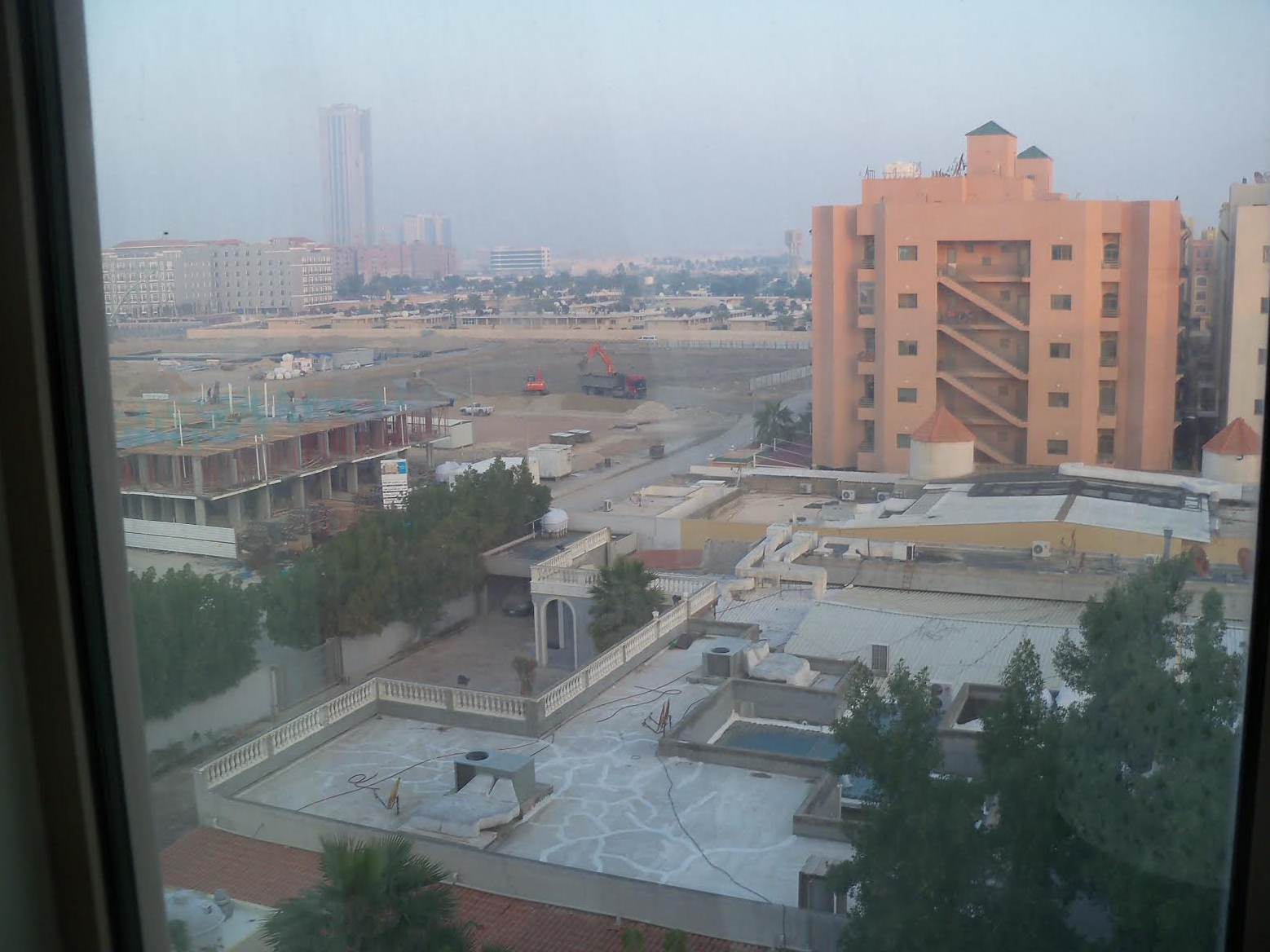
The View From Your Window Contest: Winner #190

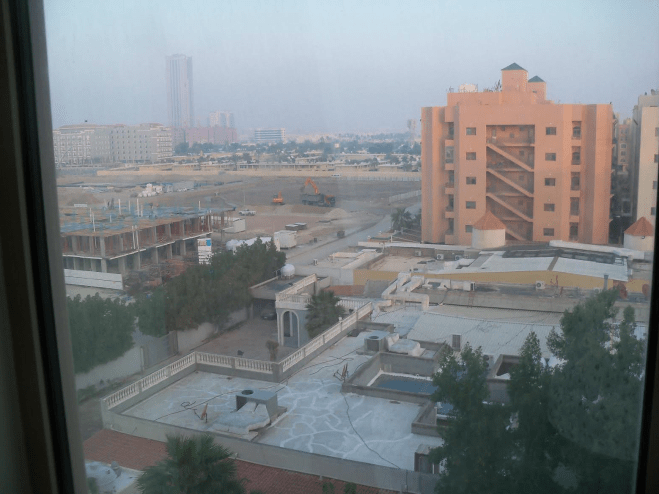
vfyw_2-1

A reader takes in the scene:

Subtropical climate? Check. No snow? Check. Lots of unfinished construction? Check. Gotta be Sochi.

Another disagrees:

A smoggy city somewhere in the Northern hemisphere where they are building things. I might be mistaken. There are palm-like trees, so it could be Rio and the World Cup venue. Building is not far enough along to be Sochi, since it is around the corner.

Another is unimpressed:

Could this be a desolate part of Salmiya, Kuwait? It’s so hideous it could be well be true.

Another gets dreary:

We humans sure have made this a fugly world, haven’t we? Everything looks like San Jose to me. Or China somewhere.

Another:

Dakar, Senegal. My husband who is from there, assures me it is not but the landscape and huge construction projects are so evocative of Dakar to me that I had to lob in the guess anyway. Otherwise, it must be somewhere close by in West Africa.

Another:

You had me stumped on this one at first, but then I recognized the Marriott in the background – clearly the McMurdo Station Marriott, Antarctica. Seriously, I’m stumped beyond belief on this one.  I know there’s a clue in there that gives it away, but three hours of looking hasn’t turned it up. Bravo, a real puzzler this week!

Another:

Yep, harder this week.

I haven’t spent nearly anytime in this part of the world and can’t do a big search, but this feels like a Gulf State. Bahrain’s Al Manamah suburbs seems like it might fit in terms of the mix of larger buildings and empty lots. I’m guessing near Sanibis because there is a cluster of hotels.

If my guess is close, I hope we’ll hear from someone about the island-state’s natural features. I remember meeting a British expat from Bahrain telling me that it has the most amazing marine and bird life, which seems pretty different from the city-scapes and endless sand that we typically associate with the place. And of course, he noted that everything was in trouble from climate change and encroaching development.

Another:

Tall brown building in the background appears to be the YAR Group building in Nicosia, Cyprus. I am guessing the picture was taken on top floor of Kolan British Hospital in Northern Sector of Nicosia, Cyprus.

Another:

My new year resolution is to guess each week. Looks like the sand and building styles of the United Arab Emirates. I’ll guess Abu Dhabi.

Indeed, the UAE was a popular guess this week:

The vegetation, as well as what appear to be water tanks on most of the buildings, suggest a desert location. If I were to take an educated guess, I’d say it’s somewhere in the Gulf. If I were to take a slightly less educated guess, I’d say that the cityscape doesn’t look developed enough to be Kuwait, Manama, Doha, or any of the top-tier cities in the Emirates. So for what amounts to a completely uneducated guess, I’ll say it’s Fujairah, UAE.

Another:

This was a tough one. Palms and aridness indicate somewhere hot in the winter, new construction indicates somewhere prosperous. Arabian Peninsula? The distant skyscraper is the best clue and it looks a lot like Al Dana Tower, in Sharjah UAE. The water tower in the photo’s center is also possibly identifiable on satellite imagery, and using those points narrows it down to University City (Al Talah, Rifa’a, Al Turrfa, Al Darari, Al Shehba, Al Khezammia). See attached map:
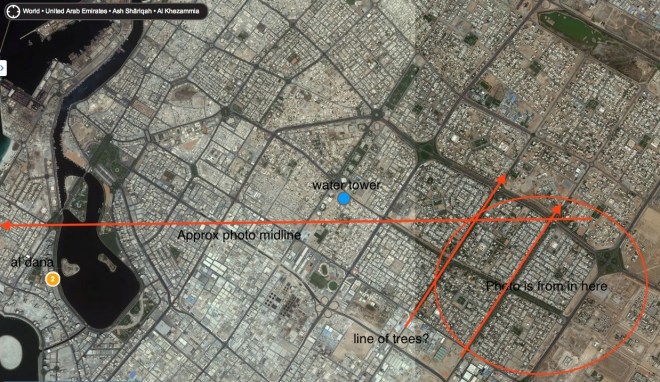
bing_sat

These neighborhoods have the right look: gated drives and lots of construction sites and open lots. As much as I scoured the area, however, I couldn’t find the building! Worth a shot.

Another looks elsewhere in the Middle East:

I searched the skyscraper.com database, but that tall building doesn’t show up. So I did a Google on “tall buildings in xxx” and went through all the Middle Eastern countries, other than Israel(given the Arabic-like script).

The closest I came to with a similar building is in Tehran. 6484806There are two towers at these coordinates: 35 45′ 48.00″ N 51° 22′ 25.84″ E that sort of resemble the one in the photo, but thanks to massive economic and political sanctions and highly suspicious Iranians, there’s no Google Street View to confirm. I don’t even know what those buildings are. The image I found here [also to the right] is similar to the one in the photo, which gave me a starting point. I searched all the nearby hotels on TripAdvisor (which is becoming a resource for resolve these images) and found nothing that has this building or the roof of the building next door.
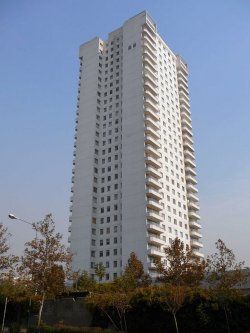
Therefore, I had to guess at a hotel. Since Tehran has mountains, I had to presume that the hotel backed up against the range. Without doing geometric tricks, I’m going to guess that the photographer was staying at: The Azadi Grand Hotel on Dr. Chamran Express Way, Evin Cross Road, Tehran. I can’t even guess a room number, I’m just shooting for closeness points this time. How close did I come?

Another gets the right country:

Wild guess this week – Dammam, Saudi Arabia.

Another reader’s spouse helps out:

“That looks like Saudi Arabia” said my wife, after about two seconds. Since she lived there for nine months, and is always right about these things, that’s where we went searching. The wiki list of tall buildings in Saudi Arabia is not very long, and the ninth one, the Dhahran Tower, has distinctive vertical lines on it, just like the one in the view! A bit of google earthing later (the striped building to the right helped), and we arrive at:

The Park Inn by Radisson Al Khobar Hotel
Al Rawabi District,
King Faisal Bin Abdulaziz Road,
Al Khobar, Saudi Arabia

The view is out of one of the back windows, fairly high up, so we’ll guess room 518. Here’s hoping this week was harder than last! In case this helps on a tie-breaker, my wife was working as an English teacher in Al-Ahsa, just down the road from Khobar, when I proposed to her, on her 28th (and my 30th) birthday, while we were on holiday in Morocco!

Every other reader who guessed Saudi Arabia also correctly guessed The Park Inn:
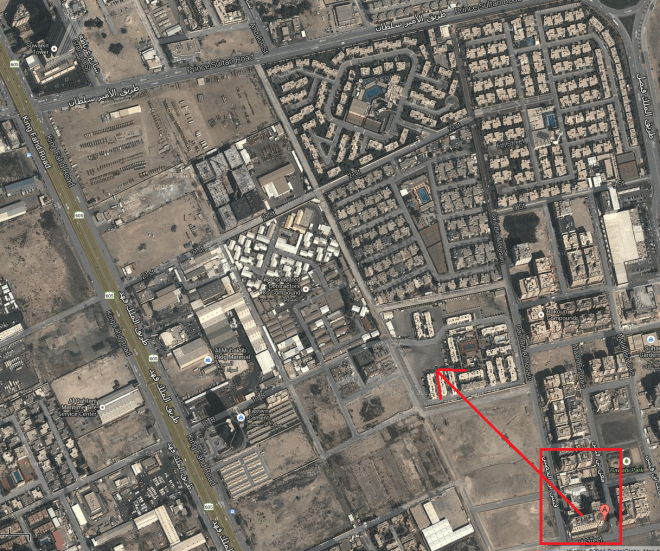
vfyw-khobar

This looks like the desert, and the writing on the white sign in the lower-left looks Arabic, so we’re likely somewhere in the Middle East.  However, no mosques in sight!  That made me think of Western compounds in Saudi Arabia, so I looked at the center of the Saudi oil industry, Dhahran. Fortunately I came across the Suwaiket Tower in nearby Khobar, which looks a lot like the tall building in this picture.  By matching up a few other landmarks on Google Maps satellite view, such as the white-and-black Patchi building and the L-1 Suwaikit compound in the middle, I was able to figure out that this week’s view is taken from the Park Inn by Radisson Al-Khobar, King Fahd Ibn Abdul Aziz Rd, Khobar, Saudi Arabia.  Attached is a diagram of the viewpoint.  I can’t find a picture of that side of the hotel to pick out the specific window, but I guess it’s taken from the fifth floor.

The Grand Champion confirms:
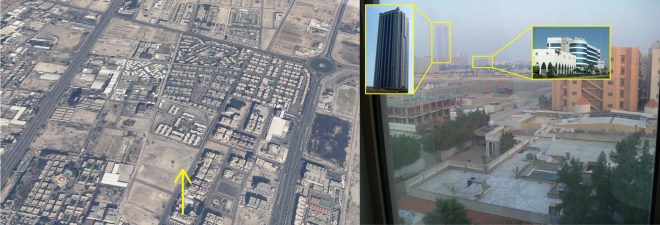
VFYW-Khobar-View-with-Insets---Copy

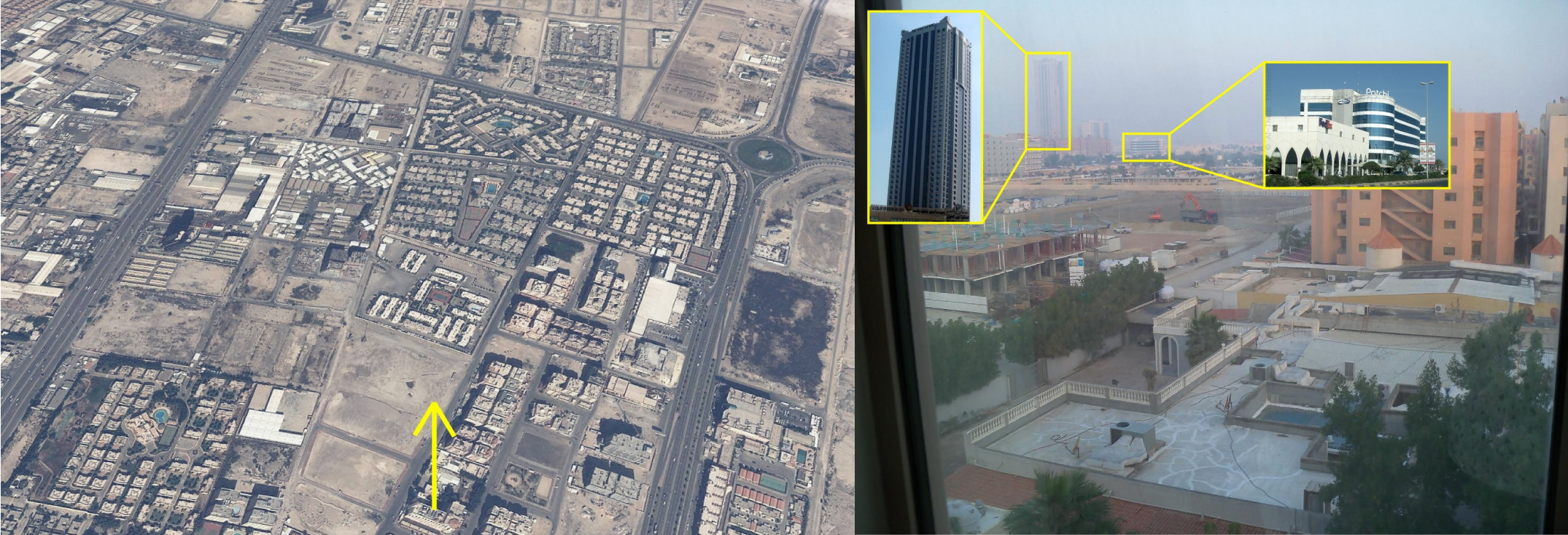
This week’s view comes from Al Khobar, Saudi Arabia. The picture was taken from roughly the fifth floor of the Park Inn by Radisson hotel and looks northwest along a heading of 324.61 degrees towards the Al Suwaiket Tower in the distance on the left.

This one almost didn’t happen. Between the Super Bowl and showing guests around town this weekend, I had no real time to work on it until Monday night. Luckily the view was chock-a-block with clues (almost too many) and one last push proved successful.

Another nails the right floor:

You promised a harder contest, but I think this was as easy as last week! Here was how I found it:

The construction sign looked vaguely Arabic, so I searched for “tallest buildings in Saudi Arabia.” Among those was Dhahran tower, and it looked very similar to the hazy skyscraper; using the nearby, shorter buildings in the horizon, I was able to figure out that the vantage point direction was towards the northwest. Suspecting a hotel, I quickly saw the Radisson on Googlemaps – with the obvious rooftop plan of the foreground building, and nearby foliage! Another giveaway: the tan building with the conspicuous fire escape, to the north.

All in all, about 15 min. The hotel address is King Fahd Ibn Abdul Aziz Rd, Khobar Saudi Arabia. I suppose you’ll get a lot of correct entries, so the deciding factor is room floor and number – I have no idea how to pinpoint that. Since there are 5 floors, and thinking they are using the European storey system, I am guessing top floor (4th) – how about, oh, 420?

Heh. It’s actually 434, per the photo submitter. Since nobody guessed that room number, this week’s prize goes to the most active correct guesser of a difficult contest who’s never won before. His enthusiastic entry:

A-ha! This is my FOURTH time getting the exact right location (if you include the Cebu, Philippines one, which apparently everyone and their mother got right as well). God, I want that book so bad I can taste it …

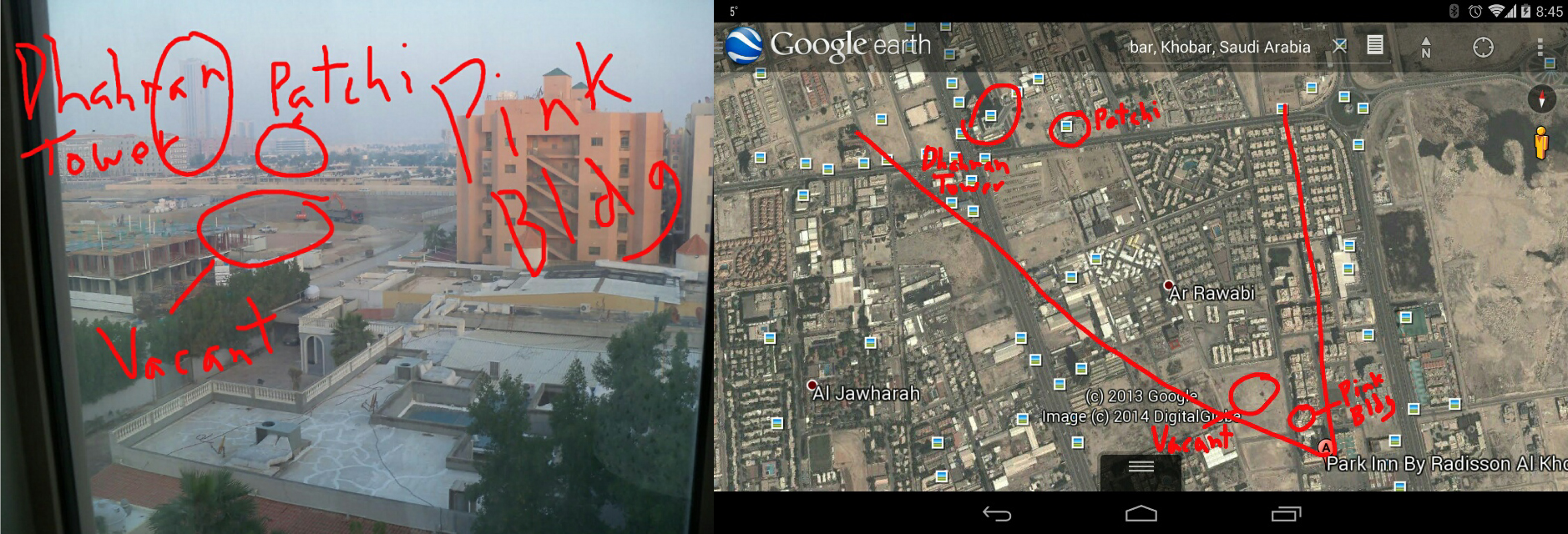
Anyway, the first clue was the sign in front of the construction project in the vacant lot, center left. It wasn’t possible to read the letters when I zoomed in, but it was clear enough that the script was Arabic. Google image searches of rooftops in Arab countries indicate the water tanks are a type common in Saudi Arabia, made by a company called Polycon. So I figured we are likely in Saudi Arabia.

Next major clue was the very tall, lone building in the background of our photo: tall enough that it is likely among the tallest in its region, lonely enough that it is likely in a small-ish city. Among the 10 tallest buildings in Saudi Arabia, Wikipedia lists only one in the mid-sized city of Khobar – the Dhahran Tower. I Google imaged it, and it looked about right, though the tower in our image is just hazy enough that I couldn’t be sure yet.

From there, it was a matter of using Google Earth to figure out the proper orientation relative to Dhahran Tower, and then working my way back from landmark to landmark until I got to our vantage point. The real a-ha moment was when I recognized the Patchi building, just east of Dhahran Tower, confirming that it was indeed the Dhahran/Khobar area and allowing me to triangulate the precise location.

guess-with-red-writing

The photo was taken from the Radisson Park Inn Al Khobar, in Khobar, Saudi Arabia, from a north-facing window on approximately the sixth floor.

Please say I won, please say I won, please say I won …

(Archive)
Clinton’s Achilles Heels

US-POLITICS-CLINTON

Ben Smith has a real scoop here – getting Obama political aides to measure up Hillary Clinton’s 2016 campaign. In many ways, she’s astonishingly ascendant, as John Heilemann and I chew over in a new Deep Dish podcast – more ascendant than in 2007 – when she also seemed inevitable. But in other ways, her campaign now – relying again on massive support from Democratic constituencies and donors – is uncannily close to the campaign she ran last time. It relies on her name, her stature, and her gender. And it’s perfectly possible that she could run and win by the George W Bush model in 2000 – by simple and early overwhelming of the field.

But there are big liabilities to being the overwhelming front-runner in any primary race:

“The further out front the effort to elect Sec. Clinton is three years before election day, the greater the incentive is for the press, prospective opponents, and adversarial groups to scrutinize and attack her every move,” said Ben LaBolt, the national press secretary for the 2012 Obama campaign. “Even if it is a well-known candidate — sometimes more so — activists, donors, and voters like to see candidates fighting for every vote. If they start to feel like their power and influence is diminished it could have unforeseen consequences — we learned that lesson the hard way during the New Hampshire primary in 2008.”

Who knows? As John notes, almost all her potential rivals have effectively deferred to her. But nonetheless, there are, it seems to me, two weaknesses at the heart of her candidacy.

What are her defining issues? Will she run on Obamacare – ensuring its success? Will she run on climate change? Or protection of entitlements? How would her foreign policy differ from Obama’s? Until we get a sense of where she is headed as far as policy is concerned, she runs the risk of appearing as some kind of large juggernaut that simply has to be elected, well, just because. Maybe being the first woman president would render all these other issues moot. But at some point, she will have to enter the fray. I’m not sure she’s actually fully prepped for that. Her campaigning and speaking skills are not as impressive as Obama’s.

But more importantly for me is the inability of her supporters to answer a simple question. I was having dinner with a real Clinton fan the other night, and I actually stumped him (and he’s not easily stumped). What have been Hillary Clinton’s major, signature accomplishments in her long career in public life? What did she achieve in her eight years as First Lady exactly? What stamp did she put on national policy in her time as Senator from New York? What were her defining and singular achievements as secretary-of-state?

Maybe readers can answer those questions. I’m a little stumped. But more important: Clinton herself must have a ready answer to that question – an answer that can unify various elements of her career and make a coherent whole. My concern is that her name, history and gender have pushed that core question to one side. And her fiercely loyal coterie may be too much in the tank to see that these are questions non-groupies want answers to. But at some point, she better have a stronger answer than her supporters can currently provide.

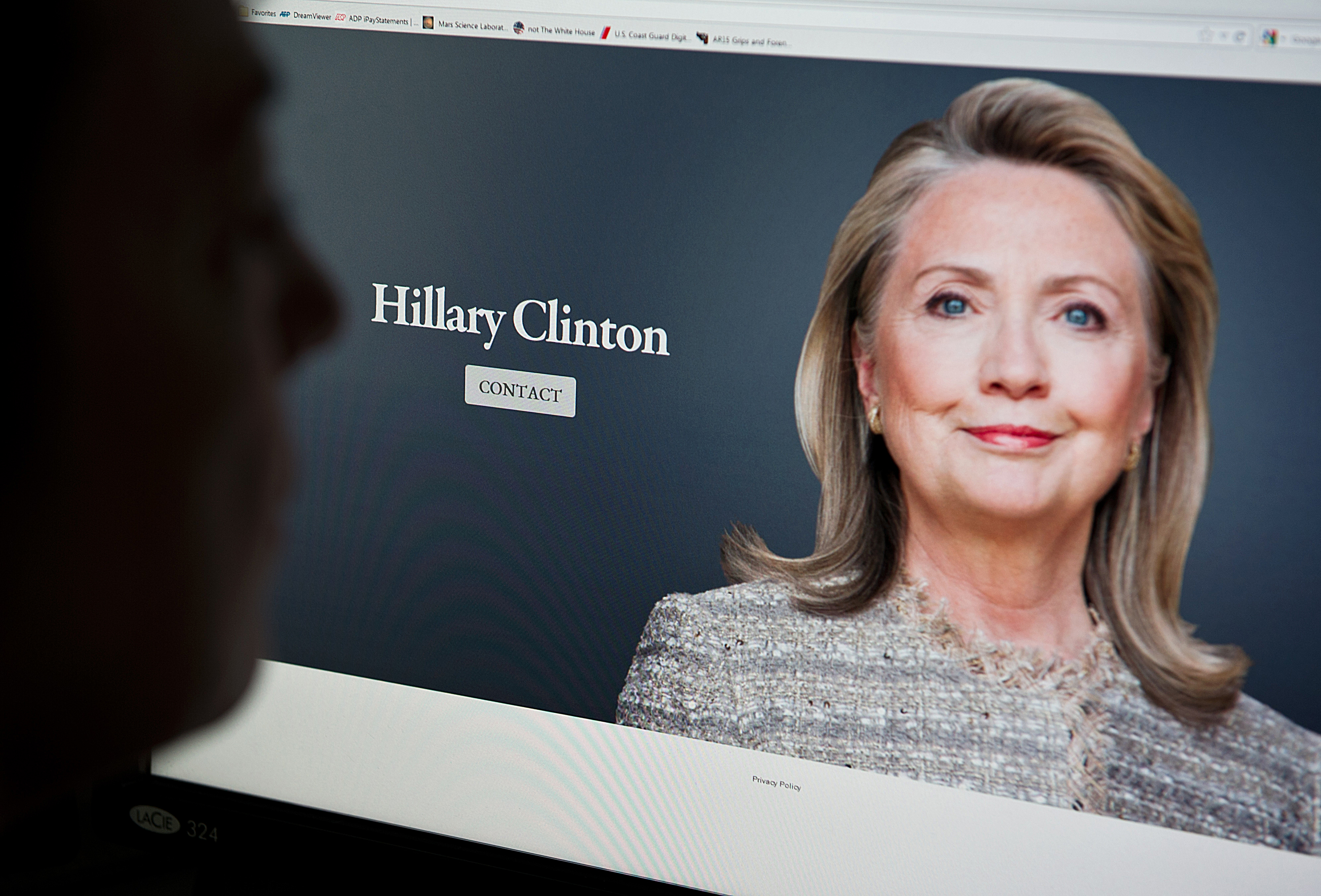
(Photo: This February 6, 2013 photo illustration shows a woman viewing the new website of Hillary Clinton in Washington, DC. According to news reports, the website was registered on Thursday, just 24 hours before Clinton stepped down as America’s top diplomat, handing the baton to John Kerry.  By Karen Bleier/AFP/Getty Images)

The Other Side Of Rouhani

He hangs poets from a scaffold. Update from a reader, who cautions:

This is based on a report by a known fabricator named Amir Taheri, the guy who wrote the infamous story about Iran requiring Jews to wear yellow stars.

I don’t know if the hanging story is true or not, but my guess is Rouhani didn’t have much to do with this. One account from a rights group I found said the intel ministry carried it out, which would be under the Supreme Leader’s purview, not Rouhani’s. That doesn’t excuse the act, of course, or Rouhani’s place in that system, but that’s not the same as him “ordering” it.

Another reader:

I am an Iranian-Canadian graduate student and this is the first time I’m e-mailing the Dish. I think it is important to note that the President of Iran (Rouhani) does not order executions. That is in the domain of the Judiciary branch of government (run by Sadeq Larijani under the supervision of Ayatollah Khomeini). The correct title for this post should have been “The Other Side of The Islamic Republic”, as there is still a lot of human rights violations in Iran and the President has very little say in preventing them. To blame these vicious executions on Rouhani is naive as it ignores the internal power dynamics within the country. I’m not saying Rouhani has no responsibility for trying to stop or reduce these cases, but to outright blame him for ordering the executions is not fair.