Tiny Treasures

dish_sandcloseup

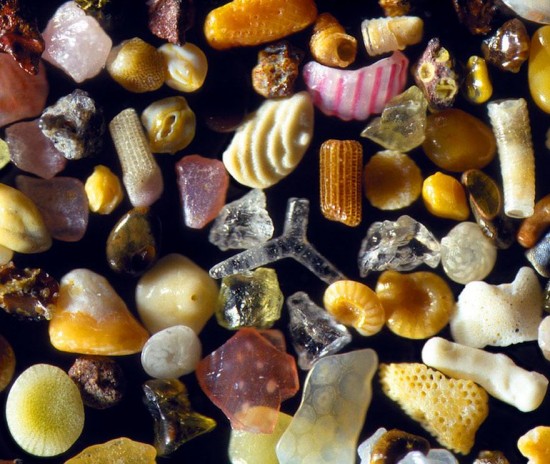
Gary Greenberg takes extreme close-ups of grains of sand:

“It is incredible to think when you are walking on the beach you are standing on these tiny treasures,” said Professor Greenberg, who has a PhD in biomedical research from University College London. He views these extraordinary particles at a magnification of over 250 times, exposing their real shapes – fragments of crystals, tips of spiral shells, bits of coral, or crumbs of volcanic rock. … He spends hours looking at thousands of tiny rocks through a high-powered light microscope. He sifts through them with acupuncture needles to find and arrange the most perfect specimens. Then he uses a painstaking technique to create his images.

“Extreme close up photography normally gives a very shallow depth of field so I had to develop a new process to make the pictures I wanted,” he said. “I take dozens of pictures at different points of focus then combine them using software to produce my images. Although the pictures look simple each grain of sand can take hours to photograph in a way that I am happy with.”

(Photo by Gary Greenberg. Previous Dish on sand here.)

The Ethics Of Eating

Julian Baggini’s new book The Virtues of the Table explores the subject:

He argues that the way we taste has a lot to do with other factors. He cites [gastronome Jean Anthelme] Brillat-Savarin’s observation that the pleasures of the table are not the pleasures of eating. We are less likely to enjoy our Nespresso, he suggests, if we know how it was prepared. This leads us to another level of taste: the sort we use when we express distaste at another’s ethics. He doesn’t use the word in that way, preferring to talk about “judgment” when urging us to make our own decisions about what to cook. As a philosopher, he feels the need to give us some criteria with which to make these assessments, and urges a balance between mind and body, arguing that food tastes better when we’ve thought about it.

Alex Renton describes a chapter on food and routine:

Routine, says Baggini, can be thought a virtue – Aristotle’s hexis, or habit, is an active condition, not a passive one. Routine and repetition are the key to kitchens great and small – whether it’s Baggini’s Italian grandmother preparing her fabulous ravioli at Easter, or a sushi shokunin practising his precise art. Some 30% of us, he quotes a recent survey, always have the same thing for lunch – is that a bad thing?

“There is nothing more tedious than culinary innovation for the sake of it,” Baggini concludes the chapter. “Every restaurant trend of recent decades, for example, has ended in a giant yawn… The knack is not simply to fall into routines and be limited by them, but to choose them well and hence be enriched and liberated by them.” This is interesting, arguable stuff and shows Baggini at his best, drawing from a glorious range of sources (I’m desperately trying to avoid a cooking metaphor here) to produce engaging thought.

Erica Wagner appreciates that Baggini considers the morality of eating meat:

[O]n our behalf he heads to an abattoir and describes in clear but not gruesome detail just what happens when a pig goes to slaughter. The conclusions he draws are rather more forgiving than those of Jonathan Safran Foer in his largely excoriating Eating Animals – but Baggini is not talking about factory farming here, rather about animals that have been raised humanely. But then, what does “humanely” mean, when it comes to animals? How much consciousness or awareness do they have? It’s a question Baggini considers too – though admitting that it’s impossible to know the answer. He decides, however, “that treating animals with respect is not incompatible with eating them”.

Meanwhile, John Crace provides a “digested read” for the book. Previous Dish on the philosophy of food here and here.

Red Hot Alternative Energy

Scientists who accidentally struck magma while drilling in Krafla, Iceland discovered a way to harness its energy:

“Drilling into magma is a very rare occurrence, and this is only the second known instance anywhere in the world,“ [researcher Wilfred] Elders said. The IDDP [Icelandic Deep Drilling Project] and Iceland’s National Power Company, which operates the Krafla geothermal power plant nearby, decided to make a substantial investment to investigate the hole further.

This meant cementing a steel casing into the well, leaving a perforated section at the bottom closest to the magma. Heat was allowed to slowly build in the borehole, and eventually superheated steam flowed up through the well for the next two years. Elders said that the success of the drilling was “amazing, to say the least”, adding: “This could lead to a revolution in the energy efficiency of high-temperature geothermal projects in the future.” …

The magma-heated steam was measured to be capable of generating 36MW of electrical power. While relatively modest compared to a typical 660MW coal-fired power station, this is considerably more than the 1-3MW of an average wind turbine, and more than half of the Krafla plant’s current 60MW output.

See the awesome power of lava engulfing cans of cola in the above video. Just imagine throwing Mentos in the mix.

Will Discrimination Rise With The Sharing Economy?

Matt Breunig worries it will:

Because successful firms have long tenures and many employees, it is easier to subject them to anti-discrimination laws. You can more easily prove that they are being discriminatory because you can present evidence of long-running patterns. They also have the organizational capacity to adopt and enforce anti-discriminatory policies internally.

All of this goes away in a sharing economy world where everyone is essentially an individual contractor selling directly to a consumer. The present slate of anti-discrimination employment laws do not reach Airbnb consumers or any consumer for that matter. They only really bind employers hiring employees into traditional firms. But more than that, it’s not obvious to me how you could practically restructure the law to reach people who directly purchase things through the sharing economy. What are you supposed to do: track their purchases and see how often they buy from sellers of a given race?

Previous Dish on the sharing economy here, here, here, and here.

Working Yourself Into The Ground

dish_pyllchart

Literally:

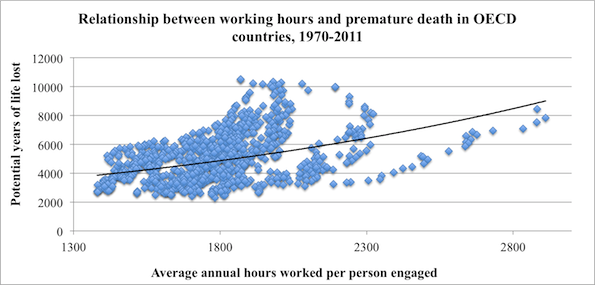
The graph … shows the relationship between working hours and “potential years of life lost” (PYLL), both of which were taken from the OECD. PYLL is a measure of premature mortality, which estimates the average number of years a person would have lived if they had not died prematurely. It gives more weight to deaths among younger people and may therefore be a better measure of mortality. The higher the value of PYLL, the worse. …

Longer working hours seem to lead to higher premature mortality. (For stats nerds: the strength of the relationship is significant, with an r-squared of 0.2). The implication that over-work is bad for you chimes with lots of research (such as herehere and here) which links long working hours with poor health. Stress, for example, can contribute to range of problems like heart disease and depression. That was, indeed, what the philosopher Bertrand Russell argued back in the 1930s. Overwork, said Russell, led to “frayed nerves, weariness, and dyspepsia”.

Texting With Many Tongues

Cellphone users in India must confront the challenges of texting legibly in a country with 22 official languages:

The narrow range of communication for Indians on the mobile Web has largely been ignored because, for years, India’s online population, nearly two hundred million people, has mostly overlapped with its English-speaking demographic. But the general prediction is that many of the next two hundred million Internet users, who will go online almost exclusively through smartphones, will not comfortably understand English. Phone manufacturers, eyeing this vast new market, have begun incorporating Hindi scripts into handsets like [48-year-old Bangalorean] Birsingh’s. However, since Hindi has twice as many vowels as English, and a wealth of consonants and character combinations, cheap phone hardware with traditional keypads still pose challenges. Reverie [Language Technologies]’s software platform, which underpins [texting app] Plustxt, aims to give local scripts the flexibility of English, providing text input for all twenty-two official Indian languages on phones, tablets, and TV top boxes. To demonstrate, [company director Arvind] Pani showed me one of Reverie’s newest products, an address book. At first, the names appeared in English. Then, with one click, they were rendered in the loop-the-loop characters of Malayalam, the language of Kerala, a south-Indian state.

Debating Woody Allen On Super Bowl Sunday

188110379ST037_Celebrity_Si

The only thing I can infer with absolute certainty from the anguished letter Dylan Farrow has written to the New York Times is that she is expressing incandescent rage. I cannot know from a distance what exactly is the reason for that rage, but she hates her former step-father adoptive father, Woody Allen, with an intensity completely compatible with child abuse, and hard to explain away entirely without it. You can see how truly she hates him from her opening and closing lines. These are sentences designed to do as much harm to Allen as he allegedly did to her – to pin the crime of child-rape onto every movie he has ever made, to obliterate his legacy as an artist by insisting that his entire oeuvre be viewed through the prism of his monstrousness. I can fully understand the impulse. Can’t you?

At first you think this is melodrama, but then you realize she is simply wielding the most lethal weapon she has:

What’s your favorite Woody Allen movie? Before you answer, you should know: when I was seven years old, Woody Allen took me by the hand and led me into a dim, closet-like attic on the second floor of our house. He told me to lay on my stomach and play with my brother’s electric train set. Then he sexually assaulted me. He talked to me while he did it, whispering that I was a good girl, that this was our secret, promising that we’d go to Paris and I’d be a star in his movies. I remember staring at that toy train, focusing on it as it traveled in its circle around the attic. To this day, I find it difficult to look at toy trains.

I’m not sure how, especially after reviewing the evidence Maureen Orth collected over twenty years ago, you manage not to believe Dylan Farrow – even though in every hugely dysfunctional family, there is more than one side. But the fact that Mia Farrow may be a few sandwiches short of a picnic doesn’t prove that Woody Allen isn’t a monster. And Farrow’s anguished yet vicious letter makes a lot of emotional sense coming after the Golden Globes’ celebration of Allen’s lifetime of achievement. Then there’s what we already know of Farrow’s behavior as a child:

Several times …  while Woody was visiting in Connecticut, Dylan locked herself in the bathroom, refusing to come out for hours. Once, one of the baby-sitters had to use a coat hanger to pick the lock. Dylan often complained of stomachaches and headaches when Woody visited: she would have to lie down. When he left, the symptoms would disappear. At times Dylan became so withdrawn when her father was around that she would not speak normally, but would pretend to be an animal.

These are classic indicators of abuse – along with plenty of other eye-witnesses to Allen’s creepy behavior around the girl.

And yet Dylan Farrow will, I’m afraid, fail in this case.

Not entirely. Re-reading that Orth piece and absorbing that letter definitely impacts my view of Allen as a whole. It reminds me again of who this man is. Like when we’re watching a Polanski or a Gibson movie, there will always be, for most of us, a tinge of guilt, even distant complicity, in admiring the craft of a man whose predilection for relationships was with women utterly under his totalitarian control. But the brutal truth is: we will move on. His art and his craft is so extraordinary in its range and scope and creative integrity that it escapes the twisted psyche that gave birth to it. It does things for us as viewers and as human beings that can eclipse the reality Dylan Farrow wants smack-dab in front of our eyes.

In some ways, I wish this weren’t so. It would be a less fallen and compromised world. But the human mind can, alas, live quite fully in places where the practical moral conscience seems irrelevant. And so it is essential to understand Heidegger’s foul complicity in the Third Reich but impossible to reduce his world-historical genius to it. That T.S Eliot was a rancid anti-Semite does not, frustratingly, dilute the perfection of the Four Quartets, nor does Philip Larkin’s racism alter the triumph of Aubade. Jefferson’s thought and career, for that matter, will always elude the facts of his ownership of human beings and intercourse with some of them. Perhaps with less essential talents, the sins may more adequately define the artist. But that, in many ways, only makes the injustice worse. Those with the greatest gifts can get away with the greatest crimes.

We can and should rail against this, while surely also be realistically resigned to it. It struck me, for example, rather apposite that as the blogosphere is debating whether to boycott Woody Allen’s films in the future because of this horrifying story, exponentially more people are tuning into the Super Bowl to watch a game we now know will render many of its players mentally incapacitated in their middle ages and beyond. We know that this spectacle is based on the premise of brain damage for many of its participants, but we watch anyway. Reforms in the game that might change the number of concussions are resisted by the fans as ferociously as by the owners. And in the excitement of the game, such things are so easy to obliterate from our minds. We forget that this massive industry knew full well what they were doing and yet subjected human beings to this fate for years. They abused people’s bodies and minds for money – and now we are required to celebrate their entire cult en masse for one night.

I imagine the family of a former football player whose brain was turned into swiss cheese by this organization might find it as painful to watch the Super Bowl as Dylan Farrow did to witness the Golden Globes. But we will watch anyway.

Humankind cannot bear very much reality. Or only so much. And only so often.

(Photo: Director Woody Allen is seen on February 1, 2014 in New York City. By NCP/Star Max/GC Images via Getty.)
Quote For The Day II

“I heard that Eastwood is saying that this will be his last film as an actor. There’s part of me that feels that way during almost every movie. On ‘Synecdoche,’ I paid a price. I went to the office and punched my card in, and I thought about a lot of things, and some of them involved losing myself. You try to be artful for the film, but it’s hard. I’d finish a scene, walk right off the set, go in the bathroom, close the door and just take some breaths to regain my composure. In the end, I’m grateful to feel something so deeply, and I’m also grateful that it’s over … And that’s my life,” – Philip Seymour Hoffman. RIP.

Faith On The Football Field

dish_supernaturalsports

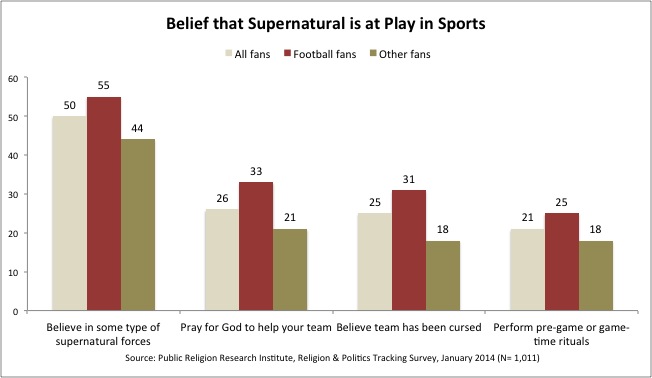
Jerry A. Coyne passes along the above chart:

This graph summarizes the data, with “average Americans” in tan, football fans in maroon, and other fans in olive. Now since the survey methodology reports a survey of 1,011 adults—not just sports fans—I assume that the data below represent a subset of those Americans who follow sports. But, according to the data, that is 89% of all Americans (I’m one of the other 11%). Yes, exactly half of the fans (and 55% of football fans) see supernatural influences in sports.

In an interview, Gregg Easterbrook is asked, “Does God participate in the National Football League?” Part of his answer:

To the extent that people believe that God controls outcomes—and I am a churchgoing Christian who does not believe that—then football games present you with a fast-moving morality play. The good guys should beat the bad guys; the virtuous athletes should succeed over the cheating athletes. If you believe that God controls outcomes, daily life is full of little morality plays—but most of them are hard to discern, whereas a football game is right on TV. You know what’s happening, you know who wins, you know which players you like and which players you don’t like. Athletics gives you a type of morality play for the presence of God’s active control in life.

Easterbrook also recently cautioned that it’s mostly not pro players who suffer the effects of game-related concussions:

What about high school concussions? Steven Broglio of the University of Illinois estimates prep football players sustain 43,200 to 67,200 concussions annually. That’s versus 80 to 100 concussions annually in the NFL, where the attention focuses. In high school there is usually no certified athletic trainer on scene (fitness trainers are nice but often unskilled in medical matters), nor ready access to neurologists. The only health insurance many high school players have is Medicaid, which is stingy about specialists; their parents or guardians may avoid doctors, fearing co-pays. The result is a head-injury double whammy: High-school concussions are far more frequent than NFL concussions, plus more likely to be mistreated (if treated at all).

Which Beer Is The Coldest?

The one in the fridge:

How cold a beer is has nothing to do with how it’s brewed and packaged and everything to do with whether and how long the consumer refrigerates it before drinking it. No thinking person would ever claim to like Beer Brand A more than Beer Brand B because Beer Brand A is colder. But beer advertisements aren’t geared toward thinking people—they’re geared toward thirsty people. Commercials that brag about beer’s coldness are a wildly unsubtle attempt to circumvent viewers’ rationality by appealing to their baser instincts. Whatever your level of media literacy, a bottle of beer that sheds fragments of ice as it’s slammed down on a countertop in slow motion looks pretty darn refreshing.