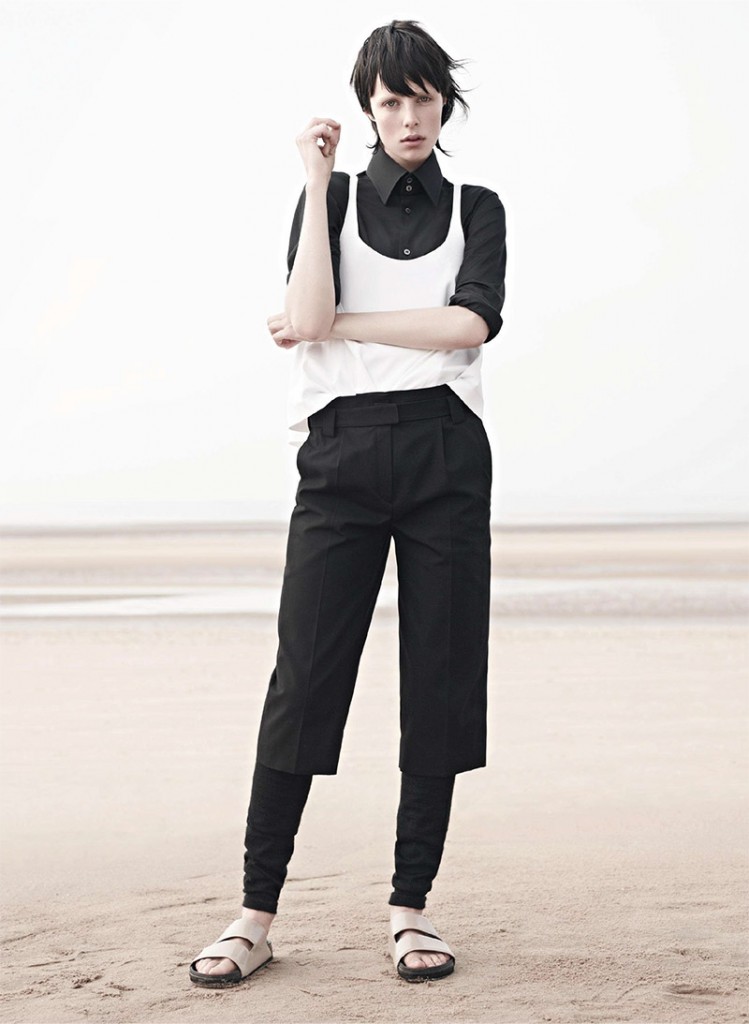
Fiona Duncan assesses a new fashion trend called “normcore,” which captures “self-aware, stylized blandness”:
By late 2013, it wasn’t uncommon to spot the Downtown chicks you’d expect to have closets full of Acne and Isabel Marant wearing nondescript half-zip pullovers and anonymous denim. Magazines, too, had picked up the look. T noted the “enduring appeal of the Patagonia fleece” as displayed on Patrik Ervell and Marc Jacobs’s runways. Edie Campbell slid into Birkenstocks (or the Céline version thereof) in Vogue Paris. Adidas trackies layered under Louis Vuitton cashmere in Self Service. A bucket hat and Nike slippers framed an Alexander McQueen coveralls in Twin. Smaller, younger magazines like London’s Hot and Cool and New York’s Sex and Garmento, were interested in even more genuinely average ensembles, skipping high-low blends for the purity of head-to-toe normcore.
Jeremy Lewis, the founder/editor of Garmento and a freelance stylist and fashion writer, calls normcore “one facet of a growing anti-fashion sentiment.” His personal style is (in the words of Andre Walker, a designer Lewis featured in the magazine’s last issue) “exhaustingly plain”—this winter, that’s meant a North Face fleece, khakis, and New Balances. Lewis says his “look of nothing” is about absolving oneself from fashion, “lest it mark you as a mindless sheep.”
Tori Telfer calls the trend both “refreshingly non-ironic” and “incredibly pretentious”:
People have been dressing à la normcore for years — they’re called parents, at least in popular clichés.
They dress like this because they genuinely don’t have time to think about fashion, not because they’ve decided not to care. And of course, fashion is an art form with a rich history, et cetera; implying that fashion is for anti-intellectuals is a pretty ignorant stance to take.
The true irony of normcore, like everything adopted by hipster-ish society, is that once you start to talk about it, it loses its authenticity. Steve Jobs was the apex of genuine normcore — he wore the same thing every day because it was convenient, which freed him up to change the world. But as soon as normcore is labeled, hashtagged, and analyzed, its idealism fails.
Jon Moy, meanwhile, is so annoyed by the trend that he turns to all-caps:
The only thing worse than making the argument that this is some sort of rally against the commodification and label-happy world of high fashion, is saying how you think “normal people” are more stylish than “fashion people”. Let me clear that up for you—STYLISH PEOPLE ARE STYLISH NO MATTER THEIR BACKGROUND. An editorial that features random people caught on Google Maps? Cool. Because if there’s one thing people love, it’s patronizing observations like “OMG normal people are so interesting.” NO THEY AREN’T. NO ONE WANTS TO BE REMINDED OF HOW THEIR LIVES HAVE GOTTEN AWAY FROM THEM AND HOW THEIR JOBS AND FAMILY RESPONSIBILITIES DON’T AFFORD THEM THE TEMPORAL AND MONETARY LUXURY TO OVERTHINK THEIR OUTFITS.
The truest and realest conclusion of Normcore? That we really are all the same no matter what we wear.
 The Dish