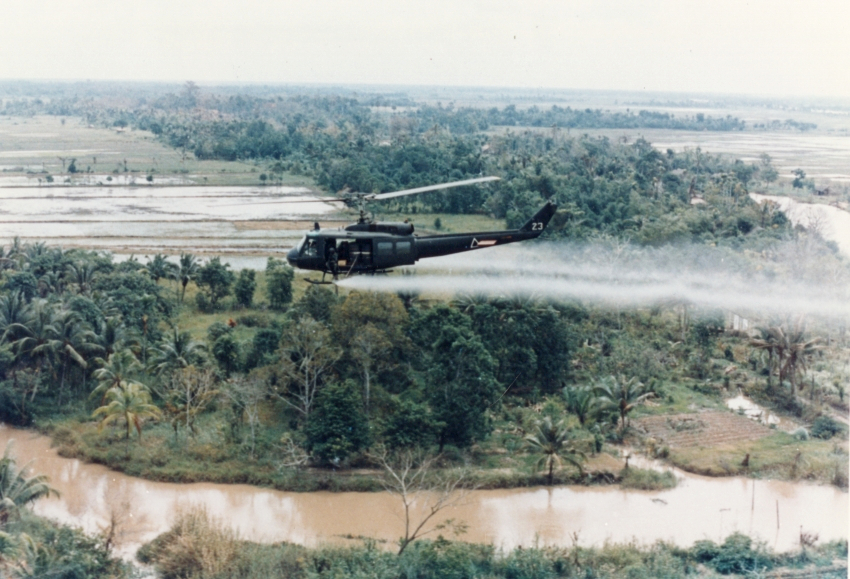
A new study suggests Agent Orange may have endangered Americans who worked with contaminated aircraft long after Vietnam:
A new study published in the journal Environmental Research reveals that Air Force reservists were exposed to higher levels of the toxic chemical than previously known (or
admitted). Many of the same aircraft that dispersed Agent Orange during the war were later used as transport vehicles during (relative) peacetime, primarily between the years 1971 and 1982. And tests taken many years after those transports show the planes still contained dangerous levels of the chemical. Initial testing of the planes after the war and before peacetime service was nonexistent.
The US Air Force and Department of Veterans Affairs have previously denied benefits to those exposed to the chemical from these planes, claiming it wasn’t a harmful level of exposure. Researchers have now proven this to be false. The study used the US Army’s own algorithms and samples taken from the aircraft to estimate how much the post-war level of exposure would have affected the body, with the results demonstrating that the levels in those aircraft were unacceptable under USAF and VA policies.
Lynne Peeples explains the implications:
Veterans who sprayed or handled Agent Orange herbicide during the war, or who spent any time on the ground in Vietnam, are automatically eligible for health care and disability compensation under federal Agent Orange legislation. The government presumes that certain conditions such as prostate cancer, Parkinson’s disease and Type 2 diabetes are a result of exposure to the chemical.
Linda Birnbaum, director of the National Institute of Environmental Health Sciences, told The Huffington Post that, in her opinion, the VA’s presumption should be expanded to include those who flew in the post-war planes. … “[I]t would be reasonable to assume that those who flew in these planes after the war were more likely to be exposed than those servicemen who had boots on the ground in Vietnam.”
Jim Stevenson recently spoke with Peter Sills, an attorney who wrote the book Toxic War:
STEVENSON: How were American veterans at that time being exposed [to Agent Orange] in harmful ways?
SILLS: When you start spraying towns and villages, there are American soldiers there too. That is part of it. The food that people ate became poisoned, and the water that people drank. There is another surprising thing: herbicides came in 50-gallon barrels. When they were emptied, they were not really empty. There were two or three gallons of herbicide left in the barrels. Soldiers used them for showers, for bar-b-ques (grills for cooking). Vietnamese used them to hold gasoline and wound up spraying dioxin all over Vietnam. The cities became defoliated even though they were never sprayed (from U.S. planes). They were sprayed by Vietnamese automobiles and motorcycles. No one could figure it out for a while. So people were exposed in surprising and unexpected ways.
STEVENSON: How many U.S. veterans are we talking about looking for some sort of compensation because of exposure to Agent Orange?
SILLS: Hundreds of thousands, possibly over a million. That is muddy unfortunately because there are so many people who are sick for reasons other than herbicide exposure. The symptoms of dioxin exposure, the poison in the herbicide, are not very different from what people get normally, heart attacks, diabetes, lung cancer, liver problems, neurological problems, things that people just get.
Previous Dish coverage of health risks in the military here.
(Image of U.S. Huey helicopter spraying Agent Orange over Vietnam via Wikimedia Commons)
 The Dish
