Readers comment on the ongoing crisis:
We have been failed deeply by the U.S. press on this conflict. If I single out the NYT, it is only because it is the newspaper I read most often, but the NYT has been uncritical in its coverage of the Maidan protests and obsessed with the personality of Putin and the question of Obama’s leadership. There has been very little attempt to explain Russia’s historical relationship with Ukraine; to critically evaluate Western political maneuvering in the region; or to analyze the actions taken by the Ukrainian interim government that have antagonized the population of eastern Ukraine. The French and British press are not much better (example here). This is not to excuse or exculpate Putin’s actions, but simple to insist that we have journalism that is critical and interested in facts, history and the ideological point of view of our putative adversaries rather than simply the pursuit of U.S. foreign policy goals.
In any case, I was very pleased to find your link to Anatol Lieven’s article, and your quote:
I fell prey to this myself, buoyed by obvious and instinctive support for any country resisting the boot of the Kremlin, and too blithe about the consequences of a revolution that overthrew a democratically elected president.
Thank you for including a fuller range of voices in this discussion. I really do believe that your ability to revise your judgment is why so many of us keep coming back to the Dish despite our disagreements with you.
Another isn’t as complimentary:
I don’t think your assessment of Putin is correct; I don’t think he is desperate or panicked. There are real reasons that Putin and Russia think the way they do and why they did what they did in Crimea. Think back to the beginning of the November protests.
They were instigated by a proposed trade union with Russia and fueled by a virulent strain of neo-Nazism and ultra nationalist sentiment. They toppled statues of Lenin, shouted anti-Russian slogans, and brought up memories of World War II. This sent a worrisome message to anyone who was Russian.
Then a deal was struck with Yanukovych, who admittedly did a poor job managing the crisis, and it was enough to keep him in power for another few months. But the right-wing protesters took objection to it, initiated some violence and, as often happens in these cases, it spiraled out of control. Yanukovych fled, and practically the first actions of the new parliament were to disband the Berkut (shades of Iraq circa 2003), vote to try Yanukovych in the ICC (which the Ukraine has not even acceded to), and outlaw the official use of Russian.
So what is Russia supposed to do? Whatever you might say about Putin or the Russian people, they are fiercely nationalistic. Putin’s first job is to protect the Russian people. An autocrat is nothing without his people, and if he isn’t going to do anything when there are visible and real threats to Russians in Crimea, then he isn’t worth anything as a president. What is happening in the Crimea is not the Sudetenland 1938; it is North Cyprus 1974. In fact, the parallels are eerily similar from the coup in Greece to the language used by Turkey and Russia.
Now the Turks were more blunt and direct in their confrontation than Russia, which is fortunate for Crimea, since no blood has been spilled. In fact, Russia’s language and actions have been very consistent – urging peaceful resolutions, not engaging in confrontations, etc. The only bellicose language is coming from the putsch regime in Kiev, which amounts to empty bluster.
President Obama has to be very careful not to misinterpret Russian actions here, which you seem to have done. Trying to “isolate” Russia is laughable: diplomatic impossible due to Russia’s seat on the Security Council, and even at the height of the Cold War American always kept an embassy in Moscow, and economically improbable given Europe’s reluctance to let go of Russian gas. Also, did you not write previously about how isolating an autocratic regime binds the people closer to that regime. This is your whole justification for talks with Iran, right?
Don’t fall into the Munich (Kagan, Kristol) Fallacy; not every international even is analogous to World War II. Let this scenario play out. Putin doesn’t want a war. I doubt he even wants the Ukraine now. What he wants is stability.
Another reader:
I appreciate that you don’t want to see us get militarily involved in the Ukraine (I don’t either), but your analysis seems to focus primarily on whether Russia was right or wrong to move in defense of the rights of ethnic Russians in the Ukraine. Take a step back: Russia has invaded a sovereign nation. We have treaties that recognize and protect the sovereignty of the Ukraine as its own country. Whether Putin has his reasons for protecting people there or not, he’s still moved his army into the Crimea and ordered the Ukraine forces stationed in that area to disarm.
This was only okay in early 20th-century politics. This is the kind of thing Iraq did with Kuwait, when it was run by someone who didn’t see how politics had changed since the end of the Cold War. And it’s really weird to see Putin make a similar mistake; he should be smarter than that.
I really hope that this can be worked out diplomatically, or that coordinated economic sanctions will be the worst that comes out of it. And we absolutely need to involve other countries and not act alone; we aren’t the only country that has recognized the Ukraine’s sovereignty and right to exist. But the Crimea can’t be left to Russia. If Putin is able to take advantage of turmoil in the Ukraine to swoop in and steal a part of their territory, it tells him (and other nations) that opportunistic military action against weaker countries is okay.
Just because we got away with it in Iraq (and we’re now regretting it) doesn’t mean we should ignore it when it happens now. At least with Iraq we spent months beforehand spreading disinformation to justify our actions; Putin doesn’t even have that.
Another:
This eagerness to dismiss Putin as crazy and foolish worries me. Scary and wrong as he may be, isn’t it possible Putin is crazy like a fox? Isn’t it possible he knows he’s losing a lot in the short term – whether it’s influence in the future Ukraine (arguably minimal regardless, as long as it’s ruled by a Western-oriented Kiev), or popularity in Europe (arguably irrelevant, as long he has so much gas to sell them) – but he doesn’t care, because the world’s outrage (outrage I tell you!) only guarantees everyone will tread lightly around him for ten more years? Surely these limited military moves (so far) buy him major fear points versus all kinds of enemies and frenemies, internally and internationally. If he mounts a full scale invasion, then he’s nuts, but if it’s anything shy of that – I think we have to ask ourselves if he’s not a far better chess player than anyone wants to admit.
This guy lets oligarchs get rich mostly to gather more power to himself, not to build the Russian middle class. Same with foreign investment. If you’re building a modern power structure where fake democracy married to provocative foreign policy serves your one-man-rule purposes best – and let’s face it, he’s one of the world’s most durable leaders of one of the most powerful countries – then maybe he’s playing his game the smartest way it can be played.
Another addresses the nuclear question:
Claiming that the Russian invasion of the Ukraine sends the message that one should never give up one’s nukes is far too facile. Russia didn’t invade the Crimea because Ukraine gave up its nukes. The Russians invaded because the Ukraine couldn’t get their shit together and were descending into a civil war. Do you really think Russia would be less inclined to invade if a nuclear armed Ukraine were coming apart at the seams? More likely is that Russia would step in and “secure” Ukraine’s nuclear arsenal with Europe’s blessing.
The Khadaffi situation is similar. We didn’t invade Libya once Khadaffi gave up his nukes. He was executed by his own people after a popular revolt. Don’t fall for this neo-con nonsense. The arguments have a veneer of truth that fades away as soon as they are subjected to scrutiny.
One more reader:
My ex-husband is an ethnic Russian from Cherkassy (a small city on the Dnieper, about 100 miles outside of Kiev), so our 4-year old son is 1/2 Russian-Ukrainian (the term my ex uses to refer to himself) and our son’s grandparents live there. We don’t communicate much, and when I broached the subject two weeks ago (his parents are planning a trip here at the end of March, and I’m concerned that they either won’t make it here or won’t make it back) he downplayed it – conflicts in Kiev are localized, what is happening on Independence Square is far from the ideas of majority of “normal Ukrainians”. I haven’t been in touch since because I imagine he’s not happy about how things are going (he has praised Putin in the past, and he does consider himself a Russian before Ukrainian) and frankly I’d rather avoid him (we divorced for a reason!). But I do worry about his parents, who are sweet, lovely folks, and recent events make me aware just how little I understand about my son’s family’s complicated social and political background.
So thanks for putting the coverage where I’m guaranteed to see it. A founding subscriber, I check the Dish several times a day.
More reader commentary on our Facebook page.
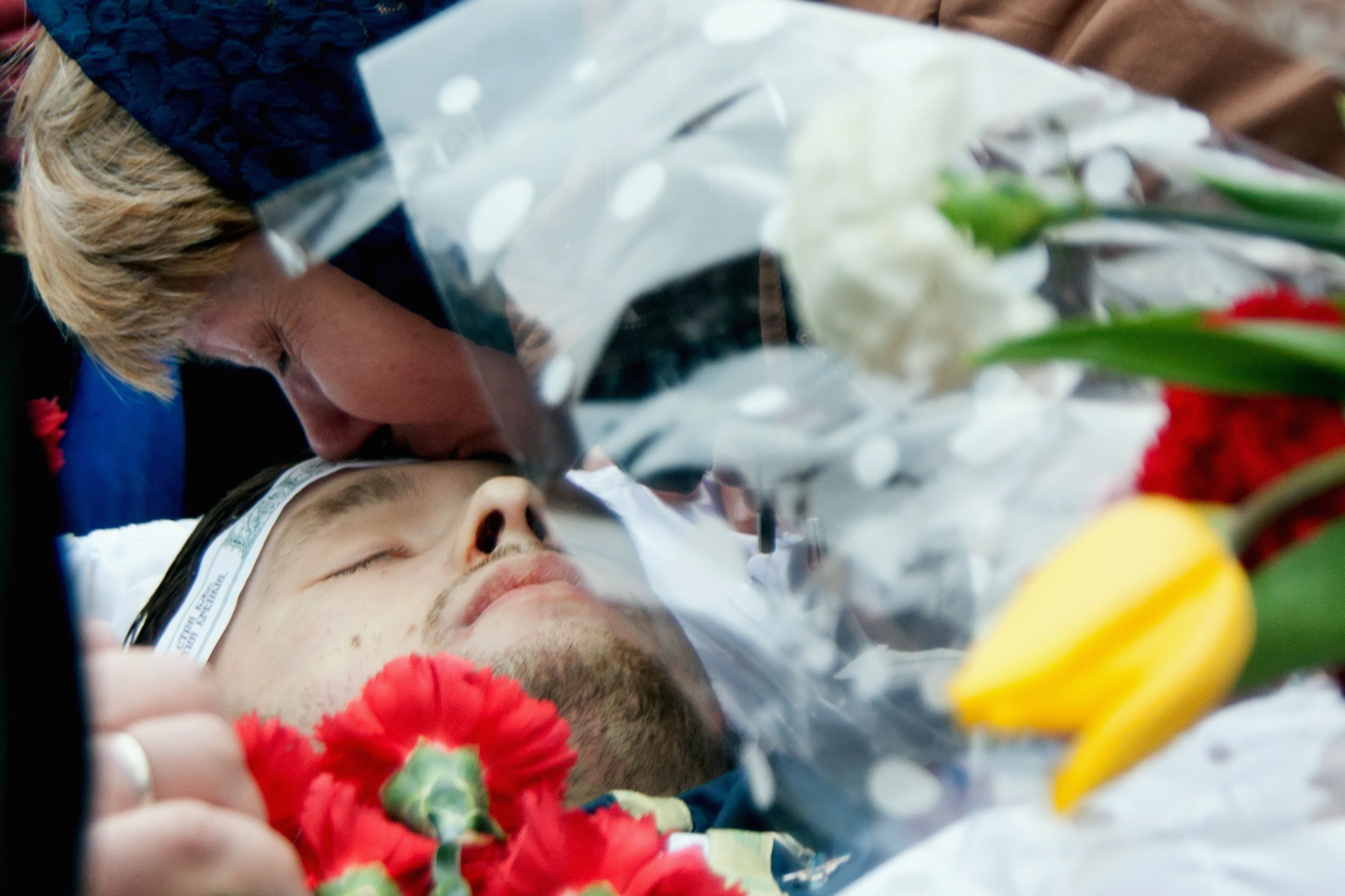
(Photo: Around 3,000 people attend the funeral ceremony of Vlad Zubenko, who died during the anti-government protests at the Independence Square, on March 2, 2014. By Sofiya Bobok/Anadolu Agency/Getty Images)
 The Dish