Philip Bump highlights some of the proposals in the 2015 budget the White House released yesterday:
Remove tax loopholes for the wealthy. Obama calls for taxing certain hedge fund and private equity earnings as income instead of capital gains, which are taxed at a lower rate, as Time reports. It would also eliminate a loophole that lets some individual income be claimed as corporate profit to avoid payroll taxes.
Enact the “Buffett Rule.” The by-now-infamous Buffett Rule would ensure that those making more than a million dollars in income annually pay the same amount in taxes as those in the middle class. The various tax changes proposed would result in about $1 trillion in new funding, according to The Washington Post.
An expansion to the earned-income tax credit for low-income taxpayers. As USA Today notes, the Obama proposal would expand the EITC to cover people aged 21 to 24, 65, and 66. In total, 5.8 million more Americans would be eligible for the credit. In addition 7.7 million would see an expanded EITC, which reduces the amount of taxes owed.
David Graham sees the budget as a political document:
If 2013 was the year of Eternal-Optimist Obama, who felt residual buzz from his reelection and held out hope Republicans might go for a compromise, Election-Year Obama’s attitude is blunter and bleaker: Fine, if you don’t won’t meet me halfway, I’m not going to put my neck out. I’ll just ask for what I want. After all, this budget is dead on arrival. Republicans showed no interest in compromising last year, and they’re even less inclined to partner with the president in an election year.
The EITC expansion, Danny Vinik points out, could be bait for Republicans. But Chait doubts the GOP will bite:
So now that Obama is agreeing to do what conservatives have been begging, Congress will quickly whisk this plan to the president’s desk, right? Ha, ha – of course not. …
In theory, the two sides might agree to combine the mutually agreeable EITC expansion with Obama’s compromise proposal to scale back cost of living increases for Social Security recipients. But this sort of bargain presupposes a functional Congress with an incentive to engage in cooperative lawmaking. All the incentives push in the opposite direction. And so, in the end, Obama’s embrace of Republican proposals to expand the EITC will likely wind up serving the sole function of calling their bluff.
Drum agrees:
Yep. This is one of the reasons I support an increase in the minimum wage: Republicans may oppose it, but they oppose the EITC even more. That’s because corporations absorb the cost of the minimum wage while the EITC is funded by taxes—and Republicans will never, ever, ever agree to raise taxes in order to fund an EITC increase. Combine this with the fact that the public is strongly in favor of raising the minimum wage but probably thinks the EITC is a communicable disease or something, and this means that even though the odds of getting Republicans to vote for a minimum wage increase are slim, they’re still better than the odds of getting them to vote for an EITC increase. The fact that the EITC is theoretically more conservative really doesn’t matter.
Christopher Ingraham explains how the budget spends so much and still claims to reduce the deficit:
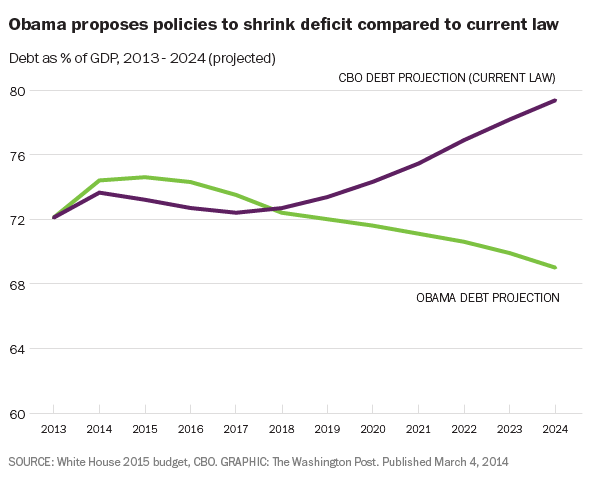
In his budget request, Obama projects public debt as a percentage of gross domestic project falling to 69 percent by 2024, while the CBO has it rising to 79 percent — a difference of 10 percentage points, or roughly $2.7 trillion.
This is largely because Obama assumes the passage of legislation that the CBO doesn’t, and he assumes those laws will generate far more revenue over the next decade. In 2024, the spending/revenue gap (i.e., the annual deficit) in Obama’s budget amounts to 1.6 percent of GDP. CBO’s projected deficit is more than twice that, at 4 percent of GDP.
The difference lies largely on the revenue side – Obama assumes hearty revenue increases coming from the elimination of tax breaks benefiting the wealthy.
Philip Klein tallies the tax increases envisioned in the budget:
These all add up to over $1.2 trillion. But pinning down an exact number for tax increases is difficult because, as Ryan Ellis of Americans for Tax Reform has detailed, there are a lot of moving parts in the budget and the administration’s presentation of its tax proposals is messy and opaque.
The proposal also includes various changes to mandatory spending programs that have implications for revenue; assumes more revenue by strengthening tax compliance; and it estimates another $456 billion of revenue from enacting immigration reform on the assumption that newly legalized immigrants would be paying more taxes.
Nicole Kaeding pans the budget for raising both spending and taxes:
Over the ten-year budgetary window, the President spends $171 billion more than Congressional Budget Office (CBO) projections. The budget also does not reach balance and runs deficits every single year. According to Obama’s budget, the federal government will collect $3.3 trillion in tax revenue this year, more than any other year in history. The budget includes $650 billion in new revenue though various distortionary tax hikes.
Vinik criticizes the budget from the other side, for doing too little to help the long-term unemployed:
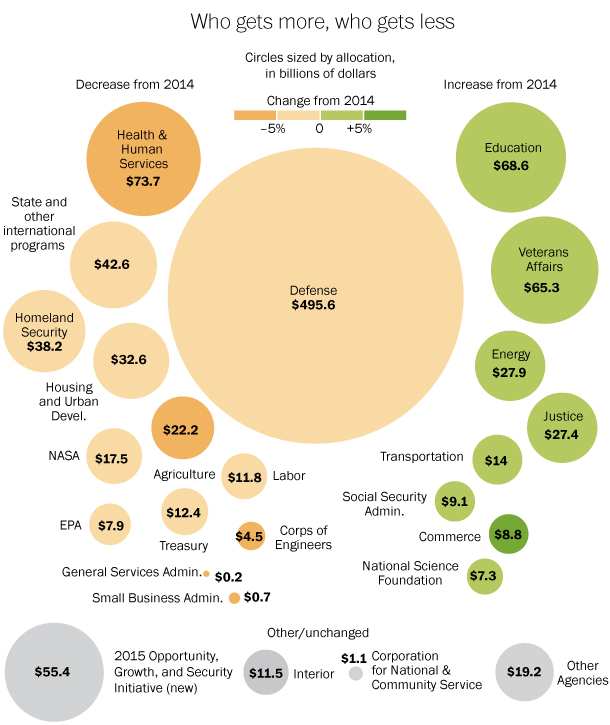
The budget does include $4 billion for a public-private partnership, designed to provide the long-term unemployed with job training so that they can rebuild skills that may have deteriorated while they’ve been out of work. It also includes a new “Opportunity, Growth and Security” initiative to invest in critical areas like research, education and public safety. More than 80 percent of the $56 billion that the White House proposes for this initiative would be spent in the first two years and some of it will certainly create new jobs. But given the current rate of long-term unemployment, that’s simply not enough. There are other smart ideas targeted at finding the long-term unemployed jobs—ideas that even have a chance at becoming law. The White House could have put them forward.
(Chart via Zachary Goldfarb)
 The Dish