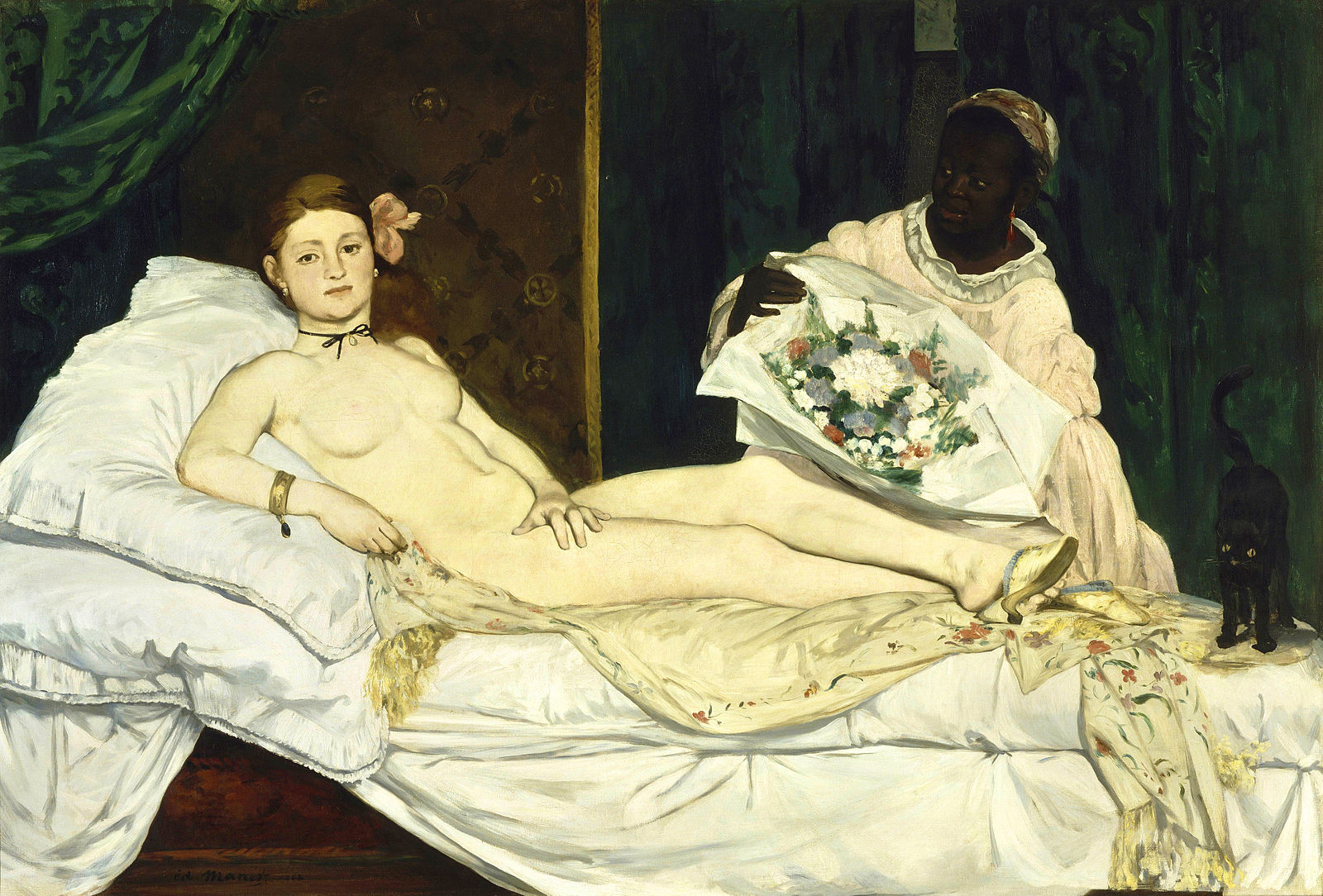
Roger Scruton frowns on “scientism,” which he describes as involving “the use of scientific forms and categories in order to give the appearance of science to unscientific ways of thinking.” The arts and humanities, he insists, lie beyond the reach of the empirical:
Art critics have a discipline, and it is one that involves reasoning and judgment. It is not a science, and what it describes forms no part of the physical world, which does not contain Olympia or anything else you see in Manet’s painting. Yet someone who thought that art criticism is therefore deficient and ought to be replaced by the study of pigments would surely be missing the point. There are forms of human understanding that can be neither reduced to science nor enhanced by it.
Here is where the neurothugs step in, to declare that, of course, the science of pixels won’t explain pictures, since pictures are in the eye of the beholder. But there is also such a thing as the fMRI of the beholder, and this does contain the secret of the image in the frame. Since understanding a picture is a matter of seeing it in a certain way — in such a way as to grasp its visual aspect, and the meaning which that aspect has for beings like us — then we should be examining the neural pathways involved in seeing aspects, and the connections that link those pathways to judgments of meaning.
But what, exactly, would such a study show?
Suppose we have achieved a perfect decipherment of the pathways involved in seeing an aspect and in stabilizing it in the mind of the observer. This is not a judgment of criticism, and while it might enable us to predict that the normal observer will, on confronting Titian’s picture, see a naked woman lying on a couch and looking at him, it will say nothing in answer to the critic who says: Yes, but that is not all that there is, and indeed you must see that this woman is not naked at all, but rather unclothed, that her body, as Anne Hollander shows so convincingly in Seeing Through Clothes, has the texture and the movement of the clothes she has removed, and that those eyes do not look at you but look through you, dreaming of someone you are not.
Critics don’t tell us how we do, with normal equipment, see things, but how we ought to see them, and their account of the meaning of a picture is also a recommendation, which we obey by making a free choice of our own. Neuroscience, then, remains only a science: it cannot rise to the level of intentional understanding, where meaning is created through our own voluntary acts. Hence we should not be surprised at the dreariness of neuroaesthetics, and its inability to cast light on the nature or meaning of works of art.
(Image of Olympia by Manet, 1863, via Wikimedia Commons)
 The Dish
