Katya Gorchinskaya points out that Crimea’s independence referendum doesn’t allow voters to choose the status quo:
The ballot asks two questions and leaves no option for a “no” vote. Voters are simply asked to check one of two boxes: Do you support joining Crimea with the Russian Federation as a subject of Russian Federation? And: Do you support restoration of 1992 Crimean Constitution and Crimea’s status as a part of Ukraine? That Constitution declares that Crimea is an independent state.
Steve Saideman calls this further evidence that the vote is a sham:
So, why bother with such a clearly illegitimate referendum? Authoritarian regimes have a long history of sham elections which provide some kind of domestic legitimacy to their rule.
To be fair, Russia’s elections have not been shams. Those for who governs in Russia, anyway. For those who govern in the frozen conflicts? Not so much. Still, those who disrespect democracy still feel compelled to use the guise of democracy to appear less authoritarian and more legitimate. It may not play well outside of Russia, but it might do ok within.
Indeed, some scholars have found that these kind of elections can be used to scare the opposition. That is, holding such an event puts opponents in difficult positions, as the fakeness may actually suggest that the government is strong, rather than weak.
Daniel Berman believes the outcome is predetermined:
The Crimean Parliament, in deciding to hold the referendum, a decision made with the help of Russian troops who removed the 36 traitors who had infiltrated the 100-man assembly, has by its own admission already decided upon accession to the Russian Federation. As the decision has already been made, the current election is a mobilization election – its objective is not to poll the population for its opinions, those are neither wanted nor desired, but rather to demonstrate to the wider world irreversibility of the decision on annexation, and the futility of efforts to reverse it. The campaign that is currently being run therefore aims to produce the highest possible turnout with the highest possible margin in support. The opinions of foreigners regarding its legitimacy are irrelevant – there will be no effort made to allow for a credible showing by the NO campaign. On the contrary, the No campaigners, by virtue of the their insistence on opposing the referendum, are demonstrating their desire to not be part of the new Crimea. It only makes sense then for the Russian forces to drive them out early.
Monitoring, Erik Voeten explains, won’t ensure the referendum is really free:
The problem is that there are many ways to manipulate an election. For example, Chris Blattman reports on a new paper, which shows that politicians simply relocate fraud from polling stations where monitors are present to places where they are not.
Even more troublesome, Alberto Simpser and Daniela Donnofind evidence that high-quality election monitoring induces governments to resort to tactics that may have long-term negative implications for democracy. Rather than simply stuff ballot boxes, which is easy to identify, governments rig courts and administrative oversight bodies or suppress the media. Indeed, Simpser and Donno find that high-quality election monitoring is correlated with subsequent declines in the rule of law, administrative performance and media freedom.
Posner advises letting Russia take the peninsula, from which it has little to gain:
In the end, Crimea—a poor, tiny region with a potentially unruly minority population of unhappy Tatars and resentful Ukrainians—is a booby prize in the contest over Ukraine. And in fact, Russia has lost that larger fight; Ukraine, more populous than Poland, is now permanently outside its orbit. Russia has no friends and only a handful of allies of convenience. Back in 2008, when Russia tried to persuade the world to recognize Abkhazia and South Ossetia as independent states, only Nicaragua, Venezuela, Nauru (population 9,000), Vanuatu (population 262,000), and Tuvalu (population 11,000) heeded the call (and Vanuatu later changed its mind). By contrast, the United States’ illegal military intervention in Serbia, a Russian client state, enabled Kosovo to break away and form a state with the support of the United States and more than 100 other countries. Today, Russia can call on Syria, Belarus, and Cuba for diplomatic support. It is a declining state that can do little more than bully a few impoverished and geopolitically insignificant neighbors. Let it.
Meanwhile, Keating situates Crimea within the long-running debate over self-determination vs. territorial integrity:
It’s true that Washington’s insistence that Ukraine’s territorial integrity be respected seems a bit incongruous with its support for the independence of, say, Kosovo or South Sudan. And Russia has certainly exploited the Kosovo precedent in its bids to gain international recognition for Georgia’s breakaway regions—Abkhazia and South Ossetia. On the other side, Russia has spent recent years talking itself blue at the U.N. Security Council about respecting territorial sovereignty in places like Libya and Syria but is willing to send its military into the territory of its neighbors on the pretext of protecting the rights of ethnic Russians—which is one possible reason why China’s been fairly tepid in its support for Russia’s actions.
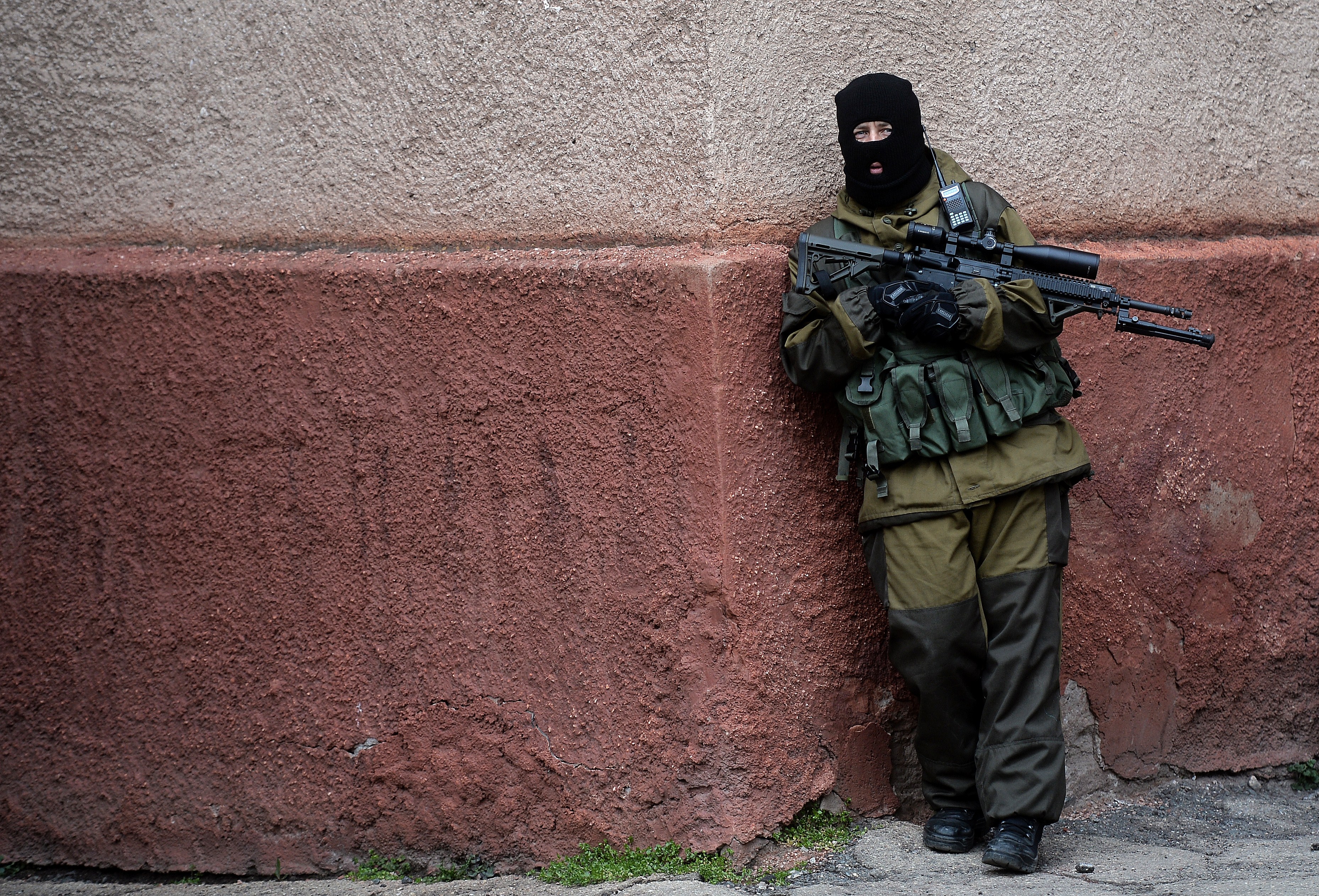
(Photo: A member of the new pro-Russian forces dubbed the ‘military forces of the autonomous republic of Crimea’ stands guard in the Republican military enlistment complex in Simferopol on March 10, 2014. Crimea’s pro-Russian authorities sought to boost their claim to break from Ukraine Monday as volunteer soldiers swore an oath of allegiance in front of prime minister Sergei Aksyonov. He told journalists 186 volunteers had so far joined the new Crimean ‘self-defence’ units after pro-Moscow forces took power in the region and announced their intention to join with Russia, with a referendum planned for Sunday. By Filippo Monteforte/AFP/Getty Images)
 The Dish