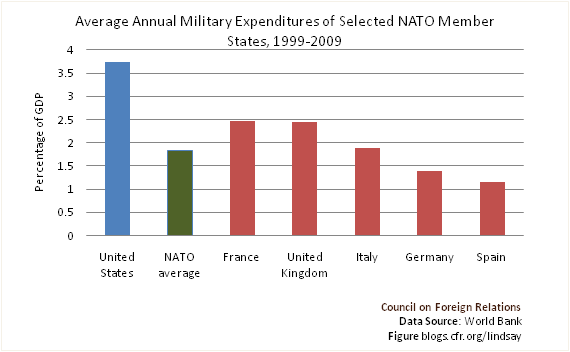
Looking at the long-term implications of the Ukraine crisis, Doug Bandow thinks “Washington should force Europe to take over responsibility for its own defense”:
In early March the administration undertook what Secretary of State John Kerry termed “concrete steps to reassure our NATO allies.” Actually, Washington should adopt the opposite strategy. America’s friends should understand that if they are not willing to defend themselves, no one else will do so.
At the same time, Washington should rethink nonproliferation policy. It’s too late for Ukraine, but Kiev gave up Soviet nuclear weapons left on its soil in return for paper border guarantees. Possession of even a handful of nuclear-tipped missiles would have changed Moscow’s risk calculations.
But Ted Galen Carpenter doubts the Europeans are willing to boost their defense budgets:
Even Russia’s jarring actions in Ukraine are unlikely to dislodge the NATO countries from their fondness for free-riding on the security exertions of the United States. The Baltic republics and other nations directly on Russia’s border have made some comments about the need to increase their military spending, but only time will tell whether they turn out to be more than yet another episode of empty talk. And the major Western European powers show few signs of altering their policies or budgets.
Indeed, even the vulnerable Eastern European countries are spending more energy trying to get the United States to enhance its military commitment to the region than they are on boosting their own defenses. Lithuanian President Dalia Grybauskaite, for example, warns that “Russia is a threat to the whole of Europe, and Europe must understand what it is dealing with.” However, just a few years ago, she led efforts to cut Lithuania’s already meager defense budget. Today, the country spends barely 0.8 percent of GDP on defense.
Also, as Carlo Davis points out, the US doesn’t devote nearly as much of our military might to NATO as we used to:
NATO relies heavily on the United States to project power and deter external threats. The U.S. provides 22 percent of NATO’s common-funded budget and is the organization’s largest member—its military spending represents nearly three quarters of all NATO members’ military spending combined. As a result, notes Stratfor Chairman George Friedman in his prescient book The Next 100 Years, NATO’s collective defense guarantee is “effective only if the United States is prepared to use force.”
Concerned Poles and Balts seeking hard evidence behind America’s rhetorical support for NATO are bound to be disappointed. Obama’s “pivot to Asia” is only the latest stage in a multi-decade drawdown of U.S. forces in Europe. Only 64,000 U.S. troops are currently stationed there, compared to 450,000 at the height of the Cold War. And U.S. military forces have never been deployed east of the Oder River, which forms the boundary between Germany and Poland. Even planned U.S. missile defense shields for Poland and the Czech Republic were cancelled as part of Obama’s attempted reset with Russia in 2009.
Jeffrey Tayler argues that Putin is right to be suspicious of NATO’s machinations in its neighborhood:
As the nuclear standoff between the two superpowers waned, the West’s most powerful military alliance, the North Atlantic Treaty Organization (NATO), has expanded three times, despite President George H. W. Bush’s apparent promise to Soviet leader Mikhail Gorbachev not to enlarge the group. NATO inducted the Baltic states in 2004, and laid the groundwork for the membership of Ukraine and Georgia. Yanukovych scuppered such plans relating to Ukraine in 2010, but deputies of the new Ukrainian parliament have just introduced a bill proposing the country again seek membership.
The Soviet Union is no more, but the entity created specifically to counter its military might thrives, as has the Pentagon’s budget, which increased relentlessly until 2011, topping $700 billion. Furthermore, in 2002, the United States withdrew unilaterally from its treaty with Moscow banning anti-ballistic missiles and plans to station such missiles in Eastern Europe. The conclusion Putin has drawn? The United States is bent on maintaining and increasing its hegemony — at Russia’s expense.
(Chart from James Lindsay)
 The Dish