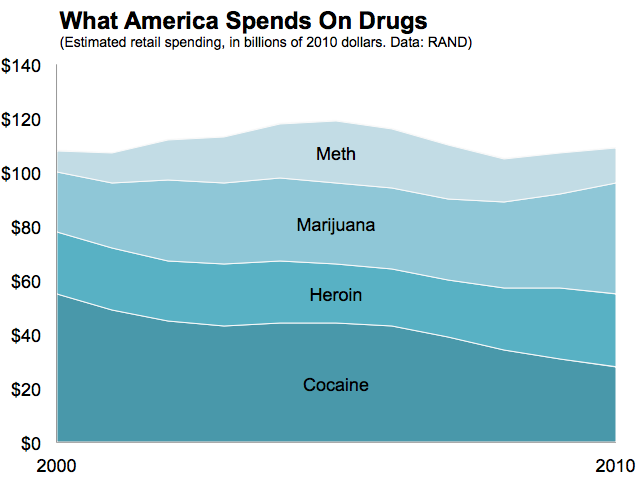
John Tozzi outlines the findings of a RAND Corporation study estimating that Americans spent $109 billion on illegal drugs in 2010:
To put that number in perspective: It’s more than we spend at furniture stores ($90 billion) or electronics and appliance retailers ($101 billion) annually, according to U.S. Census data. It’s more than one-fifth of what we spend eating out each year, and it dwarfs the $21 billion we drop at bars.
Most of that $109 billion is spent by what the RAND report calls “the minority of heavy users,” who get high during at least 21 days of a month. And while the total dollars spent (adjusted for inflation) remained roughly stable from 2000 to 2010, the mix has changed. Cocaine use has gone down; marijuana use has gone up. Meth peaked in the middle of the Aughts, though the report’s authors caution that the meth numbers are less reliable than other estimates.
Zoë Schlanger discusses the study’s limitations:
[G]athering data on undocumented dollar amounts spent on illegal drugs is extremely difficult. RAND’s numbers acknowledge a significant amount of uncertainty. For example, RAND’s best estimate of marijuana spending in 2010 is $41 billion, but it pegs the possible range of spending at $30 billion to $60 billion. For cocaine (crack and powder) RAND’s best estimate is $28 billion, with a range of $18 billion to $44 billion.
“Since there are many other sources of uncertainty, readers should not consider these as lower or upper bounds or as 95-percent confidence intervals,” the report reads. “The range should be considered plausible, but not extreme.”
Noting that the study counted far more regular heroin users than the National Survey on Drug Use and Health, Mike Riggs compares the data sources:
[R]esearchers suggest that one reason for this disparity may be that the NSDUH survey underestimates heroin use by an eye-boggling amount. “Estimates from the 2010 NSDUH suggest there were only about 60,000 daily and near daily heroin users in the United States,” drug policy researchers Beau Kilmer and Jonathan Caulkins, both of the RAND Corporation, wrote in a recent editorial. “The real number is closer to 1 million.” …
Kilmer and Caulkins came up with their much higher figures for heroin and hard-drug use by combining county-level treatment and mortality data with NSDUH data and a lesser known government survey called the Arrestee Drug Abuse Monitoring Program. Instead of calling people at home and asking them about their drug use, the ADAM survey questions arrestees when they’re being booked and tests their urine. “ADAM goes where serious substance abuse is concentrated — among those entangled with the criminal justice system, specifically arrestees in booking facilities,” Kilmer and Caulkins write.
 The Dish