by Patrick Appel
The Guardian worries about the situation:
There can be few better symbols of Libya‘s post-Gaddafi trauma than the plight of the oil tanker Morning Glory. On 11 March, the North Korea-registered ship slipped out of the Libyan port of Es Sider during a storm and headed out into the Mediterranean. It was under the command of a group of rebels from Libya’s most oil-rich region, Cyrenaica, who intended to sell its £20m cargo of crude to help fund an autonomous government.
The Libyan navy, whose capital ships are mostly at the bottom of the sea following Nato’s 2011 air campaign, was unable to stop it, as was the air force, which was in a state of near-mutiny. After Morning Glory had shouldered its way out into international waters, the Islamist-dominated Congress in Tripoli sacked the country’s long-suffering prime minister, Ali Zeidan, with whom it had been at loggerheads, and he fled to Germany. On Monday, US navy Seals seized control of the Morning Glory near Cyprus, and began to sail it back to a Tripoli-controlled port.
Christian Caryl weighs in:
Libya is in urgent need of help.
The post-Qaddafi government, chosen by the people in free and fair elections, is struggling to survive challenges to its power from myriad armed militias, Islamist death squads, and regional separatists. All of these forces share an interest in keeping the central government destabilized and weak. None of them wants to see democracy succeed. So even though it can genuinely claim a genuine democratic mandate, the government’s writ is shrinking by the day.
Recently, the biggest challenge to the central government’s authority has come from so-called “federalists,” armed groups who are demanding far-reaching autonomy for Cyrenaica, Libya’s easternmost region. The federalists, led by Ibrahim Jathran, don’t seem to be especially interested in negotiating with the government in Tripoli; instead they’ve tried to blackmail it into accepting their demands by seizing oil installations in the region and declaring that they’re going to sell off the resources under their control.
Wayne White thinks “it’s time for Western and Arab governments that came together to support Muammar Qadhafi’s overthrow so robustly to make a strenuous effort to help salvage the mess that has developed since”:
Of concern to the international community is that as long as so much of the country remains beyond central authority, a large amount of arms from Qadhafi’s former arsenals will continue flowing across Libya’s borders. A panel of UN experts recently submitted a 97-page report to the Security Council stating that Libya has “become a primary source of illicit weapons.” The panel is investigating alleged shipments to 14 countries. A number of its findings relate to attempts to transfer particularly dangerous shoulder-fired surface-to-air missiles. One such shipment, stopped by Lebanon, was bound for Syrian rebels.
Moreover, especially lawless portions of Libya like the desert southwest and some areas in the east adjacent to Egypt serve as safe havens for Islamic extremist elements staging from Libyan territory into neighboring states or assisting foreign jihadists. This has been true of al-Qaeda in the Islamic Maghreb (IQIM) elements lunging into Algeria and Mali, other groups supplying munitions to militant elements in Egypt following the suppression of the Muslim Brotherhood, and shipments into Tunisia aiding terrorist cells there.
Meanwhile, Raphael Cohen and Gabriel Scheinmann tally the costs of America’s intervention in the country:
The President may have billed the war as less costly than a fortnight in Iraq—approximately $1.65 billion with no American lives lost—but the total cost of the war and its aftermath is far higher. First, Libyan oil and gas production, which accounts for 96% of total government revenue, remains far below pre-war levels. Having produced on average 1.65 million barrels per day (bpd) of high-quality light, sweet crude oil before the war, Libya’s oil production today is at 230,000 bpd as militias and protests over revenue distribution have wreaked havoc on the energy industry. Just last week, after being ousted for failing to stop the independent export of oil by Eastern rebels, Libyan prime minister Ali Zeidan fled, seeking refuge in Europe. Second, without an effective means of securing Gaddafi’s fifteen to twenty thousand Soviet-era MANPADS, many of these weapons have found their way into other regional conflicts. They are likely responsible for the downing of an Egyptian military helicopter in the Sinai and have been used by militant groups across the region. More broadly, Libyan-trained extremists have found their way into conflicts from Syria to Mali.
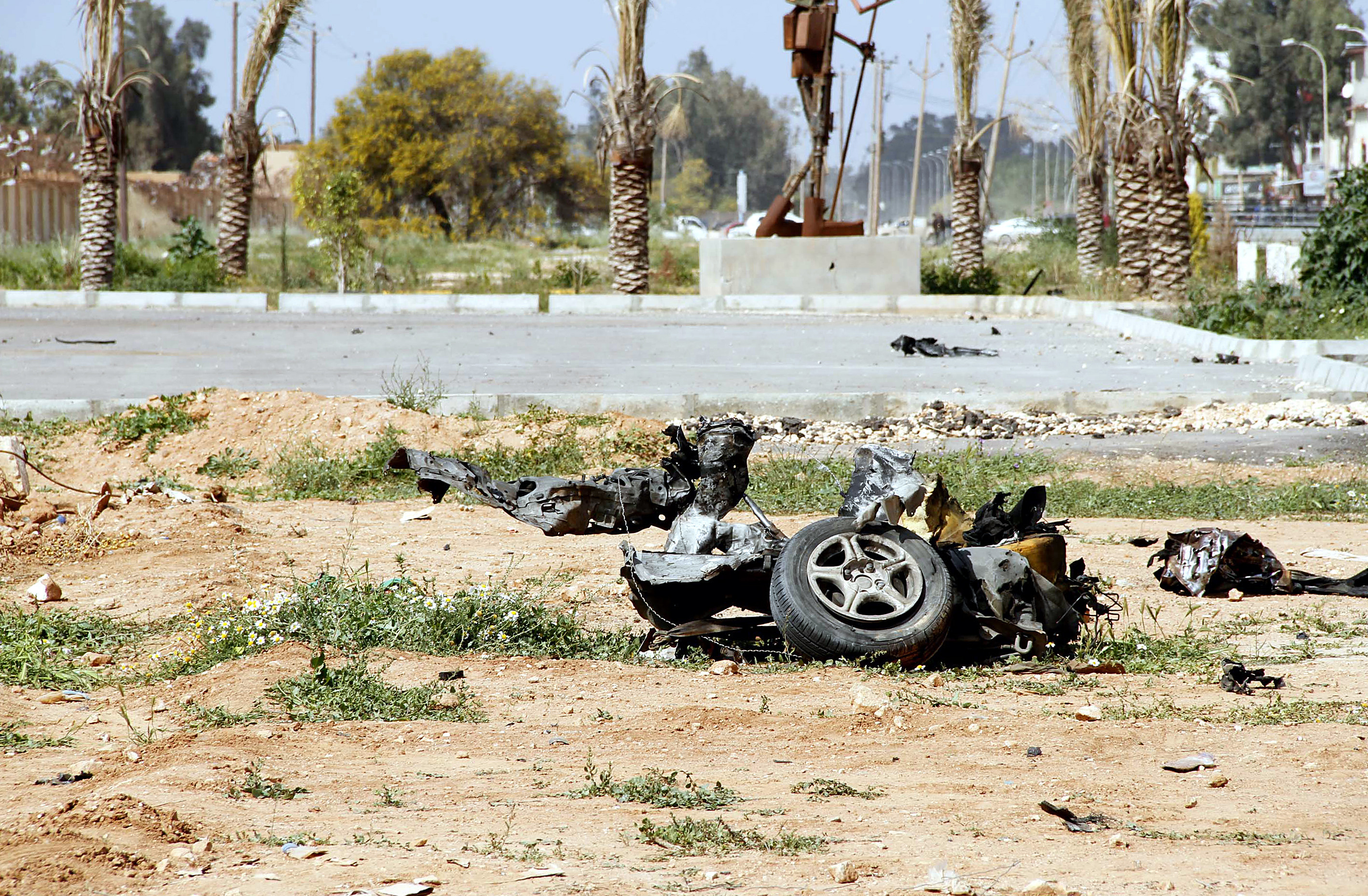
(Photo: Wreckage from a car bomb that killed at least 8 and injured many others in Benghazi, Libya on March 17, 2014. By Mohammed Elshaiky/Anadolu Agency/Getty Images)
 The Dish