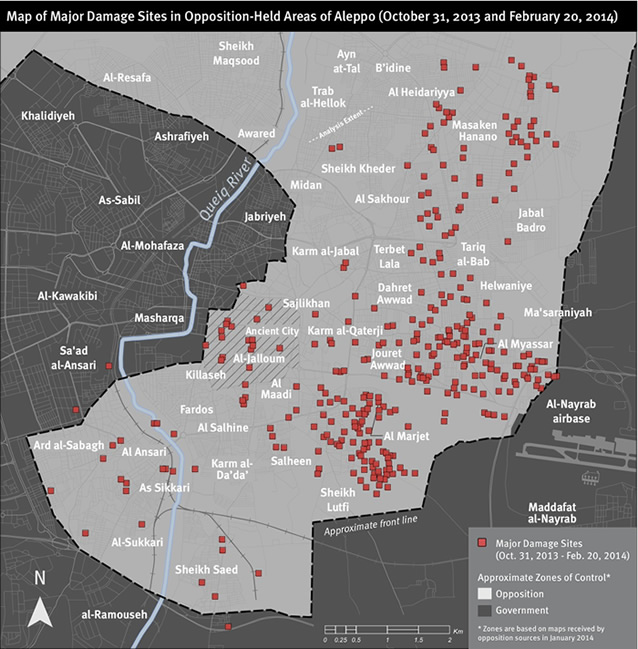
Human Rights Watch decries Assad’s use of the weapons:
Using satellite imagery analysis, Human Rights Watch identified at least 340 distinct sites in Aleppo city’s opposition-held neighborhoods that were damaged between early November and February 20, the date of the most recent image reviewed. The majority of these identified sites have damage signatures that are strongly consistent with the detonation of barrel bombs – unguided high explosive bombs, which are cheaply made, locally produced, and typically constructed from large oil drums, gas cylinders, and water tanks, filled with high explosives and scrap metal to enhance fragmentation, and then dropped from helicopters.
Lama Fakih, a researcher at HRW, wants the international community to do more to stop these bombs. She talked to Syrian refugees:
Most were leaving Syria because of the barrel bombs that were raining on Aleppo and the countryside. These unguided, high-explosive bombs — which are cheaply produced locally and filled with explosives, scrap metal, nails, or other material to enhance fragmentation — are pushed out of helicopters, dropped on densely populated areas by the Syrian army. Used in this way, the bombs are incapable of distinguishing between civilians and combatants, making the attacks unlawful under international humanitarian law. “If he left us one corner to hide in,” one woman exclaimed, “we would stay.”
The attacks had become so frequent that many civilians had concluded that the government was intentionally hitting them. One local group, the Violations Documentation Center, estimates that 2,321 civilians have been killed by barrel bombs in Aleppo since the aerial campaign began in November.
 The Dish