The size of different nations’ highly enriched uranium (HEU) stockpiles:
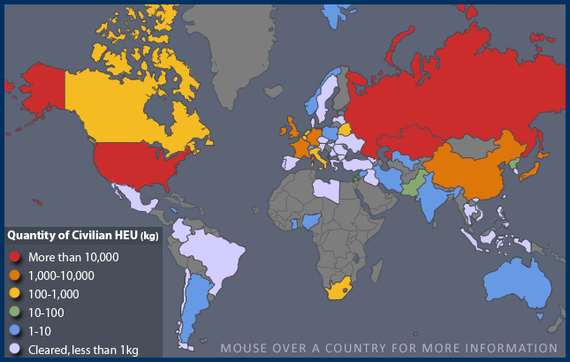
Graham Allison is happy that, “in just the last five years, the number of states with nuclear-weapons material that could fuel a terrorist’s bomb has shrunk by more than one-third”:
In Europe, six nations—Austria, the Czech Republic, Hungary, Romania, Serbia, and Ukraine—have become nuclear-weapons-material-free in the past five years. Belarus and Poland are the only countries preventing Eastern and Central Europe from becoming the second [nuclear-weapons-material-free zone (NWMFZ)]. In Africa, only one state, South Africa, continues to keep a cache of nuclear weapons material large enough to allow terrorists to build more than 20 nuclear bombs. South America could complement its status as the first NWFZ by becoming an NWMFZ—if it could persuade the single holdout, Argentina, to dispose of its 17 pounds of highly enriched uranium.
But, even if uranium supplies are further reduced, Douglas Birch illustrates the difficulties associated in getting nations to give up their plutonium stockpiles:
The call to restrict plutonium production — which applies to both military and civilian programs — is a departure and nettlesome to some countries.
Japan, India, and Russia, for example, plan to build new energy systems based on advanced plutonium-burning reactors. France and Great Britain have produced plutonium under contract for other countries. Separately, India, Pakistan, and Israel produce plutonium for weapons, according to a 2013 report by the International Panel on Fissile Materials.
As a result, while the global stocks of weapons-grade uranium have been shrinking after the Cold War, the stocks of plutonium have been growing. They are now estimated at 490 metric tons – enough, in theory, to fuel tens of thousands of weapons.
 The Dish