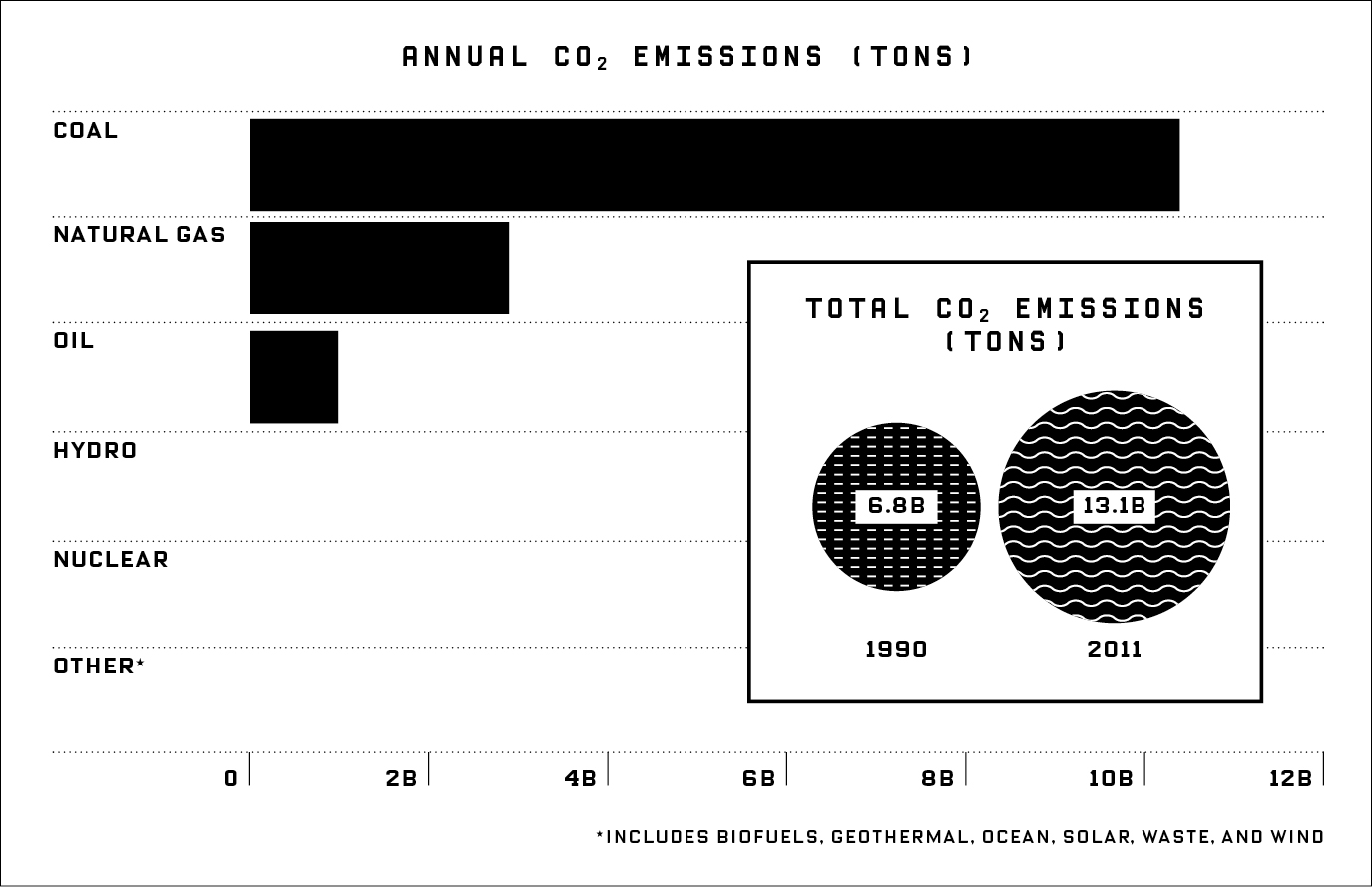
Charles C. Mann argues that developing carbon capture and storage (CCS) technology – or “clean coal” – is more important than developing renewables:
Conceptually speaking, CCS is simple: Industries burn just as much coal as before but remove all the pollutants. In addition to scrubbing out ash and soot, now standard practice at many big plants, they separate out the carbon dioxide and pump it underground, where it can be stored for thousands of years.
Many energy and climate researchers believe that CCS is vital to avoiding a climate catastrophe. Because it could allow the globe to keep burning its most abundant fuel source while drastically reducing carbon dioxide and soot, it may be more important—though much less publicized—than any renewable-energy technology for decades to come. No less than Steven Chu, the Nobel-winning physicist who was US secretary of energy until last year, has declared CCS essential. “I don’t see how we go forward without it,” he says.
Unfortunately, taking that step will be incredibly difficult. Even though most of the basic concepts are well understood, developing reliable, large-scale CCS facilities will be time-consuming, unglamorous, and breathtakingly costly. Engineers will need to lavish time and money on painstaking calculations, minor adjustments, and cautious experiments. At the end, the world will have several thousand giant edifices that everyone regards as eyesores. Meanwhile, environmentalists have lobbied hard against the technology, convinced that it represents a sop to the coal industry at the expense of cleaner alternatives like solar and wind. As a consequence, CCS is widely regarded as both critical to the future and a quagmire.
 The Dish