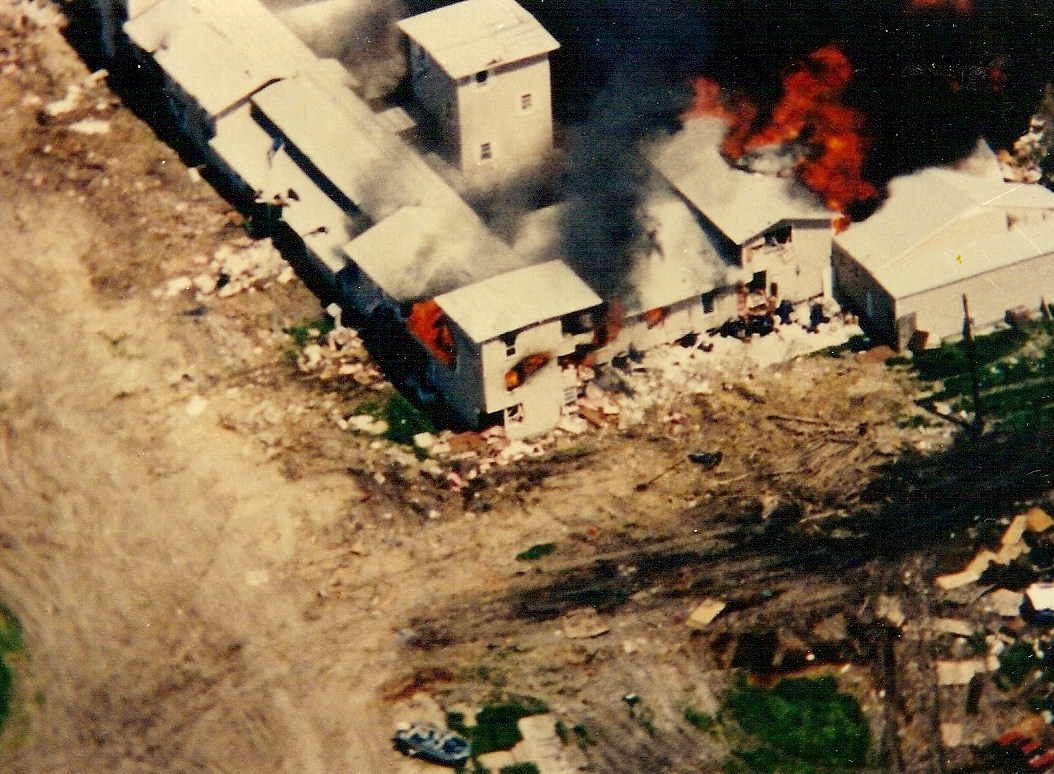
It doesn’t work unless you take his religious beliefs seriously. That’s one of the lessons gleaned from Malcolm Gladwell’s absorbing retrospective on the 1993 raid and subsequent siege of the Branch Davidian complex in Waco, TX, that resulted in the death of the sect’s leader, David Koresh, along with 82 other men, women, and children, and four ATF agents:
[A]s the conflict-studies scholar Jayne Docherty argues, the F.B.I.’s approach was doomed from the outset. In “Learning Lessons from Waco”—one of the very best of the Mount Carmel retrospectives—Docherty points out that the techniques that work on bank robbers don’t work on committed believers. There was no pragmatism hidden below a layer of posturing, lies, and grandiosity. Docherty uses Max Weber’s typology to describe the Davidians. They were “value-rational”—that is to say, their rationality was organized around values, not goals. A value-rational person would accept his fourteen-year-old daughter’s polygamous marriage, if he was convinced that it was in fulfillment of Biblical prophecy. Because the F.B.I. could not take the faith of the Branch Davidians seriously, it had no meaningful way to communicate with them.
Gladwell goes on to describe an approach – informed by Koresh’s understanding of Biblical prophecies – that could have ended the standoff peacefully:
Not long after the Waco siege began, James Tabor, the Biblical scholar, heard David Koresh on CNN talking about the Seven Seals. Tabor is an expert on Biblical apocalypticism and recognized the Branch Davidians for what they were—a community immersed in the world of the Old Testament prophets.
He contacted a fellow religious scholar, Phillip Arnold, and together they went to the F.B.I. “It became clear to me that neither the officials in charge nor the media who were sensationally reporting the sexual escapades of David Koresh had a clue about the biblical world which this group inhabited,” Tabor writes, in an essay about his role in the Mount Carmel conflict. “I realized that in order to deal with David Koresh, and to have any chance for a peaceful resolution of the Waco situation, one would have to understand and make use of these biblical texts.” …
Koresh needed another way to make sense of the prophecies in the Book of Revelation, so that a violent end was not preordained. Tabor and Arnold made a tape—a long, technical discussion of an alternative reading of Revelation—aired it on the radio, and sent it to Koresh. Koresh listened and was persuaded. He had been called a liar, a child molester, a con man, and a phony messiah. He had been invited to treat his children like bargaining chips and his followers like hostages. But now someone was taking his beliefs seriously. “I am presently being permitted to document in structured form the decoded messages of the seven seals,” he wrote back. “Upon the completion of this task, I will be freed of my waiting period. . . . As soon as I can see that people like Jim Tabor and Phil Arnold have a copy, I will come out and then you can do your thing with this beast.”
Inside Mount Carmel, [former Branch Davidian Clive] Doyle writes, there was rejoicing. Soon they would all come out together, and the ordeal would be over. The F.B.I., however, remained skeptical. “Then what’s next?” one of the agents in charge allegedly said. “He’s going to write his memoirs?”
Daniel Silliman understands the episode as revealing an aspect of secularization:
One of the current explanations about secularization, held by Steve Bruce, among others, is that secularization does not mean that religious belief disappears. What happens with secularization, rather, is that the social power of religious belief declines. What happens with secularization is that increasing numbers of people don’t take religious beliefs seriously. They don’t understand religious motivations, and assume them to be false. They fail to understand and fail to make themselves understood.
Dominic Preziosi, however, found Gladwell’s essay lacking, especially his assertion that the lesson of Waco “is that Americans aren’t very good at respecting the freedom of others to be so obnoxiously different”:
Granted, dishing up delightfully unexpected if semi-plausible interpretations of phenomena he deems insufficiently understood is Gladwell’s stock in trade, and he’s likely not responsible for how the story is titled and packaged. And fortunately, the piece doesn’t focus on lurid, cult-y details or rehash events in a way that invites readers simply to blame Janet Reno or demonize David Koresh. What’s frustrating is that it uses an extreme case to sidle up to a big question—what is a proper response to unshakeable and “different” belief?—while implicitly posing other questions about the limits and extensibility of religious expression, without actually engaging the issue explicitly.
Gladwell treats the Davidians and their beliefs with careful respect, even if it means citing sociologist Max Weber’s typology of such a group as “value-rational” (not organized around short-term goals, say, like bank robbers), and he keeps the fact of so many pointless deaths in the foreground. But it’s ultimately an unsatisfying exploration: The catchy hook and provocative marshalling of quotes and conceits have that familiar intuitive appeal but amount to little more than another Malcolm Gladwell special; molehills are made precociously out of slightly larger molehills. That the mistakes of the FBI twenty-one years ago offer a promising starting point for a discussion on responses to “obnoxiously different” expressions of belief is fine. What would have been better is if such a discussion actually followed in a meaningful way.
For more, check out this podcast Gladwell did about the essay.
(Image: A 1993 FBI photo of the Branch Davidian complex, known as Mount Carmel, in flames, via Wikimedia Commons)
 The Dish
