Putin Is Weaker Than He Looks

Alexander Motyl compares Putin and Yanukovych:

Whose rule was, or is, unstable? Yanukovych’s, obviously: the sultanistic regime he built was hyper-centralized, inefficient, and corrupt. It survived only as long as the people acquiesced in its existence. Once the mass demonstrations of November 2013 turned into a popular revolution, the regime quickly dissolved and Yanukovych was left on his own, without the support of either the masses or the elites. His systematic violations of the Constitution and his illegitimacy automatically conferred legitimacy on the people power from which he fled.

But here’s a surprise perhaps: Putin’s rule is equally unstable.

His regime is also hyper-centralized, inefficient, and corrupt. It—and Putin with it—can survive and enjoy neo-imperialist legitimacy only because it’s been the beneficiary of loads of free money derived from higher energy prices. Thanks to a vast increase in state wealth, Putin was able to buy popular legitimacy and still have enough to accommodate regime inefficiency and corruption. That’s about to change. Energy revenues are declining and will almost certainly continue to decline, as the West develops energy alternatives (shale gas, liquefied natural gas, and energy from other suppliers). With declining revenues, Putin will soon be exposed as a corrupt dictator unable to deliver neo-imperialism to the masses and embezzlement to the elites. Add to that the growing costs of his Crimean misadventure, and, sooner rather than later, Putin could become Russia’s Yanukovych.

A Bachelor’s Degree In Gettin’ Paid

Screen Shot 2014-03-26 at 8.56.46 AM

Derek Thompson tells you where to go to school to get rich:

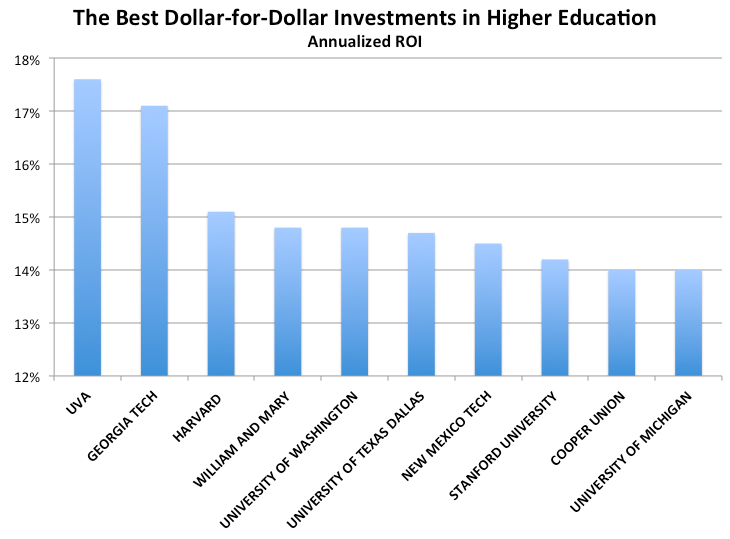
A Bachelor of Science from Harvey Mudd College, the small California science and engineering school, is the most valuable college degree in America. Stanford’s computer science program pays off more than any single major in the country. For the best dollar-for-dollar investment, nothing beats the University of Virginia. As those three (all true) facts illustrate, there are many ways to answer the question What’s the most valuable college education in the country? Every year PayScale, the largest private tracker of U.S. salaries, tries to answer the question. This year they released their findings in an elegant site that you can play with here. They also shared their hard data with The Atlantic, which we used to do some further calculations.

Jordan Weissmann has the worst buys:

The site finds almost two-dozen schools where the average graduate – not dropouts, mind you, but students who finish their degree – will probably lose money on their educations, because their earning power won’t increase enough to justify the cost of tuition. To be blunt, these schools make students poorer. And we’re talking about traditional colleges, not nefarious for-profits.

Ben Cosman notes that the highest-ROI schools aren’t exactly easy to get into:

Harvey Mudd, the school with the highest ROI overall, admits just 19 percent of applicants, according to College Board. The Massachusetts Institute of Technology (which needs no introduction), accepts only 8 percent. Stanford’s microscopic acceptance rate is 6 percent. The public schools are slightly better – Cal-Berkley has an 18 percent acceptance rate, and the top two, Colorado School of Mines and Georgia Tech, have 36 and 41 percent acceptance rates respectively. Admissions data isn’t readily available for the Massachusetts Maritime Academy (we have a feeling only a very specific group of students is applying there, anyway), but it’s definitely Missouri University of Science and Technology that’s the easiest to get into, admitting more than 80 percent of applicants. Of course, keeping enrollment numbers tight also ensures good outcomes on the other end. When everyone of your students is almost guaranteed a good career, there’s fewer rotten apples to drag down the average.

Meanwhile, Alexander Aciman wants his alma mater – the University of Chicago, ranked 154 on Payscale’s ROI list – to stop begging him for money already:

The email spam and inconvenient phone calls aren’t the problem. It is the fundamental unseemliness of universities’ relentless solicitation of donations from recent alumni in a country where the current balance of outstanding student loans is 1/15 of the nation’s entire GDP. More than half of recent graduates at the time I finished school in 2012 were unemployed or underemployed, and many more were mal-employed – working in fields other than those offered by their majors. Universities must realize that many of us cannot spare the donation required to get a mug with our class year on it. Just a few weeks ago Harvard received the largest donation in the college’s history, but recent Harvard grads are nevertheless still getting requests. Donations from recent graduates can’t possibly account for more than a fraction of a school’s endowment – so why do they pursue them so tenaciously?

A Staggering Death Sentence, Ctd

Earlier this week, Egypt sentenced 529 Muslim Brotherhood members to death. Ursula Lindsey contends that Egypt’s judiciary “has become another of the country’s rogue institutions, answerable to no one”:

In the new constitution that they helped draft, judges bestowed upon themselves almost total autonomy. They are in a retaliatory mood, not only toward the Islamists, who have accused them of corruption and have tried to force senior judges into retirement, but also toward secular activists who have criticized their rulings—some of whom have since been arraigned on charges of “insulting the judiciary.”

Nathan Brown identifies three problems facing Egypt’s judicial system. Among them:

Egypt’s legal framework, the one that judges take such pride in upholding, is deeply authoritarian ­– since all of its lawmakers have been authoritarian.

Laws governing civil society, political life, the press, states of emergency, local government, religion, education, or virtually any feature of Egyptian life have been written in a way that augments state authority and undermines or bypasses accountability to democratic mechanisms. And this has often been done in a manner sufficiently vague as to turn many citizens into potential criminals when they undertake what they might see as normal activities.

Bel Trew foresees more violence:

Even if the sentence is not carried out, the verdict has propelled Egypt back into international headlines for all the wrong reasons — and has wrecked some tentative signs of improvement in the country’s human rights environment. Prominent secular activist Alaa Abdel-Fattah, who has been in jail since December and is on trial for allegedly organizing an illegal protest and assaulting a police officer, was finally released on bail on March 23. Meanwhile, interim President Adly Mansour personally wrote letters to jailed Al Jazeera correspondents Peter Greste and Mohamed Fahmy promising them a free and speedy trial.

This ruling, however, is a sign that some elements within the Egyptian state still favor a drastic escalation of violence against Morsi supporters.

Shadi Hamid calls for the US to deny aid to Egypt:

On March 12, Secretary of State John Kerry said he hoped to resume a significant amount of military aid to Egypt “in the days ahead.” This, however, requires the State Department to certify that Egypt is making progress on democracy. For his part, Kerry has made clear, time and time again, that he sees his own administration’s partial aid cut, announced in October, as little more than a nuisance. In November, he assured his Egyptian counterparts that the “aid issue is a very small issue.” He also said that Egypt’s “roadmap” was moving “in the direction that everybody was hoping for,” a statement that seems the all the more remarkable with every passing day. …

Certifying one of the region’s most repressive regimes as moving toward democracy would be both embarrassing and transparently cynical. It would also set a precedent that even non-waiver legislation on democratization can be circumvented, assuming there’s sufficient political will to do so.


The Cashless Society Is A Safer Society

cash-crime

Christopher Ingraham points to an intriguing new finding:

Researchers have long noted that cash plays a critical role in street crime, due to its liquidity (it’s easy to access and everyone accepts it) and anonymity (it leaves no paper trail). In poorer neighborhoods, public assistance payments used to be a significant source of circulating cash: recipients would cash their assistance checks at the bank, pocketing the money and making them attractive targets for criminals.

But starting in the 1990s that changed, as the Federal government gradually phased out paper welfare checks in favor of electronic debit cards (the Electronic Benefit Transfer (EBT) program). Along with a team of researchers, Richard Wright of the University of Missouri studied the effects of this change in his home state and found that it was directly responsible for a hefty 10 percent drop in the overall crime rate there.

Derek Thompson extrapolates:

Americans are rapidly abandoning cash thanks to credit cards, debit cards, and mobile payments. Half a century ago, cash was used in 80 percent of U.S. payments. Now that figure is about 50 percent, according to researchers. … It might seem absurd to imagine Visa, Square, and Google Wallet as crime-fighting technologies. But with a better understanding of how cash’s availability affects crime, perhaps the government should consider killing more than just the penny.

Worthwhile Canadian Initiative

The carbon tax in British Columbia has been a success:

If the goal was to reduce global warming pollution, then the B.C. carbon tax totally works. Since its passage, gasoline use in British Columbia has plummeted, declining seven times as much as might be expected from an equivalent rise in the market price of gas, according to a recent study by two researchers at the University of Ottawa. That’s apparently because the tax hasn’t just had an economic effect: It has also helped change the culture of energy use in B.C. “I think it really increased the awareness about climate change and the need for carbon reduction, just because it was a daily, weekly thing that you saw,” says Merran Smith, the head of Clean Energy Canada. “It made climate action real to people.”

It also saved many of them a lot of money. Sure, the tax may cost you if you drive your car a great deal, or if you have high home gas heating costs. But it also gives you the opportunity to save a lot of money if you change your habits, for instance by driving less or buying a more fuel-efficient vehicle. That’s because the tax is designed to be “revenue neutral” — the money it raises goes right back to citizens in the form of tax breaks. Overall, the tax has brought in some $5 billion in revenue so far, and more than $3 billion has then been returned in the form of business tax cuts, along with over $1 billion in personal tax breaks, and nearly $1 billion in low-income tax credits (to protect those for whom rising fuel costs could mean the greatest economic hardship). According to the B.C. Ministry of Finance, for individuals who earn up to $122,000, income tax rates in the province are now Canada’s lowest.

Through Animal Eyes

Screen Shot 2014-03-25 at 2.26.08 PM

Elizabeth Preston envisions how critters see the world:

Rattlesnakes have low-resolution color vision during the day and plenty of rod cells for a boost at night. But what sets rattlesnakes apart is their ability to sense infrared light. Similarly to vipers, pythons, and boas, the rattlesnake has special sensory tools called pit organs – a pair of holes on either side of the snout between the eye and the nostril. Suspended in each pit is a thin membrane that detects heat, says David Julius, a physiology professor at the University of California, San Francisco. Julius discovered that a neural receptor, TRPA1, present in the nerve cells connected to this membrane is responsible for snakes’ ability to transform infrared light into nerve signals. In humans, the same receptor triggers our pain response to certain spicy foods such as wasabi and mustard. But in snakes, it responds to the heat of nearby prey. The rattlesnake’s brain merges the information from the pit organs with information from the eyes so that a prey’s thermal image is overlaid on the visual one. Julius says it’s actually not hard for humans to approximate what the snake sees: Just look through an infrared camera.

The article also explores the vision of cats, birds, bees, and cuttlefish. Photo contrasting rattlesnake vision with human vision by Dr. Klaus Schmitt.

Immature Tech

Joshua Gans urges technology companies not to focus so much on teens:

That is because the overwhelming picture of the teenager as a consumer is of a person that is going to change. Teenagers are doing things that they did not do as children and that they will not do as adults. Thus, as a consumer, they are transitory and not in a good way. Unlike childhood demand where there will always be other children to consume toys such as Lego, the next wave of teenagers will engage in their behavior using the next available technology (or fashion). And since there have been teenagers that technology has been changing.

This notion of the transient consumer implies something very strong: business exclusively built on teenager demand will lose their customers. This is as true of musicians (which is why we will soon be free of Bieber) as it is of technology (remember the Sidekick) and social networks (consider MySpace). This suggests that businesses that have become the darling of teenagers should make hay while the sun shines or, and this is the tricky part, work out how to broaden their customer base to include adults. Either way, worrying about teenager demand is futile.

The Tragedies We Cover

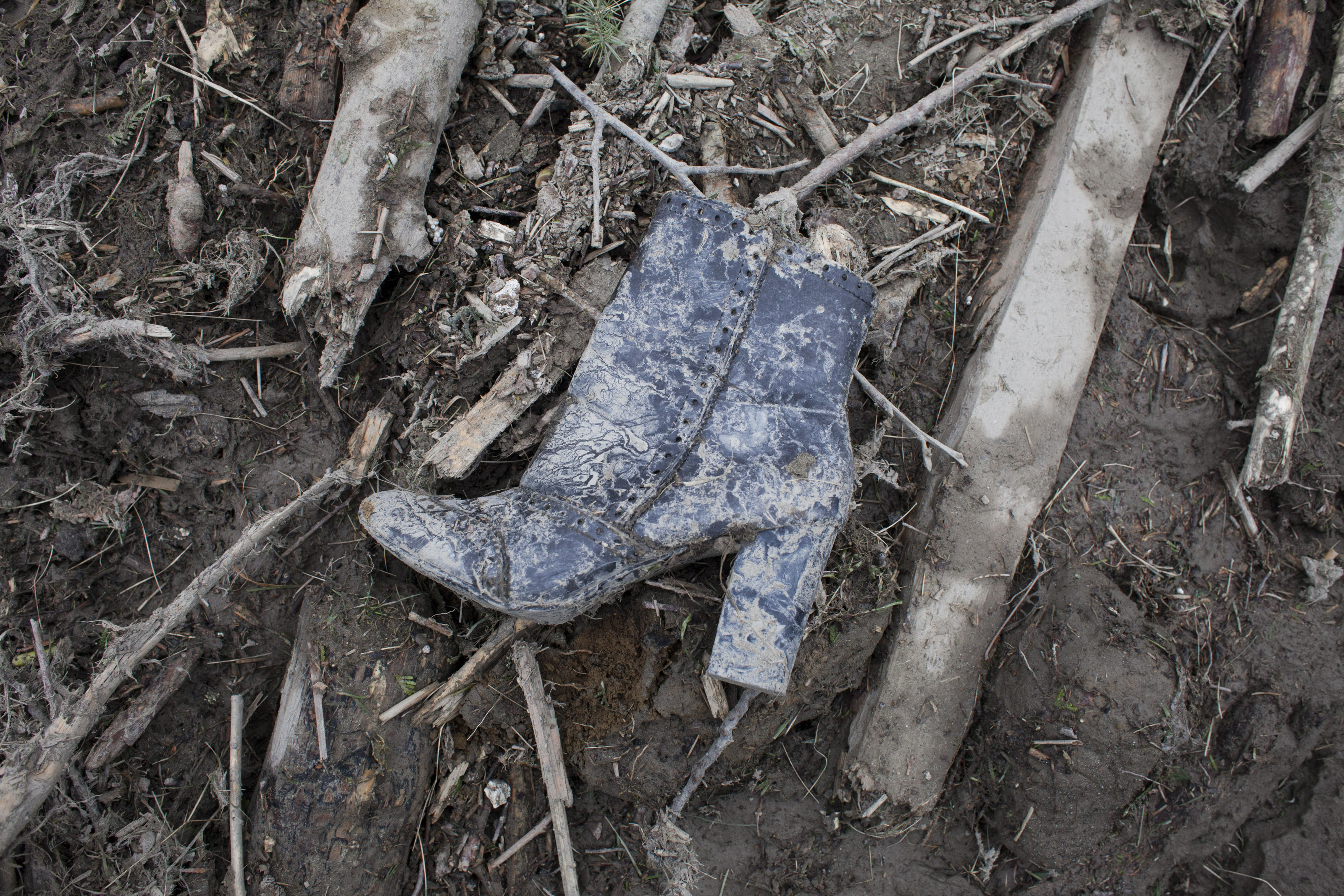
Fourteen Killed, Many Missing After Major Washington State Mudslide

Shafer considers why the Oso, WA landslide has gotten so much press:

Not to diminish the cataclysm and the human loss, but for all its fearful power and creepiness, the landslide isn’t much of a killer — at least not in America. According to a Wikipedia chart of major landslides worldwide since 1900, only 11 have struck the United States, including the one in Oso. When you factor out landslides propagated by exploding volcanos (Mount St. Helens), earthquake-tsunamis (Seward, Alaska, and Lituya Bay, Alaska) and hurricanes (Nelson County, Va.), the death count falls very low. Before Oso, fewer than two dozen people had died in all other major U.S. landslides, which you could count on two fingers (Gros Ventre, Wyo., and La Conchita, Calif.). …

Avalanches, much more frequent and deadly than landslides, don’t enthrall readers and journalists because our curiosity about how they form and how and why they kill has been adequately covered. The landslide, as an atypical disaster, demands great concentration by the press. Most reporters (outside of landslide territory) have probably never covered one, leaving hundreds of questions to ask and answer. Explainers must be posed and sorted out. Follow-ups assigned. Historical records searched. Curiosity sated.

Why Are Kids Abandoning Football?

Dallas Mavericks owner Mark Cuban took to Facebook Monday to elaborate on his “comments about the NFL imploding in TEN YEARS”:

I wouldn’t want my son playing football, would you ? I’m sure helmet technology will improve over the next 10 years, but why risk it? There are plenty of sports to play. Plenty of ways to get exercise and if my son decided to do anything outside of sports and never pick up any ball of any kind, I’m fine with that. I can think of 1k things I would prefer him to get excited about doing.

As far as watching, I good with that. I don’t think I’m alone. If we start to see a decline of popularity at the high school and then college level because kids choose other sports, it will hurt the interest in watching the NFL[.]

But the drop-off in young football players is still less pronounced than in basketball and baseball. Neil Paine suggests less youth interest for a different reason:

The NFL’s high-profile concussion issues might be playing some role in the sport’s falling popularity among kids. But as Forbes’ Bob Cook pointed out in November, the effect is just as likely attributable to other factors, including the increasing trend toward specialization in young athletes. Cook noted that data from sporting-goods retailers shows an increase in sales among hardcore football players ages 7 to 11 and a sharp decrease among more casual players in the same age range. In essence, players who don’t receive a large investment in their careers at a young age appear to be getting squeezed out of organized football.

Is Cannabis A Crime Fighter?

A new paper finds no evidence that medical marijuana leads to more crime:

[T]hese findings run counter to arguments suggesting the legalization of marijuana for medical purposes poses a danger to public health in terms of exposure to violent crime and property crimes. To be sure, medical marijuana laws were not found to have a crime exacerbating effect on any of the seven crime types. On the contrary, our findings indicated that [medical marijuana legalization (MML)] precedes a reduction in homicide and assault. While it is important to remain cautious when interpreting these findings as evidence that MML reduces crime, these results do fall in line with recent evidence and they conform to the longstanding notion that marijuana legalization may lead to a reduction in alcohol use due to individuals substituting marijuana for alcohol. Given the relationship between alcohol and violent crime, it may turn out that substituting marijuana for alcohol leads to minor reductions in violent crimes that can be detected at the state level. That said, it also remains possible that these associations are statistical artifacts

Emily Badger explains the study’s methodology:

Researchers at the University of Texas at Dallas looked at the FBI’s Uniform Crime Report data across the country between 1990 and 2006, a span during which 11 states legalized medical marijuana. Throughout this time period, crime was broadly falling throughout the United States. But a closer look at the differences between these states – and within the states that legalized the drug before and after the law’s passage – further shows no noticeable local uptick among a whole suite of crimes: homicide, rape, robbery, assault, burglary, larceny, and auto theft.

Sullum adds:

How relevant is research on medical marijuana laws to the debate about broader forms of legalization? Highly relevant, if you take the view that medical marijuana is mostly a cover for recreational use, as prohibitionists tend to argue. In truth, the legal regimes governing the medical use of marijuana range from very strict (such as New Jersey’s) to very loose (such as California’s). But it is fair to say that a lot of people with doctor’s recommendations in the looser states are recreational users in disguise. It therefore makes sense that legalizing medical marijuana would be accompanied by a decline in drinking, as Morris et al. suggest.