Pop Music’s Stockholm Syndrome

Whet Moser considers the historical irony of Sweden’s hugely successful music industry:

Sweden, and in particular Stockholm, is home to what business scholars and economic geographers call an “industry cluster” – an agglomeration of talent, business infrastructure, and competing firms all swirling around one industry, in one place. What Hollywood is to movies, what Nashville is to country music, and what Silicon Valley is to computing, Stockholm is to the production of pop. In fact, Sweden is the largest exporter of pop music, per capita, in the world, and the third largest exporter of pop overall. …

So how did Sweden, a sparsely populated Nordic country where it’s dark for much of the year, become a world capital of popular music? Rarely does such a complex question lead to such a satisfying answer: Three-quarters of a century ago, Swedish authorities tried to put a stop to the pernicious encroachment of international pop music, and instead they accidentally built a hothouse where it flourished.

Yes, you can thank WWII-era Lutheran ministers for Katy Perry’s latest:

In the 1940s, church leaders and cultural conservatives in Sweden rallied together around a solemn mission: to safeguard the country’s youth against the degenerate music — the “dance-floor misery” — that was being piped in from America. To combat this threat, the country built one of the most ambitious arts-education programs in the West. Municipal schools of music spread across the country, offering morally uplifting instruction in classical music. Many of the schools, which were often free to attend, allowed students to borrow instruments, as if from a public library, for a nominal fee. The aesthetically conservative intent of the municipal schools created an extremely democratic form of education. … An initiative that started out as an antidote to the licentious sounds of Glenn Miller, Benny Goodman, and the like, instead set loose a musical juggernaut that would help give the world such hits as Katy Perry’s “California Gurls” and Britney Spears’ “If You Seek Amy” (try saying it out loud: F, U, C…). As the super-producer Max Martin once said, “I have public music education to thank for everything.”

What Ukrainian Neo-Nazis?

Reporting from Ukraine, Frum finds little evidence of them:

Since February 22, there have been six notable anti-Semitic incidents in Ukraine: four involving the defacement or desecration of synagogues and cemeteries, and two involving outright violence. These incidents have alarmed Jewish communities worldwide. In Ukraine, however, they are regarded with unanimous skepticism, if not outright disbelief.

All my conversations on these subjects were off-the-record. The incidents are ongoing police matters, and older Ukrainians have developed a hard-learned caution about being identified in the media. However, I spoke to more than a dozen people who occupied a variety of leadership roles within the Ukrainian Jewish community. And not a single person took seriously the idea that these anti-Jewish incidents had been carried out by “neo-Nazis.”

Jamie Dettmer is more worried about Ukraine’s pervasive corruption problem:

Ukrainians had high hopes for the Orange Revolution a decade ago only to see them dashed as the politicians and their backers and allies in the business elite clawed back power and unleashed ten years of squalid political manipulation that culminated in the Yanukovych kleptocracy.

According to Ukrainian officials more than $20 billion of gold reserves may have been embezzled and $37 billion in loan money disappeared.  In the past three years more than $70 billion was moved to offshore accounts from Ukraine’s financial system.

Many in the political class are still wedded to those old ways, judging by the bribes they have been offering investigators from a new anti-corruption agency set up by the interim government on the insistence of the Maidan revolutionaries.

Previous Dish on fascist fears in Ukraine here and here.

A Victory For The Courts

The skinny on yesterday’s major terrorism conviction:

Sulaiman Abu Ghaith, former al-Qaeda spokesperson and Osama bin Laden’s son-in-law, was found guilty of three counts: conspiring to kill Americans, conspiring to provide material support to terrorists and providing support to terrorists. The jury returned its unanimous verdict fairly quickly, on the morning of the second day of deliberation. Mr Abu Ghaith was the most prominent member of al-Qaeda to be tried in a civilian court.

Adam Serwer feels vindicated. He notes that “Ghaith, who was captured in Turkey in February 2013, was charged, tried and convicted in about a third of the time it’s taken for the trial of alleged 9/11 mastermind Khalid Sheik Mohammed and his co-conspirators to even get started”:

It’s been three years since charges were sworn against Mohammed and his co-defendants, Abu Gaith, an actual Al Qaeda preacher, was convicted in about a year, and somehow without creating “a whole new generation of terrorists.”

Although Republicans did criticize the decision to try Abu Gaith in civilian court – Senate Minority Leader Mitch McConnell said Abu Gaith was “an enemy combatant and should be held in military custody” – the reaction to the trial in New York has been muted compared to the frenzied hysterics of 2010 and 2011. Media coverage of the trial has drawn scant attention. An accused terrorist received a fair trial, and somehow New York City managed to survive. There was no need to abandon the very Constitution public officials are sworn to protect.

Amy Davidson also contrasts this case with that of KSM and his co-conspirators:

Back in 2009, Holder announced that those 9/11 defendants would be tried in the same lower Manhattan courthouse where Abu Ghaith was convicted, but there were loud complaints from all sorts of parties, from Congressional Republicans to Mayor Bloomberg. (It is one of the small shames of my native city that some people objected because a trial would tie up traffic.) The Obama Administration backed down, opting to keep K.S.M. at Guantánamo and make use of a military commission there. That was five years ago; the stop-and-start pretrial hearings for his tribunal since have been so disjointed that, at times, they verge on the absurd. …

Abu Ghaith’s conviction may end “the political debate,” but when the military trial of K.S.M. finally begins – maybe next year – we’re still likely going to have to sit through a farce where the great Al Qaeda courtroom drama should have been. Abu Ghaith’s successful trial does prove something, but it’s something we ought to have already known: putting on a trial is not actually that hard when you have a justice system that is a couple hundred years old and rich in precedent, with hundreds of terrorism trials behind it.

America’s Missing Workers

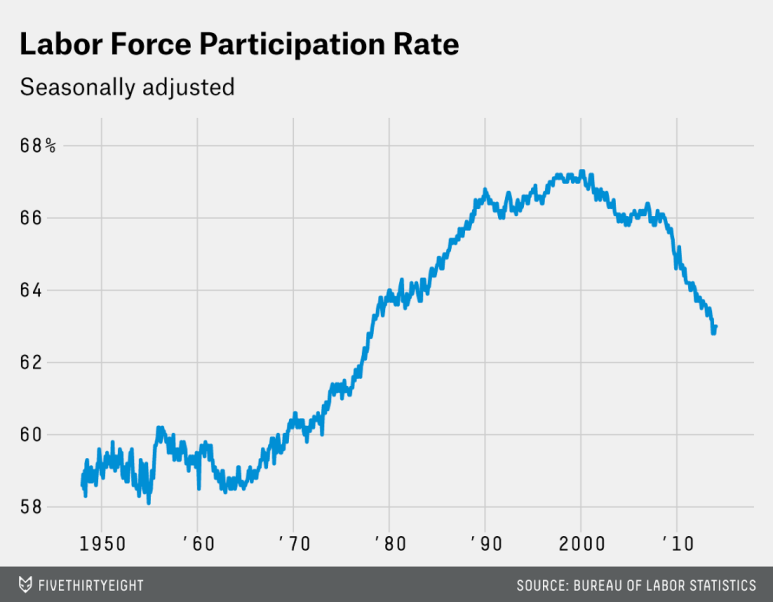
Labor Force Rate

Ben Casselman looks at how the labor force participation rate has changed over time:

The recession and weak recovery have led millions of jobless Americans to give up looking for work, meaning they no longer count as part of the labor force.

He calculates that 2 to 4 million of these workers could return:

A sufficiently strong economic recovery today could repeat the 1990s magic, drawing back all the missing workers, even the ones on disability. But there is also a more troubling possibility: If the recovery remains weak, people we now expect to return to the labor force will instead drift further away. More of them will go on disability, or retire, or otherwise drop out. The pool of 2 to 4 million workers who are still reachable by economic policy will eventually become unreachable, and the decline in the labor force will at last be permanent.

Admitting They Have A Problem

https://twitter.com/amandalcormier/status/448641924539240449

Ambinder believes the Secret Service needs an intervention:

The Secret Service has a drinking problem. It’s much worse than any other cultural deficit the elite agency has. It’s more widespread than sexism, certainly, and the other isms that have been attached to the agency since the prostitution scandal in Cartagena, Colombia. It’s something that every journalist who covers the White House kind of knows, intuitively, if they’ve ever traveled with the president. Pick your favorite White House correspondent and ask him or her whether agents on President George W. Bush’s detail created problems at the Wild West saloon in Waco. One former White House scribe told me that although reporters regularly witnessed agents drinking heavily before shifts, “we just assumed they could control themselves. After all, they were the ones who were the most responsible of all of us.”

For the most part, the agents are fine the next day. The job is stressful. But looking back at a string of incidents, many of them not well-publicized, over-consumption of alcohol is the common denominator. Sometimes, agents drinking alone make bad choices. But often, agents drinking with each other don’t have the foresight, or the ability, frankly, to tell their colleagues to stop drinking without losing face.

Margaret Carlson adds that the punishment for Colombia’s escapades obviously didn’t teach them a lesson:

Note that it wasn’t a supervisor or another agent who was worried that this behavior could compromise the agency. It was the locals — which gets to the real problem in the Secret Service. The job brings with it hours of boredom for men (it’s mostly men) ever-ready to take a bullet for the president (and a long list of lesser officials), followed by moments of danger, real and imagined. There are many nights and days away from home on an expense account, in exotic locales, some where prostitution is legal or easy to access. The temptation to turn advance trips into spring break is great.

Previous coverage of Secret Service shenanigans here.

What Happened To Explaining The News?

In a new explainer series from Vox, Yglesias downplays the importance of the debt:

Allahpundit asks how this fits within Vox’s larger mission:

Of all the current affairs they could be usefully Voxplaining to the BuzzFeed generation right now — a primer on Crimean geopolitics or Venezuela post-Chavez, a quickie take on what the Fed’s “taper” could mean to the average paycheck, etc — it’s revealing that they put out a sort of Krugman-for-kindergarteners video like this. Also revealing is how self-contained it is: There’s no hint of counterarguments, like, say, what growing interest payments on ballooning debt will do to a federal budget that’s already slowly being cannibalized by Medicare, nor is there even a hint that the issue might be more complex than this. That’s smart rhetorically, especially given the time constraints, but … complicates, shall we say, the site’s pretensions to explanation. What sort of “explanatory journalism” launches by encouraging its readers not to spend too much time thinking about a particular subject, especially one this politically salient?

Patterico thinks he found an error in the video:

Virtually everyone who follows these issues knows that the U.S. national debt is over $17 trillion. The U.S. Treasury issues daily statements on the national debt here. The latest report is that for March 25, 2014 (.pdf). It lists the closing balance for “Total Public Debt Outstanding” at $17,555,984,000,000, which is over $17.5 trillion dollars. Of that amount, $4,976,757,000,000 (almost $5 trillion) consists of “intragovernmental holdings,” and $12,579,227,000,000 (over $12.5 trillion) is “debt held by the public.” That latter number is what Yglesias is citing, as you can tell from the chart that accompanies his narration, which has a bar on a chart labeled: “Debt held by the public.”

But the debt held by the public is not the U.S. national debt.

John Aziz sides with Matt:

Yglesias is pretty clear that he’s excluding debt owed from one arm of the government to another, and only including federal debt held by the public. That is completely rational. After all, money the government owes to itself is simply money moved from one side of the government balance sheet to the other. There’s nothing dishonest or disingenuous about citing the lower figure that only includes debt held by the public, especially given that Yglesias was clear about this.

Ben Cosman covers the back and forth:

Patterico makes the point that the only people who’d recognize the difference between public and national debt are people already familiar with the subject, and thus wouldn’t need the video’s basic explanation. Anyone in need of the kind of explanatory journalism Vox is looking to provide would simply assume the two are the same, since the video seems to use them interchangeably.

Which brings up a good question: just how effective (and ideological) is Vox’s explanatory journalism going to be? In an email to Patterico, Klein wrote, “If we did have an article we’d probably spend some time explaining the difference.”

Whether or not you think the video was misleading, the fact that Klein admits an explanation deficiency on an explanatory video doesn’t look great.

The Rebirth Of Political Correctness, Ctd

A reader writes:

Oh how well do I know this topic. I’ve been thinking about it since my experience at an elite East Coast liberal arts college in the ’80s. One cause of PC attitudes on campus is that professors tend to be the kind of people who take their politics very personally, but who don’t have much of an outlet for actually solving problems. Professors sit around and talk to each other and their students about how awful things are in society. Which we all do in this democracy of course. But professors then pat themselves on the back for being particularly insightful and enlightened, because they, their students, and other professors are telling them that they are very insightful and enlightened.

But few people outside of academia have any interest in listening to them, because 1) they have no solutions to the problems they talk about, or their solutions are not realistic, and 2) they have so convinced themselves of their brilliance that they come across as elitist snobs. So they’re taking themselves incredibly seriously, but no one else is. This creates a vicious circle – the more strident they are, the less anyone else is interested in listening to them, the more frustrated they get, then they get that much more strident.

Professors get paid to pass judgment. That’s a key part of what they do. They pass judgment on each other (“Dr. Smith’s opinion on XYZ in Shakespeare is wrong for reasons ABC”), and they pass judgment on students (giving grades). So when they discuss politics, they pass judgment. What they are not necessarily paid to do is listen to other people so that they can work with them. At the end of the day, politicians and activists have to listen to people who disagree with them, because that’s part of the process of getting things done. Professors, who don’t necessarily have a project that requires the participation of other people, don’t have the same professional incentive to listen to people who disagree with them. So they have lots of reasons to pat themselves on the back for passing judgment on other people, but very little incentive to acknowledge the perspectives of people who disagree with them.

Another difference between politicians/activists on the one hand, and professors on the other, is that politicians and activists have to be prepared to admit it when they are wrong, because inevitably they will be. But professors have tenure, which means that they cannot be held accountable for their mistakes. So they have no incentive or even reason to admit when they are wrong. Lots of incentive to argue and pass judgment, very little incentive to listen or admit mistakes. Is it any surprise that academic discussions of politics are so toxic?

Update from a reader, who responds to the one above:

Look, there are a lot of people in my profession who think they are pretty goddamn smart. Some of them even are pretty goddamn smart. That doesn’t make academia a circle jerk. The whole way we work is by critiquing others and engaging in a conversation about it. We teach, we read, we write, we go to conferences where we talk over our ideas and argue about shit, and then we refine our positions and then we publish and we argue more about it. It’s not just about criticizing other ideas, it’s about improving our own as well … so the opposite of what you just said.

And yeah, the college campus has its special unique kind of pc-isms, and sure, they maybe go too far sometimes. But the reason that I think I am more careful about my language than my peers who don’t work for the academy has first to do with the fact that I am a writer and I am very careful about what my words mean, and it also has a lot to do with my students. I trust my colleagues to engage with me anyway if I am not super careful in my language or my claims. But I don’t necessarily trust my students to do so. I teach kids from all over the world and all over the US, and I model for them how to have respectful conversations with each other. That might not be what they get all the time in the real world, but in the ideal setting of the classroom, I get to teach them what their language means and how careful they ought to be with it, and how to engage with others who aren’t as careful without necessarily jumping to a call of racism. And I get to do that because I am so careful with my own language.

Another reader quotes me:

These new sins of the left can easily become the only sins that really matter (which is ridiculous), and the punishment for those sins can easily morph into an attempt at cultural control and coercion. That’s particularly true, as I found living in New York, when there’s almost no one who disagrees with you.

Allow me to fix that for you.

That’s particularly true, as I found living in the West Village among fellow homosexual (gay/LGBTQ/whatever) leaders and media grandees, when there’s almost no one who disagrees with you.

Look, yes, it’s a minor criticism of a larger and spot-on point. And you’ve gamely hashed over and been lashed over your aversion to New York. But look, again: “New York” as a concept is one of those right-wing shorthands for liberal overreach that badly fails the reality test. Stop using it as a crutch. This is a city of 8-plus-million people, most of whom weren’t born here, millions of whom weren’t even born in this country and share few of its cultural norms. It’s not a monolith. I’d be happy to put you in touch with my co-op president if you’d like the hear from a New Yorker as casually racist and passionately conserva-Catholic as your cherished target Bill Donohue. He also really loves his dogs.
Yglesias Award Nominee

“Do I worry about the negative costs, abuses and cultural consequences of unbridled recreational pot use? Of course I do. But when you get past all the ‘Rocky Mountain High’ jokes and look past all the cable-news caricatures, the legalized marijuana entrepreneurs here in my adopted home state are just like any other entrepreneurs: securing capital, paying taxes, complying with a thicket of regulations, taking risks and providing goods and services that ordinary people want and need. Including our grateful family, ” – Michelle Malkin.

Update from a reader:

I have to say, it is odd to see one person win the Malkin Award for crazy right-wing comments, and then have Michelle Malkin, whom the award is named after, win the Yglesias Award, given to those who offer commentary that goes against political type. It’s the little things that make life sweet.