“If You Don’t Kill Yourself, You’re Saving Someone Else’s Life”

Jennifer Michael Hecht, author of Stay: A History of Suicide and the Philosophies Against It, describes the contagion effect that spreads to the family, friends, and even strangers of people who kill themselves, making it more likely that they’ll follow suit:

From her bio:

Jennifer Michael Hecht is a poet, philosopher, historian and commentator. She is the author of the bestseller Doubt: A History, a history of religious and philosophical doubt all over the world, throughout history. Her new book is Stay: A History of Suicide and the Philosophies Against It, out from Yale University Press. Her The Happiness Myth brings a historical eye to modern wisdom about how to lead a good life.  Hecht’s The End of the Soul: Scientific Modernity, Atheism, and Anthropology won Phi Beta Kappa’s 2004 Ralph Waldo Emerson Award “For scholarly studies that contribute significantly to interpretations of the intellectual and cultural condition of humanity.”

The Dish featured the arguments of Stay here and Hecht’s ideas about atheism here and here – part of a thread asking, “Where are all the female atheists?” Popova loved Stay, calling the book “more than a must-read — it’s a cultural necessity.”

The Community-College Terrorist

Adam Serwer considers the case of Nicholas Teausant, a 20-year-old California student recently arrested for “attempting to provide material support to a terrorist group”:

Teausant learned the perils of social media firsthand after he was arrested on terrorism charges last Monday. His use of social media is cited prominently in the FBI’s criminal complaint, which describes Teausant posting pictures under the name “bigolsmurf,” declaring his desire to “join Allah’s army” and seeking “The Mujahid’s Handbook,” identified by the FBI as a “how-to guide for becoming a lone wolf terrorist,” compiled from Al Qaeda’s Inspire magazine. On ask.fm, a Q-and-A social networking site, he allegedly told strangers of his desire to “go fight in Syria.” Based on the FBI affidavit, that desire is ultimately how he got caught – attempting to cross the Canadian border, allegedly believing he was about to join Al Qaeda affiliates fighting against Syrian dictator Bashar al-Assad. Instead, he had really just fallen into a trap set by an FBI informant and an undercover agent.

Serwer calls the Teausant case “the latest of hundreds of cases where the FBI relies on sting operations that snare suspects who hold radical views but questionable competence and often have no formal ties to terror groups”:

The strategy is both to catch potential aspiring terrorists and to sow distrust in extremist communities and prevent them from recruiting inside the U.S. According to a forthcoming study from the Center on National Security at the Fordham University School of law, about 30 percent – 110 defendants out of 380 – of terrorism defendants have been targeted through the use of a sting operation or informant since the 9/11/2001 terrorist attacks. “This is the preventive strategy, this is what it looks like,” says Karen Greenberg, director of the Center on National Security at the Fordham University School of Law. “Over time, the suspect’s acts turn out to be more and more remote from acts of violence themselves, and more like potential beginning steps in a direction that might or might not someday take the suspect in the direction of jihadi violence.”

Meanwhile, Daveed Gartenstein-Ross notes that Teausant – who also falsely claimed to be a National Guard Reservist – is “not alone among young Westerners who have joined the jihadist movement in generously sprinkling elements of the less-than-factual into their self-image”:

Why are there so many fibbers among the ranks of these converts? Several studies point to the possibility that identity crises – which can shake up belief systems and leave once-stable individuals feeling unmoored – may make people particularly vulnerable to extremist ideas. An identity crisis can be of the kind that might first prompt a jihadist-to-be to first try on several personas for size before settling on that of radical Islamist. As the NYPD’s study Radicalization in the West puts it, sometimes an “individual is looking for an identity and a cause,” and “finds them in extremist Islam.”

Indeed, for those lost souls without a strong sense of self, there are few identities as all-encompassing as that of Salafi radical, with its emphasis on complying with voluminous and often obscure rules. Teausant, for example, seemed to relish these tenets, explaining on his blog why he considers celebrating Valentine’s Day and dating to be prohibited by Islamic law. On Facebook, he pondered the perceived religious obligation to eat with one’s right hand: “So if we eat and drink with our right hand should we not push the button on a drinking fountain with our right also?”

Little Progress On The Peace Process

JORDAN-US-PALESTINIAN-ISRAEL-DIPLOMACY

Peter Beaumont reports that John Kerry and Mahmoud Abbas met for “urgent consultations” Wednesday night “amid fears the stalled Middle East peace talks are heading towards collapse”:

Kerry arrived in the Jordanian capital hours after an Arab League summit in Kuwait released a statement emphatically declaring that Arab leaders would never recognize Israel as a “Jewish state,” a key demand Netanyahu has made of Palestinians.

The meeting between Kerry and Abbas comes amid increasingly harsh rhetoric from both sides. On Tuesday Abbas accused Israel of a “criminal offensive” to step up settlement building in Jerusalem and the West Bank. In reply a senior Israeli official accused Abbas of trying to “torpedo the peace process” while parading “rejectionism as a virtue.”

Joshua Mitnick notes that “with uncertainty rising about the fate of the talks, some members of Mr. Netanyahu’s coalition are balking at following through on a politically controversial Israeli commitment to release 26 convicted Palestinian prisoners by Saturday”:

Israel’s media reported that Jonathan Pollard, an American Jew serving a life imprisonment of spying for Israel in the 1980s, might be freed by the U.S. to gain Israeli support for the release. The reports were denied by the U.S.

Aaron David Miller has compiled a list of “five ways to tell the Middle East peace process is in big trouble.” Number one: “Jonathan Pollard’s name comes up”:

This is a peace process perennial. And when it sprouts up, look out. In 1998, in an effort to reach an interim agreement between Palestinian leader Yasser Arafat and Netanyahu, the Israeli prime minister pushed what has become a standard request since 1985 – release Jonathan Pollard. From Israel’s point of view – and as illogical and objectionable as it may sound to an American – the imprisoned spy who was convicted for spying on the United States is like a soldier left on the battlefield. Israel is obligated to get him back. The presumption is that releasing him would afford this prime minister a political coup at home and make it easier to permit him to swallow some peace-related issue. At the 1998 Wye River summit, CIA Director George Tenet threatened to resign when President Bill Clinton seemed inclined to consider the request. Current CIA Director John Brennan may well have the same reaction. Nothing demonstrates how far afield we’ve come and how shaky this peace process is when you start mixing Pollard apples with peace process oranges. It’s a sure sign that the focus has shifted to the wrong set of issues driven by the wrong set of motives.

John Judis, who calls the peace process “nearly dead” and places most of the blame at Netanyahu’s feet, notes “there have also been signs that Kerry has either been losing interest or giving up hope in the negotiations”:

In his opening statement to a Senate Committee on March 13, he mentioned American foreign policy concerns with the Ukraine, South Sudan, the Maghreb, Central Asia, the Korean peninsula, and Zambia, but not with Israel and the Palestinians. At a Town Hall meeting with students at the State Department on March 18, Kerry described the situation in the Ukraine and then listed “other challenges that are very real.” He cited “Syria, the challenge of Iran’s nuclear weapon, of Afghanistan, South Central Asia, many parts of the world.” Conspicuously absent was Israel and Palestine.

If Kerry does withdraw and lets the talks collapse, or simply allows them to peter out after a grudging agreement to extend them without a meaningful framework agreement, the Israelis and Palestinians are very unlikely to resolve their differences. And that could set the stage for a real tragedy.

Daniel Levy looks for another way forward:

[T]he emphasis placed on American-sponsored bi-lateral negotiations may not have been such a good idea in the first place. Progress might be better served by having the Palestinians pursue their rights through international fora, civil disobedience and a focus on international law and Israeli violations thereof, even if America would pro forma oppose such initiatives. The accumulation of Palestinian leverage might then change Israel’s political calculus and even create new space for American-led peace efforts. Unsurprisingly such ideas are not to Israel or America’s liking, while Palestinian civil society and many in the political arena lose patience with their leadership for not adopting such a line.

But not everyone has lost hope. Jon Emont notes that in Israel, a business group called Breaking The Impasse is trying to pressure Netanyahu on a peace deal:

BTI has real clout. The Israeli economy is dominated by a relatively small number of tycoons. According to [Yarom Ariav, [Lavi Capital executive chairman and former Ministry of Finance general director,] the businesspeople who make up BTI control more than 30 percent of Israel’s GDP, when you add up their personal wealth, the companies they run, and the funds they oversee. This gives BTI’s members, including tech entrepreneur Yossi Vardi and Meir Bran, the CEO of Google Israel, influence with Israel’s center-right leadership. It also means that the January advertising blitz was a test run for a potentially far larger public campaign.

(Photo: US Secretary of State John Kerry gestures as leaves the Jordanian city of Amman on March 27, 2014, en route to Rome. Kerry and Palestinian president Mahmud Abbas held ‘constructive’ talks on the Middle East peace process, a US official said Thursday, as crunch decisions loom in the coming days. By Jacquelyn Martin/AFP/Getty Images.)

The Computer Feels Your Pain

Machines are better than people at telling when pain is real:

In the experiment, more than 150 participants were shown short videos of the faces of people who either dunked their arms in ice water or pretended to dunk their arms in ice water. The group was asked to gauge the authenticity of each pained reaction, and succeeded in weeding out the fakers from the true sufferers only 51.9 percent of the time – no more accurate than if they simply had left their guess to chance. Next, the researchers showed the same videos to computers with special expression recognition software. The computers’ accuracy? Eighty-five percent.

That the humans performed so poorly actually is no surprise. Scientists have known for a while that even trained physicians can’t reliably differentiate between real and faked pain expressions. But the computers’ results were unprecedented.

How the experiment worked:

[Researcher Marian] Bartlett’s system is based on something called the Facial Action Coding System, or FACS, which was popularized by the psychologist Paul Ekman in the ’70s and ’80s and is used today by everyone from TSA screeners to animators trying to imbue their characters with more realistic facial expressions. It’s a way of describing virtually any facial expression that’s anatomically possible by breaking it down into its component movements — a wrinkle of the nose, a tightening of the eyelid, a lowering of the brow, and so on. The idea is that each of these movements maps onto a specific muscle or set of muscles.

Bartlett’s team has been working for years to create a computer vision system to automate FACS and to develop machine learning algorithms that can learn to recognize patterns of facial movements that correspond to particular emotions. (They also founded a company, Emotient, based on the same technology — more on that later). The new study is the first to assess how well the system distinguishes genuine from fake facial expressions and compare its performance to that of human observers.

The practical applications:

[Bartlett] thinks automated pain detection could be useful for doctors and nurses working with children. Research suggests that pain is often underreported and under treated in kids, she says. She’s also developing systems that detect more than just pain. The company she co-founded, Emotient, recently released an app for Google glass aimed initially at salespeople looking for insight into their customers’ mood. Presumably, any Google Glass wearer will eventually be able to use it.

A realtime color-coded display indicates which emotions the system is supposedly picking up in the people around you. The company claims it can accurately detect joy, sadness, anger, fear, and disgust. And if you’re being a Glasshole, the app just might clue you in: It’s also programmed to detect contempt.

Reality Check

Approval of Obamacare has rebounded slightly:

ACA Opinion

Sargent sees this as evidence that in seven months the law will “recede as an issue, while other factors (candidates, the economy, the terrible map for Dems) come to the fore”:

The new poll finds that in March, 38 percent viewed the law favorably, versus 46 percent who saw it unfavorably. That’s a substantial narrowing from the 34-50 spread during the dark days of January, and a return almost to where opinion was in September (39-43), before the rollout disaster began.

Drum adds:

This suggests that the main reason for the blip was Obamacare’s well-publicized rollout problems. Once those got addressed, and people were able to sign up without too much hassle, opinions turned back around.

But the poll also finds that many of the uninsured remain unaware of the original deadline. Kilgore calls that “genuinely depressing news”:

The poll also shows that two-thirds of the uninsured have not attempted to secure insurance over the last six months, so it’s not like the problem can be attributed to the initial problems at healthcare.gov, unless you assume large numbers of people were spooked by the bad publicity (unlikely, given the apparent lack of knowledge about all aspects of Obamacare evident among the uninsured). You can certainly argue that the administration and Obamacare proponents have vastly underestimated the difficulty of informing the uninsured of their new options. But on the other hand, the common conservative claim that “America” has looked at Obamacare thoroughly and rejected it misses what is going on almost entirely.

Suderman’s takeaway from the same poll: “Half the uninsured say they’ll stay uninsured.”

Ban Contraception?

Catholic Culture‘s Phil Lawler thinks it would be a great idea:

Catholic politicians [are] under a moral obligation to oppose contraception because they are obligated to serve the common good, and contraception violates the common good. The use of contraception is not merely a moral offense for Catholics, similar to eating meat on a Friday in Lent. As Pope Paul explained in Humanae Vitae, contraception is a violation of the natural law, harmful to anyone who engages in the practice. Contraceptives harm people (especially women) and harm our society. Catholic politicians – all politicians, actually – should look for opportunities to restrain the practice.

It would be interesting to find a single woman who agrees. But it’s always bracing to see a Christianist be consistent for a change. Ponnuru responds to Lawler:

I’m part of the small minority of Americans who agrees with nearly all of those words. They do not, however, establish that prohibition is the right policy.

There are many potential harms that we have good reasons not to seek to prohibit. … I think a faithful Catholic politician could reasonably conclude – because it is true – that there is not much that government can do to restrain contraception (there are few “opportunities”), let alone much sensible that government can do; and that in the case of many oral contraceptives, the restriction on over-the-counter sales in our society serves no useful purpose.

Meanwhile, Bouie considers how evangelicals’ views on contraception are shifting to the right:

At the moment, few evangelicals have joined conservative and traditional Catholics in opposing birth control. It has been an extreme position for evangelicals, limited to the far right wing of the movement. Indeed, in a 2009 poll by the National Association of Evangelicals, 90 percent of respondents said that they approve of contraception.

But the fight against the Obamacare contraception mandate has begun to transform the landscape of evangelical belief about hormonal birth control. Concerns over potential “abortifacients” like Plan B have led to concerns over the “pill” itself, and evangelical leaders like Albert Mohler have warned their followers against the “contraceptive mentality,” and encouraged them to “look closely at the Catholic moral argument” for guidance.

That is indeed a fascinating development. I don’t buy the Magisterium’s argument against contraception, believe it profoundly weakens the much more important case against abortion, and was a prime example of what is wrong with papal supremacy in the church. Pope Paul’s own commission came to the opposite conclusion, as have the vast majority of Catholics. But, look, I have no objection whatsoever to Christians who agree with Pope Paul actually living out the reality. The best approach if this is your view is to proclaim it by example, rather than enforce it imprudently by law.

Egypt’s New Strongman Makes It Official

EGYPT-POLITICS-UNREST-VOTE

Michelle Dunne expects that Abdel-Fattah al-Sisi, who announced his run for Egyptian president yesterday, “will not face serious competition on either the right or the left”:

There will most likely be no Islamist contender: Morsi’s Muslim Brotherhood, now officially considered a terrorist organization, would hardly be tolerated, and Salafi organizations are divided between those supporting Sisi and those boycotting the process. One serious Islamist candidate in 2012, Strong Egypt Party leader Abdel Moneim Aboul Fotouh, has already said he will boycott this election, as will 2012 leftist candidate Khaled Ali. Candidates from the nationalist camp are unlikely to run against Sisi because they do not want to defy the military, whose leaders announced their support for Sisi’s candidacy in an unprecedented statement that many politically aware Egyptians found startling. The one announced competitor so far, Nasserist Hamdeen Sabahi, will draw some protest and labor votes but the young revolutionaries he attracted in 2012 are now scattered and demoralized.

Robert Springborg, noting that two-thirds of Egyptians approve of Sisi, considers his appeal:

The field marshal’s popularity is due to that of the military, which continues to be the most trusted institution in the country, with around 90% of Egyptians expressing their support for it; to his message of restoring stability by virtue of a crackdown on Islamists; by his skillful projection of an upbeat officer image, replete with snazzy headgear, combined with that of a devout Muslim harboring traditional respect for women and Christians; and by his careful avoidance of substantive policies, especially those of economics.

That this message, which avoids truly critical matters, can be so popular and believable attests in part to his skill in delivering it, which rests both on his military background and on his traditional upbringing in Cairo’s al-Gamaliyya district, the very heart of historic, Islamic Cairo venerated by novelist Naguib Mahfouz and in the imagination of most Egyptians. He is the very living example of what traditional Egyptian values and practices can produce. And even if he is ultimately revealed as “fahlawi,” a skilled deceiver of others, that too could be positively interpreted as a sign of his Egyptianness and suitability for a leadership role.

But Steven A. Cook argues that the country’s politics “are likely to be hotly contested, even under a President Sisi”:

To the casual observer, Sisi must seem like the only political force in Egypt. A cult of personality followed closely on the heels of the army chief’s emergence last summer: The military-friendly media framed Sisi as “Egypt’s savior,” and stories quickly emerged of Egyptian brides with the field marshal’s visage painted on their fingernails, Sisi chocolates, sandwiches, and pajamas, as well as the standard Middle Eastern strongman-poster-on-every-public-building phenomenon.

But Sisi-mania actually revealed the potential fragility of the army chief’s political position. After all, if the field marshal was as broadly championed as the government would like everyone to believe, there would be no need for ostentatious professions of faith to him. Even recent popular votes don’t necessarily suggest overwhelming support: Although it is true that 98 percent of voters gave their approval to a new constitution in the January referendum – a vote widely seen as a proxy to test support for Sisi – but only 38.6 percent of eligible voters actually went to the polls. The very fact that the interim government has moved aggressively to suppress dissent suggests that Egyptian leaders are vulnerable to political challenges.

Robert Mackey registers an online backlash:

Although Mr. Sisi’s popularity with many Egyptians looking for a strongman to end the turmoil that followed the 2011 uprising is unquestioned, the news of his plans to stand for the presidency was greeted with anger, dismay and sarcasm online by activists, rights workers and commentators who had hoped for something other than a return to autocracy. Before, during and after his televised declaration, they heckled Mr. Sisi, the odds-on favorite for the presidency, on Twitter.

A sample tweet is above. Juan Cole thinks the al-Sisi run “mixes together two motifs”:

First, it is a sort of Bonapartism, a restoration of the presidency to a military man, which had been the case with Egypt’s four post-1952 presidents. The tradition was briefly interrupted in 2012-2013 when there was a civilian, Muslim Brotherhood president, Muhammad Morsi. The military in turn is a steward of the enormous public sector, both of state business elites and of public sector workers.

Second, al-Sisi represents himself as a conduit for substantial influxes of new money into Egypt. Governments that depend on outside money coming in instead of on in-country taxes are called “rentier states” by political scientists. … Most rentier states nowadays get their money from primary commodities such as petroleum and natural gas. Egypt has few hydrocarbon resources. But another way to receive “rent” or external money is to have strategic use for the donor. The $2 billion a year the US gave Egypt after 1978 was strategic rent. Now Saudi Arabia feels insecure about the challenge from Iran, given that the Obama administration seems to be making up with Iran. And it is afraid of the surge of populist Muslim movements that challenge its legitimacy. So having the Egyptian military provide security to the small oil monarchies of the Gulf makes sense both to the emirs and to Egypt. Egypt is being hired as a large security guard.

Ben W. Heineman Jr. considers the challenges Sisi will likely face in office:

Today, the Egyptian economy is in as much distress as it was when Morsi took office. Not only are rates of poverty, inflation, and unemployment high, but GDP growth is sluggish, the budget deficit is yawning, tourism is down, the need for imported fuel is great, and public debt (both foreign and domestic) stands at $268 billion, or 107 percent of GDP. … As president, rather than puppet master, Field Marshal Sisi will grapple with Egypt’s economic challenges in a far more exposed way. And, as was the case for the country’s past two presidents, these profound and prolonged problems could be his undoing – no matter how strong his security state.

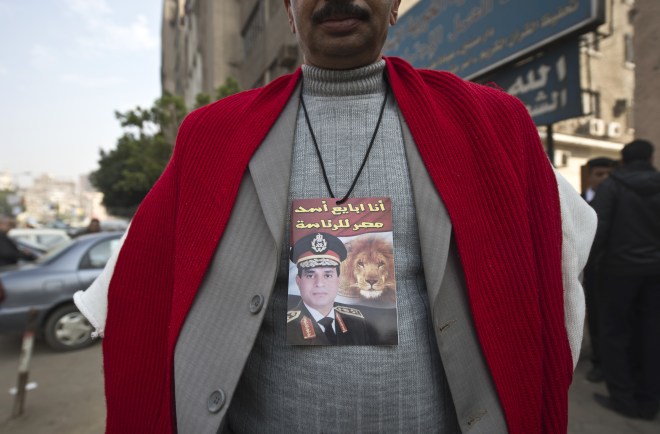
(Photo: An Egyptian man has on his chest a portrait of Egypt’s Defence Minister General Abdel Fattah al-Sisi with a slogan in Arabic reading “I vote for the loin of Egypt for the presidency” outside a polling station during the vote on a new constitution on January 14, 2014 in Cairo. By Khaled Desouki/AFP/Getty Images)

The Dirty Hands Of Diane Feinstein

Here’s a terrific brief piece by former CIA agent Philip Giraldi that helpfully treats the passive, sclerotic Senate Intelligence Committee as just as complicit in the Bush-Cheney torture program as the CIA. Their oversight was curiously blindfolded when the torture program was set up, even if the CIA also misled them. Then some real perspective:

Curiously, neither side in the argument is even suggesting that the Justice Department lawyers, CIA senior managers, and White House officials that authorized the torture should be held accountable in any way. Also lost in the shuffle are the interests of the American people. I am sure most Americans agree that the proper role for an intelligence agency is to identify and respond to genuine threats in a measured fashion that is both appropriate to the level of the danger and, within reasonable limits, ethical. Secret prisons and torture chambers are the hallmarks of a police state, not a constitutional republic. Most Americans would probably also agree that intelligence activities should be overseen by elected officials who believe in the same thing—and that magnifying threats to make an argument for reducing constitutional liberties and committing crimes against humanity is not appropriate for any government agency.

The fact that this torture program occurred in a constitutional republic, and that the representatives of all of us did not object to it at the time, and now seek cover for themselves, will go down in history as one of the darkest failures in American democracy. The institutions were there – but the will and the courage were not. The blame lies ultimately with the president who signed the order for torture, the president who then refused to hold anyone to account for torture, and the American public for widespread denial and indifference. And yes, it’s 2014. And we still do not have the definitive report on what happened.