The Animal Mind, Ctd

Virginia Morell describes why she wrote Animal Wise: The Thoughts and Emotions of Our Fellow Creatures:

I wanted to reveal something about the scientists who are investigating animal cognition and emotion, to show their personalities, backgrounds, and what led them to devote their lives to studying the mind of a particular species of animal. … When you consider their results overall, it’s not difficult to reach the conclusion that other animals think and feel. This includes the pets we have, and domesticated and wild animals. They have active minds and experience feelings.

The idea that we are special and at the top of a hierarchy of animals just doesn’t fit with what scientists now know. There isn’t a tree of life; it’s more like a bush.

Humans are at the end of one of the branches on the bush. It’s often said — even by some scientists — that there is a cognitive chasm between us and other animals. The researchers in my book are helping to close this chasm, to show us there is not as great a gap between us and the other animals. I think Darwin put it best: the differences between humans and other animals are “one of degree, not of kind.” There really isn’t any evidence for assuming that other animals are not cognitive, feeling creatures. The discoveries reported in my book show that indeed they are, and that we humans are part of a continuum of life. The scientific experiments and observations in Animal Wise are also supported by neurobiological research showing how similar our brains are to those of other animals. Ours are more complex, but at a fundamental level there are important similarities that give animals the ability to experience the world, make decisions, and do things intentionally.

In a February interview, Morell described the responses she’s been getting from readers:

I get messages from people that my book changed their lives and opened up a whole new way of looking at the world. Some say, “I can’t kill the ants on my kitchen counter anymore.” It seems to have opened people’s minds and hearts to recognizing that the other animals aren’t just robots—they truly are living, sentient beings. What an amazing world we live in, to be surrounded by all these other minds.
Previous Dish on animal cognition here, here, and here.

Punctuating Life Sentences

dish_semicolon

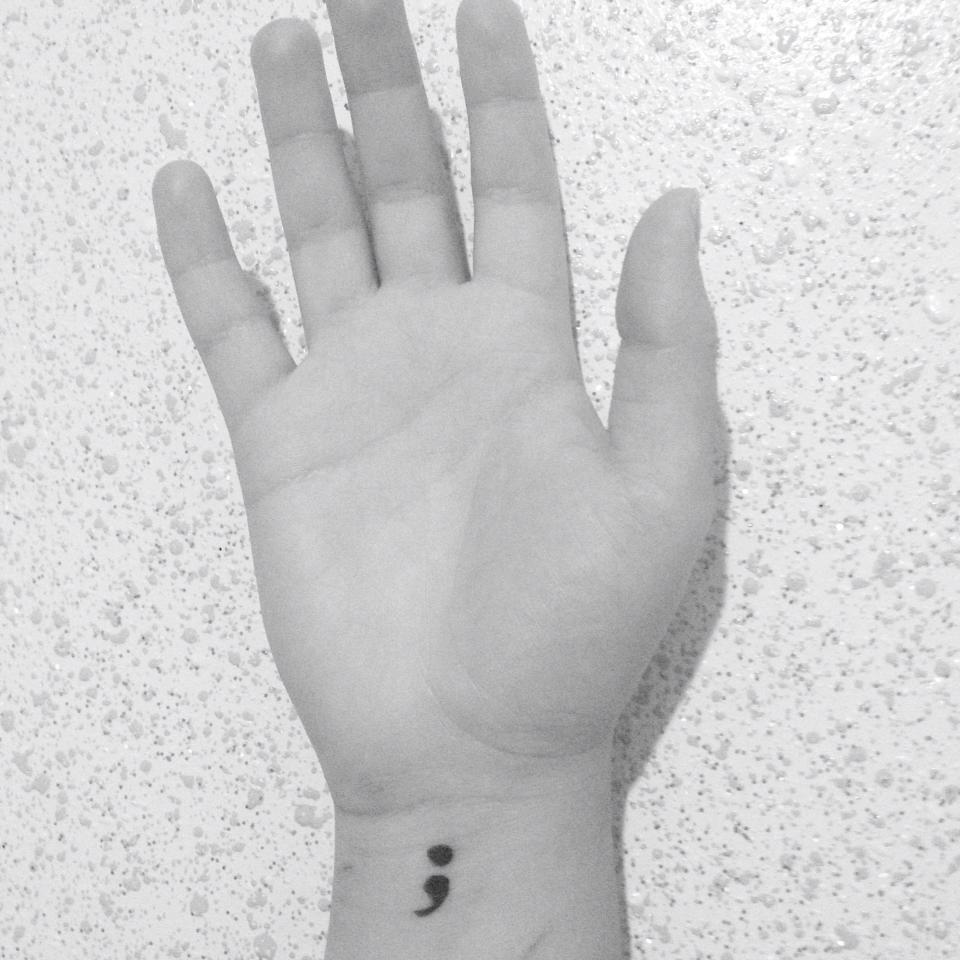
“[W]hy are people all of a sudden inking or tattooing semicolons on their wrists?” asks Allan Metcalf of a new Internet phenomenon. “To prevent suicide, of course”:

Here’s an explanation from the website of the Semicolon Movement on Tumblr:

“The semicolon is used when a sentence could have ended, but didn’t.

“The movement is for anyone who has ever self-harmed, has a personality disorder, or has tried to commit suicide. The semicolon is a sign of hope. Your sentence is not over yet. …

“If you have ever harmed yourself, attempted suicide, or just want to support the cause, put a semicolon on your wrist or wherever you feel would mean the most. Every time you see it, think of something that makes life worth living.”

You can find explanations like these, and numerous illustrations of semicolons decorating arms and wrists, on Facebook and Pinterest, as well as Tumbler. And there’s a website for The Semicolon Project, “a nonprofit organization dedicated to presenting hope, help, and support to the people and communities suffering from mental-health issues. We are here to address depression, anxiety, self-harm, addiction, and suicide.”

The website announces a special day: “On April 16, 2014, everyone who self-harms, is suicidal, depressed, has anxiety, is unhappy, going through a broken heart, just lost a loved one, etc., draw a semicolon on your wrist. A semicolon represents a sentence the author could’ve ended, but chose not to. The author is you and the sentence is your life.”

(Image via The Semicolon Movement)

Franklin And The Security State

“The government’s surveillance program,” writes Christopher Cox in Harper’s (subscription required), “is so far removed from what the Fourth Amendment defines as a permissible search … that it’s hard to believe they thought they could get away with it—and still think they can.” He looks to history to illustrate his point:

Two hundred sixty years ago … Shawnees were attacking Englishmen on the American frontier.

The frontier, at the time, was in Pennsylvania. In Philadelphia, the colonial assembly voted to raise a militia to fight back, but Governor Robert Hunter Morris rejected the bill because the assembly proposed a tax on all landowners to pay for it. Morris insisted that the legislation exempt the Penn family, who were the largest landowners in the colony (and had appointed him to his position). The assembly, led by Benjamin Franklin, refused to revise the bill.

It may have been the first time an American dispute started with a proposed tax on the rich. It certainly wasn’t the last time the country was threatened by what Franklin, in his Historical Review of Pennsylvania (1759), called the “insidious attacks of small parties of skulking murderers.” In Franklin’s account, Morris wanted to be made “provincial dictator” and was exaggerating the threat from the Shawnee and their French allies in order to get his way. (“The populace are never so ripe for mischief as in times of most danger.”) The assembly, in any case, wasn’t persuaded: better to let the frontier burn than accept Morris’s proposal. Their reply to the governor: “Those who would give up essential liberty, to purchase a little temporary safety, deserve neither liberty nor safety.”

Time has edited the phrase to remove the adjectives; Franklin would probably admit that there’s really no such thing as permanent safety or inessential liberty. And its application has shifted over the years. In the eighteenth century, fighting for liberty meant preserving the power of the legislature; today, it means preserving the power of individual citizens to resist the state’s intrusions. But Franklin’s sentiment, made universal, should be the one to guide us in this debate.

Where The Wild Things Are

dish_exoticpets

dish_exoticpetsmapkey

Lauren Slater investigates exotic pet ownership across the country:

Privately owning exotic animals is currently permitted in a handful of states with essentially no restrictions: You must have a license to own a dog, but you are free to purchase a lion or baboon and keep it as a pet. Even in the states where exotic-pet ownership is banned, “people break the law,” says Adam Roberts of Born Free USA, who keeps a running database of deaths and injuries attributed to exotic-pet ownership:

In Texas a four-year-old mauled by a mountain lion his aunt kept as a pet, in Connecticut a 55-year-old woman’s face permanently disfigured by her friend’s lifelong pet chimpanzee, in Ohio an 80-year-old man attacked by a 200-pound kangaroo, in Nebraska a 34-year-old man strangled to death by his pet snake. And that list does not capture the number of people who become sick from coming into contact with zoonotic diseases.

The term exotic pet has no firm definition; it can refer to any wildlife kept in human households—or simply to a pet that’s more unusual than the standard dog or cat. Lack of oversight and regulation makes it difficult to pin down just how many exotics are out there. “The short answer is, too many,” says Patty Finch of the Global Federation of Animal Sanctuaries. It’s estimated that the number of captive tigers alone is at least 5,000—most kept not by accredited zoos but by private owners. And while many owners tend to their exotic pets with great care and at no small expense, some keep their pets in cramped cages and poor conditions.

The Ambiguity Of Friendship

Mark Vernon finds that “a definitional approach to friendship has its limits”:

Try listing some of the friends you have – your partner, oldest friend, mates or girlfriends, one or two family members, work colleagues, neighbours, friends from online chat rooms, family friends, a boss perhaps, therapist, teacher, personal trainer – whoever you might at some time think of as a friend. A look at such a list puts your friends in front of you, as it were, and highlights the vast differences. For example, the friendship with your partner will in certain key respects be unlike that of your oldest friend, though you may be very close to both. Conversely, although friendship is for the most part a far less strong tie than say the connection to family, you may feel less close to members of your family in terms of friendship than others with whom you have no genetic or legal bond. Then again, lovers might make you blush and families can make you scream, but friendship – even soul friendship – is usually cool in comparison.

As you continue further down the list to the friends who are in many ways little more than acquaintances, associates or individuals for whom you have merely a sense of friendliness, it is obvious that friendship stretches from a love you could scarcely do without to an affection that you’d barely miss if it ended.

Some people would say there is some minimal quality which means that it makes sense to call all of them friends, perhaps Aristotle’s goodwill. Others would disagree: they are the sort who say they have a handful of friends and that others are people they only know. In other words, the ambiguity of friendship extends to the very possibility of prolific and profound friendship-making.

Personally, I think that Aristotle is on to something in his belief that the closest kind of friendship is only possible with a handful of individuals, such is the investment of time and self that it takes. ‘Host not many but host not none’, was his formula. He would argue that less is more and it is easy to substitute mere networking for the friendships it is supposed to yield. He actually went so far as to express a fear of having too many friends, ‘polyphilia’ as it might be called. There is an expression attributed to Aristotle that captures the concern: ‘Oh my friends, there is no friend.’

For more, check out Vernon’s book-length treatment of the subject, The Meaning of Friendship. My long essay on friendship is in Love Undetectable.

The Best Of The Dish This Weekend

U.S. Soldiers Continue Patrols Outside FOB Shank In Afghanistan

There is something quite remarkable about the desperation of Chris Christie – but also telling about the litmus tests you have to pass in today’s GOP money primary. The price of entry is denying that Palestinians have any right to the country they have lived in their entire lives (and many generations), and thereby ensuring that Greater Israel is the formal policy, for the first time, of the United States. The occupied territories are not “occupied”. They are Israel. Anyone who says otherwise (i.e. the overwhelming majority of the entire world and every U.S. president since the founding of the state of Israel) “either doesn’t understand the issue at all, or he’s hostile to Israel,” as enforcer, Morton Klein, president of the Zionist Organization of America, insisted. And we know Christie can bully. But watch his talent at groveling:

The source told POLITICO that Christie “clarified in the strongest terms possible that his remarks today were not meant to be a statement of policy.” Instead, the source said, Christie made clear “that he misspoke when he referred to the ‘occupied territories.’ And he conveyed that he is an unwavering friend and committed supporter of Israel, and was sorry for any confusion that came across as a result of the misstatement.”

I slept twelve hours last night. The Dish didn’t. This weekend, we explored the laughter of animals, Oscar Wilde’s view of Christ as a poet, what straight women look for in men on a dance-floor, and the bitter honesty and self-doubt of Flannery O’Connor. Aronofsky’s “Noah” needs to be seen in the same light as Rembrandt’s “The Raising of the Cross.” Malcolm Gladwell unearths the great secular-religious divide that led to the massacre of so many in Waco, Texas. If you want to see something surpassingly beautiful tonight, watch this.

One quote:

For the first time in my life, I felt like there was a creator of the universe, a force greater than myself, and that I should be kind and loving.

How do you achieve such an epiphany? See here.

The most popular post of the weekend was It’s Not Easy Being Grün, followed by The Quintessential American Word: “Hi!”

See you in the morning.

(Photo: SGT Martyn Piggott from Pittstown, New Jersey with the U.S. Army’s 2nd Battalion 87th Infantry Regiment, 3rd Brigade Combat Team, 10th Mountain Division patrols across barren foothills outside of Forward Operating Base (FOB) Shank looking for positions the enemy has used to send rockets onto the FOB on March 30, 2014 near Pul-e Alam, Afghanistan. By Scott Olson/Getty Images.)

The Art Of Climate Change

dish_turner

Scientists are taking cues from painters:

Greek and German researchers have compiled the results of looking at sunsets in 310 works from the Tate and National Gallery in London. The art dates from 1500 to 2000 and covers some 50 volcanic explosions and the stunning skies in their aftermath. The focus is on sunsets because, as atmospheric refractions beaming light through the Earth’s atmosphere in a way we usually can’t see, they can potentially show what the climate was like in the past and help improve climate change models for the future. Called ”Further evidence of important environmental information content in red-to-green ratios as depicted in paintings by great masters,” the study follows and confirms findings from the team’s 2007 exploration of paintings by such artists as Rembrandt, Hogarth, and Rubens. The current study is heavy on J. M. W. Turner, who was drawn to the sunsets just after the [1815 Mount] Tambora eruption.

Becky Oskin provides more details:

By measuring the amount of red and green in the paintings, the researchers were able to figure out past aerosol pollution levels. More aerosols meant redder sunsets, because the tiny particles are small compared to the wavelength of visible light, More long wavelength red light makes it through the aerosols, and shorter wavelength blues and violets get scattered by the aerosol particles. “Regardless of the school and style, all painters provided quite accurate aerosol information when red/green ratios were examined,” lead study author Christos Zerefos, a professor of atmospheric physics at the Academy of Athens in Greece, said in an email interview.

Update from a reader:

In a similar vein, “Vanishing Ice: Alpine and Polar Landscapes in Art, 1775-2012” just ended it’s first exhibition at the local art museum in Bellingham, WA.  Admittedly, it scrimped as small museums must by using occasionally using reproductions in place of originals, but the themes and messages were all quite original and powerful.  Explore the meaning of ice in our world, in its many forms, and witness the changing ice patterns in “before and after” type comparisons of paintings, prints, sketches and photographs. Lots of other great media reviews on the exhibition website.

At the start of the exhibit in November 2013, the museum commissioned an installation in the museum courtyard. Called “Melting Ice” by Jyoti Duwadi in collaboration with Bellingham Cold Storage. From this YouTube video: “The sculpture was assembled with blocks of ice from the company’s old ice house and left to melt. A variety of fossils, some dating to the Ice Age, was embedded in the cube and revealed during the melting process. Fossils are time capsules into the earth’s natural history. Students from Bellingham schools participated in various educational activities related to the artwork. The process of creating this installation and the ice melting was captured on tape.”

The exhibition website is here. A complete video tour of the exhibit is here (damn the internet is cool).

(Image of Chichester Canal by J. M. W. Turner, 1828, via Wikimedia Commons)

Life After A Stroke

Geoff Dyer comes to terms with suffering an ischemic stroke at age 55:

There had certainly been some cognitive impairment, but my wife insisted that this had occurred before the stroke. I used to pride myself on my sense of direction but that had long gone south, or maybe north or east. I had trouble concentrating but that too had been going on for ages; I put it down to the internet, not to my brain blowing a fuse or springing a leak. So no, nothing had gone permanently wrong in my head, or at least nothing had gone wrong that had not been in the process of going wrong for a while, but I now regarded my head and the brain snuggled warmly inside it in a new and vulnerable way.

I’d been looking forward to signing up for a medical marijuana card in LA, but the prospect of smoking pot now seemed quite dreadful. While marijuana might meliorate the symptoms of some conditions it seemed guaranteed to send the stroke victim spinning into an epic bummer in which you either fixated on the stroke you’d just had or the one that could blow your brain apart at any moment, the one that might be brought on by worrying about it. That was the thing about all this: it was a brain thing, and I loved my brain and the way it had been going about its business so gamely for more than half a century.

Let’s say you have something wrong with your liver or heart. Terrible news. But if you’re lucky, if you get another one and take the right medication you’ll be back to your old self again. But with the brain, the one you were born with either works or it goes wrong and you start sliding away from yourself.

When Fish Go Peopling

Dan Piepenbring marvels at the 1980 short seen above, Fisheye, by the Croatian animator Joško Marušić:

Fisheye is an inspired blend of the macabre and the mundane. Its premise is simple: instead of people going fishing, fish go peopling. At night, these jowly blue creatures of the deep take to the land, a murderous glint in their eyes—they feast on the residents of a sleepy coastal hamlet. While they’re well-bred enough to use forks, they seem to have forgotten that forks are intended for use with food that has already been killed. And they spareth not the rod: children are maimed, old ladies clubbed. If this doesn’t sound like your cuppa, give it sixty seconds; you may find yourself, as I did, transfixed. Is the film best paired with a psychotropic substance? That’s not my place to say. (Yes.)

A few years ago, Ian Lumsden described the experience of watching the film as “a chilling one”:

Josko’s whole design from sound by Tomica Simovic, colour scheme, images and violence is disquieting. Take the colour. Each variation on green or blue has a tinge that is unpleasant. No blue fish of this intimidating shade would be selected from the fishmonger’s slab. The beasts may waddle on land in ludicrous fashion but there is no laughter as they club old women to death or spear them with their forks. No mercy is shown by fish or fishermen; and note the absence of warmth amongst the humans, except perhaps for the small children who, let me emphasise, are not spared the net and thrown back for a later date. There are some remarkable scenes but perhaps nothing matches the net of humans being dragged to the sea by malevolent predators whose menace matches the nonchalance of the fishermen killing by torchlight unaware that their families are suffering a similar fate on land.