The Poverty The Right Doesn’t Want To See

by Jonah Shepp

Agunda Okeyo reviews Maria Shriver’s HBO documentary Paycheck to Paycheck: The Life and Times of Katrina Gilbert:

What makes Gilbert’s story so compelling is that she challenges almost every stereotype underpinning right-wing rhetoric about poverty, single mothers and the underemployed. Gilbert isn’t looking for a government “handout,” and she doesn’t blame others for her plight. She’s also remarkably patient and affectionate with her children, even as she raises them by herself. (As we learn, a significant portion of her childcare burden is relieved by the Chambliss Center , a 24-hour, seven-day-a-week childcare facility that offers a range of educational and counseling services for low-income families on a sliding scale. “If it wasn’t for them,” Katrina declares, “I wouldn’t be able to work because I would just be paying for daycare. How would you pay your bills? It’s impossible.”)

Gilbert’s tale also offers a refreshing reminder to conservative politicians that economic hardship is not the exclusive domain of ethnic minorities. Like Monica Potts’ illuminating feature in The American Prospect, “What’s Killing Poor White Women,” “Paycheck to Paycheck” explores the complex texture of inequality — and examines why white women are an oft-ignored face of poverty in modern America.

But L.V. Anderson worries that by focusing on an exemplary individual like Gilbert, the film undersells the many more imperfect Americans also in desperate need of a leg up:

[F]ew people, be they rich or poor, behave with as much forbearance, compassion, and hopefulness as Gilbert does in Paycheck to Paycheck. This isn’t a criticism of Gilbert—she truly is amazing. But the poor people who are less extraordinary and less overtly likable than Gilbert need help, too. Watching Paycheck to Paycheck, I couldn’t help thinking about the New York Times’ gripping “Invisible Child,” Andrea Elliott’s recent profile of an 11-year-old homeless girl in New York named Dasani. Dasani is surrounded by adults who often make bad decisions, and Dasani makes some bad decisions, too—but Elliott makes it clear that they would all benefit considerably from robust social safety nets.
Earlier Dish on poverty and the GOP here and here.

A Bang-Up Job

by Chris Bodenner

A reader tees up the viral video:

Professor Andrei Lindi receives news that his decades-long life’s work has proven fruitful: observations confirm gravity waves consistent with a rapid inflationary period in the first moments of the universe. It’s being hailed as one of the most important physics results in decades, on par with experimental observation of the Higgs Boson by the LHC. (Maybe it’s not a Face of the Day, as that’s a photo feature, but just watch the video – Lindi about passes out. It’s pretty touching.)

Here’s a video from Nature explaining the basics. For me, here’s the highlight: We often talk about the Cosmic Microwave Background Radiation (CMB) as “the echo of the big bang.” While it’s the (highly redshifted) light of the first photons able to escape the primordial cosmic soup, they date it to about 379,000 years after the Big Bang. So while it’s less than 1/10,000 of the universe’s age, it’s still a long time after the initial moment in human terms.

The BICEP2 results are a direct observation of an event that took place when the universe was 10^-34 seconds old. I just tried to write that out as a decimal, but a decimal point followed by 33 zeroes is just, well – the second time I lost count, so I gave up. That’s 47 orders of magnitude earlier than our previous view. It’s a truly mindboggling result. Talk about a Nobel slam dunk!

Transplanting Technology

by Jessie Roberts

Regulations in the US prohibit the recycling of implanted medical devices after their owners die, but Frank Swain reports that there’s “a growing trend to recover them for use in the developing world”:

At $4,000 for a pacemaker and $20,000 for an ICD [internal cardiac defibrillator], a second-hand implant is the only way that millions of people will be able to afford this life-saving equipment. In the UK, charity Pace4Life collects functioning pacemakers from funeral parlours for use in India. In a similar effort, the journal Annals of Internal Medicine recently published the results of a US programme called Project My Heart Your Heart, which found that 75 patients who received second-hand ICDs showed no evidence of infection or malfunction. The group are now applying for FDA approval to send recycled heart devices overseas.

Back in Nashville, Standing With Hope has adopted a similar approach by shipping prosthetic limbs to Ghana.

Chart Of The Day II

by Patrick Appel

Streaming Growth

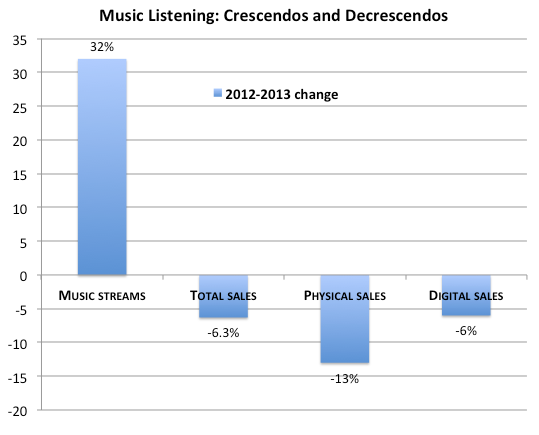
Derek Thompson covers the growth of music streaming:

This is at least the third destructive wave for the music industry in the last decade and a half. First, Napster and illegal downloading sites ripped apart the album and distributed song files in a black market that music labels couldn’t touch. Second, Apple used the fear and desperation of the record labels to push a $0.99-per-song model on iTunes, which effectively destroyed the bundling power of the album in the eyes of millions of music fans (even though country album sales are still pretty strong). For a decade, music sales plummeted. Third, digital radio and streaming sites got so good that now many music fans wonder why they need to buy albums in the first place. So, they don’t.

The Poisons In Our Pantry

by Katie Zavadski

James Hamblin sinks his teeth into the so-called “silent pandemic” of toxins hidden in our everyday items. A team of researchers identified a dozen common poisons – such as ethanol, lead, and mercury – that leech IQ points:

The greater concern lies in what we’re exposed to and don’t yet know to be toxic. Federal health officials, prominent academics, and even many leaders in the chemical industry agree that the U.S. chemical safety testing system is in dire need of modernization. Yet parties on various sides cannot agree on the specifics of how to change the system, and two bills to modernize testing requirements are languishing in Congress. [Mount Sinai’s Philip] Landrigan and [Harvard’s Philippe] Grandjean’s real message is big, and it involves billion-dollar corporations and Capitol Hill, but it begins and ends with the human brain in its earliest, most vulnerable stages. …

Economist Elise Gould has calculated that a loss of one IQ point corresponds to a loss of $17,815 in lifetime earnings. Based on that figure, she estimates that for the population that was six years old or younger in 2006, lead exposure will result in a total income loss of between $165 and $233 billion. The combined current levels of pesticides, mercury, and lead cause IQ losses amounting to around $120 billion annually—or about three percent of the annual budget of the U.S. government.

Low-income families are hit the hardest. No parent can avoid these toxins—they’re in our couches and in our air. They can’t be sweated out through hot yoga classes or cleansed with a juice fast. But to whatever extent these things can be avoided without better regulations, it costs money. Low-income parents might not have access to organic produce or be able to guarantee their children a low-lead household. When it comes to brain development, this puts low-income kids at even greater disadvantages—in their education, in their earnings, in their lifelong health and well-being.

Beard Of The Week

by Chris Bodenner

A reader passed it along:

I thought you might want this as a Beard of the Week. My colleague Matthew Bingley took the photo while covering the World Women’s Curling Championship in Saint John, New Brunswick.

Previous BOTWs here. And, because Andrew’s away from the blog, here’s a babe of the week.

The Wear And Tear Of Police Work

by Jonah Shepp

Nineteen years after her friend Sangeeta Lal was murdered by her ex-boyfriend, Erika Hayasaki connected with Brian Post, the police officer who responded to the shooting. Over the years, the beat has taken a serious toll on Brian’s health:

In squad rooms full of cops, Brian would compare blood pressure meds with his colleagues. Most, if not all, of the police he knew with more than 10 years of service were dealing some kind of medical or psychological issue.

At night, Brian would hide his drinking from his wife. He went from sipping whiskey, to downing cheap 100-proof vodka.

“You see nothing but bodies, I swear, dead people,” he said. “Car accidents, hangings, suicides, murders, SIDS deaths.” He remembered a diabetic who killed himself by overdosing on chocolate. And then there was the conversation with a tongue-pierced meth user with an enlarged heart who had told Brian, “I’m white trash until the day I die.” He assaulted people in a parking lot and died in custody after deputies restrained him. The next day, Brian found himself close to fainting after viewing the autopsy photos of the same kid’s esophagus, and pierced tongue.

“I was so angry at this one woman for dying, that I yelled at her,” he said. “I just didn’t want to see another dead body…I should have recognized at that point, it’s time for me to back up.”

The Whiteness Of Poverty

by Patrick Appel

Race Poverty

Yesterday, a reader took Paul Ryan to task for ignoring rural poverty. Waldman makes related points:

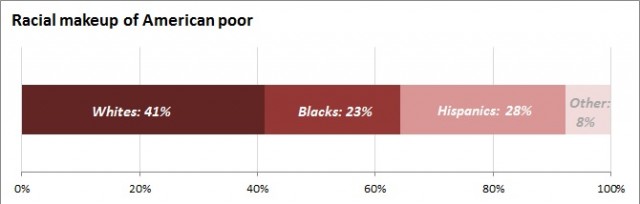
Everyone knows that minority populations in America, particularly blacks and Hispanics, suffer from disproportionate levels of poverty. For the moment, we don’t have to go into why that is and what can be done about it. I just want to note something that seldom gets mentioned: the actual racial makeup of America’s poor. In fact, when I tried to find a chart laying it out to paste into this post, I couldn’t find one. So I took poverty data and population data and made one myself (this is as of 2012) … The point of this chart is that even though blacks and Hispanics are disproportionately poor, the largest group of poor people in America is … white people.

Despite that fact, when you say “the poor,” what pops into most people’s heads is an image of a black person, probably due in no small part to the fact that poverty in America is represented in the media as a largely black phenomenon (I’m not just saying that; there’s research backing that up).

Bad Ideas We’ve Seen Before

By Patrick Appel

On Sunday, Robert Costa floated a new Republican GOP health care plan. Kevin Drum points out that the proposal is nothing the GOP hasn’t proposed a thousand times. Jonathan Cohn focuses on the interstate insurance sales component:

[I]f the GOP were to get its way, scrapping Obamacare and replacing it with the yet-unpublished plan Costa describes, the insurance industry would likely evolve just like the credit card industry did, with carriers relocating to states with the least regulations. That would be good news for healthy people willing to carry bare-bones coverage, and for people with enough money to pay for a plan, would love this arrangement. But people with preexisting conditions, the ones who were only able to buy coverage thanks to the ACA’s rules, would be back to the bad old days.

Bob Laszewski piles on:

A new carrier could conceivably come into the market with much lower rates––because it is offering fewer benefits––attracting the healthy people out of the old more regulated pool leaving the legacy carrier with a sicker pool. Stripping down a health plan is a great time tested way for a predatory insurance company to attract the healthiest consumers at the expense of the legacy carrier who is left with the sickest.

He suggests that “supporters of this idea first ask the leaders of the insurance industry if they would even do this under the best of circumstances.”