Busting The For-Profit College Racket

by Jonah Shepp

college_default_rates_by_sector

The Department of Education on Friday proposed new regulations (pdf) intended to address the high rate of student loan defaults among graduates of for-profit colleges. Ashlee Kieler outlines the proposal:

Programs would be deemed failing if loan payments of typical graduates exceed 30% of discretionary income or 12% of total annual income. Programs would be given a warning if a student’s loan payments amount to 20 to 30% of discretionary income, or 8 to 12% of total annual income. Discretionary income is defined as above 150% of the poverty line and applies to what can be put towards non-necessities.

Passing along the eyebrow-raising chart above, Danny Vinik praises the crackdown on for-profit colleges:

Students at for-profit colleges drop out at an alarming rate and those that do graduate have much higher levels of debt than students in public and private non-profit colleges. For-profits also receive a substantial share of their revenue—more than 80 percent to be exact—from loans and grants from the federal government. In 2012, the Senate Health, Education, Labor and Pensions Committee, led by Senator Tom Harkin, completed a two-year report into for-profit universities to investigate whether this taxpayer money was being well spent. Across the board, degrees and certificates from for-profit colleges cost significantly more than those from non-profits[.]

Those extra costs are not leading to high graduation rates though. Fifty four percent of students who enrolled during the 2008-2009 school year had withdrawn from the institution by 2010. Only 18 percent had earned their degree or certificate.

America’s Foreign Policy Is Bankrupt

by Patrick Appel

Literally:

If America and Europe have failed to adequately defend Ukraine, it’s not for lack of guns. It’s for lack of money. Over the last year, the real contest between Russia and the West hasn’t been a military one (after all, even McCain knows that risking war over Ukraine is insane). It’s been economic. In part because of two wars that have drained America’s coffers, and in part because of a financial crisis that has weakened the West economically, the United States and Europe have been dramatically outbid. …

Whenever the United States debates using its money to buttress democracy and Western influence in a strategically important part of the world, commentators offer comparisons with the Marshall Plan that America offered Europe after World War II. But in today’s dollars, according to one estimate, the Marshall Plan would total roughly $740 billion. That kind of money would certainly enable far-reaching economic reforms in Ukraine, and likely anchor the country in the West for years to come. But, of course, the suggestion is absurd. Today’s Senate can barely pass an aid package 740 times as small.

The View From Your Window Contest: Winner #196

by Chas Danner & Chris Bodenner
vfyw_3-15

A reader gets wistful:

Savannah, Georgia. The state that broke my heart. Twice.

Another goes way west:

This is Guilin, China.

Another wild guess:

If I’m correct, this picture is taken right off the Bosphorus River, in Istanbul. I think the bridge is the Ataturk Bridge. Hope I’m right! This is my first ever try for a VFYW, so does that cut me some slack?

A little but not enough. A reader gets the right continent:

The license plates look European, and the flag on the front of the boat looks blue.  I’m going with northern Greece, somewhere near Albania.

Another thinks he’s got the right river:

I spent a summer studying abroad in the Czech Republic. Made a trip to Linz one weekend to see what was there. Linz’s waterfront looks very similar to that picture and so does the bridge. Also the cruise boat makes me think its somewhere on the Danube.

A few others thought it was the Danube as well. But another gets closer:

Like many other readers, I suspect, I have been meaning to subscribe, but I’ve not yet gotten around to it. As far as the VFYW, this is the first time I’ve ever had a real glimmer of recognition. The bridge and gently-sloping hills in the background strike me as Rouen, one of my favorite towns in France.

Another gets the right country:

This bridge looks very much like one that I crossed on foot with a suitcase about 20 years ago, when I was a graduate student studying in Germany for a year.  I remember taking a ferry down the Rhine from Mainz to Koblenz, walking across the bridge to a fleabag hotel I where I spent the night (the guidebook I used them called the decor “cheesy” and the facilities “a little worn”). The wintry scene, the German-style apartment houses in the background, the European economy cars and the bicyclist all make me think of Koblenz.

Another gets really close:

This appears to be in Cologne. The view seems to be looking from the left side of the Rhine over to Deutz (a neighborhood in Cologne) on the right side. If it’s not Cologne, it must be somewhere along the Rhine.

It is. Another gets the right city:

I think your contest photo is a picture of Bonn, Germany. That’s the bridge running over the Rhine, if I’m not terribly mistaken. Two summers ago I walked over that bridge every morning to my German classes. Terrible classes, but my wife and I had a lovely time in the city all the same.

Another nails the right hotel in Bonn:

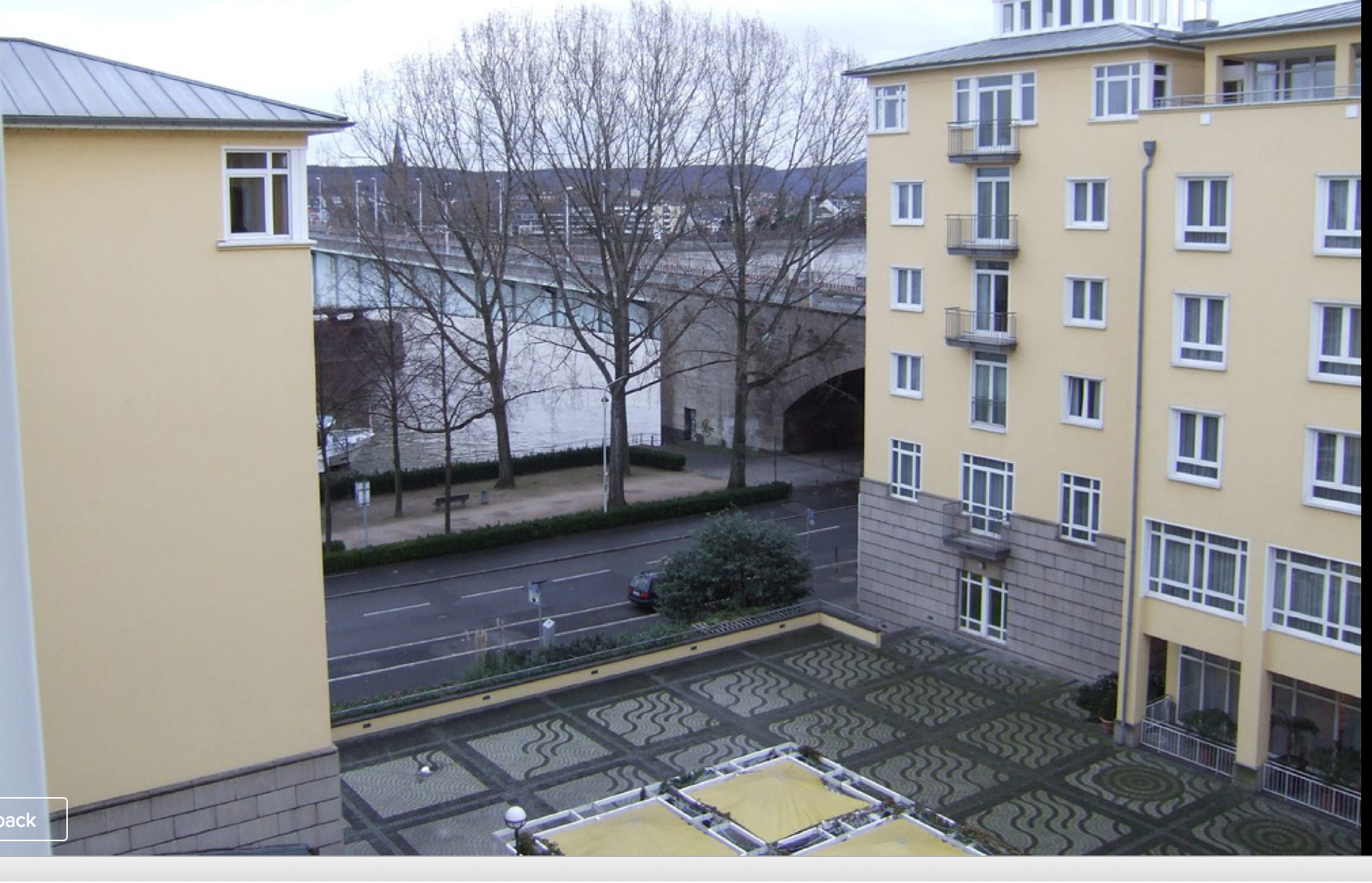
I’m a loyal reader but fairly new subscriber, and this is the first contest I’ve ever entered. If I get this right, then a million other people probably will, too, given my very rudimentary search technique skills. Right off the bat, this looked like Germany to me, and the Rhine River, and for some reason I immediately thought “Bonn”, a city I’ve been to a few times. Then a couple of image searches and some basic Google mapping and lo and behold … Hilton Hotel, looking out over the Kennedy Bridge. I’m too lazy to even try to figure out exactly which room the photo was taken from, which means someone else will probably take the prize. Please tell me I’m right, as I’m already shaking with excitement …

Yep you’re right. But more than 50 readers correctly guessed the Hilton Hotel. Here’s a fantastically thorough entry:
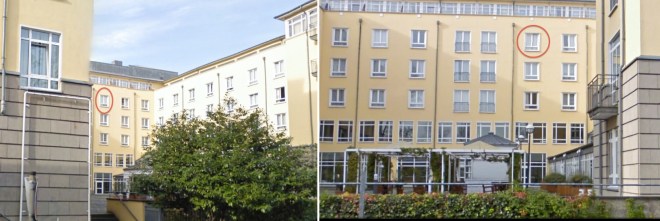
window-from-in-front-angle

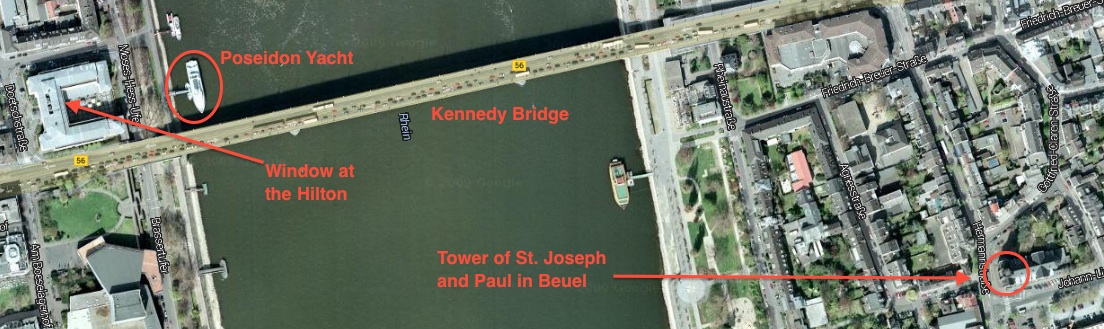
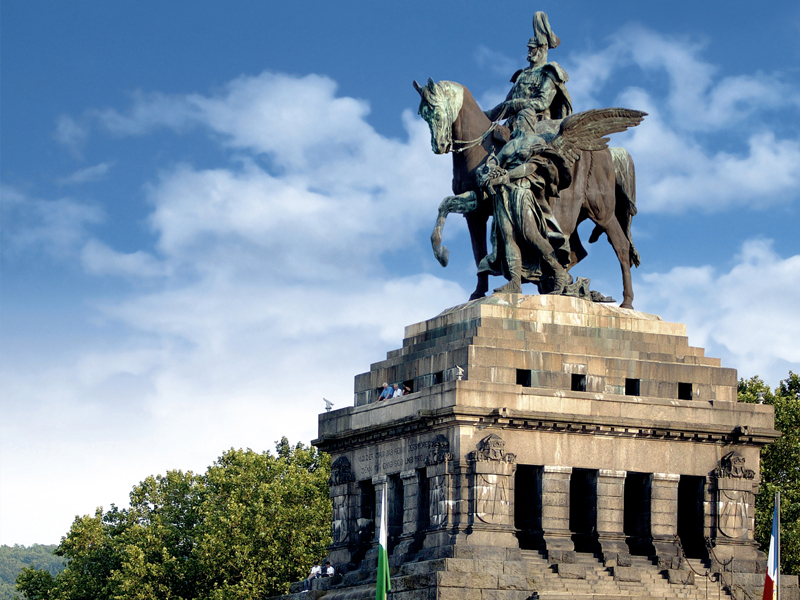
This week, I first traveled the Danube and the Elbe before navigating down the Moselle to join the Rhine at Koblenz, where Kaiser Wilhelm I and his genius loci survey the rivers’ confluence at the German Corner.  From there, it was a short ride to the Poseidon Yacht anchored in front of the Hilton Hotel at Berliner Freiheit 2 D-53111 in Bonn, Germany, where this week’s contest window is located. Beautiful scenery the whole way.  I’ll guess room number 410, on what we in America accurately call the fifth floor.  I compared this photo – that seems to have been taken from the same room – with a photo looking out of room 326 to help estimate the room number.  Even if it’s not room 410, [above] are two pictures with the window circled. [Below] is an overview photo with labels for the hotel, the Poseidon Yacht, the Kennedy Bridge, and the church tower that is through the trees and across the Rhine from the contest window:

Overhead-1

The Poseidon Yacht looks better in all its neon glory at night. But the city’s most famous landmark is not in the picture; Bonn hosts the corporate headquarters of Haribo, the company that gave the world gummy bears.

Perfect timing for a German riverboat trip, as I have been reading Patrick Leigh Fermor’s A Time of Gifts. Fermor walked across Europe before the war, starting a few months after the Nazis took power. He made his way up the Rhine by barge in December 1933 just before Christmas, with stops in Bonn and Koblenz. The war and the Holocaust are still in the distance, but they hang over the memoir.  It’s a wonderfully written adventure with digressions into history, art, language, and religion.  I recommend it to other Dish readers.

Another geeks out on the bridge:

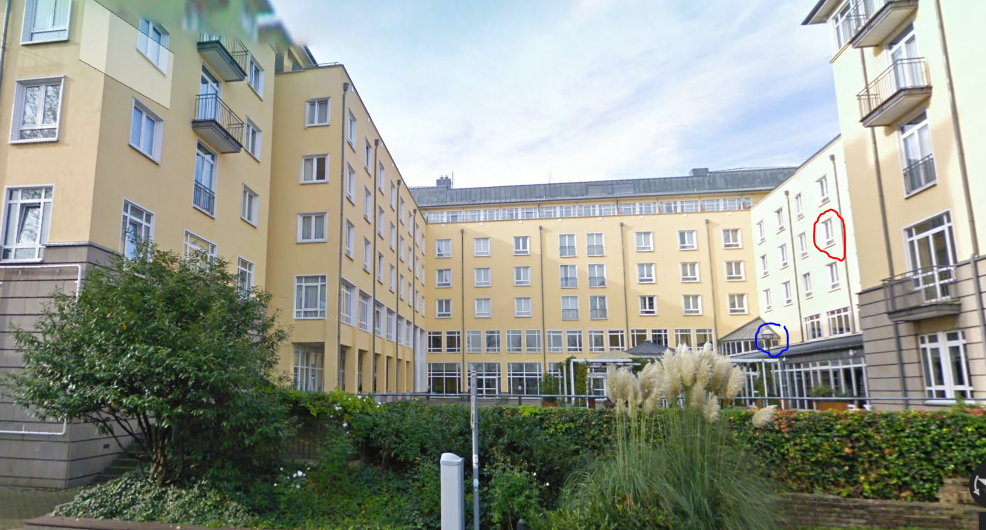
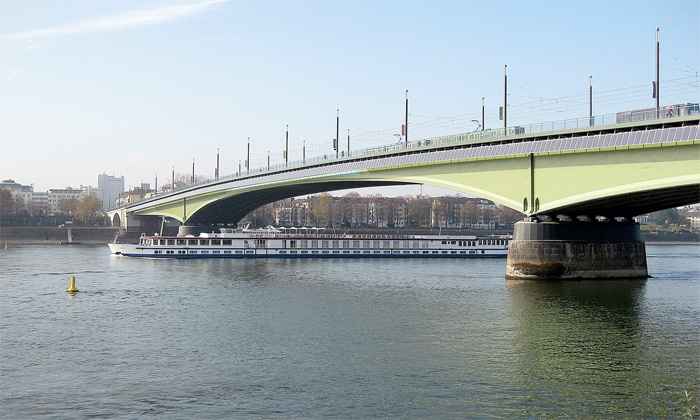
Finally got one! Kennedy Bridge, near where the Allies reached the Rhine in 1945. I couldn’t read the sign on the boat, but I had some sort of advantage – bridges! This one is strange for the US – the piers are wrong, and the Coast Guard HATES having fixed steel bridges that low over navigable waterways. Plus, the buildings looked vaguely European/Scandinavian. After finding a web database of bridges, and sorting to “multiple girder steel bridge over water” and finding a picture of a bridge in Strasbourg with similar features, then realizing we just passed the date of the allied advance, I traveled down the Rhine in Google Earth until I found it. I got thrown off the trail a bit because the photo clearly shows six girders, but the Streetview/Earth photos show it before its recent renovations with expansion to six girders. Here’s the hotel the photo was taken from:
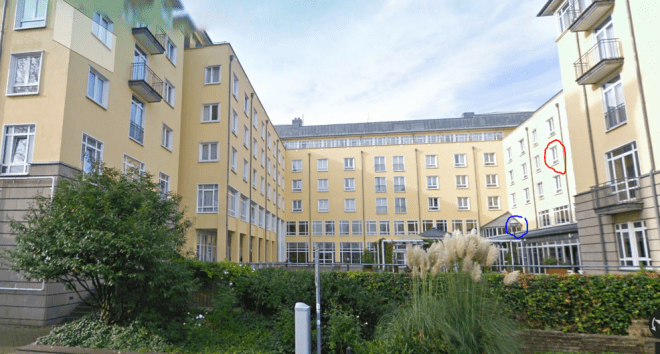
image-3

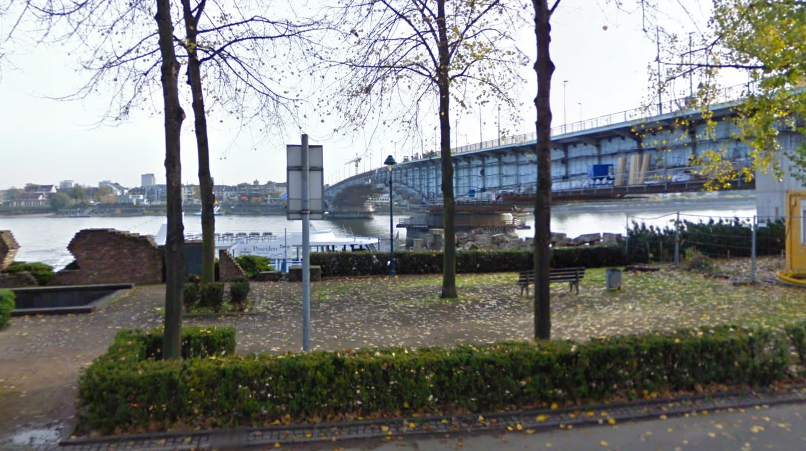
The lamp post (blue) is kind of to the left of the photographer, but they are close to it. I am going to guess: 3rd floor, middle of north wing (red circle). Here’s the Streetview of the bridge, same direction as shot:
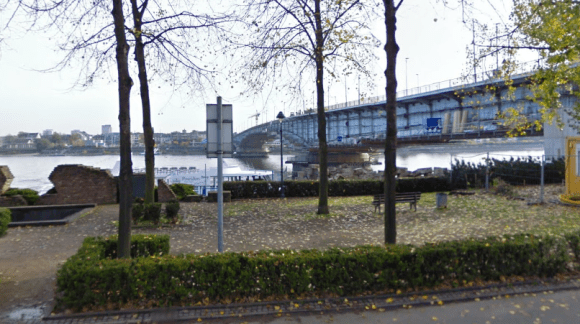
image-2

A nearby resident shares more info on the bridge:

The Kennedy Bridge had been renamed in December 1963 in honor of President John F. Kennedy, who had visited both Bonn (Germany’s capital at the time) and Berlin half a year earlier in June 1963 to commemorate the 15th anniversary of the Berlin Airlift and give his famous “Ish bin ein Bearleener” speech. The name of the street leading up to the bridge, Berliner Freiheit, translates to “Freedom of Berlin”, and the street faces pretty much in the direction of today’s capital of Germany.

Another adds:

The street below was previously known as Matthias-Erzberger-Ufer, after the Catholic politician and vice-chancellor of the Weimar Republic, who had signed the armistice at Compiègne in 1919, and was vilified by conservatives and right-wing press and politician until his assassination in 1921. It was renamed in 2011 after Moses Hess, the Jewish philosopher, who was an important precursor to Marx and Engels as well as to Zionism, and who, different from Erzberger, was actually from Bonn. You can see, in the lower left, across the street, a memorial for the Jewish community of Bonn, a fragmentary star of David, erected from the stones of the nearby synagogue, that had been destroyed during the pogrom of November 9, 1938. Strange contrast with the “party yacht” Poseidon moored behind it waiting for customers for a joyful booze cruise on the Rhine.

Another:

The best part of these puzzles is all the trivial knowledge I gain playing; this week: street lamps, European river cruises and EU vehicle registration protocol! I have yet to summon the courage to involve the front desk in getting exact room number. Maybe next time.

Another claims some bragging rights:

Yes! I beat my husband! (I always do.) I found the Hilton Bonn, Berliner Freiheit 2, 53111, Bonn, Germany after a Google search for solar energy bridges, while he was still going through all the bridges on the Danube : ) Here’s a picture of my guess for the exact window (my graphic skills aren’t quite as advanced as some of your readers’):
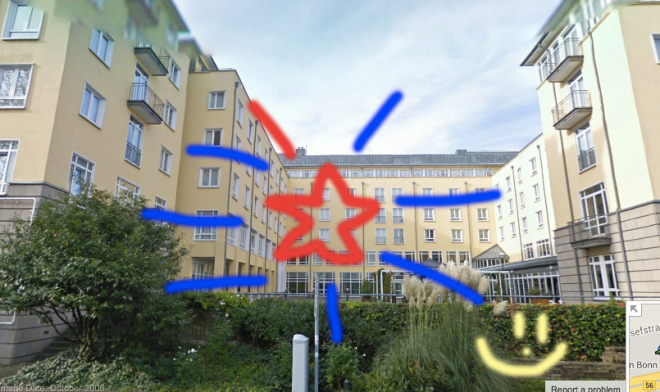
hilton bonn room

But there’s a hitch in this week’s contest, as the original submitter can’t remember the room number. What to do when that happens? In Chini we trust:
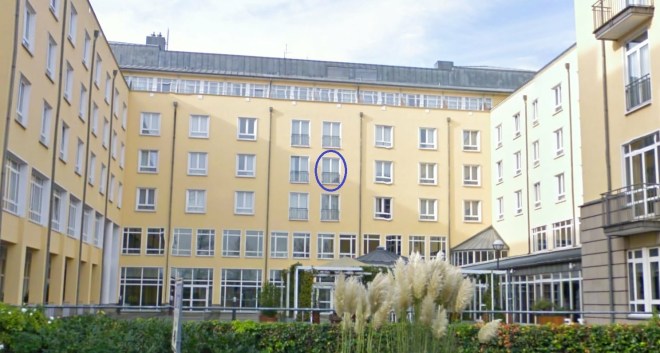
VFYW Bonn Actual Window Marked - Copy

At first this seemed like it might be a toughie, but once I saw that there was a dead giveaway clue I knew you’d get quite a few correct guesses. This week’s view comes from Bonn, Germany. The picture was taken on the 3rd floor of the Bonn Hilton and looks due east to the town of Buele on the far bank of the Rhine.

One notable feature in the image is the Kennedy Bridge on the right. As you might guess, based on its aging pillars and abutments, the current structure is a post World War II replacement. The original, far more beautiful bridge was blown up by the retreating Wehrmacht on March 8th, 1945. Fortunately the demolition of the Bonn bridge was too little, too late. On March 7th, the U.S. First Army had captured the Ludendorff Bridge at Remagen just 13 miles upriver and the door into Germany swung wide open. Here’s a black-and-white image of the original bridge and a marked overhead view of it from 1943:
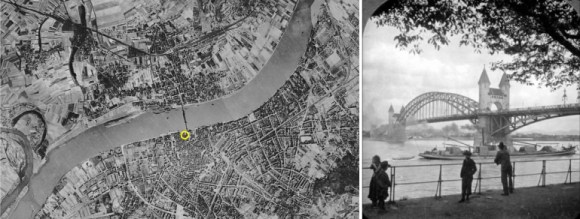
VFYW-Bonn-Original-Bridge-aerial

For the truly curious, here’s a documentary on the capture of the Remagen bridge.

Several readers agreed with Chini’s window selection, but the prize this week goes to the reader with the most correct guesses in previous contests without yet winning:

I was upset with myself for not entering the past two weeks. I had a general sense of where the images were taken, but didn’t get to the right city quickly enough, and didn’t have the time to look further. I committed to solving this week’s image no matter how difficult. I started with the sense that we were looking at a northern European city, flag on boatobviously on a river. But, all cities in Europe were built on rivers. Looking for clues, I noticed a light blue flag on the boat docked in front, and thought I’d start there. The blue colored European country flags were Greece, Sweden, and Latvia. It couldn’t be Greece, as this city looked northern. But, the flag was too light in color for it to be any of these countries. Nonetheless, I searched some cities in Sweden and Latvia before I abandoned that approach. After striking out in Sweden and Latvia, I tried to find the distinctive patio flooring that is shown in the picture. I couldn’t find it.
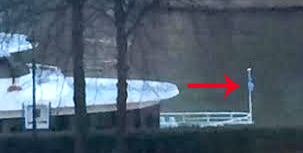
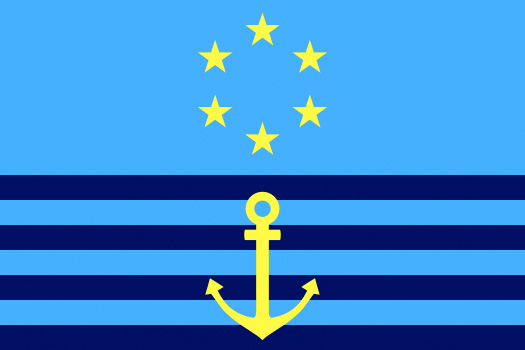
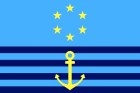
So, back to the flag. I found this flag for the Central Commission for Navigation on the Rhine. The color seemed rhine flagright, and so did the river. Now, I really have no idea if this is the flag on the boat, but it brought me to the Rhine. So, I took a journey down the Rhine. After looking around at images in Basel, I decided to get more efficient with my search. So, I searched for Rhine bridges. The search quickly brought me to the Kennedy Bridge in Bonn, and it was a match:
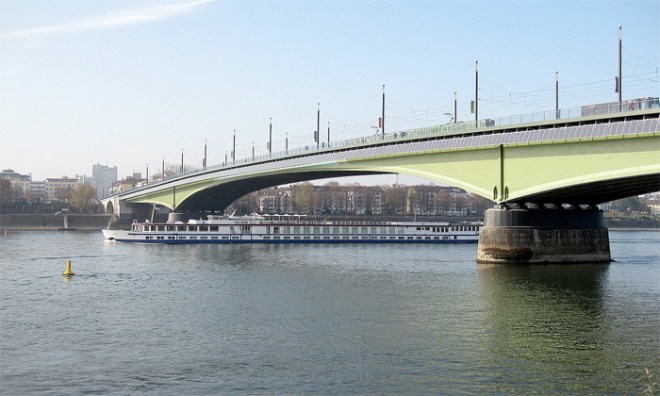
Kennedy bridge

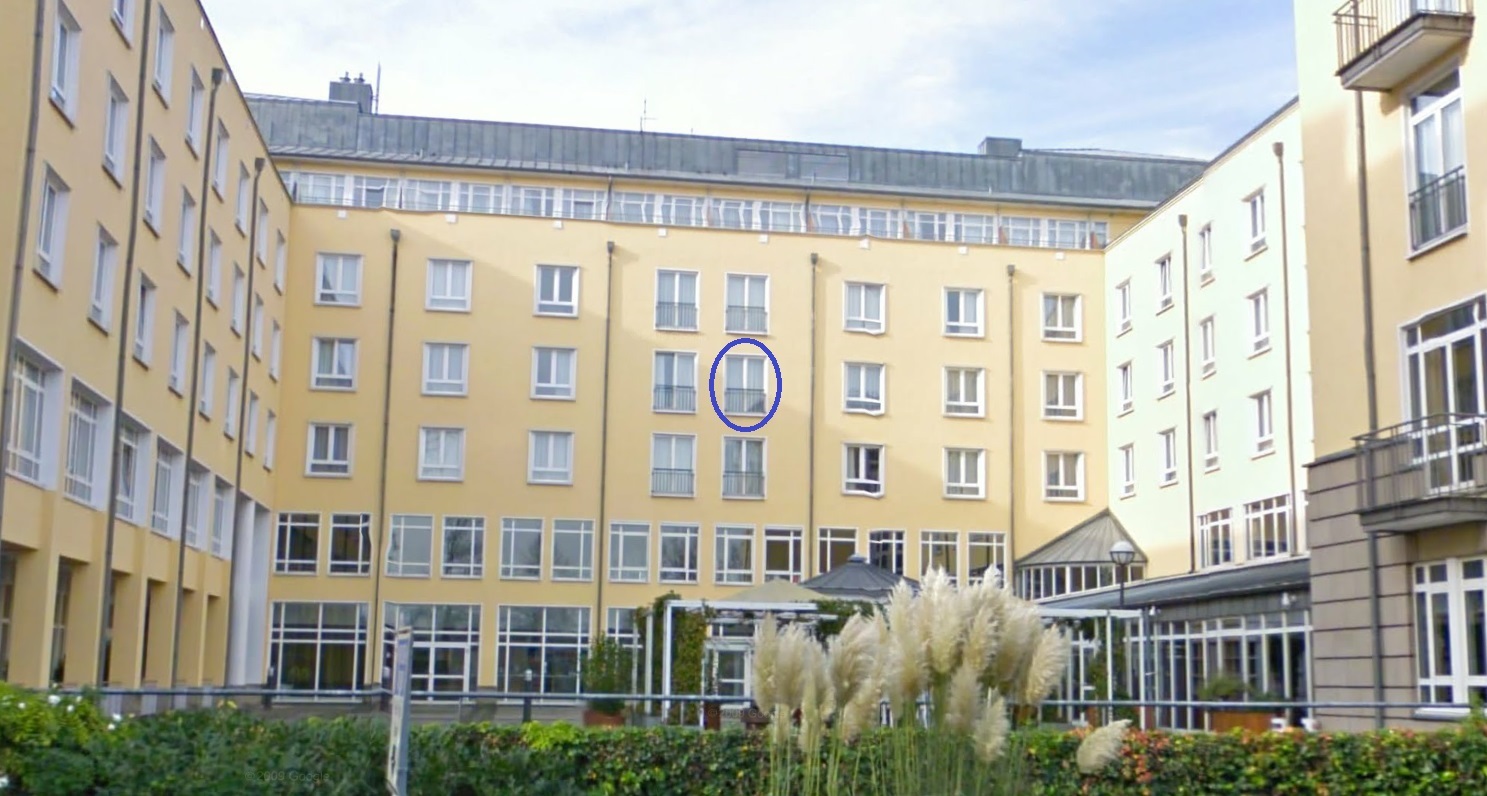
The original bridge was completed in 1898. To see the animated gif of the stereoscopic view of that bridge, go here. The Bonn Hilton at Berliner Freiheit 2 is where this week’s picture was taken from. Here is a picture that shows the distinctive courtyard—the courtyard that I had hoped would help me on my search, but didn’t:
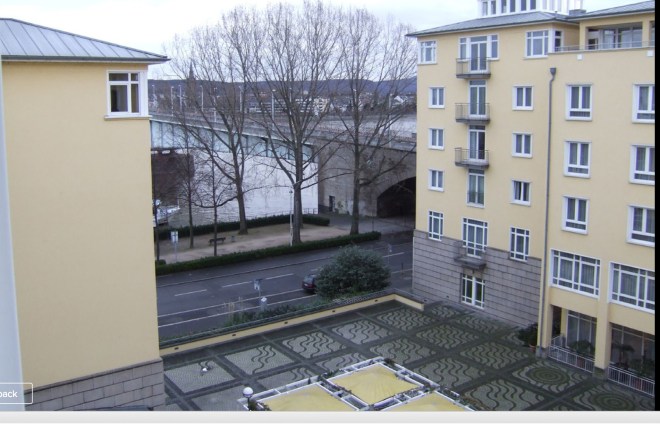
courtyard

And where was the picture taken from? I think it was from the room I boxed in red:
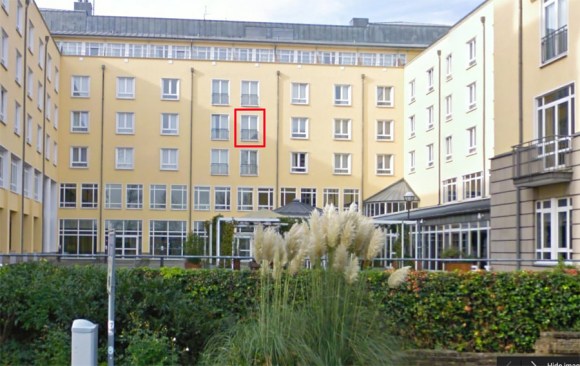
room

I know that your consistently winning players always know the room numbers. That frustrates me, as I have never found a floor plan for hotel guest floors. Someday, I am going to win this thing.

Well that someday is today. From the reader who submitted the contest view:

Unfortunately, I don’t remember my room number from that trip.  I want to say it was 311, which would be the fourth floor because, like most European buildings, the ground floor is considered “zero”.   However, I would not bank on that memory of my room number, or even my floor.

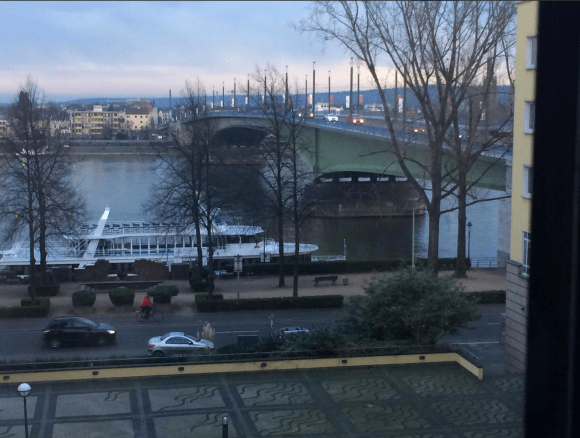
I’ve stayed at the Hilton in Bonn several times, but this was the first time I had that river view, which I found immediately compelling. I took the picture just after sunrise and thought it captured a scene from that part of Germany perfectly – the bicyclist, the bridge, the boat, and the architecture across the river.  Bonn is mostly a university town, and I often tell people it’s like Albany, in that it was a small city to be a capital, with a good university, and is often overshadowed by its larger, more well-known neighbors, Cologne and Dusseldorf.

I took the picture the first week of February, in the heart of winter. While news of the polar vortex was dominating the news at home, Europe was having the mildest/warmest winter I can remember. I was able to take a few long runs along the Rhine in shorts, with just a long-sleeved shell on top. Normally, at that time of year in Northwest Germany, I run indoors on a treadmill because it is too cold to run outside. In fact, I chose the Hilton precisely because they have a good modern gym and I expected to use it that time of year, but I ended up just running outside along the river every morning.

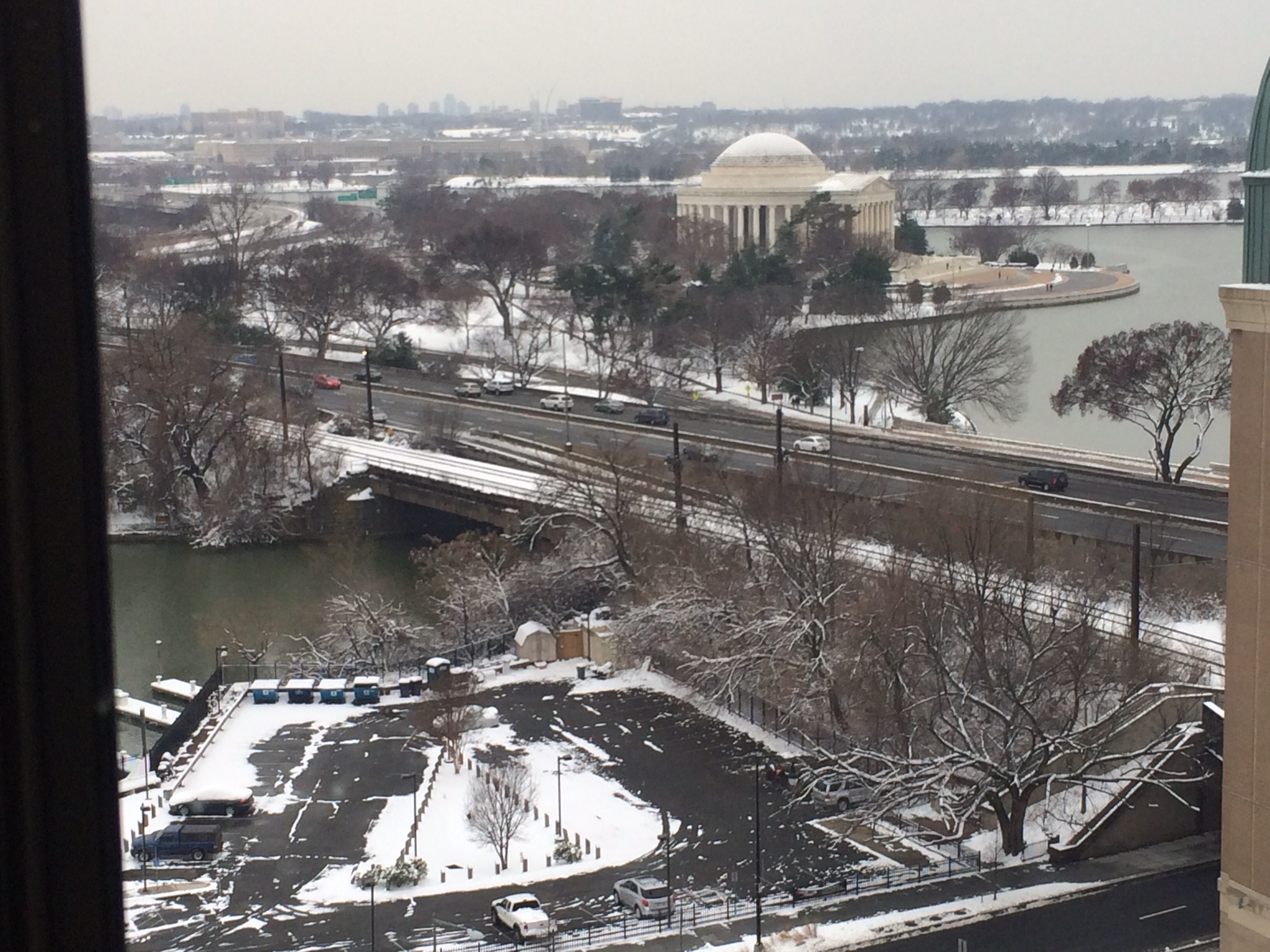
It is apropos that you used my photo this week. While Andrew is enjoying warmth and sunshine on his vacation, I am stuck in his hometown of DC, which just got yet another generous helping of snow. Still, as I write you from my current hotel room, I can’t complain about my view:
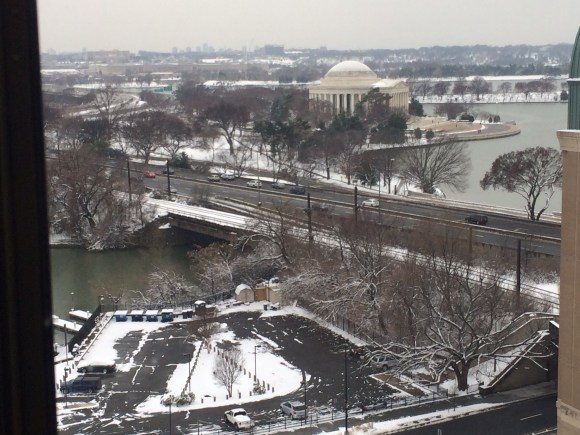
image

(Archive)

Sanctions For Sanctions’ Sake, Ctd

by Jonah Shepp

Yesterday, the US slapped sanctions on seven Russian and four Ukrainian officials for their involvement in the Crimean secession, including ousted Ukrainian president Viktor Yanukovych, but not on Vladimir Putin himself. The EU also announced similar sanctions on targeted individuals. Adam Taylor takes a closer look at the names on our list:

These people may not be household names in the United States or Western Europe, but they hold real power in Russia, which may not be apparent from the one-line descriptions given by the White House.

For starters, there’s Vladislav Surkov, described as a presidential aide to Putin. Surkov is notorious in Russia-watching circles as the theater director who later became a PR man for Mikhail Khodorkovsky. He eventually came to the Kremlin and used his understanding of publicity and image to help sustain and strengthen Putin’s presidency, with some even suggesting that he was the real power behind the throne. He was called “Putin’s Rasputin” in the London Review of Books, and the “Gray Cardinal” by many others. While he apparently fell out of favor after anti-Putin protests in 2012, he was brought back last fall to help deal with Ukraine and other situations.

Bershidsky slams the list, which he says doesn’t include the real culprits:

If the U.S. authorities’ purpose was to punish people responsible for Putin’s Ukrainian escapade, they should have started with the Russian president himself: He alone decides what Russia will or will not do. They also could have gone to the trouble of finding out who commanded the unmarked Russian troops that spread across Crimea, and who sent goons to foment unrest in southeastern Ukraine. Punishing Putin, however, must have seemed like a scary idea, and identifying those who did his dirty work turned out to be too challenging.

The EU, in fact, did a better job on that front. On Monday, it revealed its own list of 21 people targeted for sanctions, and it includes the commanders of Russia’s Black Sea Fleet and southern and western military districts, as well as a longer list of pro-annexation legislators and separatist Crimean officials.

Russia plans to retaliate with sanctions of its own:

[W]hile the final list is still being crafted, it will include top Obama administration officials and high profile U.S. senators, in an effort to roughly mirror the U.S. sanctions against Russian officials and lawmakers, according to diplomatic sources. At the top of the list in Congress is Senate Majority Whip Dick Durbin, who recently co-authored a resolution criticizing Russia’s invasion of Crimea.

Durbin’s inclusion on Putin’s list would mirror Obama’s naming of Valentina Matvienko, the head of the upper chamber of the Russian Duma. Senate Majority Leader Harry Reid and Minority Leader Mitch McConnell are not expected to be on the Russian sanctions list.

Scott Clement notes that sanctions are the only response to Russia most Americans support:

Americans’ reluctance was laid bare in a CNN poll last week. Obama’s current policy is widely popular, with almost six in 10 supporting economic sanctions on Russia (it was 56 percent support  in a Post-ABC poll). But at least half of Americans opposed all five other potential actions asked in the survey: economic assistance to Ukraine’s government (52 percent opposed), canceling an international summit (58 percent), sending weapons to Ukraine’s government (76 percent), U.S. air strikes (82 percent) and ground troops (88 percent).

Larison reiterates the futility of sanctions:

When the U.S. passed the Magnitsky Act, did this cajole Russia into adopting reforms of its legal system or force it to commit fewer abuses? Obviously, it did nothing of the kind. All that it achieved was to irritate Moscow and convince them of American hostility, and it led to a series of Russian retaliatory measures that damaged relations with the U.S. and made the situation inside Russia significantly worse than it was before. Attempting to compel desired changes in Russian behavior contributed to a deterioration in the conditions that the attempt was supposed to ameliorate. These tactics almost never work, but Westerners keep trying them out of a misguided belief that anything that the other government dislikes must be the right and the smart thing to do. All sanctions are ultimately “unserious” in that they are reflexive responses to international events that often achieve nothing good. Sanctions frequently can’t deliver the results that their advocates claim that they can, but they can be dreadfully serious in their ability to wreck relations with other states and make bad situations worse.

Previous Dish on sanctions here.

The Wealth Chavez Wasted

by Patrick Appel

Venezuela Oil

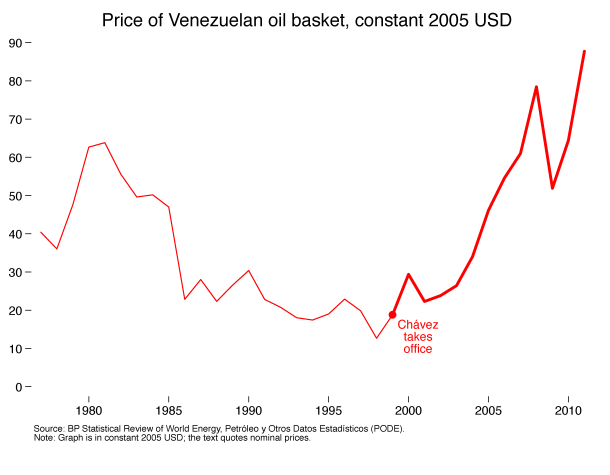
Dorothy Kronick trashes Hugo Chavez’s economic legacy using a series of charts:

Nature handed Chávez by far the biggest resource windfall in Latin America (Figure 4), yet compared with its less-lucky neighbors, Venezuela experienced slow economic growth (Figure 5) and high inflation (Figure 6). Nor did Venezuela eclipse many of its neighbors in lowering infant mortality (Figure 7), slashing poverty, reducing inequality or improving school attainment during Chávez’s tenure. Many of the countries that surpassed Venezuela in these social achievements did so in part by implementing innovative anti-poverty programs called conditional cash transfers, in which the government pays poor women who take their children to school or the doctor. While Mexico, Brazil, Peru, Colombia and other countries pursued these highly effective policies, Venezuela scaled up projects that “one will be hard-pressed to find [evidence of] in human development statistics,” in the words of a prominent Venezuelan economist who evaluated the programs.

Kronick goes on to compare Venezuela’s economic failures with Bolivia’s successes. Greg Weeks adds:

What she does not address, though, is the “why” question. Why did Evo Morales, who uses similar rhetoric, professes a similar ideological orientation, and faces a similarly elite opposition, go in such a different and more successful direction? Perhaps because it’s so uninterestingly stable at the moment, Bolivia gets no attention paid to it at all.

Win The Senate, Lose The Country

by Patrick Appel

If the GOP retakes the Senate, Scott Galupo fears the party will sabotage its presidential nominee:

[T]he seeming tranquility in Washington is simply the sound of two parties behaving well until a midterm election. If and when Republicans retake the Senate, the intraparty feud, now simmering, will begin to boil anew. The rightmost flank, flush with victory, will need to be appeased. And the ideological toxicity; the demographics of death; the lack of a viable national standard-bearer — these factors and others will conspire to elect the next President Clinton.

Waldman imagines how Republican control of Congress might play out:

The senators accept that the ACA is law and are thinking about how they’d like to change it. The House members are coming up with another way to make a futile, symbolic shaking of their fists in the general direction of the White House. And this may offer a clue to how legislating would proceed in a Republican Congress. The House, still dominated by extremely conservative Republicans for whom any hint of compromise is considered the highest treason, could continue to pass one doomed bill after another, while the Senate tries to write bills that have at least some chance of ever becoming law.

And that would be just fine with Barack Obama. If he’s faced with both houses controlled by the opposition, there’s nothing he’d rather see than them fighting with each other and passing only unrealistic bills that he can veto without worrying about any backlash from the public.

What’s The Best Way To Combat Military Rape? Ctd

by Chris Bodenner

A reader writes (with an updated reader retort below):

I’m a reserve naval officer with a young daughter that I love very much. I mention this information just to let you know where I’m coming from when I say that the media (including The Dish) is getting this story wrong and missing the larger problem.

One rape is too many – period – and does it happen in the military? Obviously. That said, I can tell you from personal experience that the military is more proactive on this problem than any other public or private institution. I’m not an apologist – just telling you the facts. Every year, every single member of the military goes through several hours of sexual assault prevention training. As long as I can remember – at least 10 years – this training has included outside-the-chain-of-command hotline numbers and other reporting techniques. You should also know that sexual assault stats in the military can include incidents that wouldn’t even be reported within civilian institutions – things like “brushing by” and “staring for too long.”

The reason that I mentioned that I have a young daughter is that, after studying the data, I can say with confidence that she would be safer in the military than at most American colleges. I’m not even talking about the frat colleges like USC or Duke. I’m talking about places like Harvard. Check out the Class of 2013 survey that was published in The Crimson, especially this tidbit:

In the survey, 45 people—41 of whom were women or transgender students—said that they had been sexually assaulted at Harvard. Just eight of those victims said they reported the assault to Harvard administrators. And just one, a male victim, went to the police.

I believe only about half of the graduates responded to this survey and so it doesn’t include those who were so traumatized that they had to leave Harvard. But even so, those numbers are roughly the same as the numbers for the military – and remember that the threshold of what is defined as “sexual assault” at Harvard is probably much higher than the military. Finally, and most damning, only one – one! – victim out of 45 went to the police. And only 8 notified anyone at all. That is absolutely egregious.

Clearly this is just the tip of the iceberg. So who has the problem? We all do. Like I said, one rape is too many.

Lastly, Harvard and every other college gets a shitload of federal money for research and student loans and grants, so their sexual assault problem is not theirs alone. If the tax-payer is funding those institutions, the tax-payer has a right and duty to demand higher standards.

Update from a reader:

Responding to the Naval Reserve Officer who excuses the military’s demonstrably unsuccessful response to sexual assault while pretending not to: I’m a retired Naval Officer, and now a civilian working on a military base, and I call bullshit on his assessment that the military is more proactive on this than anyone else. A few points:

1. Mentioning he has a daughter he loves is irrelevant, manipulative hand waiving.

2. The annual sexual harassment training we receive is a check-in-the-box lecture conducted by ill-trained and apathetic instructors. The last one I attended devolved into a lengthy discussion that was little more than victim-blaming accusations of inappropriate dress, which the instructor allowed without interruption or contradiction. This was not much different than the post-DADT training lecture, during which the instructor opened with “You don’t have to like it and I’m not gonna try to justify it,” signaling his clear dislike of the new policy.

3. Your correspondent’s dismissal of military assault statistics because the include “brushing by” and “staring too long” is insulting to all those that have been assaulted. It is a repulsive and inaccurate minimization of a very real problem. The writer is conflating sexual harassment issues – which, just as in the civilian world, can include ogling, leering, and staring inappropriately – with assault, while pretending that such concerns are unheard of in the civilian workplace.

4. Comparing “the military” to “colleges” is a nonsensical logical fallacy. It is much more appropriate to compare the military to other industries and workplaces. The fact that our daughters are not particularly safe at colleges is a problem, but to hand-wave away the military issues with little more than “but other places that are worse” is childish.

We have a major sexual assault problem that has confounded the uniformed leadership despite having vastly greater authority over their employees than nearly any other industry or professional leadership cadre.  It is this contradiction that suggests a significant structural and cultural problem not to be dismissed by lazy comparisons and minimizations.

“He’s A Much Greater President Than The Polls Suggest”

by Chris Bodenner

Andrew’s Overtime appearance on Real Time is up:

This embed is invalid


Earlier in the show, Rand Paul came up:

Maher says Paul’s success could be based on his aversion to “American Empire”. “Like his father, he is for not for having an American empire,” Maher said, referring to former GOP presidential candidate and his dad, Rep. Ron Paul (R-Texas). “That’s the thing I love about the Pauls.”

Blogger Andrew Sullivan concurred with Maher saying, “I think Rand Paul’s attempt to say what most people in this country really understand, which is we don’t need to run the world. We don’t want to run the world. America would be in a better place if we were less interested in our own power, and more interested in freedom.”

Most of the show isn’t available online, but featured on YouTube below is Maher’s blistering take on the upcoming movie Noah and the 60% of Americans who believe the Biblical flood story is true (money quote: “Hey god, you know you’re kind of a dick when you’re in a movie with Russell Crowe and you’re the one with anger issues”):

Update from a reader:

You can get a podcast of Real Time (full audio, no video) for free at iTunes or HBO.com. Usually comes out midweek after the show.

The iTunes version is out – here.

Don’t Bite The Hand That Buys Your Gas

by Jonah Shepp

James Surowiecki contends that when ” it comes to natural gas [Putin] isn’t thinking enough moves ahead”:

You might take Putin’s brandishing of the gas weapon as a shrewd geopolitical move. But it’s a classic case of putting short-term interests ahead of long-term gain. Although the region’s need for Gazprom supplies may strengthen his hand in the present, the strategy is forcing Europe to end its reliance on Russia.

After the crises of 2006 and 2009, Europe increased imports from Norway and Qatar. It built new facilities for receiving liquefied natural gas, and upgraded storage capacity, so that supplies could be stockpiled in case of a cutoff. It imported more coal. Pipeline connections within the E.U. were improved, making shortages easier to alleviate. The Crimea crisis will give new impetus to these efforts. The U.K.’s foreign secretary has said that the crisis is likely to make Europe “recast” its approach to energy. A draft document prepared for a forthcoming E.U. summit deplored the Continent’s “high energy dependency” and called on E.U. members to diversify their supplies. These moves are reminiscent of what happened after the oil crises of the nineteen-seventies made it clear to the West and Japan that relying on opecsuppliers was foolish. Europe installed energy-saving technologies and invested heavily in nuclear energy and natural gas. France built fifty-six nuclear reactors in the fifteen years after the oil embargo of 1973.