The Newest Voters Lean Right? Ctd

by Patrick Appel

Last week, John Sides claimed that the youngest millennial voters in 2012 skewed Republican. Daniel Berman casts doubt on this analysis:

When one recognizes that 18 year olds were only 55% white in 2012, that implies either a large shift among younger minorities, or a percentage in excess of 75%-80% among whites.

A more plausible outcome is that the Exit Poll collection method is fundamentally flawed when collecting this data, as its owns creators have claimed, noting their own (ANES) estimate that Obama won 71% of 18-20 year olds. Polls are not collected at all polling stations, but rather at a selection. While efforts are made both to gain representative samples of certain groups, and to weight them accurately, the numbers for groups that were not targeted for representative samples, say 19 year olds, are likely to be off, with margin of errors meaningless.

The One-Armed, Three-Handed Drummer

by Jonah Shepp

Drummer Jason Barnes, who lost his right arm two years ago, gets an assist from a robotic prosthesis:

[T]hings got more interesting when [founding director of the Georgia Tech Center for Music Technology Gil] Weinberg added a second drum stick into the mix. Now Barnes can play with one stick in his human hand, with a second stick following along to the rhythm, while a third can fill in with computer-improvisation that’s computed based on the rhythm of the other two sticks. In essence, Weinberg helped turn Barnes into a three-handed drummer.

“I think [the potential] is limitless,” Weinberg told me. “I’m very excited about actually helping someone with a disability to become actually better than his teacher.”

Correction Of The Day

by Chris Bodenner

“An earlier version of this article misquoted a comment from Malachy McCourt on St. Patrick.  Mr. McCourt said, ‘My attitude is, St. Patrick banished the snakes from Ireland and they all came here and they became conservatives.’ He did not say St. Patrick banished the slaves from Ireland,” – the New York Times.

Political Biology

by Jonah Shepp

Chris Mooney reviews John R. Hibbing, Kevin B. Smith, and John R. Alford’s Predisposed: Liberals, Conservatives, and the Biology of Political Differences:

As Hibbing et al. explain, the evidence suggests that around 40 percent of the variation in political beliefs is ultimately rooted in DNA. The studies that form the basis for this conclusion use a simple but powerful paradigm: they examine the differences between pairs of monozygotic (“identical”) twins and pairs of dizygotic (“fraternal”) twins when it comes to political views. Again and again, the identical twins, who share 100 percent of their DNA, also share much more of their politics.

In other words, politics runs in families and is passed on to offspring. Hibbing and his coauthors suspect that what is ultimately being inherited is a set of core dispositions about how societies should resolve recurring problems: how to distribute resources (should we be individualistic or collectivist?); how to deal with outsiders and out-groups (are they threatening or enticing?); how to structure power relationships (should we be hierarchical or egalitarian?); and so on. These are, of course, problems that all human societies have had to grapple with; they are ancient. And inheriting a core disposition on how to resolve them would naturally predispose one to a variety of specific issue stances in a given political context.

He also looks at Avi Tuschman’s Our Political Nature, which takes the same argument further:

Tuschman doesn’t hold back. Conservatives, he suggests in one of three interrelated evolutionary accounts of the origins of politics, are a modern reflection of an evolutionary impulse that leads some of us to seek to control sexual reproduction and keep it within a relatively homogenous group. This naturally makes today’s conservatives more tribal and in-group oriented; if tribalism does anything, it makes it clear who you are and aren’t supposed to mate with.

Tuschman’s liberals, in contrast, are a modern reflection of an evolutionary impulse to take risks, and thereby pull in more genetic diversity through outbreeding. This naturally makes today’s liberals more exploratory and cosmopolitan, just as the personality tests always suggest. Ultimately, Tuschman bluntly writes, it all comes down to “different attitudes toward the transmission of DNA.” And if you want to set these two groups at absolute war with one another, all you need is something like the 1960s.

Arnold Kling thinks this type of scholarship is overhyped:

Mooney leaves readers with the impression that psychologists explain a larger share of political differences than they themselves claim to explain. In contrast, my guess is that they explain less. These are the sorts of studies that tend to suffer from publication bias (20 studies are tried, one out of 20 passes the “significance test” of having a 5 percent probability of being true by chance, and that study gets published). In these sorts of studies, attempts at replication sometimes fail completely, and even when successful the effects are smaller than in the original published study.

In fact, my guess is that we are approaching peak political psychology. I would bet that ten years from now the links between political beliefs and psychological traits will be regarded as a very minor field of inquiry.

In his own review, Kling panned Our Political Nature:

Overall, the pattern is that for Tuschman, every evil of conservatives is essential, by which I mean that it follows directly from the conservative point of view. On the other hand, every evil of the left is accidental, meaning that it occurs in spite of what leftists believe.

And yet, Tuschman declares early on that he will not take an ideological position, but instead he will speak objectively. To me, this lowers his credibility. It would have been more persuasive had he simply said at the outset, “I think that conservatives are racist, authoritarian, and warmongering, and here is some psychological research that supports my point of view.”
Overturning Politics With Art

by Jessie Roberts

Erica R. Hendry spotlights Los Encargados (Those in Charge), a striking 2012 short film by Spanish artists Santiago Sierra and Jorge Galindo:

Their 2012 return [to Madrid] came unannounced mid-day in August in the form of a live performance piece: An unauthorized parade along the Gran Vía, Madrid’s central thoroughfare, of black Mercedes-Benz sedans carrying upended portraits of Juan Carlos I, the sovereign who began Spain’s transition to democracy after the 1975 death of the dictator Francisco Franco, and the country’s six subsequent prime ministers. … Using 12 cameras, the artists captured the procession in black and white as it made its way around the city on unusually empty streets (by chance, there was another demonstration across the city, Gordon says).

The event—which was nearly halted by police, Gordon says—caused a viral sensation after bystanders posted photos and videos online. The beauty of the film—and the editing—is it lets the artists play with perception. In some shots, the portraits, which were created by Galindo, are righted while the cars roll upside down, or backwards, down the streets. In the film, as the procession of cars passed museums, old cinemas and other landmarks, the editors added the populist Polish song “Warszawianka”—the signature anthem of the Spanish Civil War. The screen is split into three as cameras zoom in to the whites of the leaders’ eyes, and an ominous police siren swells and fades as the piece comes to a close.

Quote For The Day

by Chris Bodenner

“The honest system of advertising should be but a simple announcement of the offer of goods for the information of those who desire to purchase, in such a manner that they may by seeking find. But in advertising as it now exists, exaggeration is piled on exaggeration, and falsehood is added to falsehood. The world is filled with monstrous lies, and they are thrust upon attention by every possible means. When a man opens his mail in the morning the letter of his friend is buried among these advertising monstrosities. They are thrust under street-doors, and they are offered as you walk the streets. When you read the morning and evening papers, they are spread before you with typographic display; they are placed among the items you desire to read, and they are given false headings, and they begin with decoy paragraphs. … [T]he whole civilized world is placarded with lies, and the moral atmosphere of the world reeks with the foul breath of this monster of antagonistic competition,” – John Wesley Powell, “Competition as a Factor in Human Evolution,” American Anthropologist 1, no. 4 (October 1, 1888): 297–323. Italics mine. Thanks to a reader for flagging. Previous Dish on the early history of sponsored content here.

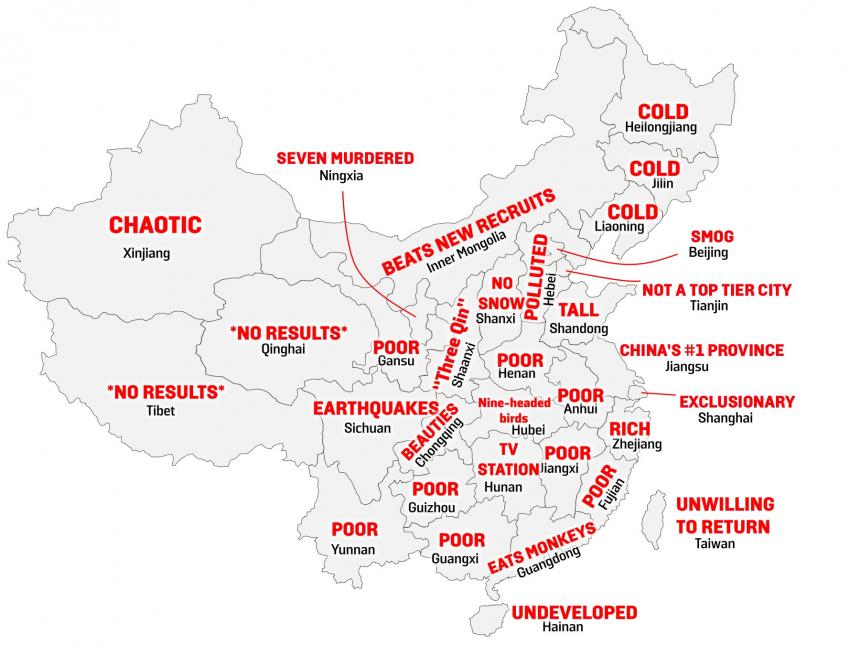
The PRC According To Autocomplete

by Jonah Shepp

finalbaidumap

Warner Brown mapped China’s regional stereotypes according to Baidu autocomplete:

Why is the northwestern Chinese region of Xinjiang “so chaotic?” Why are many from the southern metropolis of Shanghai “unfit to lead”? And do people from central Henan Province really steal manhole covers? These are just some of the questions — ranging from the provocative, to the offensive, to the downright ridiculous — that Chinese people ask about themselves and each other on Baidu, the country’s top search engine, which says it processes about 5 billion queries each day.

In the West, amateur sociologists use Google’s voluminous search history to finish half-written questions about different regions. They then plot the stereotypes onto maps such as this one of the United States, which The Atlantic called “The U.S. According to Autocomplete.” China, with its long history of regional stereotyping, is ripe for similar treatment.

Christopher Beam explores what else the search engine reveals about Chinese web users:

Sex questions are popular—understandably so, given the relative dearth of sex education in China. (Plus, asking the Internet is less awkward than asking your teacher or mom.) The top “why” question among Googlers may be “why is the sky blue,” but Baidu users have a different primary concern: “Why is my semen yellow?” Runners up include “Why do I ejaculate so quickly?” and “Why don’t I have any semen?” They also pose questions they might be too shy to ask their partners, such as, “Why do girls go to the bathroom after sex?” You may have noticed these are all dude questions. It’s hard to say whether that’s because Chinese men have a disproportionately large number of sexual hang-ups, or because Baidu users are disproportionately male, or because China itself is disproportionately male. Evidence points to the latter two explanations: If you type in “I’m looking for,” “a wife” makes the list of top suggestions, but “a husband” does not.

Joseph Conrad’s Third Language

by Matthew Sitman

Remarkably, it was English. Theodore Dalrymple points to this passage from Conrad’s 1902 short story, “The End of the Tether,” as an example of his literary chops:

For a long time after the course of the steamer Sofala had been altered for the land, the low swampy coast had retained its appearance of a mere smudge of darkness beyond a belt of glitter. The sunrays fell violently upon the calm sea—seemed to shatter themselves upon an adamantine surface into sparkling dust, into a dazzling vapour of light that blinded the eye and wearied the brain with its unsteady brightness.

How, then, did the author of Heart of Darkness come to be a virtuoso stylist in his adopted language?

Of course, the writer must have a fine command of English, far beyond that of the vast majority of native speakers of the language. Ford Madox Ford, Conrad’s friend and collaborator, makes an interesting, but not indubitably true, point in Joseph Conrad: A Personal Remembrance, published immediately after Conrad’s death in 1924. He says that Conrad to the end of his life was more comfortable speaking and writing French than English, and actually thought in that language. He therefore had to take special care when composing prose in English, which accounted for its superb quality. In other words, it was Conrad’s lack of mastery that, overcome, gave him his mastery.

How To Look Trustworthy

by Tracy R. Walsh

Smiling_Girl,_a_Courtesan,_Holding_an_Obscene_Image 2

It’s all in the cheeks:

The Dutch psychologist Corine Dijk gave volunteers a series of photos of people, some blushing and some not, accompanied by tales of their recent mishaps, ranging from appearing overdressed at a party to farting in a lift. The blushers were judged more favorably, despite their indiscretion.

Other research has found that if you blush people are more likely to forgive you, and it can even avert a conflict. When you’re trying to work out who to trust, it makes sense to choose the people who would feel guilty if they did anything wrong. The ideal person is someone who would blush and give themselves away.

Update from a reader:

That blushing article is really troubling (as is the research producing it). Everyone blushes, but not everyone’s blush is visible to everyone. Indeed, this sounds a lot like Thomas Jefferson’s infamous “Query XIV” in Notes on the State of Virginia, in which he aesthetically assesses human beings of European and African descent:

Whether the black of the negro resides in the reticular membrane between the skin and scarf-skin, or in the scarf-skin itself; whether it proceeds from the colour of the blood, the colour of the bile, or from that of some other secretion, the difference is fixed in nature, and is as real as if its seat and cause were better known to us.  And is this difference of no importance?  Is it not the foundation of a greater or less share of beauty in the two races?  Are not the fine mixtures of red and white, the expressions of every passion by greater or less suffusions of colour in the one, preferable to that eternal monotony, which reigns in the countenances, that immoveable veil of black which covers all the emotions of the other race?  Add to these, flowing hair, a more elegant symmetry of form, their own judgment in favour of the whites, declared by their preference of them, as uniformly as is the preference of the Oranootan for the black women over those of his own species.  The circumstance of superior beauty, is thought worthy attention in the propagation of our horses, dogs, and other domestic animals; why not in that of man?

In other words, Jefferson’s eye can’t see the blush. He “sees” like a black-and-white photocopier that would later reproduce complex, verisimilitudinous images of lighter-complexioned people and reduce images and thus the humanity of darker-complexioned people to an undifferentiated dark blop. It doesn’t take too much reason and imagination to see how pernicious and dangerous this all is amid current conversations about how cops see black children as “less innocent and less young than white children.” Jefferson’s beliefs are hardly a relic of the past.

(Gerard van Honthorst’s Smiling Girl, a Courtesan, Holding an Obscene Image, 1625, via Wikimedia Commons)

Asylum, Sponsored By Coca-Cola

by Jonah Shepp

Masha Gessen suggests a way for pro-gay companies to support LGBT individuals in Russia and other oppressive countries without damaging their business interests:

Immigration Equality, a legal organization that represents LGBT asylum-seekers in the United States, has recently hired a full-time Russian-speaking paralegal to help with the intake of new clients.

Russian speakers now represent the bulk of the group’s incoming clients, overtaking people from Jamaica, who had traditionally held first place. (To grasp the significance of that information, think how much more difficult it is to get to the United States from Russia than from Jamaica.) The hundreds of Russian LGBT refugees who have come over in the last few months are but the forerunners of a larger looming exodus—these are the people with enough money or self-confidence to leave now. As things get more desperate, as they inevitably will, many more will follow. These people are lucky enough to get legal help from Immigration Equality, but at this point there is no organization that can reliably help them with housing, money, job training, and job placement.

This is where the multinational companies come in. First, they should offer their Russian LGBT employees and their families the opportunity to transfer to the United States. Second, they should create programs to actively recruit, hire, and, if necessary, retrain LGBT refugees who are already in the United States. Such programs should not be limited to Russians: As the civilizational divide along LGBT-rights lines grows ever wider, increasing numbers will face more and more danger in countries all over the world, and they will need a safe haven.

Listen to Masha in a long conversation with Andrew about Russian gays, Putin’s policies, and what we should do about them here. A sample: