Russia Can Mess With Us, Too

Norm Ornstein explains why getting tough with Putin is tricky for Obama:

Putin saved the president from a huge embarrassment with the intervention to resolve Syria’s chemical-weapons stockpile, just before the Senate would have voted down his request for authorization to use force to punish Assad for using the weapons repeatedly against Syrians. Russia is a key player in the delicate negotiations with Iran over its nuclear program. Moscow can make the U.S. transition out of Afghanistan more painful and disruptive, and can be a positive or negative player in negotiations between the Israelis and Palestinians.

For those who immediately began calling for the harshest sanctions we can apply against Russia after its outrageous behavior in Crimea, those considerations were nowhere evident. Of course, one can make the case—and it is a powerful one—that Putin’s Russia will act in its cold, hard self-interest no matter what we do to try to appease it or cushion any reaction. But it is also likely that the harder we push, the more Russia will respond in a hard and negative way in every other area of our interest, at least in the short run. And when it comes to Russia and Syria, the short run is absolutely crucial.

In addition, Jamila Trindle warns the US not to underestimate how badly Russia can mess up our efforts to crack down on international criminal finance:

[Russia] could stop helping the U.S.-led effort to ferret out financial transactions of drug kingpins, weapons traffickers, and terrorist organizations like al Qaeda.

Russia has signed on with international efforts to combat money laundering, bribery, and nuclear weapons proliferators by stepping up oversight of the financial system, isolating bad actors, and freezing their assets. If Russia becomes a target of those same efforts, it will likely be less enthusiastic about enforcing them against others. …

If the United States tries to isolate Russia financially, Juan Zarate, formerly a senior Treasury Department official charged with overseeing the Bush administration’s sanctions program, said the effort could backfire. If Russian banks are cut off from the financial system by sanctions, they could react by slacking off on enforcement of those rules or creating financial havens for sanctions-breakers and criminals.

Rogin highlights another way Russia might retaliate:

One administration official told The Daily Beast that the White House’s National Security Council is leading an interagency process to examine all of the possible retaliatory steps Moscow might take if U.S. and European sanctions move forward. The potential counterstrikes include what this official called “asymmetric” actions by Moscow — Russian actions against the U.S. that have nothing to do with Ukraine. The NSC is preparing for potential Russian actions on all issues in its multi-faceted relationship with the United Stated: American military access to Afghanistan through Russia; Moscow’s cooperation on the destruction of Syria’s chemical weapons stockpiles; Russian pressure on Iran to strike a deal over its nuclear program; and much, much more.

Juan Cole points out that the Ukraine crisis is pushing Moscow and Tehran closer together:

Since Iran is under financial blockade by the United States, increases in bilateral trade with Russia would be very welcome. … [One] area of cooperation between the two is that Russia built three nuclear reactors for Iran at Bushehr, and is rumored to be considering constructing two more. Putin also referred to Iran’s observer status in the Shanghai Cooperation Council (which links Russia, China, Turkmenistan, Uzbekistan, Tajikistan, Kyrgyzstan and Kazakhstan) and spoke of the need to implement the decisions taken recently at Bishkek by the SCC. Iran wants to become a full member of this trading and political bloc, in a bid to escape the isolation imposed on it by the United States.

Can Writing Be Taught? (Can Teaching?)

Novelist and playwright Hanif Kureishi recently savaged creative writing MFA programs as “a waste of time,” having done one himself:

It’s probably 99.9 percent who are not talented and the little bit that is left is talent … A lot of my students just can’t tell a story. They can write sentences but they don’t know how to make a story go from there all the way through to the end without people dying of boredom in between. It’s a difficult thing to do and it’s a great skill to have. Can you teach that? I don’t think you can.

Scott Esposito offers constructive criticism:

I agree with this in spirit. But I would very quickly add that learning how to write is not the point of the MFA. They’re more about having time off to write and making connections than actually being taught how to write.

I think in the best case you have a group of talented, motivated people who want to learn things from truly great writers, and the program ends up being partly getting a master’s “spin” on writing/editing, partly two years of uninterrupted time to do your thing. (Or fuck around on Facebook, if that’s what you prefer.) Yes, programs admit people who have no clue, and those people probably won’t get much out of their MFA and will end up in some completely different line of work in a year or two, but I don’t know that there’s any kind of professional degree where this isn’t the case.

Matt Haig objects to Kureishi’s hypothesis on innate talent:

Creative writing lessons can be very useful, just like music lessons can be useful. To say, as Hanif Kureishi did, that 99.9 percent of students are talentless is cruel and wrong. I believe that certain writers like to believe they arrived into the world with special, unteachable powers because it is good for the ego. …. Of course, it is always important to know your limitations. For instance, I could have 7,000 guitar lessons but I wouldn’t be Hendrix, though I would be a lot better than I am now. Like most art forms, writing is part instinct and part craft. The craft part is the part that can be taught, and that can make a crucial difference to lots of writers.

Jane Messer suggests Kureishi could learn a thing or two about teaching:

Kureishi, it would appear, is from the school of teachers whose focus is not on the learner, but on themself. This approach focuses on the transmission of knowledge from the expert to the receptive learner. Ideally, the student is an elite talent: preternaturally bright, both an autodidact and a willing disciple. Students for whom sentences and narrative are not easy, whose best work comes with much rethinking and rewriting, who are sometimes inarticulate on the page; these students are hard work in Kureishi’s world. In the learner-teacher model in which the learner is a reflection of the teacher, such students offer the teacher a spotty mirror image.

Previous Dish on MFAs in the visual arts here.

Face Of The Day

Taronga Zoo Welcomes Baby Tree Kangaroo

In this handout image provided by Taronga Zoo, an unnamed baby Goodfellows Tree Kangaroo joey is seen in its mothers pouch in Sydney, Australia on March 10, 2014. Taronga Zoo is celebrating the successful birth of its first Goodfellows Tree Kangaroo joey in more than 20 years. Zookeepers have only just begun seeing her peeking out from first-time mother, Qwikilas, pouch after she was born in September last year. By Taronga Zoo via Getty Images.

Another Shot At Unemployment

Alex Rogers summarizes a bipartisan Senate proposal to restore the emergency unemployment benefits that expired in December:

The proposal from senators representing some of the most economically distraught states would be paid for through changes to single-employer pension plans and extending fees on U.S. customs users through 2024. The extension would not be restored for the tiny fraction of millionaires who receive unemployment insurance. Sen. Jack Reed (D-R.I), who led the negotiations with Sen. Dean Heller (R-Nev.), called it a “bipartisan breakthrough.”

But the reaction from influential House conservatives who had yet to hear of the plan ranged from skeptical to outright opposition, suggesting the bill will struggle to get beyond the Senate.

Danny Vinik explains what the proposal would do:

It means people who have been out of work more than 26 weeks and less than 73 would receive a big check from the government for unemployment benefits they would’ve been collecting over the past 10 weeks.

If you were out of work 70 weeks as of December 28, you’d receive three weeks of unemployment insurance. If you were unemployed 50 weeks as of then, you’d receive 10 weeks of benefits now and continue receiving them until the five month extension expires. Oh, that’s assuming you didn’t make more than a million dollars last year. If you did, then you wouldn’t get anything.

As for the amount, unemployment benefits generally make up half a person’s previous wages by average, although the exact amount varies by state. In 2012, average benefits ranged from $133 in Puerto Rico to $653 in Massachusetts.

Sargent thinks bringing up the subject again benefits the Democrats:

This is really good news, and let’s hope it passes. It probably won’t; it will probably die in the House.

But in raw political terms, that means UI as a key issue is back. Now the Senate will vote on it, and Senate Republicans will be challenged to vote against it. Senate candidates on both sides will be asked by the press to take a position on it. Presuming it passes the Senate, which it should (any Dem defections are unlikely), the House GOP will have to decide whether to kill it — by not allowing a vote on it or by voting it down. House Republicans will now have to confront the issue.

Chad Stone supports extending UI, considering the still-weak job market:

It’s still hard to find a job, especially for the “long-term unemployed” — those who’ve been looking for a job for 27 weeks or more. In the early stages of the recovery, when unemployment insurance spending was at its highest, there were about six or seven unemployed workers for every job opening. That ratio has declined substantially, but it is still closer to the highest level it reached in the 2001 recession and its aftermath than to the more normal levels just before the Great Recession.

Most tellingly, long-term unemployment remains much higher than at any previous time when policymakers allowed emergency unemployment insurance to expire

Noting that there’s no ironclad argument against extending UI, Jennifer Rubin suggests the GOP support it and try to get something in return:

Let me suggest that Republicans have leverage here and should apply it precisely to the issue at hand: jobs. The House has already passed the SKILLS Act, which reforms job-training programs. That trade would signal that Republicans are willing to work with Democrats but insist on meaningful measures that help job readiness. It’s hard for Senate Democrats to say no to job-training reform, especially with UI, a big issue with their depressed base, in play. Alternatively, the House could attach a pro-growth, pro-jobs energy bill.

How We Feel About Ukraine, Ctd

ukraine5

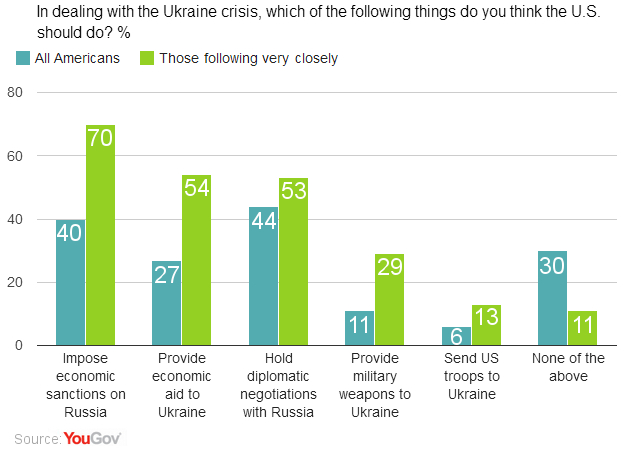
Kathy Frankovic summarizes the latest YouGov poll on how Americans think we should respond to the crisis:

Even those paying very close attention doubt that either a military or an economic response from the U.S., like sending troops to Ukraine, would result in Russian troop withdrawal.  Just one in four overall think military action by the United States would result in the Russians leaving the country.  One in four think economic sanctions on Russia would have that result. Still, most Americans would approve of some action by the United States, with the largest numbers supporting negotiations and economic sanctions against Russia.  A majority of those paying very close attention would also support economic aid.  There is far less support for military assistance and only 6% overall would favor sending U.S. troops to Ukraine.

Sheldon Richman proposes an option not asked about in the poll:

I’m talking about opening America’s borders—scrapping immigration controls.

Ukrainians who want to get out of their dicey neighborhood, whether permanently or temporarily, should be free to move to the United States. Look at it this way: How dare we Americans confine Ukrainians to a condition they might desperately wish to escape? How can we imagine ourselves to be a humane people while engaged in a policy with such odious consequences and implications for liberty?

Opening the borders, of course, is not offered here as a comprehensive answer to the conflict between Russia and the Ukrainians who want to be free of Russian influence, but it may be an answer for some Ukrainians. How many, no one can know. But it makes little difference. Let them in! There are about a million Ukrainians in the United States (2006 census figures), second only to Canada outside of Ukraine itself, with the largest centers in New York City, Philadelphia, Chicago, Los Angeles, Detroit, Cleveland, and Indianapolis. The newcomers need not be strangers in a strange land, though they should be welcome throughout the country.

More recent US polls on Ukraine here.

The Christianist Closet? Ctd

A reader writes:

You are right that much of the Christian self-pity on the issue of homosexuality is pathetic. However, events on university campuses (which can herald broader cultural shifts) suggest that things are moving faster than perhaps you realize.

The debate right now surrounds Registered Student Organizations (RSOs) that have access to campus facilities and even funding. Christian RSOs are facing de-recognition (or have been de-recognized) because of their discriminatory policy on homosexuality. Here’s the problem: most of these Christian RSOs allow any student to join and become members, but they require that the student leaders agree with the organization’s statement of faith. I don’t have to belabor the point. You recognize how insane it is to require a religious organization to not discriminate based on religion in its selection of leaders. In 2012, Vanderbilt went ahead and de-recognized 13 Christian RSOs for requiring that the student leaders agree with their basic beliefs. Other schools have followed suit.

Andrew, you promised Ross to fight for religious freedom. I don’t remember you writing about this issue. Perhaps you can begin here.

(Confession: I’m a long-time reader, haven’t subscribed yet.)

That is indeed a troubling development. I guess I’m going to become really unpopular again with some of the gays.

The New 538

Nate previews his new site:

People also think it’s going to be a sports site with a little politics thrown in, or it’s going to be a politics site with sports thrown in. I understand why people say that — what we’ve been known for, plus ESPN, plus ABC News. But we take our science and economics and lifestyle coverage very seriously.

We are repositioning FiveThirtyEight away from being a politics site. It’s a data journalism site. Politics is one topic that sometimes data journalism is good at covering. It’s certainly good with presidential elections. But we don’t really see politics as how the site is going to grow. It’s very seasonal in terms of traffic. If you’re trying to get politics traffic outside of election years, you’re mostly looking toward hardcore partisans, and we, frankly, don’t want to write that content to appeal to hardcore partisan readers. Not to say we don’t have political views, but that’s not what we’re all about, really. The growth is in sports and economics and science. That said, we have another election coming up in November and 2016.

The Boring, Relentless Advance Of Obama’s Agenda, Ctd

A reader writes:

You forgot one boring, but vital, detail about Obama’s relentless advance: The courts.  Yes, the president has seated two Supreme Court Justices (on par with Bush’s three and Clinton’s two), and he may get one or two more shots at it, but the real action is in the appellate courts.  For 50 years, Democrats reigned supreme at the appellate level.  This was a center of power that wasn’t dismantled until Ronald Reagan, who managed to flip the majority of the courts by around 1986.  Because George H. W. Bush amounted to a third Republican term, the GOP was able to consolidate that majority so decisively that Clinton was barely able to make a dent in it before George W. Bush could continue the process.  Now, however, 9 out of 13 appellate courts have majority Democratic appointees.

(No, that doesn’t include the semi-retired “senior bench,” but they take a much a lighter course load, and don’t really factor into a long, or even medium-term political calculus.) “But if you see [Hillary Clinton] as being to Barack Obama what George H.W. Bush was to Reagan,” as you said, four years could also be enough to push the courts to the left for the indefinite future.  FDR’s power play gave him 50 years of court dominance.  Reagan, the only president to successfully flip the court since WWII, maintained his influence well beyond his death – 30 years.  A president Clinton will have all those same advantages, plus a very gray Supreme Court (FOUR octogenarians in her first term).  Think about what that means for all those Voting Rights Act cases winding their way up, for gerrymandering (hence, the makeup of the House), for a whole host of immigration issues (as they relate to the electorate).  Those are all issues with profound political consequences (the merits of each issue aside).

The courts are a full third of our political system, and Obama has been marching them in his direction very quietly, and more successfully than any president in a generation.

Illiberalizing Russia

Ioffe can’t keep up with the snowballing absurdity of Russia’s nationalist fervor:

Within the span of a couple months, the Kremlin, by hook and by crook, has cleared all the media underbrush. There’s suddenly not much left of the independent media, even of what little of it there was left after Putin’s first two terms at the wheel.

She fears that the game is up for Moscow liberals:

What [they] are discovering is how quickly the ground has shifted beneath their feet since Putin came back to power in 2012, how futile and pathetic their resistance, and how easily wartime mobilization can steamroll them into nonexistence, in a way it couldn’t when Russia went to war with Georgia in 2008. This time, even their tiny Internet ghetto isn’t safe anymore. And it’s not clear that, once all this over and Crimea is safely part of Russia, that the regime will roll back these measures. In fact, it’s highly likely that it won’t.

Leonid Ragozin notices something all too familiar in Putin’s media manipulations:

One can clearly sense what’s next by following government propaganda, whose main target these days is the “fifth column”: journalists, opposition activists, and anyone else who dares to doubt the wisdom of President Vladimir Putin’s decision to send troops into Ukraine. Here’s how it works: First an “investigative” documentary appears on government TV, then the authorities launch criminal cases against those that the documentary targeted (as was the case with left-wing leader Sergey Udaltsov, now on trial on charges of organizing riots). It was the same in Stalin’s times, when show trials were preceded by Pravda editorials pointing at “enemies of the people.”

And yet, Adam Taylor points out, the president’s star just keeps rising:

In a poll conducted by the Russian Public Opinion Research Center (VTsIOM) last week, Putin’s popularity level in Russia has reached 71.6 percent. That’s a 9.7 percent increase since mid-February, which seems quite obviously linked to the Russian president’s handling of Ukraine and the Sochi Olympics. As Ria Novosti notes, it means that Putin’s popularity levels are now at a three-year high.

You might want to put that down to the fact that the VTsIOM is state-run, but that argument doesn’t really hold. The Levada Center, a well-respected independent polling center, has also found that Putin had a 72 percent approval rating, up 7 points from January and a recent record.