The Mandate Fight Is Back

Jon Cohn covers the new attempt to kill Obamacare’s mandate:

The Republicans’ latest gambit is to propose a five-year delay, which would save the government money, and then use those funds to offset the cost of a “doc fix”—a measure to spare physicians looming cuts in Medicare reimbursements.

It’s a new and clever way to package an effort to undermine the mandate—and, through it, the law. But, of course, it has consequences. According to the Congressional Budget Office, which released an analysis of the proposal on Wednesday, pushing back the mandate by five years would mean about 13 million fewer people would have health insurance, while premiums for those buying coverage would be 10 to 20 percent higher than they would be if the mandate remained in place. The estimates were for 2018 but, CBO said, the results would be similar for each of the previous years.

Jason Millman relays what both sides are saying:

People can avoid any penalties if they “experienced another hardship in obtaining health insurance.” This language is pretty broad. And those who claim hardship don’t have to provide documentation. So doesn’t this mean anyone can just claim hardship and avoid the penalty for not having insurance? The GOP is arguing as much.

But the administration says these exemptions are limited, and just applying for one doesn’t guarantee you’re going to get it. Each request is processed manually, and people could be asked to provide more information or be denied outright.

Suderman argues that the mandate is fairly toothless:

In some sense, it’s like used car pricing, or cable company discounts. Officially, the price is what’s on the sticker. But if you make even a token effort to bargain, or half-heartedly threaten to cancel service, you can get the price lowered. Mostly, it’s a mechanism that allows the administration to have it both ways: Of course the mandate is absolutely essential to the law, and of course practically anyone who wants out of it can get an exemption on a hardship basis. But that approach also reveals the tough spot administration officials are in with regards to the mandate: They don’t want to remove the requirement, but they don’t really want to enforce it either.

Does Vaping Lead To Smoking? Ctd

Clive Bates takes issue with the study we highlighted last week:

The reasoning for claiming e-cigarettes do not help people quit smoking amounts to a crude non sequitur: “e-cigarettes were associated with more, not less, cigarette smoking among adults“.  More, not less… but compared to what? The study found that more smokers were using e-cigarettes than non-smokers. However, this banal observation does not confirm that e-cigarettes do not help quitting any more than finding that [Nicotine Replacement Therapy (NRT)] is used more by smokers would suggest NRT is not used for quitting. The real test of the impact of e-cigarettes is hard to gauge because it requires knowledge of what would have happened in the absence of e-cigarettes.  If you could show there is “more, not less” smoking than there otherwise would have been had e-cigarettes not become available, then that would definitely be a concern.  But of course the study does not and cannot do this, given the limitations of its methods and the available data. That doesn’t stop you claiming the following, which as far as I can see, is based on nothing at all:

“E-cigarettes are likely to be gateway devices for nicotine addiction among youth, opening up a whole new market for tobacco”

Kleiman piles on:

The editors of JAMA Pediatrics should be embarrassed by this; the methods in the piece don’t pass the giggle test. The good news is that the tobacco control research and policy community is not united on this issue, with plenty of dissent from the anti-e-cig party line. The bad news is that politicians in places such as Los Angeles have allowed themselves to be buffaloed by junk science into making junk policy.

The Left’s Favorite Bogeymen

Cillizza considers why Harry Reid has been vilifying the Koch brothers from the Senate floor:

The more he talks about the Kochs, the more — he hopes — rank and file Democrats get fired up to turn out to stick it to the Kochs. And the more — he hopes — major Democratic donors open up their checkbooks to counter the Kochs spending.

Sargent’s take:

As I noted the other day, this is all about creating a framework within which voters can be made to understand the actual policy agenda Republicans are campaigning on. … [The Koch attacks] aren’t really about the Kochs. They are a proxy for the one percent, a means through which to tap into a general sense that the economy remains rigged in favor of the very wealthy.

Waldman doubts this strategy will pay dividends:

The problem is that most Americans have no idea who Charles and David Koch are. Yet they’re already being featured in ads like this one in which we see their picture without any explanation. I’d be interested to see a poll on their name ID, but until somebody does one, I’d guess that maybe 10 percent of voters are familiar with them. Now maybe between now and November, Democrats can successfully educate enough of the voters on the Kochs to have a real impact. But it won’t be easy.

Like Cillizza, Alex Roarty thinks the target audience is donors more than voters:

Although most citizens may not know who the Kochs are, liberal activists certainly do—including the wealthy ones, from whom the Democrats are desperately trying to coax the kind of large donations that will let them push back more forcefully in TV ads. And the Kochs do complicate the GOP’s own political efforts, too, as when their company closed down a small plant in Alaska. It wasn’t a game-changer for the Alaska race, but it did allow Democrats to blast the GOP field’s ties to the brothers.

But those efforts are about mitigating the damage done by the [Americans For Prosperity’s] ads, and not necessarily a way to start scoring points of their own.

How Morrissey sees the attacks:

When asked to rank their top priority, unemployment and jobs topped yesterday’s Gallup poll list, while environmental issues and global warming didn’t even make the list. Income inequality, by the way, polled 2% at the bottom. They’re flailing, and the reek of desperation is only getting more obvious.

Update from a reader:

Ed Morrissey conveniently missed the forest for the trees. Individuals like the Koch brothers, Sheldon Adelson, Shaun McCutcheon, Jeffrey Katzenberg, and Tom Steyer are all corrupting the political process by dropping huge piles of money on political advocacy and pushing the president and Congress to listen to their opinions and sign into law policies that they support rather than listening to and signing into law policies that the voters who elected them support. This Gallup poll showed that Americans in July 2012 believed reducing corruption in the federal government was the second-most important task for the future President Obama or Romney to tackle. Conveniently, it’s also the second-most important task in the poll that Morrissey cited as well!

The Skinny On The Senate

Senate Map

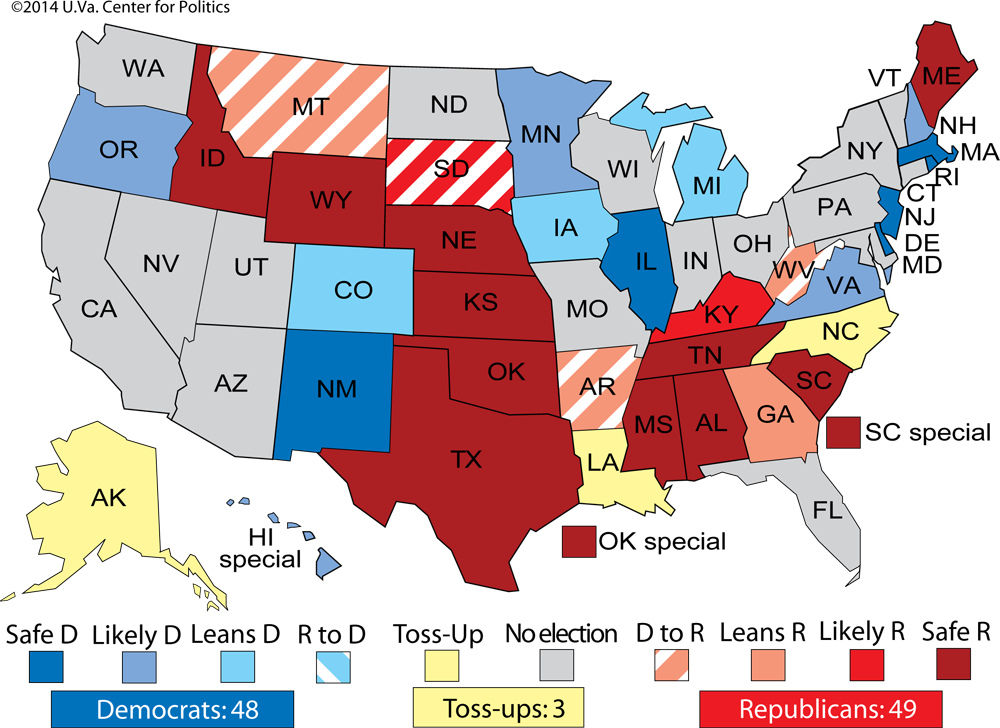
Kyle Kondik updates the Crystal Ball’s Senate map:

Democrats have to hope that Republicans continue their multiple-cycle trend of blowing winnable races by nominating bad candidates: The likeliest places for that to happen are Georgia, Iowa and North Carolina. Any improvement in President Obama’s approval rating would also help, and it remains interesting that despite the president’s weak numbers, Democrats are typically tied or slightly ahead on most generic ballot surveys measuring voter preferences in the House, which can also reflect the national sentiment in Senate races.

That might end up being thin gruel for many Democrats, particularly Senate candidates and incumbents in Red states, but it could also lead to an election that is less about a big wave and more about certain Republican-leaning states aligning their senators with their presidential preference.

Trende’s model finds that “Republicans win the Senate about 80 percent of the time”:

Why is this different from outcomes predicted by other modelers, such as Alan Abramowitz and John Sides/Eric McGhee? Part of it is that the predicted outcomes really aren’t that different. Abramowitz’s most likely outcome is a GOP pickup of six, while this model’s most likely outcome is a pickup of eight. This has great substantive importance, but in statistical terms, the findings are well within the confidence intervals of the various models.

These other models also take a much broader swath, putting results from back to the 1950s into their data set. One of the assumptions behind this model is that something has substantially changed in the past few cycles as we’ve become increasingly polarized. Red states don’t vote for blue senators except in exceptional circumstances, and vice versa. There’s some support for this in the Sides/McGhee models; if they base their predictions off of findings from 1980 to the present, instead of from 1952 to the present, they find that Tom Cotton’s chances of winning in Arkansas skyrocket.

At the end of the day, it’s important to remember that these models are largely heuristic devices, especially this far out.

Meanwhile, Scott Bland reports that Democratic fundraisers are using Nate Silver’s predictions to scare up campaign contributions:

The last time [Silver] wrote about the Senate landscape, all the way back in July 2013, [he] said Republicans “might now be close to even-money to win control of the chamber” in 2014. He also cited North Carolina as “the closest thing to the tipping-point state in the Senate battle,” and called Democratic Sen. Mary Landrieu’s seat in Louisiana “a true toss-up.”

That’s scary stuff if you’re a Democratic supporter, especially coming from an analyst whose accuracy made him a household name in the past few years. And the repeated name-dropping has probably opened some wallets for Senate Democrats.

“There’s a lot of testing, particularly for subject lines, to see what has the best open rates,” said Taryn Rosenkranz, a Democratic digital-fundraising consultant unaffiliated with the DSCC. “Using that name over and over suggests it’s successful, and people are opening and giving.”


Running Against The Family Dynasty

Kilgore compares how Rand Paul is trying to differentiate himself from Ron Paul to how George W. Bush veered away from George H.W. Bush:

It’s hard to imagine Rand Paul pulling off this sort of parricidal coup, particularly since these days there is no figure like Robert Novak around to signal a consensus “movement” blessing on a suspected heretic. It might require an actual public admonishment from Ron Paul to make Rand Paul kosher, so to speak.

The whole subject is also a reminder of the exceptionally tough challenge facing Wall Street’s current favorite, Jeb Bush, if he decides to take their money and run. How does he simultaneously distinguish himself from his father and from his brother, without casting some doubt on his credentials as a “family values” man? “Bush 3.0” doesn’t sound like a very compelling signature, and “Vote for the smart one” or “Vote for the REALLY conservative Bush” wouldn’t look too good on bumper stickers. I honestly don’t know how he pulls it off, unless he changes names.

High Consumer Spending

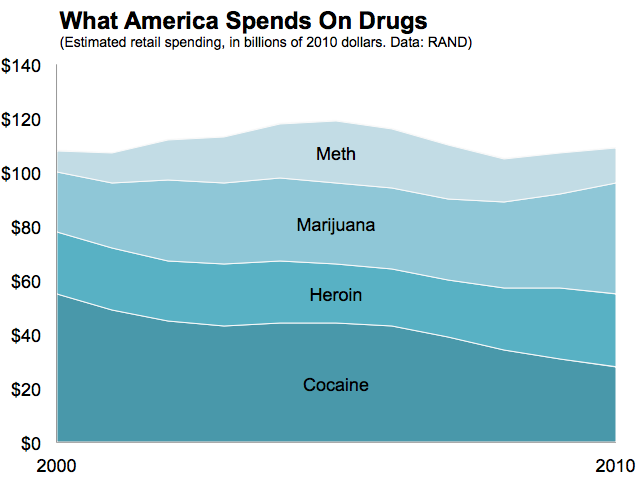
rand_drugs1

John Tozzi outlines the findings of a RAND Corporation study estimating that Americans spent $109 billion on illegal drugs in 2010:

To put that number in perspective: It’s more than we spend at furniture stores ($90 billion) or electronics and appliance retailers ($101 billion) annually, according to U.S. Census data. It’s more than one-fifth of what we spend eating out each year, and it dwarfs the $21 billion we drop at bars.

Most of that $109 billion is spent by what the RAND report calls “the minority of heavy users,” who get high during at least 21 days of a month. And while the total dollars spent (adjusted for inflation) remained roughly stable from 2000 to 2010, the mix has changed. Cocaine use has gone down; marijuana use has gone up. Meth peaked in the middle of the Aughts, though the report’s authors caution that the meth numbers are less reliable than other estimates.

Zoë Schlanger discusses the study’s limitations:

[G]athering data on undocumented dollar amounts spent on illegal drugs is extremely difficult. RAND’s numbers acknowledge a significant amount of uncertainty. For example, RAND’s best estimate of marijuana spending in 2010 is $41 billion, but it pegs the possible range of spending at $30 billion to $60 billion. For cocaine (crack and powder) RAND’s best estimate is $28 billion, with a range of $18 billion to $44 billion.

“Since there are many other sources of uncertainty, readers should not consider these as lower or upper bounds or as 95-percent confidence intervals,” the report reads. “The range should be considered plausible, but not extreme.”

Noting that the study counted far more regular heroin users than the National Survey on Drug Use and Health, Mike Riggs compares the data sources:

[R]esearchers suggest that one reason for this disparity may be that the NSDUH survey underestimates heroin use by an eye-boggling amount. “Estimates from the 2010 NSDUH suggest there were only about 60,000 daily and near daily heroin users in the United States,” drug policy researchers Beau Kilmer and Jonathan Caulkins, both of the RAND Corporation, wrote in a recent editorial. “The real number is closer to 1 million.” …

Kilmer and Caulkins came up with their much higher figures for heroin and hard-drug use by combining county-level treatment and mortality data with NSDUH data and a lesser known government survey called the Arrestee Drug Abuse Monitoring Program. Instead of calling people at home and asking them about their drug use, the ADAM survey questions arrestees when they’re being booked and tests their urine. “ADAM goes where serious substance abuse is concentrated — among those entangled with the criminal justice system, specifically arrestees in booking facilities,” Kilmer and Caulkins write.

Our Profitable National Parks

Very profitable:

The National Park Service returns 10 dollars for every dollar of taxpayer investment, not only collecting admission and camping fees, but filling surrounding hotels and restaurants while emptying the shelves of local grocery stores and sporting goods outfitters.

The profitability of the NPS was most ironically demonstrated last October during the 16 days of the federal shutdown, when 7.88 million visitors stayed home because the parks were closed. Even that short period cost $414 million in lost revenue: All the entrance passes visitors would have bought, all the hotel rooms and bed and breakfast nooks where they would have stayed, all the meals they would have purchased in communities surrounding the parks, and all the walking sticks and picnic baskets and hiking boots they would have bought for their adventures.

It’s Hardly Hard Out There For A Pimp

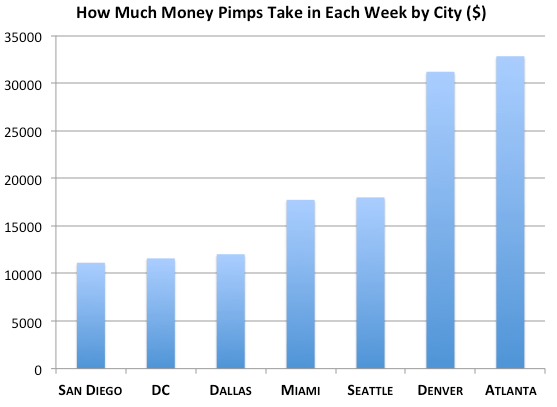
pimps

A report (pdf) from the Urban Institute looks at the sex work economy in eight major US cities. Emily Badger recaps the findings:

Urban’s researchers estimate that, in 2007, the entire illegal sex economy in Atlanta – including brothels, escort services and dubious massage parlors –was valued at $290 million. In Miami, it was $205 million (that’s more than twice the size of the market there for illegal drugs). In Washington, it was $103 million. On the low end, in Denver it was about $40 million.

Between 2003 and 2007, Washington’s market shrunk. Seattle’s boomed. Meanwhile, the mean weekly income for a pimp in Denver, post-2005, was $31,200.

The report is the first of its kind to affix hard numbers like this to the shadowy market for sex work. The findings are based in part on 260 interviews with convicted pimps and sex workers, prosecutors, law enforcement officials and other experts in San Diego, Seattle, Dallas, Denver, Washington, Kansas City, Atlanta, and Miami (cities selected, among other things, for being part of “known ‘pimp circuits’ in the United States”).

Derek Thompson, who passes along the above chart, pulls some highlights from the report, which also covered illegal drug and gun markets:

1. Atlanta has the biggest sex economy among the studied cities, by far. Dallas has the largest market for drugs or guns. …

2. As a share of each city’s cash economy (i.e.: doesn’t include the vast majority of commercial activity with credit) Atlanta has both the biggest sex and guns trade. San Diego has the biggest underground drug economy. If you add all the underground economies together, you’ll see the largest combined black markets (by city) are: Atlanta, Miami, San Diego, and Dallas. Across the studied cities, the largest underground market is sex, followed by drugs, then guns.

Kyle Chayka focuses on how pimps and sex workers employ social media marketing, including on the mostly defunct MySpace:

[P]imps set up profiles for their workers with codewords like “girlfriend experience” and wait for the customers to inquire. “Friend them, once you make a connection, you let them know what the deal is. It’s [sex] for sale,” one former sex worker interviewed in the study explained. “Myspace, all that, it’s just a disguise.”

The report shows even Twitter being used to advertise job openings. “Believe it or not, people still use [social networks], and the ones that are using them are usually younger, and pimps are on there like crazy,” a Dallas police official said.

And Amanda Hess takes note of how the pimps interviewed for the report represented themselves:

Many of the convicted pimps didn’t identify as pimps because they claimed not to engage in some of the behavior typically associated with the profession, like confiscating money, beating sex workers, or trafficking women. The madam insisted that she took smaller cuts of her workers’ fees than many assumed. And a male manager said: “The old school cats would talk about how the girls would hide money, not give it all up, and in the old days they would beat the girls if they didn’t get it all. Now, I know the girls come to me and will stash some around the corner before they come in, but I’m just as happy if they give me any of it, as long as they bring me something, because they’re the ones doing all the work.”

Update from a skeptical reader:

The Urban Institute numbers seem a tad bit farfetched; the entire Denver area illicit sex market is valued at $40 million USD, even though the average pimp is making somewhere in the neighborhood of $31,000 * 52 = ~$1.6 million USD a year? Are there only twenty pimps in charge of “brothels, escort services and dubious massage parlors” in Denver?

Another is even more skeptical:

I would take that Urban Institute study of prostitution with several massive helpings of salt. It represents everything that is wrong with how sex work is studied in this country. The researchers interviewed a grand total of 36 actual sex workers.  In three cities, they interviewed none.  And all the interviews were of sex workers in prison, which is a known massive bias in studies of sex work (80-90% of sex workers are not street walkers, but most jailed sex workers are). They interviewed twice as many pimps and almost five times as many law enforcement personnel. In effect, this “study” amounts to taking the boasts of convicted pimps and the speculations of law enforcement and putting a very thin scientific veneer on it. Massive parts of the study consist of lurid anecdotes from law enforcement personnel speculating on what sex work is really like.

I’ll also point you to Maggie McNeill’s discussion of pimps, where she argues that they are actually rare in sex work. So this study is looking at a tiny sliver of the sex industry. It’s not representative at all.

The War Over The Core

Seth Masket considers the latest debate roiling the education world:

By now, you’ve probably heard of the Common Core State Standards. They are a set of skills expectations for students that have been adopted by 45 states plus the District of Columbia. They require that students be broadly competent in mathematics and literacy and know how to do things like critically read a text, argue and defend a point of view, interpret data, etc. – all things that we’d consider pretty useful for students entering college or the work world. The Common Core itself contains no specific prescriptions for content or curriculum, just the requirement that students learn these vital skills.

But that’s not at all what you’ll hear about it in the conservative media. For them, not only is the Common Core a massive federal intrusion into state and local education policy (a debatable point, but one roughly grounded in reality), but it’s a primary tool of President Obama and the Left (and possibly the United Nations) to fundamentally transform education, to undermine the authority of religion and parents, to track the location and behavior of children who’ve committed thought crimes (perhaps using iris scans), and to essentially impose collectivism upon America. As Glenn Beck sums up, “This is like some really spooky, sci-fi, Gattaca kind of thing.”

Peter Wood’s criticisms are more reality-based. He argues that Common Core “set a ceiling on the academic preparation of most students”:

None of this might matter if the Common Core were just a baseline and students and schools could easily move above it if they wished to.  The trouble is that the Common Core has been designed to be a sticky baseline.  It is hard for schools to rise above it.

There are two reasons for that. First, it uses up most of the time in a K-12 curriculum, leaving little room for anything else. Second, the states that were leveraged into it via Obama’s “Race to the Top” agreed that students who graduate from high school with a Common Core education and are admitted to public colleges and universities will automatically be entered into “credit-bearing courses.” This is tricky. Essentially what it means is that public colleges will have to adjust their curricula down to the level of knowledge and skill that the Common Core mandates. And that in turn means that most schools will have little reason to offer anything beyond the Common Core, even if they can. In this way, the Common Core floor becomes very much a ceiling, too.

Neal McCluskey isn’t thrilled about Common Core’s relationship with the SAT:

What’s the connection between the Core and the SAT? A big one: David Coleman, who is both a chief architect of the Core and president of the SAT-owning College Board. Coleman announced when he took over the Board that he would align the SAT with the Core, and it was clear in the Board’s SAT press release that that is what’s happening. Employing Common Core code, the Board announced that the new SAT will focus on “college and career readiness.” Why is this potentially bad news for Core supporters? Because the SAT changes are widely being criticized as dumbing-down the test – good-bye words like “prevaricator,” hello toughies like “synthesis” – and that may drive attention to people who are questioning the quality of the Core.

And longtime standards proponent Diane Ravitch recently leveled her own criticisms:

The Common Core standards have been adopted in 46 states and the District of Columbia without any field test. They are being imposed on the children of this nation despite the fact that no one has any idea how they will affect students, teachers, or schools. We are a nation of guinea pigs, almost all trying an unknown new program at the same time.

Maybe the standards will be great. Maybe they will be a disaster. Maybe they will improve achievement. Maybe they will widen the achievement gaps between haves and have-nots. Maybe they will cause the children who now struggle to give up altogether. Would the Federal Drug Administration approve the use of a drug with no trials, no concern for possible harm or unintended consequences

She made similar points in new interview:

[Common Core standards] haven’t been tried anywhere, they’ve been tested — and we know that where they’re tested, they cause massive failure. So I would say we need to have more time before we can reach any judgment that they have some miracle cure embedded in them.

I know, and a lot of teachers know, they’re totally inappropriate for children in kindergarten, first grade, second grade and third grade, because when they were written there was no one on various writing committees who was an expert in early childhood education… They’re also totally inappropriate for children who have disabilities — they can’t keep up. There’s an assumption in the Common Core that if you teach everybody the same thing, everybody will progress at the same speed. And that’s not human nature. It doesn’t work that way.