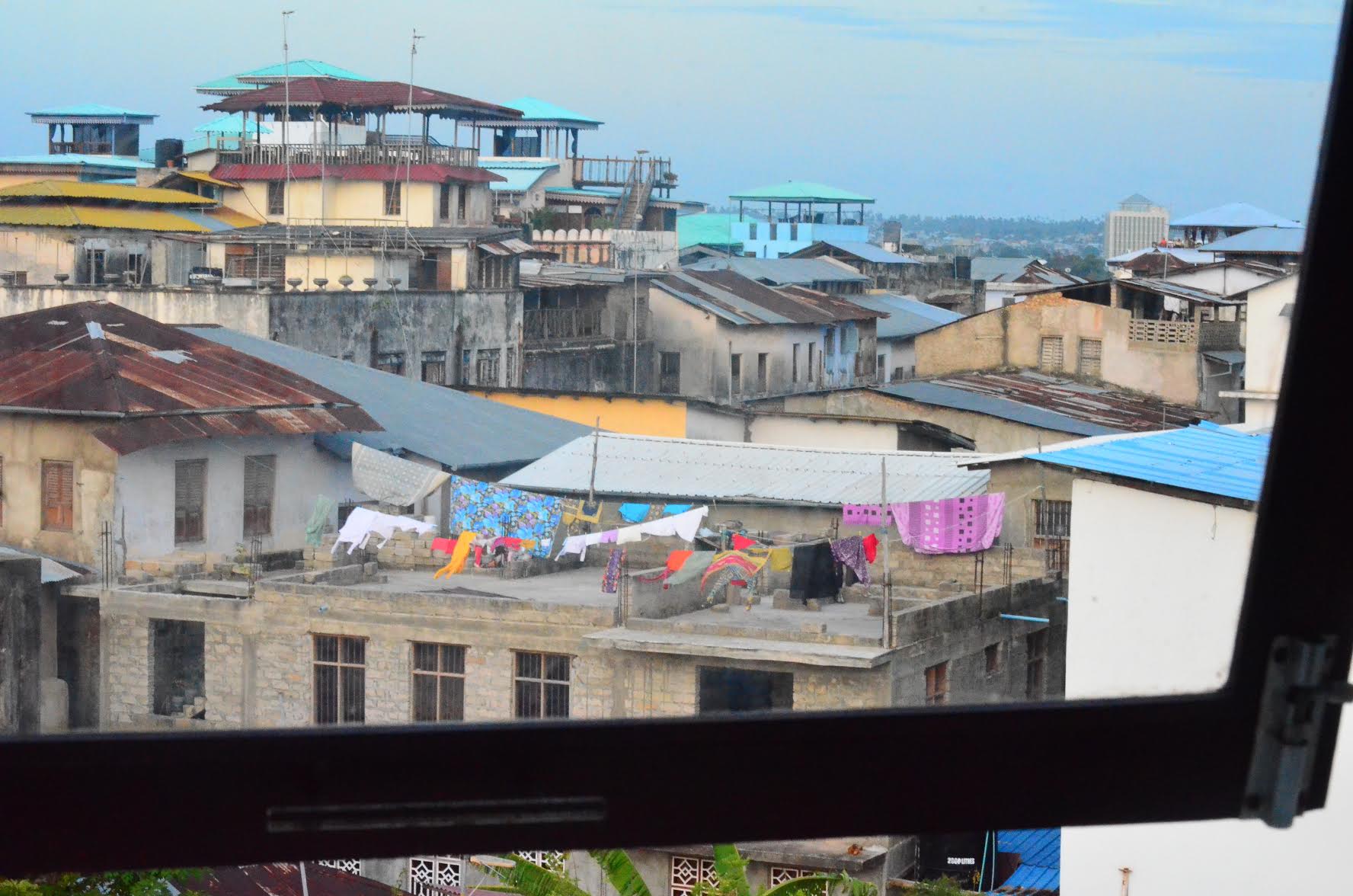
Stone Town, Zanzibar, 5.30 pm
Stone Town, Zanzibar, 5.30 pm
Jason Koebler flags a study showing that whole-genome sequencing is still prohibitively expensive and not very useful:
A new study on the present-day feasibility of whole-genome sequencing for clinical use by researchers at Stanford University found that it will cost at least $17,000 per person to sequence a genome and interpret the results, and it’ll take roughly 100 man-hours to perform any sort of meaningful analysis.
“The gist of it is we found that the results are generally not clinically acceptable,” said Frederick Dewey, lead author of the analysis, published in the Journal of the American Medical Association. “It’s a relatively sobering thought, and there are tough hurdles to get over before this is common.”
Dewey and his team completely sequenced the genomes of 12 people and analyzed them to predict their propensity for genetic diseases and other health concerns. The study was designed to test out some of the leading genome sequencing techniques and analysis methods. The expensive part, Dewey says, isn’t necessarily the sequencing of the genome (a cost that is constantly coming down), but the analysis after the fact.
But these findings don’t discourage Ricki Lewis:
I’m not surprised that looking at the genomes of a dozen healthy people didn’t provide a crystal ball to predict their medical futures for a simple reason. The human genome is so complex, with instructions buried in layers of molecular language, that the very idea of going from sequence to diagnosis may be flawed, at least until we can work out all possible gene-gene interactions, against the backdrop of the environment. But this limitation is itself limited. It will go away with time, as more and more human genomes are subjected to the sequencers and the annotators, who then whisper to the clinicians what, exactly, to impart to a patient. …
But even when we have complete genome sequences for millions of us, something I predict will be true within five years, genotype will not always predict phenotype. For DNA is not destiny.

The former US secretary of state and Chairman of the Joint Chiefs of Staff facebooks:
Throwback Thursday – I was doing selfies 60 years before you Facebook folks. Eat your heart out Ellen!
Ian Bateson examines how through “speeches and state-controlled media Putin is able to create another world where the figures and places feel familiar, but the events and motivations are drastically different”:
When protestors on Kiev’s Maidan began organizing into so-called self-defense forces after attacks on demonstrators, Moscow was quick to call them Western-trained and funded militias. With the groups’ mismatched uniforms, bits of pipe, and occasional spaghetti strainer helmet Russia’s claims gained little currency abroad.
When men armed with automatic weapons wearing Russian military uniforms devoid of military insignia and accompanied by military vehicles bearing Russian license plates began appearing on Crimea’s streets, however, it was Russia’s turn. If Kiev could have self-defense forces than Crimea could too. And so Moscow declared them Crimean self-defense forces.
In this world Russia was not invading Ukraine, but reprising its role as the great vanquisher of Nazism, heroically halting the eastern advances of suitably amorphous Ukrainian fascism.
Oleg Kashin sees these distortions backfiring on Moscow:
Through its clumsiness, Russia has given the Ukrainians a winning image: that of a small defenseless country which has become the victim of aggression by a cruel, strong neighbor, as Lithuania, Latvia, and Estonia were in 1940. The Ukrainians, who have thus far been unable to boast of a rich national mythology, are writing their new heroic myth in real-time, about which films will be made and songs composed. This is often more important than any weapon.
Putin’s lie could be attributed to the particularities of international diplomacy, but in a situation where the entire world has already seen the Russian soldiers blockading Ukrainian bases on the Crimean peninsula, it’s hard to believe that the lie has any diplomatic subtext. Really, it’s just habit. A culture of propaganda has formed over the last fifteen years in Putin’s Russia, and even in the most critical moment, telling the citizens the truth would, for Putin, be a violation of some kind of personally sacred taboo.
David Remnick covers Putin’s press crackdown:
The latest step came on Wednesday, with the announcement that Galina Timchenko, the longtime and much admired editor of the news site Lenta.ru, has been fired and replaced by Alexei Goreslavsky, the former editor of Vzglyad.ru, a site that is far more sympathetic to the Kremlin.
The announcement came shortly after an agency called the Federal Mass Media Inspection Service (oh, Orwell!) warned that Lenta.ru was venturing into “extremism.” Lenta.ru had published an interview with Andriy Tarasenko, a leader of a far-right ultra-nationalist group, Right Sector. Part of the Kremlin’s pretext for the invasion of Ukraine has been to “protect” Russians from “fascists.” Tarasenko is an unlovely figure, but Lenta.ru was hardly endorsing him; the editors were guilty of nothing more than committing journalism. And now they are paying for it.
Richard Maass offers a poli-sci explanation for why Washington and Moscow have such radically divergent views of what is happening in Ukraine:
U.S. leaders have ‘renormalized’ their reference point after the Maidan revolution, accepting the West-leaning interim Ukrainian government as a legitimate foundation for any resolution to the crisis. In contrast, the reference point of Russian leaders continues to be the pre-Maidan status quo, as they seek to recover their lost influence in Ukraine or achieve compensating territorial gains. As a result, the United States is focusing on rolling back Russian “aggression” in Crimea, while Russian Foreign Minister Sergei Lavrov objects to U.S. proposals because they take “the situation created by the coup as a starting point.” If U.S. and Russian leaders are bringing contradictory perspectives to their attempts at negotiation, as prospect theory predicts, it is difficult to envision a diplomatic resolution to the crisis that will satisfy both sides.
A reader passed it along:
Thought you and your readers might get a kick out of this. Someone sent it to my French wife. A first we both thought it would be stupid and/or vulgar and instead thought it was pretty imaginative. Safe for all audiences, too. And somehow so typically French!
Update from a reader:
I have to nitpick. Les Beaux Freres aren’t French. They’re Canadian. They’re part of the fantastic contemporary circus arts movement coming out Quebec. Bio here. I love shows like Cirque de Soleil (and apparently so does everyone else in the world). The transformation of circus arts into something that is as much art as circus is something wonderful, and something that Canada should get the credit for.
In the latest Snowden revelation, Ryan Gallagher and Glenn Greenwald report that the NSA is planning to infect millions of computers with malware:
In some cases the NSA has masqueraded as a fake Facebook server, using the social media site as a launching pad to infect a target’s computer and exfiltrate files from a hard drive. In others, it has sent out spam emails laced with the malware, which can be tailored to covertly record audio from a computer’s microphone and take snapshots with its webcam. The hacking systems have also enabled the NSA to launch cyberattacks by corrupting and disrupting file downloads or denying access to websites.
The implants being deployed were once reserved for a few hundred hard-to-reach targets, whose communications could not be monitored through traditional wiretaps. But the documents analyzed by The Intercept show how the NSA has aggressively accelerated its hacking initiatives in the past decade by computerizing some processes previously handled by humans. The automated system – codenamed TURBINE – is designed to “allow the current implant network to scale to large size (millions of implants) by creating a system that does automated control implants by groups instead of individually.”
Joshua Kopstein explains why this matters:
This revelation suggests that the NSA’s tailored-access platform is becoming a bit more like the un-targeted dragnets everyone has been so upset about: stuff like the mass-collection of phone metadata, and the tapping of undersea Internet cables, which allows the agency to filter through raw communications for keywords.
Of course, the question is whether having the capability to “target” people en-masse means that the NSA and GCHQ will necessarily do so. But based on what we know so far from the Snowden files, it’s hard to imagine what would stop them.
Sean Gallagher points out the dangers of such broad surveillance:
All of these capabilities give the NSA and GCHQ considerable reach. But they also run the risk of allowing others to stand on the agencies’ shoulders and take advantage of the exploits the NSA has already seeded into parts of the Internet’s infrastructure. Regardless of the scope of the NSA’s ongoing surveillance, the chance that someone else could hijack or repackage a capability like Hammerstein or SecondDate for criminal or other malicious means poses a risk to the entire Internet.
Meanwhile, Henry Farrell makes the case that Snowden’s leaks are actually helping the US by advertizing our cybersecurity capabilities:
Snowden’s revelations may provide a much more credible signal about the strength of the U.S. cybersecurity apparatus than anything that the government itself could say. Clearly, Snowden did not leak his information in order to puff up the reputation of the U.S. cybersecurity apparatus. His leaks have provoked fury among senior government officials. Equally, the material published to date has not been nearly as harmful to the U.S. government as it could have been. It has suggested that the U.S. and its close allies have strong and sophisticated capabilities, while providing only limited information on how those capacities are used against states like China and Russia. And these suggestions are taken seriously by other states. Snowden’s disagreements with the U.S. government makes him a much more credible messenger about the extent of U.S. cyber capabilities than any U.S. official. He doesn’t have the same incentives to bluff, exaggerate or misrepresent. Paradoxically, Snowden’s public conflict with the burgeoning U.S. cybersecurity state makes him a far better spokesman for the deterrent capabilities of that state than any US official could be.
In this video from the Veronica Mars creator, he appreciates the arrival of Netflix and Amazon to the television business:
Rob’s show Party Down was cancelled after two seasons, and Veronica Mars was cancelled after three, despite unique efforts by fans, such as a campaign to send the head of Warner Brothers 10,000 Mars candy bars as a sign of their support. In a profile of Thomas, Jason Cohen puts the show’s popularity and demise in context:
The show premiered in September 2004, and a certain segment of TV viewers absolutely loved it. “Best. Show. Ever,” wrote Joss Whedon, the creator of Buffy. “I’ve never gotten more wrapped up in a show I wasn’t making. . . . These guys know what they’re doing on a level that intimidates me. It’s the Harry Potter of shows.” Critics also liked the show. Joy Press, of the Village Voice, called it “a fusion of Chinatown and Heathers,” while blogger Alan Sepinwall eventually named it one of the best dramas of the 2000’s, right up there with The Wire, The Sopranos, and Friday Night Lights. … [But d]uring the three seasons it aired, the show generally drew between 2.5 and 3 million people. This put it among the ten least-seen prime-time network shows, and before the fourth season, it was canceled, much to the despair of its fans (they’re known as Marshmallows, a pun based on a famous line in the first episode).
Measured against recent cable hits like AMC’s Breaking Bad, which didn’t top 2.5 million viewers until its fourth season, or Mad Men, which drew just 2.7 million for its most recent season finale, Veronica Mars was practically a smash. But the TV business was a different place seven years ago. In the time since, streaming video, DVDs, and downloads (both legal and illegal) have given high-quality cult shows numerous ways to reach a larger audience and encouraged execs to put a greater premium on patience.
In this next video, Rob weighs in on the plight of shows with small but devoted fanbases:
One year ago this week, Rob launched one of the most successful Kickstarter campaigns of all time in support of a Veronica Mars movie. (Our discussion thread of the innovative, Dish-like project is here.) The movie is coming out in theatrical release and video-on-demand tomorrow. One reader’s looking forward to it:
Thanks for much for “Ask Rob Thomas Anything” (though I lamely declined to submit a question). My love of Veronica is rivaled only by my love of Buffy, and the successful Kickstarter campaign to finance/green-light the movie has been fascinating. Excited to see the movie I helped fund tomorrow. Also, woof.
If there has been one consistent feature of the Obama years, it has been the resilience of a ferocious opposition and its simultaneous, accumulating irrelevance. That can always change, of course. Another shellacking in the mid-terms and a bungled presidential race, and we could be looking at serious attempts at rollback. But so far, even as critics and opponents have thrown wrench after wrench into the administrative and legislative churn, some core changes look set to endure. The drawdown in “defense” has not produced the kind of popular revolt the neocons would prefer – and has support among key factions of the Republican party. A slightly higher tax hit for the rich was effectively endorsed in Dave Camp’s tax reform proposal. The massive increase of investment in solar and wind energy will not be soon undone – alongside the fracking revolution. And, as we’ve seen in Crimea and Syria, public appetite for a hegemonic, interventionist foreign policy is close to non-existent.
But obviously the core domestic achievement of the president – the expansion of healthcare to the working poor – is the main event. The repeal of it has been the prime cause for the GOP since 2010. They hope to win the mid-terms on it. And yet, as a new Bloomberg poll reveals, the actual key elements of the law garner widespread popular support:

Even on the mandate, the verdict is pretty even.
Now it may be that a Republican alternative, which does its best to meet these same goals, could be fashioned. But if it is, and if it is somehow wrestled into law, aren’t the key reforms above still in place? And isn’t that a victory for Obama after all? Added to this is a majority emerging that wants to see the current law as the basis for further reforms:
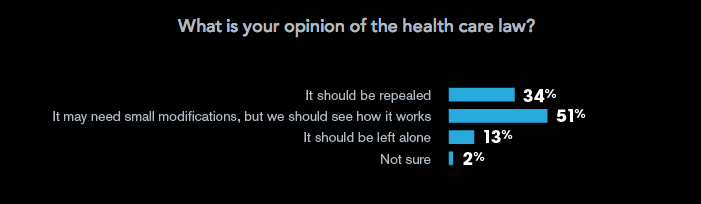
When 64 percent of Americans want to see the law fixed or left alone, you have the recipe for long-term resilience.
Has this dented in any way Republican fury at the law? Not so far as you can see from the messaging being unveiled for the midterms, where repealing the law is front and center in the campaign. Karl Rove may be prescient in noting that Obamacare may not be sufficient to win back the Senate – in part because it’s not as potent an electoral ploy as populist hostility to big banks. But his party doesn’t seem inclined to listen.
My own view is that this entire debate over the last few years reveals a core truth about our current politics. One party has taken a ruthlessly pragmatic approach to governing, while the other has taken a ruthlessly rhetorical approach to opposition.
It is as if the Republicans had decided that their opposition to the president would become a kind of performance art version of all their previous tricks. Obamacare is a function of a tyrant! The president is a mom-jeans-wearing weakling compared with Putin! He’s coming to take away your guns! He’s robbing white seniors to pay for poor blacks! And almost none of their critiques has carried the kind of decisive bite that could actually arrest Obama’s relentless chugging forward. In a war of attrition, one side is all histrionics, and the other all action. It reminds me a bit of the 2008 primary race. One side was crusading for the first woman president; the other was quietly counting delegates.
Some of this is inherent, of course, in one side being the government and the other the opposition. But the absence (until very recently) of any Republican legislative proposal that might attract serious, bipartisan support on the budget or climate change or immigration, and the absence in particular (until very recently) of even a modestly practical and palatable alternative to Obamacare reveals the core disparity. 50 votes to repeal Obamacare is not smart politics; it’s entertainment. One side is theater – and often rather compelling theater, if you like your news blonde, buxom and propagandized. The other side is boring, relentless implementation. At any one time, you can be forgiven for thinking that the theatrics have worked. The botched roll-out of healthcare.gov, to take an obvious example, created a spectacular weapon for the GOP to hurl back at the president. But since then, in undemonstrative fashion, the Obama peeps have rather impressively fixed the site’s problems and signed up millions more to the program. As the numbers tick up, the forces of inertia – always paramount in healthcare reform – will kick in in defense of Obamacare, and not against it. Again, the pattern is great Republican political theater, followed by steady and relentless Democratic advance.
Until the theater really does create a new majority around Republican policies and a Republican candidate, Obama has the edge. Which is to say: he has had that edge now for nearly six years. Even if he loses the entire Congress this fall, he has a veto. And then, all he has to do is find a successor able to entrench his legacy and the final meep-meep is upon us. And that, perhaps, is how best to see Clinton. She may not have the stomach for eight years in the White House, and the barrage of bullshit she will have to endure. But if you see her as being to Barack Obama what George H.W. Bush was to Reagan, four years could easily be enough. At which point, the GOP may finally have to abandon theater for government, and performance art for coalition-building.
Mark Halperin reports on Ready For Hillary’s preparations:
There is now talk among Ready officials about finishing 2014 with 5 million supporters and 2 million active volunteers, numbers that would likely dwarf the assets of all the GOP wannabes combined. If realized, that would be substantially more than the piddling grassroots effort that Clinton mounted against Obama six years ago. Could anyone, Democrat or Republican, catch the Clinton machine this time? “I don’t know,” [Craig] Smith says. “I think it takes a long time to build a grassroots operation. These things don’t pop up overnight.”
He claims the president is nervous about his people’s involvement:
Obama’s advisers have had to reassure the President that the early embrace of Clinton by his far-flung team is a good thing. He has fretted to aides about the leadership role his campaign manager Jim Messina has taken on in another pro-Clinton super PAC, Priorities USA Action, and worried that the early organizing might distract from his effort to limit losses in the looming midterm election.
Ben Jacobs explains how Ready For Hillary is also poaching Obama’s Iowa corps:
With its deep connections to key players like [Obama’s 2008 state director Jackie] Norris and [Obama’s 2008 Iowa field director Mitch] Stewart on Obama’s first presidential campaign, it is clear Ready For Hillary is trying to woo as many former active Obama supporters as possible and using a wealth of information generated more than six years ago to do so. This not only means that a potential 2016 campaign by Clinton will be that much stronger, but preempts other potential Democratic candidates, like Vice President Joe Biden, from being able to build on Obama’s fabled Iowa organization.
This strategy is already paying dividends. For instance, while [Ready For Hillary spokesman Seth] Bringman admitted that his group fell short of their 99 county goal last Saturday, they were still able to deploy 250 volunteers in an impressive 84 counties across the state. About a third of those volunteers were Obama supporters in 2008, he said.
Looking at the long-term implications of the Ukraine crisis, Doug Bandow thinks “Washington should force Europe to take over responsibility for its own defense”:
In early March the administration undertook what Secretary of State John Kerry termed “concrete steps to reassure our NATO allies.” Actually, Washington should adopt the opposite strategy. America’s friends should understand that if they are not willing to defend themselves, no one else will do so.
At the same time, Washington should rethink nonproliferation policy. It’s too late for Ukraine, but Kiev gave up Soviet nuclear weapons left on its soil in return for paper border guarantees. Possession of even a handful of nuclear-tipped missiles would have changed Moscow’s risk calculations.
But Ted Galen Carpenter doubts the Europeans are willing to boost their defense budgets:
Even Russia’s jarring actions in Ukraine are unlikely to dislodge the NATO countries from their fondness for free-riding on the security exertions of the United States. The Baltic republics and other nations directly on Russia’s border have made some comments about the need to increase their military spending, but only time will tell whether they turn out to be more than yet another episode of empty talk. And the major Western European powers show few signs of altering their policies or budgets.
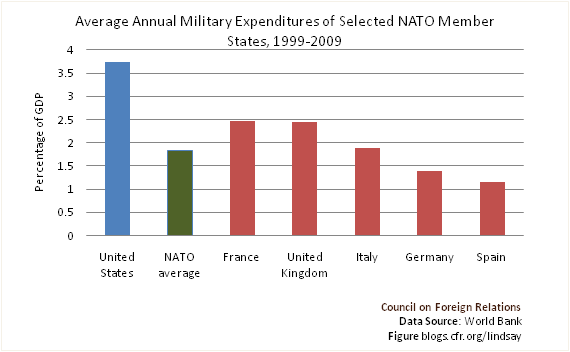
Indeed, even the vulnerable Eastern European countries are spending more energy trying to get the United States to enhance its military commitment to the region than they are on boosting their own defenses. Lithuanian President Dalia Grybauskaite, for example, warns that “Russia is a threat to the whole of Europe, and Europe must understand what it is dealing with.” However, just a few years ago, she led efforts to cut Lithuania’s already meager defense budget. Today, the country spends barely 0.8 percent of GDP on defense.
Also, as Carlo Davis points out, the US doesn’t devote nearly as much of our military might to NATO as we used to:
NATO relies heavily on the United States to project power and deter external threats. The U.S. provides 22 percent of NATO’s common-funded budget and is the organization’s largest member—its military spending represents nearly three quarters of all NATO members’ military spending combined. As a result, notes Stratfor Chairman George Friedman in his prescient book The Next 100 Years, NATO’s collective defense guarantee is “effective only if the United States is prepared to use force.”
Concerned Poles and Balts seeking hard evidence behind America’s rhetorical support for NATO are bound to be disappointed. Obama’s “pivot to Asia” is only the latest stage in a multi-decade drawdown of U.S. forces in Europe. Only 64,000 U.S. troops are currently stationed there, compared to 450,000 at the height of the Cold War. And U.S. military forces have never been deployed east of the Oder River, which forms the boundary between Germany and Poland. Even planned U.S. missile defense shields for Poland and the Czech Republic were cancelled as part of Obama’s attempted reset with Russia in 2009.
Jeffrey Tayler argues that Putin is right to be suspicious of NATO’s machinations in its neighborhood:
As the nuclear standoff between the two superpowers waned, the West’s most powerful military alliance, the North Atlantic Treaty Organization (NATO), has expanded three times, despite President George H. W. Bush’s apparent promise to Soviet leader Mikhail Gorbachev not to enlarge the group. NATO inducted the Baltic states in 2004, and laid the groundwork for the membership of Ukraine and Georgia. Yanukovych scuppered such plans relating to Ukraine in 2010, but deputies of the new Ukrainian parliament have just introduced a bill proposing the country again seek membership.
The Soviet Union is no more, but the entity created specifically to counter its military might thrives, as has the Pentagon’s budget, which increased relentlessly until 2011, topping $700 billion. Furthermore, in 2002, the United States withdrew unilaterally from its treaty with Moscow banning anti-ballistic missiles and plans to station such missiles in Eastern Europe. The conclusion Putin has drawn? The United States is bent on maintaining and increasing its hegemony — at Russia’s expense.
(Chart from James Lindsay)
 The Dish