The Pushback Against Rand Paul

Annual Conservative Political Action Conference (CPAC) Held In D.C.

As you could see yesterday in one of Joe McGinniss’s emails to yours truly, my fondness for the Pauls has never been a crowd favorite at the Dish. So my recent hope that he might tilt the GOP back toward a more Millennial worldview has inevitably taken a few hits. P.M. Carpenter’s hit the mark a little too well:

There is absolutely no way Rand Paul can win the White House. There is no “if” here.

What’s more, after Paul’s humiliating defeat, the GOP would conclude that running on Paulite measures in relation to foreign policy and national security was, is, and always will be a colossal loser for the party. The GOP would turn even more heavily to neocon thinking. Paulism would backfire on the very ideas he wishes to advance.

Andrew, your dream is already dead. Look, I’m no happier about a Hillary run than Joe Biden is. But I can read an electoral map–and I can read reality. Paul is pre-toast.

The most delicious way to prepare bread! I sure can’t seriously deny this high probability. I’m not sure, however, that non-interventionism would necessarily take the biggest hit in the inevitable recriminations. With Paul, any number of positions could make his defeat to Clinton epic – and his economic policy is far less popular than his foreign policy. And, besides, non-interventionism is very popular in America right now, whatever Marco Rubio and Bill Kristol – and all those who have wiped their minds clean of any memory of Iraq – want to believe. From the latest WSJ poll today:

One area of agreement among respondents of either party was on whether the U.S. should reassert itself on the world stage. Adults surveyed were less likely to support a candidate who wants to see the U.S. assume an expanded role in policing foreign conflicts and more likely to support one who doesn’t. Republicans, Democrats and independents showed more agreement on those questions than many others.

Republicans and Democrats also tended to agree that the U.S. should only involve itself in the brewing conflict between Russia and Ukraine if other nations take part, or that it should let Europeans handle the matter on their own. A mere 5% said the U.S. should take action by itself.

The scenario I’m positing is one in which Paul is actually more in line with American thinking on foreign policy than Hillary Clinton in 2016. The public’s response to both Ukraine and Syria – two major mehs – has already made this loud and clear, even though the boomer armchair generals in the punditariat have not yet noticed. And with a victory in the primaries, Paul would offer the US a real choice between the continuation of a policy of US hegemony or a gradual shift to a more prudent use of our resources. In that context, I wouldn’t under-estimate the potential power of a real change you can believe in.

But, of course, you then have to deal with Rand Paul’s actual stances. And his attempt both to neutralize GOP opposition to his non-interventionism has led him into some serious weirdness. Serious enough to be thoroughly Chaited:

Paul [argues], “America is a world leader, but we should not be its policemen or ATM.” So he’s saying the United States should lead the world, but this leadership should not entail any new financial or military commitment?  Actually, he’s going farther than that. He’s arguing that American leadership should involve less financial and military commitment. Paul’s plan entails stiffing the Ukrainians:

We should also suspend American loans and aid to Ukraine because currently these could have the counterproductive effect of rewarding Russia.

Yes, you read that right – in the face of a massive threat from Russia, the United States should impose financial penalties on Ukraine.

Patrick Brennan calls the plan “bizarre and delusional”:

This is how Paul wants to support an incredibly fragile pro-Western government running out of foreign currency and therefore teetering on the brink of default. Ukraine desperately needs to raise more debt to make loan payments, which was the whole reason it had to pick between Russia and the West in the first place. Suggesting that the West shouldn’t loan to Ukraine now because some of that will go out the door to Russia is literally suggesting that the government default on its external debts. If that happens and the West isn’t there to help because President Paul thinks we can’t afford it, there basically won’t be a Ukrainian government left to regret choosing our side.

Larison focuses on Paul’s call for isolating Russia economically:

Sen. Paul makes several proposals in his article, most of which seem unworkable or irrelevant, but this is the one that has the least chance of succeeding on its own terms. Russia has the eighth-largest GDP in the world. Even if it were somehow politically possible to get all of its major trading partners to agree to “isolate” it, it would be economically ruinous for many of them to do so. No matter how assertive or bold the U.S. might be, there is no real chance that Russia will be isolated economically, and even less drastic punitive measures could have very undesirable effects.

The trouble with abstract libertarianism is it has never actually had to grasp the realities of governance since the Second World War. And Rand Paul’s contortions suggest a worldview much less coherent than you might imagine. And his skills at management and diplomacy? Unproven, at the very least.

(Photo: Getty Images)
Where Is Putin’s Next Target?

Ioffe explains why Putin’s aggressive concern for Russian minorities doesn’t extend to the Baltic countries, where they actually face serious discrimination:

[W]here is Putin when you need him? Where are the Russian soldiers in unmarked uniforms patrolling the streets of Tallinn, the referenda to join Russia, the town square electing marginal ethnic Russians to public office? And what, if you want to be cynical about it, of Estonia’s strategic importance? Think of Estonia’s prime access to the Baltic and Russia just happens to be building a northern gas pipeline to bypass Ukraine.

But Estonia, you see, is part of NATO. As is Latvia, as is Lithuania. And NATO has been stepping up air patrols in the region in the last week. So is it about protecting Russian speakers, or is about getting away with whatever you can get away with?

But Ed Morrissey points out that Moscow is planning to offer citizenship to Russo-Latvians:

This attempt to destabilize Latvia by making a quarter of its population Russian citizens gives away Putin’s game. It also serves as a direct affront to NATO and the West. Ukraine never did join NATO, but Latvia formally joined in 2004, as did its Baltic neighbors Lithuania and Estonia. Lithuania has a minimal ethnic-Russian population — less than 7% of its population — but Estonia’s population is 25% ethnic Russian. It’s no small wonder thatall three nations are now “jittery” over an “unpredictable” Russia[.]

Kazakhstan and Belarus, Adam Taylor reports, have reason to be nervous:

The Kremlin has justified the use of force in Crimea and Eastern Ukraine with a vow to protect ethnic Russians, an excuse that’s easily applied in other places. In Kazakhstan, there’s a significant minority of ethnic Russians in the north of the country, [director of the Center on the United States and Europe at the Brookings Institution Fiona] Hill points out – some 24 percent of the country is said to be ethnically Russian, and the language is widely spoken. While Belarus has fewer ethnic Russians (8.3 percent), it has largely become a Russophone state and there are a lot of murky questions about who might succeed Alexandr Lukashenko. Of course, Russia has agreed to respect the sovereignty of both countries, but they did that with Ukraine, too: The 1994 Budapest Memorandum, which Russia says they are ignoring due to the change in government in Ukraine. Neither Kazakhstan nor Belarus has recognized South Ossetia and Abkhazia, the states that broke away from Georgia, by the way.

Peter Eltsov and Klaus Larres believe Putin is foolish to assume that those who speak Russian identify as Russians:

Many Russian-speaking people living in Ukraine and in many other post-Soviet states no longer consider themselves Russian. This illustrates a truth regarding national identity: Things change fast. Punjabis from Lahore and Amritsar speak the same language but have distinctively different national identities: Indian and Pakistani. Bangladesh is even younger that Pakistan, yet it did not take long for its citizens to acquire a new identity. During the last four to five decades many, if not most, of the three-million-plus Turks living in Germany lost much of their Turkish identity. In particular, this applies to those under 30. They sway to and fro between two cultures, whether or not they have obtained German citizenship.

Read This Post In Under 20 Seconds, Ctd

Bershidsky calls the new speed-reading app Spritz “devilish”:

Speed-reading app developers may tell us, as the Spritz team does, that they have perfected the RSVP method to minimize eye movements and optimize the delivery of symbols to our brain. In the end, however, the written text’s only advantage over audio and video is the fact that we can switch reading “gears” as we go, skimming or scanning less interesting passages and slowing down on the more important ones. … Who wants to read Harry Potter books in an hour, anyway? They were written to be enjoyed, not swallowed.

Ian Steadman worries that for some texts, Spritz will set you back:

So let’s say you’re really into what Spritz is selling, and want to start getting through War & Peace in less time than it takes to watch a full season of Breaking Bad. The practical limitations of reading text one word at a time should be obvious: shorter words are going to be easier to understand than longer ones, and Tolstoy’s epic is going to be more taxing to grasp word-by-word than, say, Harry Potter. Anything with weird formatting, footnotes or sentences that can last longer than the length of a page – here’s looking at you, Infinite Jest – are going to be made incomprehensible with Spritz. There’s a button to go back to the start of either the paragraph or sentence that the reader is on, but for texts that require multiple passes to fully grasp (like, say, a scientific study) Spritz is going to be a hindrance, not a help.

Olga Khazan finds that, according to most research, as “speed increases, comprehension deteriorates”:

In the World Championship Speed Reading Competition, top contestants read about 1,000 to 2,000 words per minute, but they only understand about half of what they take in. One study of 16 high-performing people, including self-proclaimed “speed-readers” found that none could read faster than 600 words per minute while understanding at least three-quarters of the information.

Keith Rayner, a psycholinguist at the University of Massachusetts Amherst, told me that he thinks “all speed-reading claims are nonsensical.”

Spritz’ technique, called rapid serial visual presentation, or RSVP, isn’t new, and Rayner said it causes the same comprehension problems as other strategies.

Sweet Talk

Bernd Brunner, a native German speaker, contemplates the relative beauty of different languages:

As far as I can tell, many people – including not only many Germans, but Americans – consider Italian to be the most beautiful language. Nasal French earns mixed reviews; some people find it elegant and sophisticated, while it sounds somehow stilted to others’ ears. Those who see fit to praise English – at least, if they’re from Europe – usually add in the same breath that “of course” they mean British English; specifically, the Oxford kind. …

Some people have tried to formulate rules for judging languages, but they are trapped in a dilemma:

because they have to define certain criteria in order to evaluate their findings, they can never escape their own cultural programming. One example is the author Robert Beard, who dared to write a book called The 100 Most Beautiful Words in English (including, maybe not too surprisingly, words like “love,” “eloquence” and “glamour”).  For Beard, “beautiful” sounds are “pleasing”: as he explains, “soft sounds are considered more beautiful than hard ones.” But … [c]an only a “harmonious” language be beautiful? What’s wrong with aggressive talk? Some people can say very sweet things while having to use harsh sounds. Who wants a steady diet of romance, without the occasional crime novel?

Dreher’s two cents:

I find that I don’t much like the sound of East Asian languages, but Indian dialects sound nice. I don’t have enough experience with African languages to say. Slavic tongues sound dense and knotted to my ear. Arabic sounds so staccato and aspirated, like its syllables get caught in the throat of its speakers. Dutch sounds like slurred German to me. I don’t like Latin American Spanish, but the Castilian way of speaking it sounds lovely to me. On the other hand, Brazilian Portuguese sounds sexy, but the spoken language of Portugal sounds like Russians trying to speak Spanish.

The most beautiful languages are Italian and French — Italian, because it’s so musical and vivid, and French because it is pure silk on the tongue and in the ear.

Recent Dish on learning new languages here, here, and here.

The Wrong Kind Of Development

William Easterly argues that offering technical expertise to autocrats, ostensibly to alleviate poverty, is counterproductive:

Those who work in development prefer to focus on technical solutions to the poor’s problems, such as forestry projects, clean water supplies, or nutritional supplements. Development experts advise leaders they perceive to be benevolent autocrats to implement these technical solutions. The international professionals perpetrate an illusion that poverty is purely a technical problem, distracting attention away from the real cause: the unchecked power of the state against poor people without rights. The dictators whom experts are advising are not the solution — they are the problem.

Stoned-Driving PSAs

They’ve arrived:

Colorado is starting an ad campaign to prevent pot users from getting behind the wheel. Instead of vilifying the drug, which Colorado has legalized for recreational use, the campaign takes a light-hearted approach. … Frequent marijuana users drive under the influence an average of 17 times a month, according to information the Department of Transportation gleaned from phone surveys and focus groups.

Waldman is skeptical that the ad campaign will have much of an impact:

This is a much gentler approach than some similar campaigns, which have focused more on the disastrous potential of driving drunk or while texting (this one, from the U.K., may be the most gruesome). So perhaps they’re viewing this as a multi-stage effort, and this first stage is just to introduce the idea of driving while high as a potential problem, then later on they’ll try to horrify viewers. But it does present a new challenge. There are certain psychological factors that should play out similarly whether we’re talking about drunk driving, high driving, or distracted driving—people’s risk perceptions, their responses to fear appeals, and so on. On the other hand, pot exists within a social milieu and set of rituals that are different from those of alcohol, and that may affect how you want to confront the driving issue. For instance, a lot of drunk driving happens when people travel to an establishment where alcohol is served (there are around 65,000 bars and nightclubs in America), then need to get home, whereas we don’t (yet) have thousands of cannabis cafes.

Speaking of cannabis establishments, America will soon get its first cannabis club:

[Cheryl and David Fanelli] plan to open what KUSA, the NBC station in Denver, describes as “the only legally sanctioned cannabis club in the country” this month in Nederland (elevation:  8,228 feet; population: 1,500)

The Fanellis are taking advantage of an exception to the Colorado Clean Indoor Air Act for “a place of employment that is not open to the public and that is under the control of an employer that employs three or fewer employees.” The same exception covers VFW posts, Elk’s clubs, and other private, members-only spaces where smoking is allowed. The Fanelli’s establishment, Club Ned, will be open only to dues-paying members, who will have to make appointments and bring their own pot. But Club Ned will have tables and sell refreshments, creating something resembling the convivial, tavern-like atmosphere at Dutch “coffee shops” (which are not legal, strictly speaking, but have been tolerated for decades). Since David Fanelli mentions an “acoustical stage area,” I gather that there will be live music as well.

Questionable Intelligence

The thing about outlandish CIA history is that there’s just so much of it. Here’s a gem from 1960:

The agency’s director at the time, Allen Dulles, loved the Bond novels. Despite the derision most agents held for the series, [political scientist Christopher] Moran notes that he had a signed copy of each and every novel. Dulles and [Bond author Ian] Fleming struck up a relationship that at times seemed mutually beneficial.  … Dulles hoped to meet Fleming at a dinner hosted by the Kennedys in 1960. He had to miss the event, but asked a CIA official in attendance to report back. During dinner, Kennedy asked Fleming how he would topple Fidel Castro. Moran writes of his reply:

As Fleming saw it, it was not enough simply to kill Castro; he had to be humiliated as well.

To do this, he suggested flooding the streets of Havana with pamphlets explaining that radioactive fallout from atomic testing caused impotence and was known to be drawn to men who had beards. As a result, Cuban men would be forced to shave off their facial hair, thus severing a symbolic link to Castro and to the revolution. If this did not work, he suggested that the CIA should build a religious manifestation, ideally a cross of sorts, and fly it over the Havana skyline in order to induce the Cubans to look skyward. Everyone, including the President-elect, burst into laughter. The next day, [CIA official Howard] Bross informed Dulles of Fleming’s madcap scheme, fully expecting his superior to see it as poppycock. To his astonishment, Dulles thought it was a wonderful idea and raced to the telephone to speak to the author.

Other good ideas at the time here and here.

The Cat That Conquered The West

Noah Sudarsky describes the mountain lion as “something of a wildlife success story”:

It is the most widespread large carnivore in the Americas, managing to survive even as other predators have nearly perished. The wolf was hunted to the brink of extinction, and has been able to make a shaky comeback thanks only to expensive and difficult reintroduction programs. The grizzly, once found on the shores of San Francisco Bay, remains only in the Northern Rockies and Alaska, ecosystems large enough to accommodate its need for large, open spaces. The coyote, famously, is one predator that has seen an actual gain in numbers since European colonization (thanks mostly to the disappearance of other carnivores). But the coyote’s success – like that of, say, the crow and the raccoon – is due in large part to the animal’s ability to accommodate itself to human development. In contrast, the cougar remains as cagey as ever.

Cougars are, above all, solitary, connecting with other cougars only to mate. Since it is effectively invisible, this enigmatic species doesn’t enjoy (or suffer) the kind of cult of personality that surrounds the grizzly and the wolf. A cougar sticks to the shadows, and that instinct helps explain its enduring success, a success that seems all the more remarkable given the odds stacked against it. And the odds are staggering.

The Coveillance State

Kevin Kelly believes that, rather than try to resist surveillance, we should make it work for us:

We’re expanding the data sphere to sci-fi levels and there’s no stopping it. Too many of the benefits we covet derive from it. So our central choice now is whether this surveillance is a secret, one-way panopticon — or a mutual, transparent kind of “coveillance” that involves watching the watchers. The first option is hell, the second redeemable. …

The remedy for over-secrecy is to think in terms of coveillance, so that we make tracking and monitoring as symmetrical — and transparent — as possible.

That way the monitoring can be regulated, mistakes appealed and corrected, specific boundaries set and enforced. A massively surveilled world is not a world I would design (or even desire), but massive surveillance is coming either way because that is the bias of digital technology and we might as well surveil well and civilly. In this version of surveillance — a transparent coveillance where everyone sees each other — a sense of entitlement can emerge: Every person has a human right to access, and benefit from, the data about themselves. The commercial giants running the networks have to spread the economic benefits of tracing people’s behavior to the people themselves, simply to keep going. They will pay you to track yourself. Citizens film the cops, while the cops film the citizens. The business of monitoring (including those who monitor other monitors) will be a big business. The flow of money, too, is made more visible even as it gets more complex.

Michael Brendan Dougherty pushes back:

Kelly’s vision of the future is more straightforwardly dystopian than any of the other controversial visions of a libertarian “opt-out” society emanating from Silicon Valley. He believes human life can, and ought to be, reduced to data points, that people will consent to be ruled like a mere cell in an Excel Spreadsheet and will even begin to understand themselves in the rudimentary categories of computation.

His essay is an occasion to remind ourselves that the future doesn’t unfurl out of present trends extrapolated into infinity; it is contested. And we have older, rather durable technologies that can prevent us from being dropped into a digitized fishbowl: the art of political resistance for one. Our Constitution, another.

The Enduring Appeal Of Ruins

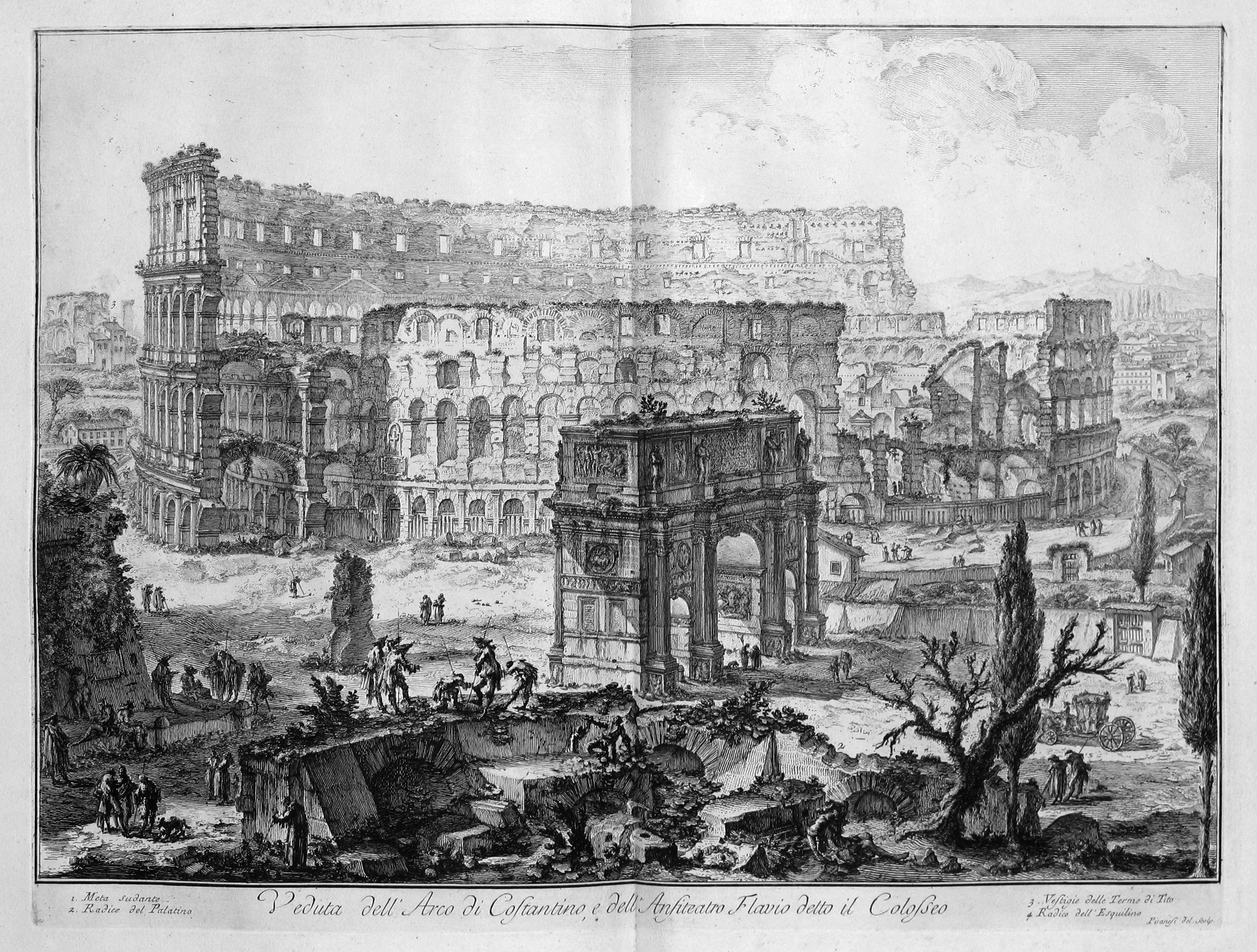
piranesivedute14 3

In a review of the Tate Britain’s current show Ruin Lust, Frances Stonor Saunders suggests that urban wrecks offer a shortcut to self-transcendence, “a steroidal sublime that enables us to enlarge the past since we cannot enlarge the present”:

When ruin-meister Giovanni Piranesi introduced human figures into his “Views of Rome,” they were always disproportionately small in relation to his colossal (and colossally inaccurate) wrecks of empire. It’s not that Piranesi, an architect, couldn’t do the math: he wasn’t trying to document the remains so much as translate them into a grand melancholic view. As Marguerite Yourcenar put it, Piranesi was not only the interpreter but “virtually the inventor of Rome’s tragic beauty.” His “sublime dreams,” Horace Walpole said, had conjured “visions of Rome beyond what it boasted even in the meridian of its splendor.”

Piranesi’s engravings were such a potent framing device for the cultural imagination of the 18th century that the actual ruins had to compete with them. Many Goethes and Gibbons arrived in Rome with these images imprinted on their minds, and when this superimposition cleared, the real thing was initially something of a disappointment. François-René de Chateaubriand’s account of a visit to the Colosseum in July 1803 conformed to all the requirements of the ruin gaze: “The setting sun poured floods of gold through all the galleries … nothing was now heard but the barking of dogs”; a distant palm tree, glimpsed through an arch, “seemed to have been placed in the midst of this wreck expressly for painters and poets.” But when he returned to this locus romanticus a few months later, he saw nothing but a “pile of dreary and misshapen ruins.”

Previous Dish on ruins herehere, and here.

(Piranesi’s Veduta dell’ arco di Costantino, e dell’ anfiteatro Flavio detto il colosseo, 1760, via Leiden University.)