Noah’s Arc

In an interview, Darren Aronofsky, director of the just-released Noahargues that the biblical story of Noah actually is more powerful when “you get away from the arguments about history and accuracy and literalism” and grasp its underlying message:

[W]hen you think about Icarus, you don’t talk about the feathers and the wax and how the wax attached to his body and how is that physically possible that he could fly with feathers on his arms. No. You’re talking about how he flew too high and was filled with hubris and it destroyed him. That’s the message and that’s the power. That’s power to have that idea.

But when you’re talking about a pre-diluvian world—a pre-flood world—where people are living for millennia and centuries, where there were no rainbows, where giants and angels walked on the planet, where the world was created in seven days, where people were naked and had no shame, you’re talking about a universe that is very, very different from what we understand. And to portray that as realistic is impossible. You have to enter the fantastical. The Leviathan in the sea. It’s a different understanding of the world, and that’s OK. That’s not dangerous.

What happens is that you get nonbelievers, then, saying “That’s impossible, because all the species of the world would never all fit on the ark.” But that’s the exact wrong argument, you know? And then you have other people saying, “Yeah, it’s possible by the grace and majesty of God.” If you look at it as poetry and myth and legend, then you can actually use it to understand your world and who you are.

Even so, after his own conversation with Aronofsky, Jonathan Merritt notes “the amount of biblical and historical research his team conducted for this movie nearly knocked me off my chair,” and hopes evangelical Christians will give it a chance:

“Noah” was never intended to be a heavy-handed evangelistic tool, but rather good art. And I’m sorry to say that few evangelicals today have an eye, ear, or stomach for such things. Not much has changed since the late Francis Schaeffer wrote in Art and the Bible, “I am afraid that as evangelicals, we think that a work of art only has value if we reduce it to a tract.”

In order to engage with “Noah,” Christians must recognize that artistic liberties are inevitable whenever a story is transferred from one medium to another. What Aronofsky has done is similar to Rembrandt inserting himself into “The Raising of the Cross.” The Bible obviously doesn’t mention Rembrandt lifting the cross with the executioners more than a millennium earlier, but the artist was making a deeper point. Christians traveling to Munich could boycott the Alte Pinakothek museum where the painting is on display, but they would miss an opportunity for theological reflection.

Like other artistic endeavors drawing on biblical themes, “Noah” requires that audiences actually think about symbols and forms. Aronofsky adds elements to Noah’s story, for example, that reflect the grief God must have felt over having to destroy creation. The movie doesn’t get every detail right, but it captures the spirit of the scriptural narrative and the character of God displayed therein.

E. Stephen Burnett nods:

Noah could be a terrible adaptation of any number of elements: the person and story of God, the person and story of Noah, and the side characters and story-world of the Flood. I can likely live with filmmakers messing up those last two. Others would disagree. But I would suggest that all Christians enjoy the potential right to see or even appreciate a bad biblical fantasy film.

We can do this without adapting the few that some marketers and biblical-fidelity critics imply: that if a film is not “useful” for evangelism, then it’s not useful at all.

Brook Wilensky-Lanford defends Noah as more biblical than some will admit, claiming that “none of the film’s inventions are explicitly disallowed by Genesis or other biblical texts”:

If you’re going to make a movie of a Bible story, you’re going to need to fill in some major gaps. Genesis mentions Noah’s kids, but not his wife. How did that happen? We know that God had to flood the earth to punish humanity’s wickedness,but the mass graves are invisible. After Noah saves the world, the next thing he does is get drunk and naked, and curse his sons. What’s that about? The more interesting question is not “Did he add stuff?” but “What did he add, and why?” Impressively, Aronofsky’s interpretation manages to stay “true” both to the messiness of the Old Testament and to his own directorial sensibilities. …

In the story of Noah, Aronofsky has found the quintessential thought experiment: If God asked you to save the world, but lose your soul, would you do it? What kind of person is able to save the animal kingdom and his own family, but leave the rest of humanity to drown? The deal this time is with God, but that doesn’t mean Noah suffers less pain. When he sees that even his own sons are impure, which means that all humans contain both good and evil, which means that his agreement to leave thousands of people behind amounts to mass murder; the realization hits him like a stone to the gut.

But he knows he has to proceed with the Ark; this is the Old Testament after all, where God, is less concerned with redemption than with loyalty and obedience. So Noah makes a decision that turns him into the villain for a good bit of the film. There’s a moment with a knife and a baby that I won’t say any more about. Still, what makes Aronofsky’s moviemaking compelling is his unwillingness to judge the tortured souls that populate his films.

Andrew Romano comes to similar conclusions:

Most of the early press about Noah has focused on its fidelity to the Bible (or lack thereof). Having seen the finished product, I doubt that anyone but the most fanatical fundamentalists will object. Sure, the characters call their deity “The Creator” rather than “God.” And yes, not all of those characters appeared in Genesis. But go back and reread the Noah story sometime. It’s basically an outline—Noah is righteous; God tells Noah to build a boat; it rains; and so on. There’s no conflict, no villain, no characters, and very little dialogue.

A totally faithful movie wouldn’t have been a movie at all. It would have been an elementary-school film strip. To adapt Noah for the big screen—Aronofsky’s dream for more than a decade, apparently—the director had two choices: either invent or extrapolate. He chose the latter. And so almost everything in Noah, as nutty as it might seem, has its roots in the actual text of the Bible.

Recent Dish on Hollywood and religion here.
Torn Between Greatness And Grace

Tuesday was the Catholic writer Flannery O’Connor’s birthday. TNR celebrated by pulling Ellen Douglas’s essay “Provincialism in Literature” from their archives, which praises O’Connor for building “her life in a specific place and on a specific faith”:

In O’Connor we see the masterful presentation of the universal through the particular, the provincial. Consider, for example, “A Good Man Is Hard to Find,” where the evil in human hearts, and the possibility of grace, the gift of love, are made terrifyingly and magnificently real in the lives of ignorant and limited people on a Southern backwoods roadside. In this sense, then, we must rejoice when our writers are provincial and parochial.

As for the provinces we live in, the real places that we perhaps think of as our homes, we may believe to begin with that we apprehend them through our own experience; but the more we read and compare, the clearer it is that we see them through the eyes of our writers. We would be crippled and limited without the insights that fiction brings to our provincial reality.

Reviewing her recently published prayer journals, Jamie Quatro finds their “driving tension” – whether O’Connor could consecrate her life to God and achieve literary greatness:

“I want so to love God all the way,” she writes on November 6, 1946. “At the same time I want all the things that seem opposed to it—I want to be a fine writer. Any success will tend to swell my head—unconsciously even.” The deep dive into the self that writing requires and the natural temptation of pride literary success would surely bring; contrasted with the dying to the self love for God requires, the sacrifice and suffering—how to reconcile the two? Aren’t they inherently inimical to one another?

What is a Christian writer to do but accept—indeed, possess—the struggle?

It’s striking how often O’Connor expresses her fears of “mediocrity” in both arenas, religious and creative. On the one hand, she prays against a lukewarm faith: “I don’t want to be doomed to mediocrity in my feeling for Christ. I want to feel. I want to love.”

… But if she fears a mediocre faith, she abhors the thought of a mediocre craft, calling it a “scourge,” saying she’d rather be an “imbecile” or “nothing” than become anything less than a fine writer. To accept mediocrity, she writes, would be to resign herself to a life of despair: “Maybe I’m mediocre. I’d rather be less. I’d rather be nothing. An imbecile. Yet this is wrong. Mediocrity, if that is my scourge, is something I’ll have to submit to.” And: “Mediocrity is a hard word to apply to oneself; yet I see myself so equal with it that it is impossible not to throw it at myself . . . I think to accept it would be to accept Despair. There must be some way for the naturally mediocre to escape it. The way must be Grace.”

Marking O’Connor’s birthday, Popova highlighted her classic essay, “Some Aspects of the Grotesque in Southern Fiction,” found in Mystery and Manners: Occasional Prose. One passage worth noting:

There is something in us, as storytellers and as listeners to stories, that demands the redemptive act, that demands that what falls at least be offered the chance to be restored. The reader of today looks for this motion, and rightly so, but what he has forgotten is the cost of it. His sense of evil is diluted or lacking altogether, and so he has forgotten the price of restoration. When he reads a novel, he wants either his senses tormented or his spirits raised. He wants to be transported, instantly, either to mock damnation or a mock innocence.

Listen to O’Connor read from the essay here. Previous Dish on O’Connor’s prayer journals here, here, and here. Recent Dish on Southern fiction here.

The Evolution Of Street Art

Ayun Halliday spotlights the above short film:

There’s a rapacious, run-amok energy to Italian street artist Blu’s stop motion animation, “BIG BANG BIG BOOM.” However long it took him, assisted by a slew of local artists, to render a host of painted large-scale characters across a primarily industrial landscape in Argentina and Uruguay, it takes less than ten, gloriously gritty minutes for his just-dawned world to destroy itself.

This is evolution at its most apocryphal (and least scientific). Crustaceans and giant lizards who mere decades ago would have terrorized the streets of Tokyo are here no match for man. In fact, man is no match for man, rapidly engineering his own demise as he chases about an appropriately circular, abandoned-looking silo. The necessary demise of his murals—animation frames, if you like—serves as a nifty reminder of the evolutionary fate of most street art.

A Journey, Not An Escape, Ctd

NYU psychiatrists have been experimenting with using psilocybin to treat cancer patients. For Nick Fernandez, a study participant who was diagnosed with leukemia in high school, the experience was transformative:

[A]s the drug began to take effect, the blackness inside his head turned into an onrushing cascade of white dots that swiftly morphed into a kaleidoscope of geometric patterns – gears, stars, triangles, trapezoids – in all the colours of the rainbow. He started to hear an insistent voice in his head, telling him over and over: ‘I’m going to show you what I can do.’ Fernandez slowly suspended his skepticism and reluctantly surrendered to the experience. What he perceived to be his spirit guide took him on a Marley’s ghost-style journey, with stops at his own funeral, a hellish place littered with skulls that smelled of death where he was in excruciating pain. Once his agony reached an almost unbearable crescendo, his spirit guide catapulted him through hundreds of light years of space, allowing him to escape the pain. ‘I went into this mystical state, and this intense visual palate took over my mind,’ Fernandez said.

He suddenly found himself in Grand Central Terminal, which was filled with hundreds of people he knew dressed in tuxedos and ball gowns, dancing happily to symphonic music. He spied his girlfriend, Claire, across the dance floor.

They walked towards each other and embraced, which filled him with intense feelings of bliss and joy. Soon he was again catapulted, down into the sewers of the city, and then to the top of the Empire State Building where he serenely surveyed the city just as dawn broke its rosy glow over the skyscrapers. The spirit guide took him from there to a cave in the forest where he went shopping for another body, but the only body to be had was his own.

This realisation gave Fernandez a new appreciation of his body, and all it had been through: the workouts, the swims, the bike rides, the sickness when the cancer cells had taken over, and the chemotherapy drugs that had destroyed them. ‘For the first time in my life, I felt like there was a creator of the universe, a force greater than myself, and that I should be kind and loving,’ he said. ‘Something inside me snapped and I experienced a profound psychic shift that made me realise all my anxieties, defences and insecurities weren’t something to worry about.’

Previous Dish on psychedelics here.

Putting Your Right Knee Forward

dish_dancemoves

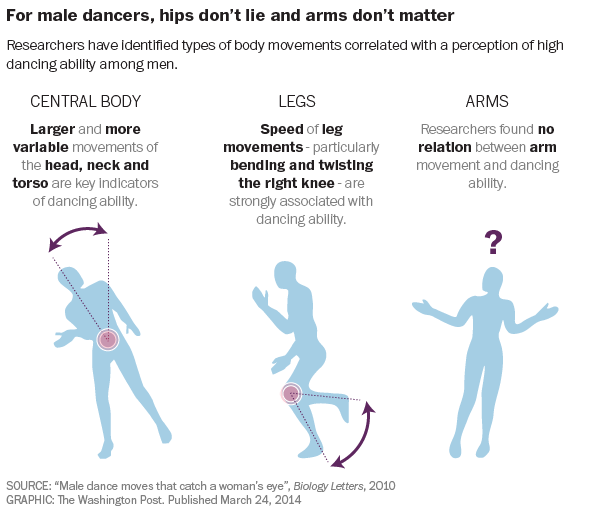
Researchers investigated what attracts straight women to guys on the dance floor:

[W]omen rated dancers higher when they showed larger and more variable movements of the head, neck and torso. Speed of leg movements mattered too, particularly bending and twisting of the right knee. In what might be bad news for the 20% of the population who is left-footed, left knee movement didn’t seem to matter. In fact, certain left-legged movements had a small negative correlation with dancing ability, meaning that dancers who favored left leg motion were rated more poorly. While not statistically significant, these findings suggest that there might be something to that old adage about “two left feet” after all. One final surprise – arm movement didn’t correlate with perceived dancing ability in any significant way.

Going beyond the dance floor, these findings could demonstrate that mens’ dance moves could carry “honest signals of traits such as health, fitness, genetic quality and developmental history,” although the authors stress that more research is needed to be sure. It would be particularly instructive to see whether similar findings hold true for mens’ assessments of womens’ dancing ability.

Update from a reader:

The Washington Post summary of the “putting your right knee forward’ article gets a couple of things pretty badly wrong.

Yes, the variability and speed in neck and trunk movement predict dance ratings but the implication that arm movement does not predict dance ratings is simply wrong. Arm movement amplitude, variability, and speed are correlated r= .45, r=.44 and r=.34 respectively with ratings of dancing quality. These would typically be interpreted as moderately strong effects and are only “non-significant” because the original study was based on so few individuals and because the authors chose to interpret these effects using a statistical significance standard that is largely arbitrary and highly limited for such a small sample. Men wishing to impress women on the dance floor should not, however, conclude that arm movement does not matter because it matters almost exactly as much the movement speed of your legs (r= .47). Even some of the left leg movement indicators are pretty decent predictors of ratings of dance quality. Left hip twisting and left knee bending, for example, both correlate r = .31 with ratings of dance quality while left knee twisting correlates r= .34 with dance quality ratings – all moderately large effects.

The authors of the original paper also share some blame for using a statistical method (stepwise regression) that is pretty awful for analyzing this kind of data. The take-home message should be that straight men wishing to impress women on the dance floor should definitely vigorously move their trunk, neck, arms, and both legs – not just their trunk, neck and right leg.

Hanging On To The V-Card

Jon Fortenbury looks at the statistics on virginity:

[M]any individuals who lose their virginities “late” do so for many reasons—not just the stereotypical “can’t get laid” or “super-religious” assumptions. Whether it’s by choice, circumstance, or both, late virginity loss can bring anything from pride to sexual dysfunction for the few Americans who experience it.

According to the Centers for Disease Control and Prevention, the average age Americans lose their virginities (defined here as vaginal sexual intercourse) is 17.1 for both men and women. The CDC also reports that virgins make up 12.3 percent of females and 14.3 percent of males aged 20 to 24. That number drops below 5 percent for both male and female virgins aged 25 to 29 and goes as low as 0.3 percent for virgins aged 40 to 44. …

Statistically, if you didn’t have sex in your teen years, you’re in the minority. But most people I asked in my unscientific poll felt virginity loss wasn’t “late” if the person was still college-aged. Many thought 25 was the first late age. One friend told me that for secular people, “late” is 20 and older, and for religious people, 40 and older. The popular 1999 film American Pie suggests that late is freshman year of college. And the character Jess (played by Zooey Deschanel) on New Girl stated in a flashback in a recent episode, “In three years, I’ll be 25. I can’t rent my first car as a virgin. They’ll know.”

A Beard To Revere

The Dish would be remiss not to post this short doc about a man, Jack Passion, a multiple-time World Champion in the Full Beard Natural category at the World Beard and Moustache Championships:

Passion answered a few questions about his facial hair back in 2012:

What tricks do you have for keeping your beard clean while eating? Are there any foods you’ve sworn off? 

Have you ever seen an Olympic fencing champion wield a sword? I’m like that with napkins. Also, the beard doesn’t just pop out over night; you have time to adjust to it, so nothing is really that difficult to eat without making a mess of one’s face. It’s really hard to eat ice cream cones, but I don’t even like ice cream. A juicy, rare burger might be difficult, but you can always ditch the bun and eat it with a fork and knife. Where there’s a will, there’s a clean beard. …

Obviously, you get a lot of attention for your beard. How do you handle it when you just want to go to the grocery store or what have you without stopping to talk to curious strangers?

Funny you should ask. I was just at the grocery store and like ten people gave me business cards (this is L.A.)! The older I get, the more I value time, and the less I want to waste it entertaining stupid comments like, “Hey, have you seen that show about beards!?” or “Dude! ZZ Top!” Thus, I usually braid my beard and stick the braid down my shirt, and just look like a guy with a pretty big beard but nothing extreme. If I don’t, it’s almost impossible to get through the day going anywhere in public with any kind of efficiency.

If someone recognizes me with my beard braided and hidden, they’re recognizing me, and that’s awesome, so I’m more than happy to chat with them. It’s hard to be more than a beard when the beard is more than your head and torso.

The Not-So-Bitter End

Ted Thompson appreciates John Cheever’s talent for penning convincingly happy endings:

This is one of the things that’s so apparent when you’re reading Cheever: his openness to redemptive beauty. His suburbs aren’t corrupt, awful places. They’re not places that have dark, ugly roots that he’s trying to expose—which is often the basic project in the subgenre of American suburban fiction (and film and TV). Cheever’s world is one that, no matter how buttoned-up it may be, is continuously ruptured by unexpected beauty. For me, finding this on the page was a revelation. You aren’t supposed to write about suburban neighborhoods like that—to acknowledge their beauty, and locate great meaning in it. It’s pretty clear why writers like Jim Harrison spend so much time describing the natural world, but we’ve become almost conditioned to believe that manicured suburban aesthetics are only an illusion to conceal some fundamental rottenness.

In Cheever, this isn’t really the case. No matter how cruel his characters are to each other, no matter how much they disappoint each other or what sins they commit, there’s still a sense that there’s light in his world. It comes through in the way he describes trees so well, and smells and breezes and the ocean. The landscape balances out the torment of the tortured characters within it—and sometimes, that beauty is even enough to save them.

Writing a happy ending that feels meaningful is probably one of the hardest tricks in literature. There’s a lot of comedy out there (particularly in movies and television) that follows that ancient structure of the world falling apart and then being put back together again, but so much of it feels like, okay, those problems were solved and now I can forget about them. You don’t want a literary story to have that effect—you want it to have a resonance with the reader beyond the last page, and I feel like it’s a lot easier to do with tragedy than comedy.

Is Literary Criticism An Art Or Science?

Joshua Rothman highlights the work of Franco Moretti – founder of the Stanford Literary Lab, dedicated to analyzing texts with computer software – who firmly believes it’s the latter:

The basic idea in Moretti’s work is that, if you really want to understand literature, you can’t just read a few books or poems over and over (“Hamlet,” “Anna Karenina,” “The Waste Land”). Instead, you have to work with hundreds or even thousands of texts at a time. By turning those books into data, and analyzing that data, you can discover facts about literature in general—facts that are true not just about a small number of canonized works but about what the critic Margaret Cohen has called the “Great Unread.” At the Literary Lab, for example, Moretti is involved in a project to map the relationships between characters in hundreds of plays, from the time of ancient Greece through the nineteenth century. These maps—which look like spiderwebs, rather than org charts — can then be compared; in theory, the comparisons could reveal something about how character relationships have changed through time, or how they differ from genre to genre. Moretti believes that these types of analyses can highlight what he calls “the regularity of the literary field. Its patterns, its slowness.” They can show us the forest rather than the trees.

Moretti’s work has helped to make “computational criticism,” and the digital humanities more generally, into a real intellectual movement. When, the week before last, Stanford announced that undergraduates would be able to enroll in “joint majors” combining computer science with either English or music, it was hard not to see it as a sign of Moretti’s influence.

Micah Mattix pushes back:

While Moretti has done some interesting work, the problem with many “scientific” approaches to literature is that too often they don’t begin with a question to be answered or a problem to be solved but are interested simply in proving the validity of a method for merely professional reasons. It’s the difference between a scientist who is fascinated with isotopes and energy conservation and who uses the scientific method to help answer his pressing questions, and one who is interested in the scientific method alone and who chooses to look at isotopes and energy conservation as a means of proving the validity of a method. The results are data dumps no one reads, answers to questions no one is asking or answers to questions that have already been answered.

Rachel Cordasco is skeptical as well, arguing that “books are NOT data, they’re books“:

[F]iguratively pouring mass quantities of books into a big computer and figuring out the average title length in the 19th century or the average number of words in 18th-century novels is not reading- and seems to belittle books, to me. Now, I know it sounds like I’m comparing apples and oranges, but still. We’re still talking about the worlds and words that change us for the better.

Now, I heard Moretti speak on the campus of UW-Madison several years ago, and I was charmed. This dude is just so darn charming. And smart. And suave. But as I looked at his charts and listened to his analysis, I felt chilled. His work was interesting, but his data told me nothing about the books themselves.

For me, distant reading, like close reading and all the other critical theories that offer us different ways in to books, is just another theory of reading. But what I’ve realized, after reaching the other side of academia and launching back into reading for the fun of it, is that only you can decide how you appreciate reading. Ultimately, though, reading is the act of running your eyes across the page and processing the words into images, sounds, feelings, and ideas. We talk to each other about books, we read passages out loud to one another. We lovingly arrange books on shelves or in piles. We download hundreds of them onto our devices. And we immerse ourselves in the stories they tell. So don’t talk to me about data, Franco, my dear. I simply don’t want to hear about it. I’m busy reading.

Previous Dish on the digital humanities here, here, and here.