Speaking to an audience at South by Southwest via Google Hangout yesterday, Edward Snowden stressed the need for consumers to start encrypting the information they send online and demand that tech companies make that easier:
To protect against secret surveillance, Snowden said, we need to make encryption a part of everything we do. “The bottom line is that encryption does work,” he said. “We need to not think of encryption as an arcane, dark art, but as basic protection for the digital world.”
He offered a personal example, which got laughs from the crowd. The NSA has a massive investigation team looking into Snowden, and “they still have no idea what documents” what documents he’s leaked to journalists “because encryption worked.” He did say that one can break into a computer and steal encryption keys, which “happens every day,” but cracking modern encryption would require an unfeasible amount of resources—and we should continue to develop crypto for the future.
The non-techies in the audience may have found some of what Snowden said a bit obscure, but it wasn’t, really. The sort of encryption he was recommending is so-called end-to-end encryption, in which data is readable only by the receiving—not by intermediaries, such as Internet-service providers and the intelligence services that intercept their traffic. Some tools of this nature are already available, but they can be complicated to use or costly to implement; commercial services like Gmail and Facebook don’t provide them. The key to progress, Snowden said, is developing cheaper and easier to use encryption methods, which could be incorporated into big e-mail and messaging systems. “It has to be out there,” he said. “It has to happen automatically. It has to happen seamlessly.”
Snowden’s co-panelist, ACLU principal technologist Chris Soghoian, explains the big picture:
We, the everyday consumers, must make privacy and security profitable. If we want these companies to put our interests first, we must pay for the services that they provide us. We must demand that those products preserve privacy – again, by default. Until this business model changes, the services that are made for the mass market will remain insecure, vulnerable and optimized for data collection.
By making it harder for the NSA to engage in mass surveillance, we force the agency to target the communications and devices of people genuinely suspected of wrongdoing without compromising the privacy rights of everyone else. I cannot stress enough what I said yesterday: the goal here isn’t to blind the NSA. The goal here is to make sure they cannot spy on innocent people, in bulk. Starting right now.
Mimi Dwyer is disappointed that Snowden didn’t address his critics:
From such a public venue as SXSW—more than 40,000 were watching the livestream at peak viewership—it makes sense for Snowden to address the criticisms levied towards him, like that he’s advocating for free speech from Russia, or that he’s done more harm to public security than good. These criticisms, common in public discussion of Snowden, barely came up in the interview. That’s not doing anyone any good.
Peter Beinart dismantles Rubio’s knee-jerk interventionism:
Taken together, Rubio’s statements divide the world into three parts: the utterly virtuous (us), the utterly evil (our adversaries), and the utterly feckless (everyone else). It’s not merely a cartoonish vision. It’s a cartoonish vision that was tested against reality for several years after 9/11, when George W. Bush and Dick Cheney hyped Saddam Hussein’s Iraq as a new totalitarian superpower, ridiculed the UN weapons inspectors who questioned American claims about Saddam’s military arsenal, and insisted, despite the misgivings of close U.S. allies, that America could replace Saddam with a model regime.
Say what you want about Rand Paul: He’s trying to learn from the disasters of the Bush years. Rubio, the supposedly serious Republican candidate on foreign policy, is making them his template.
Read the whole thing. What I gleaned from it is how dumb Rubio is. He seems to think, for example, that almost all our foes are “totalitarian.” Seriously. Someone needs to hand him a copy of Arendt – if he has the intelligence to understand it. What you get from him are the vapors of neo-conservatism, the key component of which is total amnesia during the years 2000 – 2008, and an inability to conceive of the world as anything different from the one that existed in 1984. Dickerson questions whether Paul will be able to reorient the debate:
Rand Paul is calling for a more reasoned and fact-based discussion of foreign policy; he is asking people to assess whether the people taking hawkish positions have the standing to take those positions. This is the way we should all want to talk about foreign policy in a presidential campaign, but it bears little resemblance to the way that it is is discussed. In a campaign, the conversation is reductionist and appeals to emotion.
Putin’s actions in Ukraine are quite popular in Russia, as is the president himself:
Most Russians appear to support Putin’s moves: Polls by different organizations, from pro-Kremlin VTsIOM to the liberal-leaning Levada Center, suggest that the president’s popularity is at its highest since his re-election in 2012.
The news on Channel 1, Rossiya 1 and Rossiya 24 is aimed, first and foremost, at viewers in Russia, where the power of these channels is indeed considerable. Television continues to be the primary news source for almost 90 per cent of the Russian population. Around 65% of Russians believe the main federal channels to be ‘completely’ or ‘for the most part’ objective. Their news programmes have enjoyed soaring viewing figures during the crisis in Ukraine – some 13 million Russian viewers tuned in for one ‘Vesti’ bulletin on 21 February. It is therefore unsurprising to see that Russian public opinion on the Ukrainian revolution is broadly in line with official rhetoric.
For David Harsanyi, Russia illustrates the point that democratic processes don’t guarantee liberal outcomes:
[T]he reversal of once promising liberal reforms in Russia is not the result of an undermining of democracy. It happened with the full consent of the electorate. In Russia’s first presidential election, in 2000, Vladimir Putin, who had previously been made prime minister, won 53 percent of the vote. In 2004, he won 71 percent of the vote. In 2008, his lackey Dmitry Medvedev also won in a landslide. In 2012, Putin returned to the presidency in a landslide election with a parliament dominated by members of his party, giving him virtually one party rule.
Sadder still, Putin may be a better choice. It’s not like there democrats with widespread support are waiting in the wings. Remember, it was the Communist Party leader, Gennady Zyuganov, who came in second place last election with 20 percent of the vote. In a 2009 poll. nearly 60 percent of Russians said they ‘deeply regret’ the Soviet Union’s demise.
Masha Gessen examines how Putin has encouraged a “political culture … based on the assumption that the world is rotten to the core”:
This was first evident in the way Putin talked about corruption. In his official autobiography, published in 2000, Putin told a joke in which President Carter and Soviet leader Leonid Brezhnev compare notes: Both are embezzling, but Brezhnev embezzles twice as much, blatantly. This is the line Putin’s officials have taken in response to all accusations of graft over the last 14 years: Corruption is endemic to all governments; Russian corruption is just less hypocritical.
The same goes for Russia’s treatment of minorities and political protesters, as well as violations of international law: Putin and his officials are always quick to point out that Western countries are also imperfect on these issues. More than a rhetorical device, this is an expression of the Putin world view: He believes that all governments would like to jail their opponents and invade their neighbors, but most political leaders, most of the time, lack the courage to act on these desires.
Rob Thomas – no, not the singer – is an American producer and screenwriter, best known for creating the critically-acclaimed TV series Veronica Mars and Party Down. One year ago this week, he launched one of the most successful Kickstarter campaigns of all time in support of a Veronica Mars movie. (Our discussion thread of the innovative, Dish-like project is here.) The movie is coming out in theatrical release and video-on-demand this Friday.
In our first video from Rob, he addresses the possibility of thousands of Kickstarter investors actually getting part of a film’s profits:
But, as he explains at length in the next video below, fans who invested in the Veronica Mars Kickstarter are getting much more than just pride out of the deal:
Pilot-blogger Patrick Smith is debunking speculation about the disappearance of Malaysia Airlines Flight 370, which vanished from radar screens on Saturday while en route from Kuala Lumpur to Beijing. Smith’s bottom line:
Unfortunately it could be weeks or even months before we have a solid idea of what happened. And tempting as might be, we should be careful not to speculate too broadly. Almost always the earliest theories turn out to be at best incomplete; at worst totally wrong. Seeing how little evidence we have at the moment, any theories are, for now, just guesses.
All we know for sure is that a plane went missing with no warning or communication from the crew. That the crash (assuming the plane did in fact go down) did not happen during takeoff or landing — the phases of flight when most accident occur — somewhat limits the possibilities, but numerous ones remain. The culprit could be anything from sabotage to some kind of bizarre mechanical problem — or, as is so common in airline catastrophes, some combination or compounding of human error and/or mechanical malfunction.
Jordan Golson explains how a plane can disappear in this day and age:
It is a misconception that airline pilots are in constant communication with air traffic control, or that planes are constantly watched on radar. Once a plane is more than 100 or 150 miles from shore, radar no longer works. It simply doesn’t have the range. (The specific distance from shore varies with the type of radar, the weather, and other factors.) At that point, civilian aircraft communicate largely by high-frequency radio. The flight crew checks in at fixed “reporting points” along the way, providing the plane’s position, air speed, and altitude. It isn’t uncommon to maintain radio silence between reporting points because cruising at 35,000 feet is typically uneventful. Some aircraft communication systems don’t require pilots call in; flight management computers transmit the info via satellite link.
Rachel Lu observes how Chinese media are covering the disappearance of the plane, which was carrying 153 Chinese nationals:
On Chinese social media, a particularly anxious place after the Kunming horror, some speculation about the cause of MH370′s disappearance has linked it to terrorism or sabotage. On March 10, well-known television host Yang Lan wrote to her 34 million followers on Weibo that “more and more signs are pointing to a terrorist attack.” Huang Sheng, a professional investor and author, compared MH370′s disappearance to the terrorist bombing of Pan Am Flight 103 over Lockerbie, Scotland that killed 270 in 1988. Ran Xiongfei, a sports commentator, also wrote, “Everything is unknown, but signs of terrorism are becoming more noticeable.”
By contrast, Chinese state-owned media have been very cautious not to draw conclusions about MH370′s disappearance. While some state-owned media have translated international reports about possible probes into terrorism, People’s Daily and China Central Television (CCTV), two of the Communist Party’s flagship media outlets, have not explicitly associated the plane’s disappearance with terrorism. Although many readers would likely prefer those outlets to engage the question directly, state media’s hands are tied. According to the U.S.-based China Digital Times, China’s Central Propaganda Department has issued instructions prohibiting “independent analysis or commentary” of the incident.
Update from a reader:
Here’s how I’ve been explaining the Malaysian Airlines search to friends: Suppose I asked you to find my car (yes, it’s smaller than a plane but no smaller than a life raft or debris field). I don’t know exactly where I left it, but I think its somewhere between Los Angeles and Las Vegas (250 miles – about the over-water distance between Malaysia and Vietnam). It was dark, so I don’t know if I was on the main highway or a side road, and there wasn’t anyone around in the desert to see me go by. Oh, and it’s possible I made a turn and ended up somewhere in Arizona (although, based on the latest news, maybe I ended up turning around and driving towards San Francisco?)
One more thing: I might have parked it in an underground garage.
Another:
Your reader’s analogy is off base. The car would be the ONLY car in the entire vicinity, with no cities, or buildings, or other cars in the way. If you have 100 of that guy’s friends and some experienced helicopter pilots and sent them into a barren area with only one car to find, you would expect they would find something – especially if your friend can tell you the last GPS point his car was recorded at. And the underground garage is simple a red herring: the plane might be at bottom of the sea, but it certainly smashed into pieces when it hit the water, and would be visible.
Something is very very bizarre here, especially if it’s true that after going off of civilian radar, it kept flying in the opposite direction for more than an hour.
Followup from the first reader:
I don’t dispute the suggestion that my car would stand out in the desert … IF YOU CAME ACROSS THE CAR. The point of my analogy was to address the sheer immenseness of land (or water) mass to be covered by an aerial or sea search, much less at satellite level (more coverage but smaller detail). I’ve been working with Tomnod, the crowd-sourced satellite image analysis site, and there’s a whole lot of nothing to work through before even covering a small fraction of the original expected crash site.
Of course, the new indications that the plane turned and headed for the Straits of Malacca mean all bets are off in even remotely guessing how long it will take to find the plane.
Finally, Dianne Feinstein – not exactly a radical critic of the surveillance state – is pushed to the Senate floor to expose the CIA’s unauthorized obstruction of the Senate’s inquiry into their torture program:
She nails the CIA under John Brennan as being contemptuous of Congress and demands to know why they haven’t responded to her inquiries:
This is a remarkable, unprecedented speech – an open accusation from a respected Senator that the CIA has illegally spied on the Congress, done its utmost to prevent the truth about the torture program coming out, and has been engaged in stone-walling and misinformation and deliberate “intimidation” of Senate staffers tasked with the huge task of finding out what happened. The full text of DiFi’s remarks are below. They’re meticulous and damning about the CIA’s actions under director John Brennan – so damning, I’d argue, that the president has to ask himself if this man can be trusted to follow the constitution and the law. I urge you to read the entire speech. It’s one for the history books.
Feinstein reminds us that the Senate investigation began after the news broke that the CIA had destroyed tapes of its torture sessions – over the objections of the Bush White House Counsel and the Director of National Intelligence. The CIA insisted that the tapes’ destruction was not obstruction of justice because there were countless other records of the torture sessions. So the Senate Committee convened an inquiry into those other cables and documents. Here’s what they found:
The resulting staff report was chilling. The interrogations and the conditions of confinement at the CIA detention sites were far different and far more harsh than the way the CIA had described them to us. As result of the staff’s initial report, I proposed, and then-Vice Chairman Bond agreed, and the committee overwhelmingly approved, that the committee conduct an expansive and full review of CIA’s detention and interrogation program.
At the very beginning, then, the CIA – in the person of Jose Rodriguez – was destroying video evidence of its war crimes. Brennan’s subsequent shenanigans with the Committee – and attempt to sue back in retaliation after being exposed as spies on their very over-seers – is utterly of a piece with this pattern of concealment. Through all the details of this battle, that has to be kept in mind. The CIA’s actions are bizarre – unless you understand the gravity of the war crimes they committed and illegally and unconstitutionally concealed from the Congress. And it seems they sure do, as their own internal Panetta report – the smoking gun Feinstein says the CIA itself provided to the Senate – confirmed. Hence the bottom line from DiFi:
I have grave concerns that the CIA’s search may well have violated the separation of powers principles embodied in the United States Constitution, including the speech and debate clause. It may have undermined the constitutional framework essential to effective congressional oversight of intelligence activities or any other government function. … The CIA’s search may also have violated the Fourth Amendment, the Computer Fraud and Abuse Act as well as Executive Order 120003, which prohibits the CIA from conducting domestic searches or surveillance.
Brennan this morning said that “nothing could be further from the truth.” And yet this is how Feinstein says she found out about the illicit spying on the committee’s staffers:
On January 15, 2014, CIA Director Brennan requested an emergency meeting to inform me and Vice Chairman Chambliss that without prior notification or approval, CIA personnel had conducted a “search” — that was John Brennan’s word — of the committee computers at the offsite facility. This search involved not only a search of documents provided to the committee by the CIA, but also a search of the ”stand alone” and “walled-off” committee network drive containing the committee’s own internal work product and communications.
According to Brennan, the computer search was conducted in response to indications that some members of the committee staff might already have had access to the Internal Panetta Review. The CIA did not ask the committee or its staff if the committee had access to the Internal Review, or how we obtained it.
Instead, the CIA just went and searched the committee’s computers.
So either Brennan or Feinstein isn’t telling the truth. Then there’s this passage from the speech that got me to sit up straight:
As I mentioned before, our staff involved in this matter have the appropriate clearances, handled this sensitive material according to established procedures and practice to protect classified information, and were provided access to the Panetta Review by the CIA itself. As a result, there is no legitimate reason to allege to the Justice Department that Senate staff may have committed a crime. I view the acting general counsel’s referral as a potential effort to intimidate this staff—and I am not taking it lightly.
I should note that for most, if not all, of the CIA’s Detention and Interrogation Program, the now acting general counsel was a lawyer in the CIA’s Counterterrorism Center—the unit within which the CIA managed and carried out this program. From mid-2004 until the official termination of the detention and interrogation program in January 2009, he was the unit’s chief lawyer. He is mentioned by name more than 1,600 times in our study.
Think about that for a moment. A man who was once the lawyer for the torture unit is now the lawyer for the CIA as a whole! A man deeply invested in war crimes is now the designated point man for “intimidating” the Senate staff. If that alone doesn’t tell you how utterly unrepentant the CIA is over its past, and how determined it is to keep its actions concealed, as well as immune to prosecution, what would?
And how do we know that the lawyer is not just protecting his own posterior, because the report could lead to consequences for those who enabled such war crimes?
We don’t. The evidence is mounting that the CIA committed horrific war crimes, destroyed the evidence, and subsequently obstructed the Senate’s inquiry and intimidated Senate staffers with a spurious counter-suit. We still cannot read the Senate report on a vital matter for this country’s historical record and the rule of law. The CIA is obviously trying to stonewall the truth about this as long as is possible – perhaps in the hope that a GOP Senate victory this fall could bottle up the report for ever.
The president must make sure this doesn’t happen. He needs to hold Brennan fully accountable for the unconstitutional crimes he is accused of. He needs to ensure that if he doesn’t have the stomach to investigate and prosecute war crimes from a previous administration, which is his legal obligation under the Geneva Convention, he at least won’t prevent the full and awful truth from seeing the light of day. So far, I have not seen any clear sign that Obama is on the side of transparency and constitutionalism in this. And many of us are sick and tired of waiting.
What Feinstein didn’t say—but it’s surely implied—is that without effective monitoring, secret government cannot be justified in a democracy. This is indeed a defining moment. It’s a big deal for President Barack Obama, who, as is often noted in these situations, once upon a time taught constitutional law. Feinstein has ripped open a scab to reveal a deep wound that has been festering for decades. The president needs to respond in a way that demonstrates he is serious about making the system work and restoring faith in the oversight of the intelligence establishment. This is more than a spies-versus-pols DC turf battle. It is a constitutional crisis.
And it must be resolved in favor of the rule of law.
Particle Fever is a new documentary that follows the scientists who worked with CERN’s Large Hadron Collider for four years until July 4, 2012, when they announced the discovery of the long-theorized Higgs boson, or “God particle.” Josh Modell explains what was at stake for the scientists depicted:
After years and years of meticulous planning and building—from both the big-dreaming theoretical physicists and their more down-to-earth counterparts, the experimental physicists—the Collider came online in 2008. To understand what an extraordinary achievement the construction of this massive thing was, imagine the inside of a computer blown up to five stories, complete with a 17-mile circular underground track.
What’s harder to convey, and Particle Fever does its best to do so, is the real-world importance of the Higgs particle itself. Scientists know it will inform their field forever—or, if it doesn’t exist, disprove everything they know. The mass of the Higgs is what it all comes down to. If it’s heavier, that suggests the existence of a chaotic “multiverse,” exploding the field of physics. If it’s lighter, it suggests that theories of orderly “supersymmetry” are more likely.
[Director Mark] Levinson—whose film background consists of dramatic narratives—had one requirement. “I did not want to make a science documentary about particle physics,” Levinson says. “I wanted to make a dramatic character-oriented film that could engage people in a unique period in the history of science.”
Russell Brandom appreciates the chance to witness the scientists’ enthusiasm:
Tracking the scientists from the collider launch onward, you can see them growing more confident with each test. After the first energy beam successfully circulates through the collider ring, the joy is tangible. “It worked. It just worked. And there are so few times in life when it just works,” gushes physicist Monica Dunford. “We rocked! The first beam? We destroyed that shit.”
Christy Lemire finds the film “accessible but fun, with a surprisingly emotional payoff at the end”:
Heady stuff, indeed. But “Particle Fever” also works on a purely visual, visceral level. It’s shot beautifully, with crisp, vibrant footage of not just the collider itself—which resembles a buzzing, whirring, seven-story stained glass window—but also of the striking landscape surrounding the lab. The snow-covered French Alps against a baby-blue sky are especially spectacular.
And Mark Moring thinks that “especially [for] those interested in the intersection between faith and science, it’s a fascinating film”:
The field of particle physics is incredibly complex and difficult to understand, but the filmmakers do an admirable job of “dumbing it down” for a lay audience while also communicating challenging ideas. It finds a nice balance, and makes for not only an entertaining 99 minutes, but quite educational and thought-provoking as well. Faith-based audiences will especially appreciate wrestling with spiritual questions about the origins of the universe while getting a glimpse into the science behind it all.
Previous Dish on the Higgs boson here, here, and here.
“Because of an editing error, an earlier version of this article misstated one of the duties of the character Jesse Pinkman, played by Aaron Paul, on “Breaking Bad.” He had to help babysit a D.E.A. informant shackled in the basement. He did not babysit for the informant,” – the New York Times.
Katya Gorchinskaya points out that Crimea’s independence referendum doesn’t allow voters to choose the status quo:
The ballot asks two questions and leaves no option for a “no” vote. Voters are simply asked to check one of two boxes: Do you support joining Crimea with the Russian Federation as a subject of Russian Federation? And: Do you support restoration of 1992 Crimean Constitution and Crimea’s status as a part of Ukraine? That Constitution declares that Crimea is an independent state.
Steve Saideman calls this further evidence that the vote is a sham:
So, why bother with such a clearly illegitimate referendum? Authoritarian regimes have a long history of sham elections which provide some kind of domestic legitimacy to their rule.
To be fair, Russia’s elections have not been shams. Those for who governs in Russia, anyway. For those who govern in the frozen conflicts? Not so much. Still, those who disrespect democracy still feel compelled to use the guise of democracy to appear less authoritarian and more legitimate. It may not play well outside of Russia, but it might do ok within.
Indeed, some scholars have found that these kind of elections can be used to scare the opposition. That is, holding such an event puts opponents in difficult positions, as the fakeness may actually suggest that the government is strong, rather than weak.
Daniel Berman believes the outcome is predetermined:
The Crimean Parliament, in deciding to hold the referendum, a decision made with the help of Russian troops who removed the 36 traitors who had infiltrated the 100-man assembly, has by its own admission already decided upon accession to the Russian Federation. As the decision has already been made, the current election is a mobilization election – its objective is not to poll the population for its opinions, those are neither wanted nor desired, but rather to demonstrate to the wider world irreversibility of the decision on annexation, and the futility of efforts to reverse it. The campaign that is currently being run therefore aims to produce the highest possible turnout with the highest possible margin in support. The opinions of foreigners regarding its legitimacy are irrelevant – there will be no effort made to allow for a credible showing by the NO campaign. On the contrary, the No campaigners, by virtue of the their insistence on opposing the referendum, are demonstrating their desire to not be part of the new Crimea. It only makes sense then for the Russian forces to drive them out early.
Monitoring, Erik Voeten explains, won’t ensure the referendum is really free:
The problem is that there are many ways to manipulate an election. For example, Chris Blattman reports on a new paper, which shows that politicians simply relocate fraud from polling stations where monitors are present to places where they are not.
Even more troublesome, Alberto Simpser and Daniela Donnofind evidence that high-quality election monitoring induces governments to resort to tactics that may have long-term negative implications for democracy. Rather than simply stuff ballot boxes, which is easy to identify, governments rig courts and administrative oversight bodies or suppress the media. Indeed, Simpser and Donno find that high-quality election monitoring is correlated with subsequent declines in the rule of law, administrative performance and media freedom.
Posner advises letting Russia take the peninsula, from which it has little to gain:
In the end, Crimea—a poor, tiny region with a potentially unruly minority population of unhappy Tatars and resentful Ukrainians—is a booby prize in the contest over Ukraine. And in fact, Russia has lost that larger fight; Ukraine, more populous than Poland, is now permanently outside its orbit. Russia has no friends and only a handful of allies of convenience. Back in 2008, when Russia tried to persuade the world to recognize Abkhazia and South Ossetia as independent states, only Nicaragua, Venezuela, Nauru (population 9,000), Vanuatu (population 262,000), and Tuvalu (population 11,000) heeded the call (and Vanuatu later changed its mind). By contrast, the United States’ illegal military intervention in Serbia, a Russian client state, enabled Kosovo to break away and form a state with the support of the United States and more than 100 other countries. Today, Russia can call on Syria, Belarus, and Cuba for diplomatic support. It is a declining state that can do little more than bully a few impoverished and geopolitically insignificant neighbors. Let it.
Meanwhile, Keating situates Crimea within the long-running debate over self-determination vs. territorial integrity:
It’s true that Washington’s insistence that Ukraine’s territorial integrity be respected seems a bit incongruous with its support for the independence of, say, Kosovo or South Sudan. And Russia has certainly exploited the Kosovo precedent in its bids to gain international recognition for Georgia’s breakaway regions—Abkhazia and South Ossetia. On the other side, Russia has spent recent years talking itself blue at the U.N. Security Council about respecting territorial sovereignty in places like Libya and Syria but is willing to send its military into the territory of its neighbors on the pretext of protecting the rights of ethnic Russians—which is one possible reason why China’s been fairly tepid in its support for Russia’s actions.
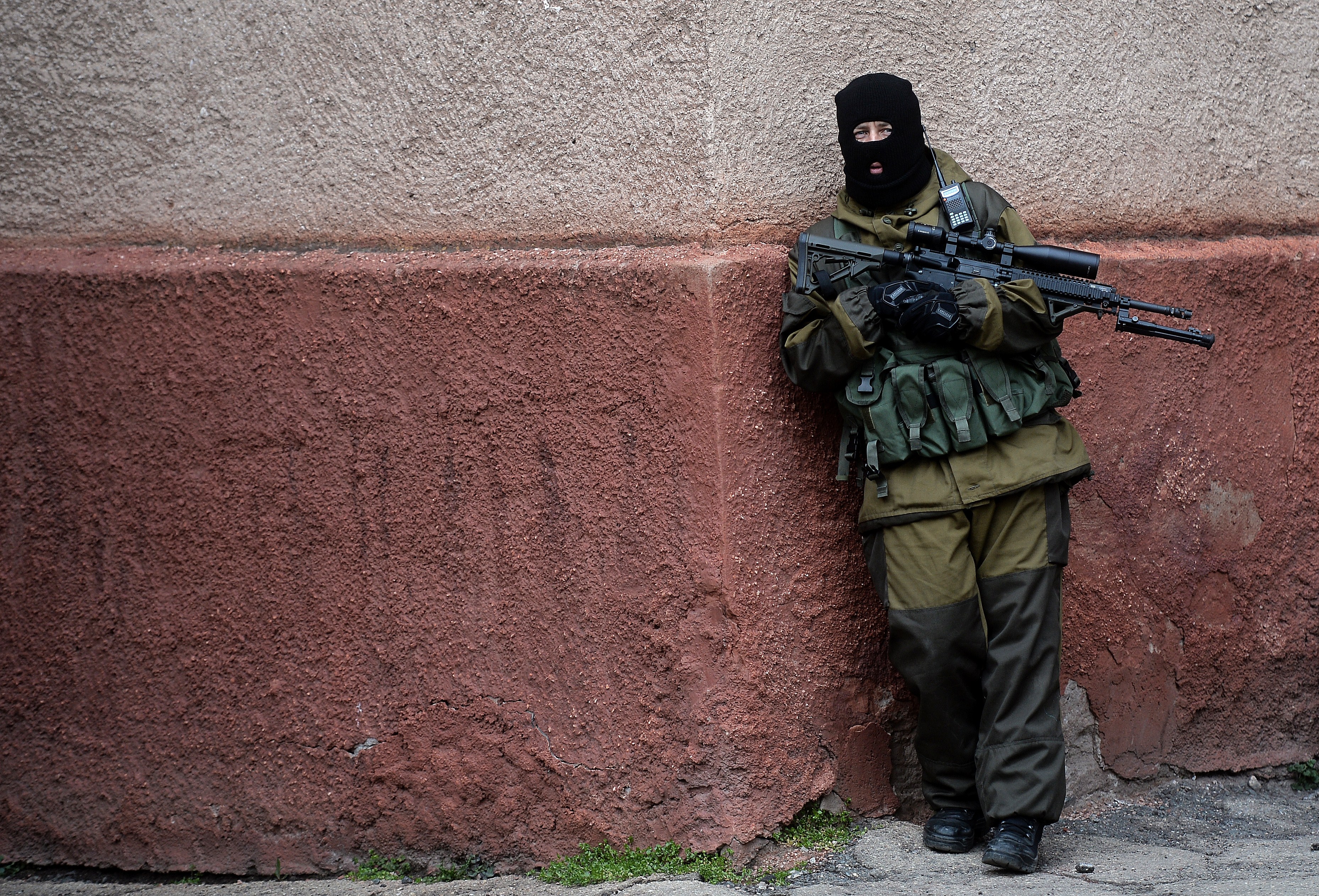
(Photo: A member of the new pro-Russian forces dubbed the ‘military forces of the autonomous republic of Crimea’ stands guard in the Republican military enlistment complex in Simferopol on March 10, 2014. Crimea’s pro-Russian authorities sought to boost their claim to break from Ukraine Monday as volunteer soldiers swore an oath of allegiance in front of prime minister Sergei Aksyonov. He told journalists 186 volunteers had so far joined the new Crimean ‘self-defence’ units after pro-Moscow forces took power in the region and announced their intention to join with Russia, with a referendum planned for Sunday. By Filippo Monteforte/AFP/Getty Images)
 The Dish