Joe McGinniss, RIP


Joe McGinnis was responsible not only for several books that are rightly understood as landmarks of journalism – he was also the case study of arguably the most famous essay about journalism, Janet Malcolm’s “The Journalist and the Murderer.” He was a deeply curious and ferociously independent writer, compelled by the minutiae of the human comedy and riveted by the depths  of human tragedy. I think of him as some kind of eternal, unstoppable foe for Roger Ailes, whose media campaign for Nixon in 1968 presaged so much of what was to come – and still reins supreme – at Fox News. And yet Ailes and Joe were extremely close friends their entire lives and Joe would defend him – if not his network or politics – tenaciously as the years went by. That was how Joe was. Once he loved you, he loved you. And I was blessed by some of that love.

SellingofthePresident-resiz

It’s not an exaggeration to say that Joe – at the tender age of 26! – transformed political journalism with The Selling Of The President, the legendary expose of the cynicism of media optics in presidential campaigns – and, by the by, a lovely, ornery rebuke to the magisterial tomes of Theodore H White, as Ann Althouse notes. And the first thing to say is that the man could write. He couldn’t write a bad sentence. His narratives powered along; his prose as clear as it was vivid; his innate skill at telling a story sometimes reaching rare moments in non-fiction when you’re lost in what is, in effect, a factual novel.

But what I truly treasured about Joe – and I came to love him even though we only met a couple of times – was his dogged imperviousness to his peers or to establishment opinion. If he smelled a story, he would dig in, obsessively recovering its human truth. If others thought the story was irrelevant or non-existent, it wouldn’t affect him. His motivation, as it was with his first book, was to peel back the layers of image and propaganda and spin to reveal the reality. He did this with Jeffrey McDonald. And he did it with Sarah Palin.

Of course, we bonded over the former half-term governor. He reached out to me when I was wildly exposed among journalists for refusing to believe her stories at face value. And what we bonded over was not a mutual revulsion at her politics. What we bonded over was the abject failure of the American press to say what had to be said about this preposterous, delusional maniac plucked from deserved obscurity by John McCain to be a heartbeat away from a potential presidency.

Her candidacy was a total farce; a disgrace; an outrage to American democracy; an appalling act of cynicism. Joe saw the creation of this media figure as a continuation of the Ailes recipe for optic politics, and he was appalled as so many mainstream outlets nonetheless insisted on taking this joke seriously.

So he went to do what others wouldn’t: to find the real truth about Palin, and he came closer than almost anyone.

I don’t see his last book as some kind of aberration, though it was obviously not in the same league as The Selling Of The President or Fatal Vision. I saw them all as a continuing crusade for a journalism that takes a stand, that welcomes obloquy if that’s what it takes to get to the truth, and that cares about our democracy. He would never have aimed for the “view from nowhere” or the facile mantra that one leading Washington journalist gave me when asked to explain why they hadn’t sought any proof for the fantastic Trig story that Palin spun: “Why ask questions when you know you won’t get an answer?” For Joe that was pathetic. As indeed it was.

One email I got from him that captures his tenacity and his humor:

My shrink asked me this afternoon if I thought my book was a factor in Palin’s decision not to run. I said, “It might have been. It certainly didn’t tip her toward running. She may well have seen what one lone reporter turned up in four months and realized what teams from MSM outlets might learn in twelve, as they would have done over the next year, if she’d run.”

She said, “In that case, the people of the United States will be eternally in your debt.”

I said, “Great: let’s work out a payment plan, like the ones I have with the IRS, the federal student loan agency, and American Express.”

She said, “By the way, you owe me $375: did you bring a check?”

Another, responding to this aside from me – “My cd4 count just plummeted to 350. But I’m fine”:

If I were an irreverent bastard, I’d note that this coincides with your endorsement of Ron Paul.

Romney will be the GOP nominee. If all the media energy expended on chasing phantoms were put to good use, we could stop importing foreign oil.

And Obama will trounce Romney in November. As he deserves to.

And Sarah is finished. Forever.

I’ll miss him – but not as much as we will.

The View From Your Window Contest: Winner #195

vfyw_2-8

A confident reader writes:

Easy one. This is Kuala Lumpur. Looks to be near Chow Kit and very near where I used to live and work. Lovely city, shame it’s not a better photo.

Another:

Quezon City, Philippines. Just a guess, but the buildings look very familiar.

Another looks closer:

Neoclassical architecture in a somewhat rundown location … Havana? Given the new cars on the street, I’m probably way, way off but I can’t think of another location that fits the bill. A tough one this week! Kudos to the reader who figures it out …

This week our hats are off to the small handful of readers who even ventured a guess. In fact, this might have been our most difficult contest yet. Another reader noticed an architectural hint of Italy:

I saw this and I thought: Porticos! Bologna! But Bologna (at least the parts I was in) didn’t look this drab and industrial. And these porticos don’t look like Bologna’s … but I thought I’d give a shout-out to Bologna anyway for being so stupendously endowed with 23 miles of porticos. (Are porticos the feminine opposite of masculine towers and spires? I get big domes as the outward opposite … maybe porticos are the inner opposite? People do a lot of socializing in them … )

Another must be joking:

That’s Nahant as viewed from Kelly’s Roast Beef on Revere Beach, MA.

This one definitely is:

Hell on Earth, Hades.

Other readers went south of the border:

Tall cactus, Spanish-style roof, Spanish language sign on the wall (Prohibido Fumar?), Catholic-style church, DirectTv satellite dish all point to Mexico, but I can’t home in on anything closer than this. So let’s go with Oaxaca, because it’s fun to say.

Two others guessed Mexico:

For no particular reason, I’m guessing Mexico. And I would like to propose a new sub-category for your contest: The Ugliest Building. I nominate that monstrosity in the left foreground. I hope someone found a way to stop the designer before he or she had a chance to work on a second building.

And:

Some churches get photographed a lot.  Take for example the little blue-domed jewel on the Isle of Santorini that shows up everywhere. The church in this week’s contest – not so much. While searching I did find this incredible mid-century monstrosity from Oklahoma City:

church-of-tomorrow

Now that’s a church I would have grooved to as a 10-year-old skeptic. As for this week, a semi-informed guess puts this somewhere in Latin America. A wild guess puts it in Aguascalientes, Mexico.

Latin America is right, and Mexico was the closest incorrect guess. A frustrated reader at least gets the right continent:

Fuck this shit. Twenty hours I’ve been at it, including a laborious wiki-google tour of every cathedral in Brazil, and I’m still not even sure I have the right continent. I’m going with São Paulo because they get DirectTV there, they’re big into roof-mounted radio antennas, and I found one (1) streetlight on Street View that matches the one on that utility pole. But who knows. This morning’s failed waking brainwave – a search for “ugliest cathedral” – was my official last gasp.

Only two readers even guessed the correct country, city, or address. One of them, naturally, was Grand Champion Chini:

Now this is a bit more like it. Though it was pretty obvious that we were dealing with South America, I had to overcome a personal misconception to get to the right spot. See, my only previous encounter with this week’s city was in Vonnegut’s Galapagos, a book which gave me the unfortunate impression of a much smaller town. As a result, I spent far too much time down in Argentina, when I should have been looking far to the north.

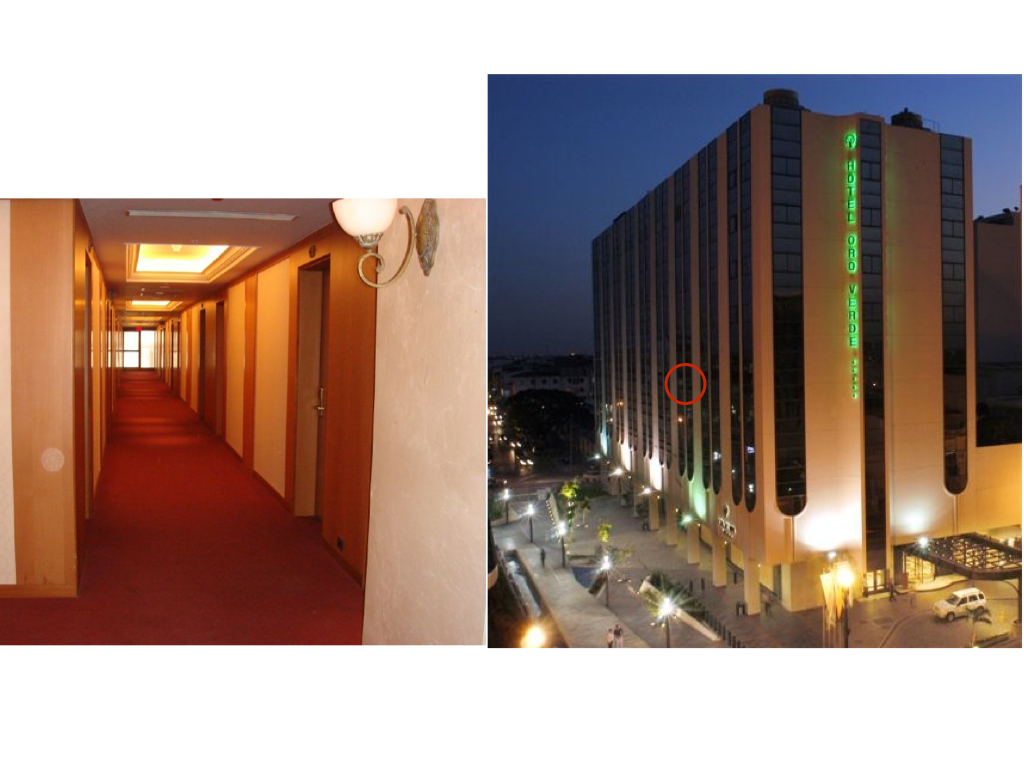
This week’s view comes from Guayaquil, Ecuador. The view looks southeast along a heading of 147.87 degrees, probably from a room on the 4th floor of the Hotel Oro Verde, perhaps room 406. A view of the actual window and a marked bird’s eye shot:

VFYW-Bird's-Eye-Far-Guayaquil-Marked---Copy

Here’s the original shot with the Edificio Forum and the Iglesia de la Victoria inserted:

VFYW Guayaquil Inserts Marked - Copy

But Chini won long ago, so here’s the winning entry:

Searching all over Latin America for last week’s contest (Medellín) paid dividends this week. After identifying the top of a San Pedro or Peruvian Torch cactus at the bottom of the photo and seeing all the AC units and open air arcades on nearby buildings, South/Latin America seemed like a good place to start. The shape of license plates on the many visible cars confirmed South/Latin America instead of the US or Southeastern Europe. A satellite dish on the nearest building indicated cardinal direction and rough latitude.

The primary architectural clue is the domed church in the distance. Latin America is full of these. A few searches IDed this one as Iglesia La Victoria in Guayaquil, Ecuador:

fig1

From there it took some Google Maps surfing to identify the tall, beige highrise with the rooftop radio tower, and from there the location of the photo: Hotel Oro Verde, next door to the (former?) US Consulate:

fig2

Hotel Oro Verde has online reviews with photos that confirm it as the window’s location:

fig3

Judging the room number is once more an educated guessing game. Based on analysis of sight lines, the estimated height of neighboring buildings:

fig4

From a photo of the hotel’s hallway, and assuming that floor numbers start with 0 in Ecuador, I submit that the room number is 512 or 513, depending on whether even or odd numbers are on the east or west side of the building:

fig5

Impressive entry! From the photo’s submitter:

I’m a 51-year-old US citizen doing my culinary externship in Ecuador. Finally I’m somewhere with a VFYW! This was taken from room 416 of the Oro Verde hotel in Guayaquil, Ecuador. So glad to have your site to keep me up to date while I’m away. I’m a proud (founding, I believe) subscriber. You and your team rock!

(Archive)

Is The ACA Helping The Uninsured?

Uninsured

Drum is encouraged by Gallup’s latest polling:

The CBO estimates that the number of uninsured will drop by 4-5 percentage points in 2014 thanks to Obamacare. If you use 2011-12 as an approximate baseline, Gallup reports a drop of about 1.5 percentage points through February. These numbers probably aren’t precisely comparable, but they represent a ballpark—and it doesn’t look like a statistical fluke anymore.

Against it have to be arrayed other surveys suggesting that the uninsured form a much smaller proportion of Obamacare patients than anyone might have hoped for:

Only one in 10 uninsured people who qualify for private plans through the new marketplaces enrolled as of last month, one of the surveys shows. The other found that about half of uninsured adults have looked for information on the online exchanges or planned to look.

To my mind, if those numbers pan out, it would be a devastating result for the law. For a new law this disruptive to fail to reduce significantly the numbers of uninsured is a pretty fundamental indictment. The trouble is: we don’t really know for sure yet, and all these surveys may be misleading. Jon Cohn is appropriately cautious about the Gallup numbers:

It’s a sign of progress, but only a sign.

Gallup is probably the best available source for real-time data on the uninsured rate. And the pattern Gallup detected—unusually large increases in coverage among African-Americans and Latinos—would be consistent with a program that benefits low-income groups the most. But Gallup’s survey is not as reliable as the big government surveys on the uninsured, which won’t be available until next year. In addition, the Gallup data for last year, 2013, shows a very strange pattern, with the uninsured rate spiking to 18 percent in the middle of the year for no apparent reason. That makes it hard to be certain exactly what’s happening right now.

Philip Klein puts the numbers in perspective:

It’s possible that people who were losing insurance as a result of changes in the law last year have been shifting to new plans on the Obamacare exchanges — which would still be consistent with the theory that Obamacare hasn’t made major gains among the long-term uninsured.

Additionally, taking the longer view, the 15.9 percent rate isn’t historically that low. Measured monthly, the uninsured rate had been as low as 15.9 percent in early 2011. In 2008, the year Obama campaigned for president promising universal health insurance, the uninsured rate was consistently below its current rate, reaching a low of 14.4 percent quarterly and a monthly low of 13.9 percent.

Bernstein’s bottom line:

It would be great if we could get a definitive “Obamacare works!” or “Obamacare failed!” But things don’t work that way. Even when we get a lot more information, researchers are going to argue about exactly what is going well or badly, and by how much.

So, yes, Democrats have something to be optimistic about today. Beyond that, there’s only one thing we can say with any certainty: Anyone who says that health-care reform has already proven to be a solid success or a total failure is talking through their partisan hat.

The Christianist Closet? Ctd

A reader writes:

I wholeheartedly second your critical views on the spurious claims of oppression and religious persecution coming from Christian opponents of same-sex marriage, like Dreher, who don’t happen to share the evolving views of the majority of the society. He wrote:

I had a conversation with a man who is probably the most accomplished and credentialed legal scholar I’ve ever met, someone who is part of this country’s law elite. The fact that I can’t identify him here, or get into specifics of what he told me, indicates something important about the climate within law circles around this issue. On this issue, he lives in the closet, so to speak, within his professional circles, and explained to me why it has become too dangerous to take a traditionalist stand in law circles, unless one is prepared to sabotage one’s career.

To be persecuted or oppressed, there has to be some one or something doing the persecution or oppressing. But he cites no action taken by any other party – such as the guy’s employer, his colleagues, the state, or anyone else – that in any way constitutes real persecution or oppression. All he cites is this particular individuals’ own personal feeling of discomfort and unease with the growing unpopularity of his personal views on the subject. I’m sorry, but that’s just life in a free, democratic, pluralistic society where public opinion, politics and the law are constantly evolving, along with the rough and tumble of discourse in the public square.

Another adds, “One has to look no further than the email from your reader about his tragic health issues after being fired for being gay to know why this whining from Rod Dreher is total crap.”

What I found striking was the ferocious emotional fervor behind Rod’s complaint – even directed toward me, who’s about as pro-religious freedom and anti-victimology as you’ll get in the gay world. The best way I can think of explaining it is Rod’s and others’ pain at being deemed by their homophobophobiapeers as some version of Bull Connor, when their perspective is much more nuanced and complicated than that. Sure, some opponents of same-sex marriage are lazy bigots. But some are traditional Christians who simply find the whole concept impossible to square with their existing convictions about marriage and sex. Some are just leery of excessive change. Some worry about unintended consequences. Some are just embarrassed by the whole thing and want it to go away. If the gay community ignores this, and rhetorically bludgeons all our opponents into the simple rubric of “bigots” or “haters”, we truly are engaging in a reverse prejudice of our own.

At the same time, of course, so many of those in favor of marriage equality, especially among the young, simply cannot fathom how someone can rationally be against it. It’s civil marriage, after all. Traditional Christians have long since gotten used to civil divorce. And so the new gay-inclusive majority is placing enormous psychological pressure on Rod and others. The next generation is demanding a reason for the resistance to civil equality for gays – and they cannot get one that makes any sense to them. Absent that, what are they going to believe? Of course they’re going to assume prejudice unless someone comes up with a very good reason for his or her position, especially when they use words like “bully” – a calculated attempt to push back against anti-bullying campaigns in high schools.

That’s why I recommended that Christianists go aggressively into the culture to make the positive case for exclusively procreative heterosexual marriage, and try to explain why preventing gay couples from having basic legal protections would be so terrible. My hunch is that Rod knows this would fail. The Pope hasn’t even been able to convince Catholics of Humanae Vitae. What hope for the heathens? And so the bigot label would stick. And Rod certainly doesn’t subjectively feel like a bigot, and objectively is not with respect to gay friends and acquaintances, as I can attest. So he’s lashing out.

Another reader:

Apart from the complaints of “I’m being persecuted!” (which are a little hard to swallow given that Christianists are successfully pushing and passing legislation that would exempt them from anti-discrimination laws), the complaint here seems to be that those on the side of marriage equality are not willing to listen to their intelligent, principled arguments against same-sex marriage. The truth is that people on side of equal rights are still waiting for such an argument.

Let’s look at Prop 8 in California. The ballot measure won originally because the right repeated the same lies about LGBT people and the LGBT rights movement over and over: child abuse! teaching about homosexual sex in the classroom! won’t somebody think of the children! When asked to provide arguments supporting their position in court, they couldn’t, to the point where their attorney admitted as much. Aside from “the Bible says so!”, the Christianists have nothing.

The case of the accomplished legal scholar in the excerpt from Dreher’s post seems to be more a case of professional censure because of a piss-poor argument. This legal scholar feels he is unable to stand up in a group of his peers and … what, exactly? Revisit the arguments that the Christianist right have been making in court? Announce that he believes same-sex marriage is wrong because the Bible says so? If that’s his position, then I think it’s perfectly appropriate that his peers would criticize his position and (probably) wonder about the fitness of an attorney who clings to such a position in spite of the merits of the arguments for and against. If, for example, I hired an attorney to represent me, and he did all his research, considered all the arguments for and against, then showed up in court and made the kind of arguments that the proponents did in the Prop 8 case, I think that I (as a client) would have very good reason to question his competence (and quite possibly grounds for a malpractice suit).

Another:

Reading your reaction to Dreher’s rant, a thought came to my mind that I have pondered often. I agree that many (most?) Christians who disapprove of same-sex marriage are probably not motivated by bigotry, at least not the kind of furious bigotry exhibited by, e.g. white supremacists towards racial minorities. But it astonishes me that Dreher can’t understand why people would be appalled at anti-equality attitudes.  He may think it’s just people adhering to their religious faith, but to people like me (pro-equality), those attitudes exhibit a lack of self reflection and empathy that I find disturbing in otherwise intelligent people.

Look, the biblical commands against homosexuality are a few lines in a book that otherwise talks mostly about the proper way to sacrifice beasts, and yet the Christianists are constantly harping on the topic as if the primary focus of Christian belief is some weird and futile goal to eradicate homosexuality. So no, if a colleague tells me that she’s opposed to same-sex marriage on the basis of her religious beliefs, I’m not going to assume that she’s a bigot, but I am going to think her to be hidebound, unreflecting, and a blind adherent to an ideology that she hasn’t bothered to really try to understand. It’s not enough that there are a few lines in the Old Testament to support systemic social injustice against millions of people.

(Image: Memegenerator)

The Newest Voters Lean Right?

John Sides examines polling on millennials:

Lurking within this broad category of millennials is a group that isn’t quite as keen on liberalism, Democrats, or President Obama: Millennials who actually entered the electorate during the Obama presidency. These youngest millennials may yet demonstrate why it is dangerous to assume that subsequent generations will be loyal Democrats. …

Among self-reported voters who were 18 years old in 2012, Mitt Romney, not Obama, won the majority: 57 percent.  Romney also won 59 percent among 19-year-olds, and 54 percent among 20-year-olds.  These youngest voters of 2012 had entered the electorate in 2010-2012, when Obama’s popularity was much lower than the high point of his inauguration.  Only among “the oldest of the youngest” — 21-year-olds, whose political memories would have been forged during Obama’s first year in office and perhaps during his first presidential campaign — did Obama win a clear majority (75 percent).

Interview Of The Day

The president sits between two ferns:

This embed is invalid

https://twitter.com/jetpack/status/443370822280179712

I thought it came off about as well as it could have. The denouement is priceless and the vibe very Millennial. Poniewozik’s thoughts on the exchange:

It’s the tone of the comedy as much as the online medium that really targets the young audience Obama is pitching to here. There’s a cringe-humor generation gap; if you’re over a certain age, or simply haven’t watched much of a certain kind of contemporary comedy, you’ll probably watch it thinking that the segment is bombing and Obama is getting legitimately angry. But it’s a good fit for Obama’s sense of humor, which is a little dry and a little cutting–in ways that don’t always play in rooms when there are no ferns present. Remember “You’re likeable enough, Hillary”?

Curing The GOP’s Colorblindness

Michael Brendan Dougherty recommends that Republicans change how they talk about race:

Conservatives in the GOP like to assail identity politics and tout their own ideology as one of color-blindness. Sometimes this is stupidly marketed to black voters as a selling point for Republicans. “We don’t categorize you by race,” brags a Republican. The black audience hears: “We don’t take the most salient part of your American political identity seriously.”

Some reasons Republicans should care about black voters:

First because it’s just the right thing to do; black Americans deserve more competition for their vote than they are getting. Secondly, in the America that is being shaped by a new great wave of immigration, black Americans stand to lose even their precarious place in the American polity, to be kicked down to the bottom of an even more racially stratified society. Conservatism provides a natural vocabulary and political direction for communities that feel like they are losing their place. Thirdly, the GOP desperately needs to win votes in cities where the party is practically absent. And improving its margin among blacks in the South will do a lot to keep those states solidly red.

Why Run Against Obamacare?

Last week, Sargent flagged a poll finding that “Obamacare is mostly a wash” politically:

[B]arely more than a third (36 percent) say support for Obamacare would make it less likely they vote for a candidate, versus 34 percent who say “more likely.” This is overwhelmingly driven by Republicans: 70 percent of them say “less likely,” while only 35 percent of independents say the same, and moderates say they’d be marginally more likely by 35-31.

Beutler’s theory about why Republicans campaign strongly against the ACA regardless:

The Republicans are going to make gains in the Senate this cycle almost no matter what. If you’re a Republican and you know that in advance, the smart thing to do is treat a single issue as if it’s the decisive one of the campaign, everywhere, in every race. That way when it’s over you can argue that the voters vindicated your position, even if they didn’t. You can claim a mandate, even if one doesn’t exist. And you can safely bet that the political media will swallow it whole.

Red, White, And Halloo

Although “Hi!” may be “the quintessential American word,” it turns out that “Hello!” also has a distinctively American history:

The real ancestry of Hello is Halloo and its variants, a shout to get attention. The Oxford English Dictionary has an example from Daniel Defoe’s Journal of the Plague Year in 1722: “I halloo, and call to them till I make them hear.” Hello is just a milder form of Halloo. And we say it thanks to the sensational electronic innovation of the 1870s, the telephone, first demonstrated to the public by Alexander Graham Bell in 1876 at the Centennial Exhibition in Philadelphia. As telephones and telephone exchanges came into commercial use, the question arose: How do you get the operator’s attention? Alexander Graham Bell proposed Ahoy, but Thomas Edison, who set up the first telephone exchanges, had the last word. He wrote to a colleague in 1877, “I don’t think we shall need a call bell as Hello! can be heard 10 to 20 feet away. What do you think?” So Hello it was. That was just for telephones, of course, and at first few people had them. But by the end of the 19th century, telephones were everywhere, along with Hello.