Whither Now, Crimea?

Jeremy Lott expects the peninsula’s referendum on annexation to Russia to pass:

You don’t have to buy Russian President Vladimir Putin’s public spin this was a far right coup to see why most residents of the Crimea might prefer the stability and familiar corruption of Russia to the protests and uncertainty of the Ukraine.

Russia was able to take the Crimea without firing a shot. The military has been able to hold it so far with only warning shots because Turchinov’s government is disorganized and torn. It is unwilling to risk a wider war over this pariah region, and this reluctance is only bolstering Russia’s claim.

It’s hard to gauge the sentiments of an occupied people, but many locals have spontaneously told reporters they are not unhappy with the outcome. “If the Russians weren’t here, the government of Ukraine would come and occupy us,” retired stage actor Vladimir Sukhenko told the AP. “They would make us speak Ukrainian.”

But Tomila Lankina believes the Crimeans might come to regret it:

The first point to note is that given Crimea’s strategic importance for Russia, the region is, and is very likely to remain, heavily militarized. Russian federal legislation has special provisions for governance of localities with substantial military, scientific, or strategic significance.

These entities are referred to as science cities, “Naukogrady,” closed territorial formations (Zakrytoe administratvno-territorial’noe obrazovanie), or closed military towns (Zakrytye voennye gorodki).  The Crimea and its municipalities with particular strategic significance are therefore likely to be subject to some form of direct administration or, at the very least, high levels of de facto central control over their politics and governance.

Ian Bremmer does some math and wonders whether the region is worth fighting for:

Between balancing Crimea’s budget and fulfilling its pension obligations, Ukraine shells out $1.1 billion a year to prop up its southern peninsula. And that’s not including the $3 billion investment Crimea needs to repair its crumbling infrastructure. This is all for a region with a gross product of around $4 billion—just 0.2 percent the size of Russia’s $2 trillion economy.

Posner argues that if Crimea secedes, it won’t violate international law:

Ukraine could certainly try to stop its territory from seceding–just as the United States fought to prevent the South from seceding–but if it fails, it can’t complain that the secession violates international law. Ukraine’s best argument is that the secession was driven by Russian meddling–Russia’s invasion of Crimea did violate international law, and the occupation violates Ukraine’s sovereignty. But if the referendum is free and fair, that argument will lose much of its force. Perhaps, Ukraine is owed some remedy by Russia (good luck), but that remedy could not be an injunction on Crimean secession, which would injure the Crimeans themselves.

Ilya Somin counters:

I am sympathetic to this view myself.

But even this relatively expansive vision of secession rights is not enough to justify what may soon happen in Crimea. The reason is that Crimean secession for the purpose of joining Russia is likely to result in human rights violations. It is safe to assume that Russian rule in Crimea will be at least as oppressive as it now is in Russia itself. And that rule has included numerous severe violations of human rights, including censorship of opposition speech, intimidation and imprisonment of dissidents, and persecution of gays and lesbians, among others. Vladimir Putin has ruled Russia exactly as one would expect from a former KGB officer. There is no reason to believe that he would rule Crimea any differently.

As for the rest of eastern Ukraine, Ralph S. Clem points out that it is unlikely to follow Crimea’s path:

Owing to a surge of ethnic Russian in-migration before and after World War II and population losses among Ukrainians and many of the ethnic minorities (in particular Jews and Crimean Tatars) in the interwar and World War II periods, the proportion of Russians in the oblasts of eastern Ukraine increased. Figures from the last Soviet census in 1989 reveal that the ethnic Russian component of eastern Ukraine’s population had increased to 36 percent; again, the lure was primarily jobs in the rapidly expanding coal and metallurgical complexes in the region. The ethnic Ukrainian share for eastern Ukraine dropped to 58 percent over this period. Importantly however, the first post-Soviet census count in Ukraine in 2001 showed a dramatic decrease in the number of ethnic Russians in eastern Ukraine — probably through a combination of low natural increase and changing self-identification from Russian to Ukrainian — and a growth in the numbers of Ukrainians, such that the Russian proportion of the region’s population dropped to just under 30 percent and the Ukrainian share grew to 66 percent. Thus, since independence, eastern Ukraine has become more Ukrainian.
Rand Paul, The GOP, And The Young

Molly Ball captures the atmosphere at CPAC during Rand Paul’s speech:

Though CPAC draws right-wingers of all stripes, from Oliver North to Santorum to a guy on stilts in a Ronald Reagan costume, it is increasingly dominated by libertarians, a combined result of their passionate engagement in movement politics and the discount rates the conference offers to college students. That makes it, for Paul, something of a hometown crowd. On Saturday, he won the conference’s straw poll in a landslide. The enormous ballroom at the convention center in the Washington suburbs was crammed with an audience of thousands for his speech on Friday, which Paul devoted exclusively to civil-liberties issues.

Jonathan Coppage recaps the speech:

Paul castigated a progressive majoritarianism run amok, whose free-floating definition of legitimacy puts all minorities at risk, whether the racial minorities persecuted in generations past, or minorities of ideas at risk in the present day. He made frequent reference to his fight against the security state’s overreaches, and insisted upon the imperative importance of specific warrants and open, free trials instead of general warrants and secret determinations of guilt. Finally, Paul closed on a muscular message rejecting the gradualist’s insistence on a hesitant program of changes, telling the CPAC crowd that their job is not to minimize liberty lost, but to maximize liberty.

I find myself wanting Paul to go the distance in the 2016 primaries. No, that’s not because I want Clinton to win (if she’s the Democratic nominee). It’s because Paul would facilitate a younger demographic for Republicans, and that can only be good – for the GOP and the rest of us.

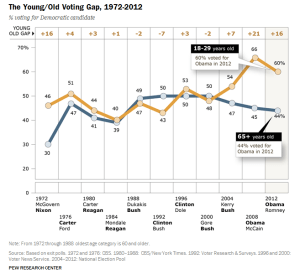
Perhaps the most crippling disadvantage the GOP now has is its dependence on seniors for political clout. We know just how divergent Screen Shot 2014-03-10 at 12.38.49 PMtoday’s generations are – to such an extent that they are effectively foreign countries to each other. 61 percent of Millennials are white, compared with over 80 percent for the pre-boomers – creating an entirely different rite of passage into adulthood. 26 percent are married, compared with 65 percent of pre-boomers and 48 percent of boomers. Millennials have far less trust in institutions, including political parties, and on social issues, Millennials are far more libertarian than their elders: marriage equality is simply a given for them, and legalizing weed a no-brainer.

On current trends, the GOP has close to no chance of winning over this demographic unless it loses its discomfort with non-whites and gays, if it pledges a re-run of George W Bush’s foreign policy, if it keeps championing the war on drugs, or the surveillance state. The widening generational gap between the parties is already unprecedented in modern times. And one segment of the voters is dying, and the other is gaining strength. Unless the GOP manages to find a way to re-brand itself with the next generation, it is facing an existence on life-support – and each pandering message to the Fox News demo will only serve to alienate Millennials.

Rand Paul is one answer to this. If he were to run against the archetypal boomer, Hillary Clinton, around the themes of individual liberty at home and non-interventionism abroad, he could immediately put the GOP on the Millennial side of this generational struggle. Even if he were crushed by Clinton, the GOP’s image would be re-made in a way much more attractive to the under-30s.

His main problem, it seems to me, is racial.

The libertarian position on the Civil Rights Act, while bracing as an intellectual critique of expansive government, is nonetheless toxic to the next generation. Ditto the Republican base’s view on immigration. And there is the problem of the unbearable whiteness of the Libertarian coalition:

A poll released by the Public Religion Research Institute in October 2013 showed that 22 percent of Americans consider themselves libertarian or lean libertarian. Forty-five percent of libertarians side with Republicans, while 5 percent identify as Democrats. Fifty-three percent of libertarians consider themselves reliable primary voters. … As Claire Thompson noted in February 2012, self-described libertarians trend “white, male, and financially secure.” Which happens to be how much of the party writ large trends. If they can only keep the twentysomethings that look like them on board, the Republican Party is going to continue to attract fewer and fewer members of the electorate. Libertarians may grow, but right now, trending toward the Rand model doesn’t seem the safest outreach.

Here’s Michelle Cottle’s take on Paul’s speech:

Ironically, despite all the love, Rand didn’t bring his A game. He was hoarse, he looked tired, and his speech (basic theme: government tyranny is bad) wasn’t particularly soaring. Not that he is ever a really electrifying orator. He tends toward the wonky, goes heavy on historical references, and likes to quote folks like Montesquieu.

But nobody cared. The crowd loved him. These were his people, and they were whooping and hollering and chanting and fist-pumping like it was Saturday night at the roller derby. By the time Rand wrapped it all up by calling on the crowd to “Stand with me! Stand together for liberty!” at least half the room would have followed him down to the gates of hell if he’d asked.

If I were among the conservative movement’s values voters or hawks, I’d be getting mighty nervous right about now.

And if I were a Republican, I’d be feeling a few twinges of hope.

Quote For The Day

RUSSIA-UKRAINE-POLITICS-UNREST

“All the important is yet to come. We do not expect a quick victory. Everything is to be paid for. Now we are witnesses of a birth of a new political reality, that is why everything acquires a special significance. This is not a technical enterprise, not a bargain. This is history itself. The struggle for Ukraine – is a struggle for reunification of Slavic peoples. Today it is clear that this reunion should be geographically different. Galicia and a number pro-western areas, and as well a large part of Kiev do not strive to Unity. We understand that. We won’t drag anyone by force. But we will not leave nor betray ours. However, for everything you have to fight and struggle to create a new political and historical reality …

If we win, we will begin the expansion of liberational (from Americans) ideology into Europe. It is the goal of full Eurasianism – Europe from Lisbon to Vladivostok. Great Eurasian Continental Empire. And we will build it. This means European Revolution will be Eurasian Revolution. This is our last horizon,” – Alexander Dugin, one of Vladimir Putin’s favorite polemicists. 

More on Dugin here.

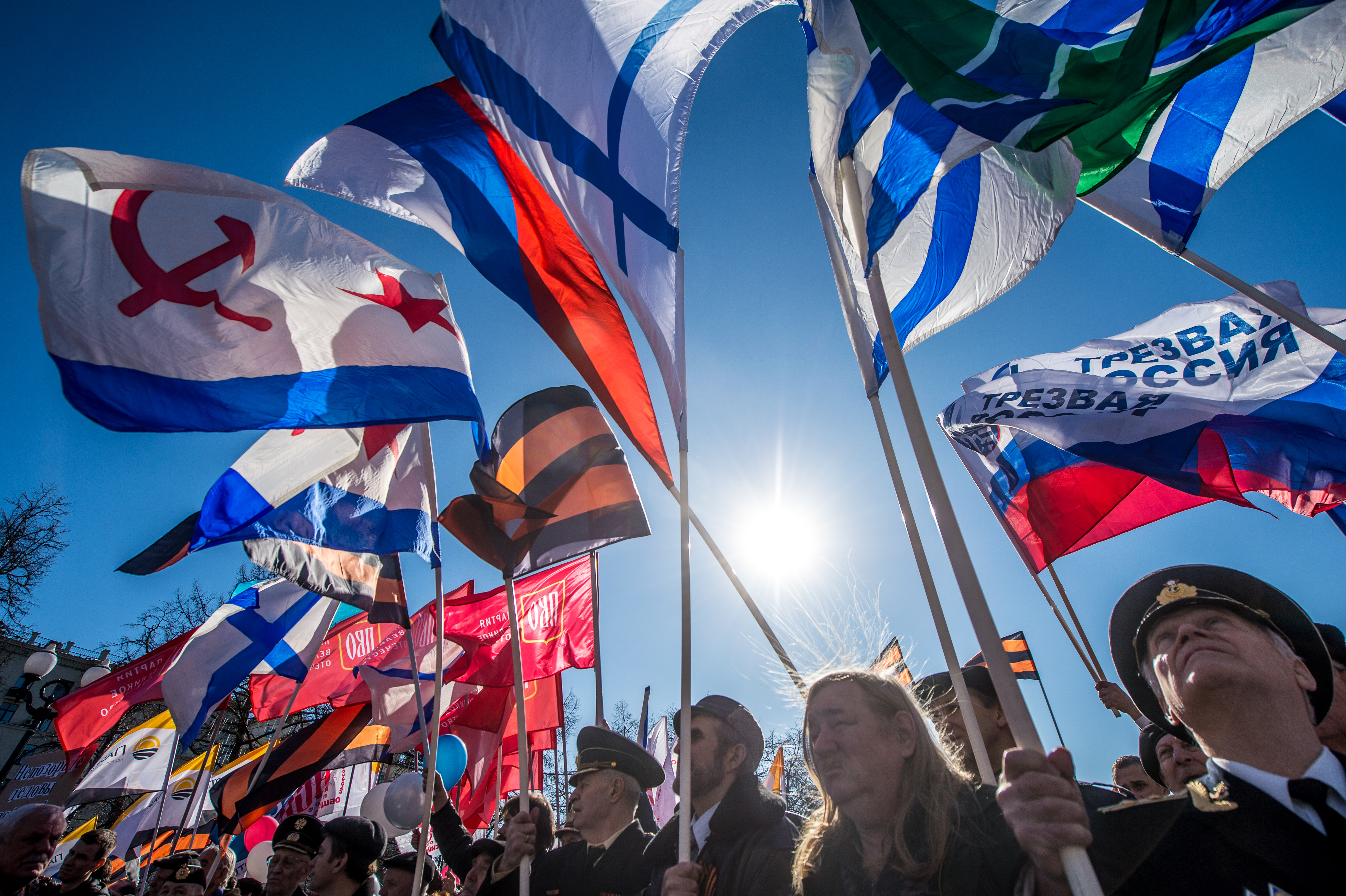
(Photo: Pro-Kremlin activists hold Russian national, Russian and Soviet naval flags and orange-black flags made of the St. George’s Ribbons, a well-known Russian symbol of military valor, during a rally in support of ethnic Russians in Ukraine in central Moscow, on March 10, 2014. By Dmitry Serebryakov/AFP/Getty Images.)

Sanctions For Sanctions’ Sake

Fred Kaplan thinks the sanctions the US imposed on Russia last week were a mistake:

[I]f Putin had been looking for some way out of this mess, he certainly wouldn’t be looking any longer, because de-escalating now would make it seem that he was backing down under Western pressure. Obama has had two long phone conversations with Putin in recent days, but as long as he insists on preconditions for renewed diplomacy (Putin must return his troops to their base, he must sit down with Ukrainian officials), Putin has no reason to comply. Russia has deeper interests in Ukraine than the West does—and more localized sources of pressure to make those interests felt.

That being the case, Putin can sit and wait. He has the upper hand in this game—and the more the West plays on his terms, the stronger his hand will seem. Sanctions won’t change his behavior, except to stiffen it—and once that becomes clear, Putin will seem stronger, the West will seem weaker, and a solution to the Ukraine crisis will recede in the distance.

Larison questions the utility of sanctions:

In general, trying to bludgeon another government into changing its behavior very rarely achieves anything positive, and the danger in trying this against a larger power is that it could then retaliate with punitive measures of its own. That would make the crisis harder to resolve and inflict damage on Western economies in the process, which would in turn spur demands for still harsher measures. Russia is already threatening to block inspections for the current arms reduction treaty, and it could choose to make things more difficult for the U.S. on other issues as well. Many Westerners seem very eager to demand economic punishment of Russia, but I suspect very few actually want to pay the price that could be associated with it.

Drezner approaches the issue from a different angle:

The first thing to understand about sanctioning Russia over its incursion into Crimea has nothing to do with the impact of the sanctions and everything to do with what is being demanded of Moscow. The United States wants Russia to withdraw military forces from a piece of territory they have long coveted. However much Russia has contravened international law over the past week, they’ve changed the facts on the ground. They control Crimea, and public opinion in that autonomous republic is pretty Russo-friendly. The current status quo for Russia is that they control that territory. In world politics, there is no greater demand to ask of a government than to make de facto or de jure territorial concessions. The domestic and international ramifications of such a concession are massive — especially after force was used to occupy the territory. So recognize that the demand being attached to the sanctions is so large that success is extremely unlikely.

Drum agrees:

For my money, the biggest price Putin is paying comes not from any possible sanctions, but from the very clear message he’s now sent to bordering countries who have long been suspicious of him anyway. Yes, Putin has shown that he’s not to be trifled with. At the same time, he’s also shown every one of his neighbors that he can’t be trusted. Two mini-invasions in less than a decade is plenty to ramp up their anti-Russian sentiment to a fever pitch.

Wise or not, sanctions are the most popular course of action, a new poll finds:

While almost 59 percent of Americans do support the U.S. and its allies imposing sanctions on Russia slightly over half oppose sending economic aid to Ukraine, and over 75 percent are against sending military supplies to Ukraine.

When it comes to possible military responses to the Ukraine crisis Americans are overwhelmingly opposed, with only 12 percent of respondents saying they would support having American troops on the ground in Ukraine and 17 percent saying they would support U.S. airstrikes on Russia forces in Ukraine.

Previous Dish on sanctions here, here, and here.

Hathos Red Alert

Charles Pierce unloads on the barrel:

A friend bailed on the speech, making the very plausible case that Palin is simply another political celebrity freakshow, like Donald Trump. I can see the point there but, with Palin, and watching the hysterical reception her puerile screed received, there is something more serious going on. She is the living representation of the infantilization of American politics, a poisonous Grimm Sister telling toxic fairy tales to audiences drunk on fear, and hate and nonsense. She respects no standards but her own. She is in perpetual tantrum, railing against her betters, which is practically everyone, and volunteering for the job of avatar to the country’s reckless vandal of a political Id. It was the address of a malignant child delivered to an audience of malignant children.

Update from a reader:

My eyes actually bugged out when she said, “I do not like ‘Oh yes we can.'” Is it just me or was that a little bit of “sassy black woman” finger-snapping, head-swiveling, lip-pursing?

Another notes further:

Man, Sarah Palin even plagiarized that Dr. Seuss bullshit from an email meme that was popular three years ago.

Plus, there’s the irony that at the end of Green Eggs and Ham, the narrator does a total about-face and it turns out that he actually loves the very thing he’d just been railing against out of complete ignorance. Maybe Sarah never made it that far.

Ask Rob Thomas Anything

Rob Thomas is an American producer and screenwriter, best known as the creator of the critically-acclaimed TV series Veronica Mars and co-creator of Party Down. One year ago this week, he launched one of the most successful Kickstarter campaigns of all time in support of a Veronica Mars film (our discussion thread of the innovative, Dish-like project is here). The film is now finished and will be out in theatrical release and video-on-demand this Friday.

Let us know what you think we should ask Rob via the survey below (if you are reading on a mobile device, click here):


This embed is invalid

Has The Web Made Us Freer?

Linda Besner wonders if the promise of an Internet as a great cultural leveler – granting an audience to obscure artists as well as to the well-known and well-funded – might be wildly overstated:

In The People’s Platform, [author Astra] Taylor discusses how the supposedly open, free, and hierarchy-busting world wide web has failed to do better than a roomful of public television commissioners in encouraging the production or consumption of risky independent cultural products. In fact, it does significantly worse. Internet traffic follows a statistical pattern known as power law distribution; essentially, while there is a wide range of available options, almost everyone is crowded together at the most popular end of the spectrum. It’s a problem that’s getting worse: “In 2001, ten Web sites accounted for 31 per cent of U.S. page views,” Taylor writes, “by 2010, that number had skyrocketed to 75 percent.” Most nights, 40 per cent of the U.S.’s bandwidth is taken up by people watching Netflix movies.

In a similar vein, Dougald Hine challenges notions of the Internet as an agent of “liberation from the boredom of industrial society, a psychedelic jet-spray of information into every otherwise tedious corner of our lives”:

At best, it allows us to distract ourselves with the potentially endless deferral of clicking from one link to another. Yet sooner or later we wash up downstream in some far corner of the web, wondering where the time went. The experience of being carried on these currents is quite different to the patient, unpredictable process that leads towards meaning.

The latter requires, among other things, space for reflection – allowing what we have already absorbed to settle, waiting to see what patterns emerge. Find the corners of our lives in which we can unplug, the days on which it is possible to refuse the urgency of the inbox, the activities that will not be rushed. Switch off the infinity machine, not forever, nor because there is anything bad about it, but out of recognition of our own finitude: there is only so much information any of us can bear, and we cannot go fishing in the stream if we are drowning in it.

The Male Biological Clock, Ctd

Kathleen Goodwin summarizes a recent paper that examined how paternal age affects children:

[R]esearchers found that in a sample size of over 2.6 million, advanced paternal age has a detrimental effect on the mental health of offspring, with a greater risk for autism and attention-deficit/ hyperactivity disorder, as well as likelihood of suicide attempts and low educational attainment, even when controlling for multiple other factors.

She considers the implications:

Until now, the onus of choosing when to prioritize career and when to attempt pregnancy was ultimately a woman’s to bear. While men are undoubtedly affected by their partners’ decision to delay pregnancy and the ensuing fertility issues and health risks that accompany this decision, they were free of the worry that their aging sperm would have any negative consequences on their unborn child. Anecdotally, there are many examples of successful men have married younger women and thus been able to avoid the complications of advanced maternal age (Donald Trump comes immediately to mind—his current wife Melania Knauss-Trump is 23 years his junior and he was 59 when their son Barron was born). The publication of this study puts the age of a father into the list of factors that parents must balance when deciding to begin a family. If this study is able to be replicated with the same results and becomes part of the public health lexicon, men will be forced to consider their own age when it comes to planning their careers and choosing when to have children with their partners.

Previous Dish on the subject here.

The Most Beautiful Equation?

dish_euler

There was an objective way to find the answer:

[R]esearchers led by Semir Zeki of University College London asked 16 mathematicians to rate 60 equations on a scale ranging from “ugly” to “beautiful.” Two weeks later, the mathematicians viewed the same equations and rated them again while lying inside a functional magnetic resonance imaging (fMRI) scanner.

The scientists found that the more beautiful an equation was to the mathematician, the more activity his or her brain showed in an area called the A1 field of the medial orbitofrontal cortex. The orbitofrontal cortex is associated with emotion, and this particular region of it has shown in previous tests to be correlated with emotional responses to visual and musical beauty. …

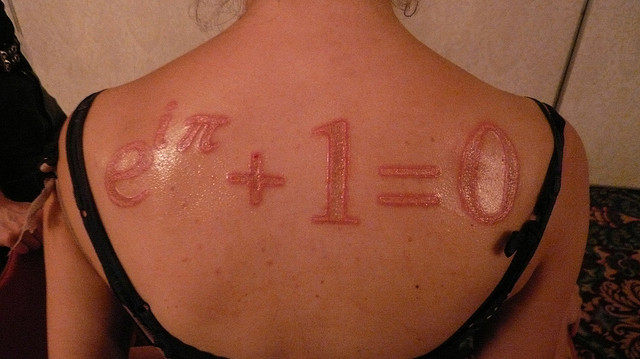
The study found … that the beauty of equations is not entirely subjective. Most of the mathematicians agreed on which equations were beautiful and which were ugly, with Euler’s identity, 1+e=0, consistently rated the most attractive equation in the lot. “Here are these three fundamental numbers, epi and i,” [mathematician Colin] Adams says, “all defined independently and all critically important in their own way, and suddenly you have this relationship between them encompassed in this equation that has a grand total of seven symbols in it? It is dumbfounding.”

(Image of Euler’s Identity scarification via Flickr user gruntzooki)