Photographer Hiroshi Watanabe captures Japanese theater traditions:
Particularly interested in forms of theatricality, Watanabe sought to capture individual performers within the traditions of Sarumawashi, Noh, Ena Bunraku and Kabuki. Stylized human actors, monkeys, masks and puppets become the subject matter of Watanabe’s striking and powerful photographs. Though the traditions come from different regions and periods of history, they are tied together by Watanabe’s eye.
A 2009 profile quoted Watanabe’s philosophy of photography:
I don’t want to tell the viewer what to see. I believe in subtlety. I don’t believe in barking at the viewer. Of course it is my vision, but this is what I think is perfect about photography; it is flexible but also subtle… There is always an element that appears in the final frame, it can be very small but if you look closely you can find it. I challenge the viewer to find what I see. If they really look at the expressions, poses and the composition, they will really find something intriguing both visually and socially.
Thinking through the question of when creative influence becomes plagiarism, Rachel Hodin comes to this conclusion: “All we can say for sure is that it’s not only fair to take ideas and inspiration from others, it’s necessary for the survival of art”:
As humans, we take ideas, information, and insight from others every second of our waking days, and more often than not, this process is subconscious. For this reason, we have no authority to claim the right and wrong ways of drawing influence from others; all we can do is observe, and take note. And it’s worth noting that both Hemingway and Fitzgerald were influenced by Tolstoy. Hemingway “took on board every technique that Tolstoy ever devised,” except he never took on Tolstoy’s themes when they weren’t true to him: “He could never imagine himself as a weak [man], and the idea of a strong man weakened by an emotional dependency was not within his imaginative compass.” Whereas Fitzgerald had no qualms about taking Tolstoy’s themes. And while there’s no clear answer as to why, Hemingway’s approach, when compared to Fitzgerald’s, just seems more genuine — and all the more so when you consider the fact that Fitzgerald’s writing never came close to anything Tolstoy ever wrote.
In a 2007 Harper‘s essay plumbing similar themes, Jonathan Lethem connects art to the idea of a “gift economy,” arguing against those who view “the culture as a market in which everything of value should be owned by someone or other”:
Artists and their surrogates who fall into the trap of seeking recompense for every possible second use end up attacking their own best audience members for the crime of exalting and enshrining their work. The Recording Industry Association of America prosecuting their own record-buying public makes as little sense as the novelists who bristle at autographing used copies of their books for collectors. And artists, or their heirs, who fall into the trap of attacking the collagists and satirists and digital samplers of their work are attacking the next generation of creators for the crime of being influenced, for the crime of responding with the same mixture of intoxication, resentment, lust, and glee that characterizes all artistic successors. By doing so they make the world smaller, betraying what seems to me the primary motivation for participating in the world of culture in the first place: to make the world larger.
Access to Lethem’s article is free for Dish readers this weekend, courtesy of Byliner. Related Dish on the subject here.
In an excerpt from his new biography of the late writer, Adam Begley suggests the reason why John Updike’s fiction could draw liberally from his own experiences:
Part of what allowed Updike the freedom to indulge his autobiographical impulse was his relationship with his mother, the elderly widow who tugged at Ecenbarger’s sleeve in the Shillington public library, eager to talk about her son, the famous writer. To say that Linda Grace Hoyer Updike encouraged her only child and nurtured his precocious talent is to understate and simplify an unusually close and complicated relationship. She helped him to become a writer (and he, when the time came, helped her, getting ten of her short stories published in The New Yorker), offering him yards of advice and unstinting praise from the moment he set pen to paper. She was, as he put it, “an ideally permissive writer’s mother,” meaning that he was free to write exactly what he pleased, no matter how painful to his family. When the biographer Ron Chernow, who went to see Linda Updike in Plowville in the early ’70s when he was a young journalist eager to write about Updike, asked her how it felt to pop up as a character in her son’s fiction, “she paused and said, ‘When I came upon the characterization of myself as a large, coarse country woman I was very hurt.’ She said she walked around for several days, brooding—and then she realized she was a large, coarse country woman.”
Commenting on Begley’s treatment of Updike’s 1977 novel, Marry Me, Peter Quinones notices one area where all is not revealed – Updike’s affairs:
It is, like much of Updike’s fiction, a thinly disguised account of actual events – in this case, his affair with Joyce Harrington. To me, Begley’s account of this situation alone would make his book worth reading, but it leads into another area – one that I’m sure future biographers of Updike will dive into with much gusto: Begley’s decision to let Updike’s many lovers remain anonymous, with two exceptions – the aforementioned Harrington and Martha Bernhard, who eventually became his second wife. He also chooses to let the Ipswich, Mass. couples who were the models for the Tarbox couples in Couples remain anonymous. Begley writes that he let the lovers remain unnamed in order to protect their privacy and, also, in order to encourage them to tell him about their encounters with Updike. However, there isn’t very much in the book in the way of these encounters at all, a curious turn of events. In any case, I’m willing to bet that future generations of Updike fans and researchers will want to puncture all this anonymity, whether justifiably or not. It just seems like too broad an avenue of potentially important research.
The Dish recently featured Updike’s poetry here, here, and here. Update from a reader:
I just want to thank you and the Dish staff for featuring so much John Updike lately. I’m a huge fan of the late master’s and had the honor of meeting him a few years at the Book Expo America in D.C. (where he shared the dais with a young and freshly-minted U.S. Senator named Barack Obama). Of course, because I’m me and prone to tremendous bouts of asshattery when confronted with my literary heroes, I visibly terrified the gentle and always-smiling Updike by inexplicably asking if he had read Augusten Burroughs’s essay “Killing John Updike.” Even that famous and face-creasing beatific smile of his couldn’t dispel the discomfort I’d caused him, and so I slunk away miserably, happy with my autographed copy of Terrorist and glad I didn’t get the chance to open my stupid mouth near a future U.S. president.
I used to be friendly with a kid called Sam Bamburger, whose mother was the first woman I ever heard of to get divorced. Sam was about nine at the time and up to that point something of an all-American kid, except maybe shorter and paler. He had fair hair and a small nose and the kind of face that looked either innocent or cruel. Sam played shortstop on my Little League team and had the reputation among the fathers of being a prospect—if he grew, that is. He never grew much.
Hard to say how we became friends. He lived not far from me, just the other side of Speedway, in a small corner house that overlooked a park. The park had the nearest swimming pool—nearest, I mean, to me. I used to bike there in the summer and lock my wheels against the chain-link fence that surrounded the pool. Afterwards, when I was tired of swimming, I looked around for kids to play basketball with on the court next door. Sam’s house was close enough that we could run back for a ball if no one was playing, but that can hardly be how I got to know him in the first place. I remember feeling that I didn’t have much choice in the matter—in our friendship. Maybe he took me in a game of pickup, and together we held court for an afternoon. (I was already about a head taller than Sam.) Sam liked leading; I liked winning.
Read the rest here. For more, check out Markovits’s latest novel, Childish Loves. Previous SSFSs here.
You have until noon on Tuesday to guess it. City and/or state first, then country. Please put the location in the subject heading, along with any description within the email. If no one guesses the exact location, proximity counts. Be sure to email entries to contest@andrewsullivan.com. Winner gets a free The View From Your Window book or two free gift subscriptions to the Dish. Have at it.
Michael Shermer examines research on the psychology of deception:
Psychologists Shaul Shalvi, Ori Eldar and Yoella Bereby-Meyer tested the hypothesis that people are more likely to lie when they can justify the deception to themselves in a 2013 paper entitled “Honesty Requires Time (and Lack of Justifications),” published in Psychological Science. Subjects rolled a die three times in a setup that blocked the experimenter’s view of the outcome and were instructed to report the number that came up in the first roll. (The higher the number, the more money they were paid.) Seeing the outcomes of the second and third rolls gave the participants an opportunity to justify reporting the highest number of the three; because that number had actually come up, it was a justified lie.
Some subjects had to report their answer within 20 seconds, whereas others had an unlimited amount of time. Although both groups lied, those who were given less time were more likely to do so. In a second experiment subjects rolled the die once and reported the outcome. Those who were pressed for time lied; those who had time to think told the truth. The two experiments suggest that people are more likely to lie when time is short, but when time is not a factor they lie only when they have justification to do so.
The Hudson Review is one of America’s most distinguished literary quarterlies, founded in 1948 and still one of our liveliest and best. A new book has just been published by Syracuse University Press celebrating the great poetry in translation which has appeared in the review since its inception, when the founding editors were deeply influenced by Ezra Pound.
The contents of this splendid book range from translations of Homer, Sophocles, anonymous Old and Middle English masterpieces, and Chinese Court poetry from the 8th century to work by 20th-century masters such as Anna Akhmatova, Antonio Machado, Zbigniew Herbert, and Lars Gustaffson. Today and in the days ahead, we’ll hold aloft some gems from the collection, edited by Paula Deitz and introduced by the poet Mark Jarman.
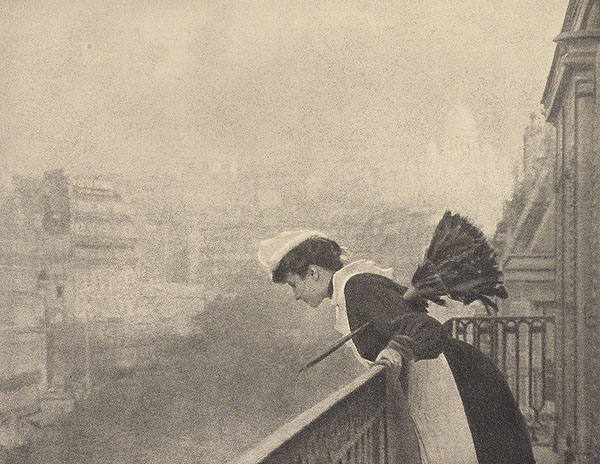
“Maids on Saturday” by Christian Morgenstern (1871-1914):
They hang them over the ledge,
The carpets large and small;
In their minds they start to beat
Up masters, one and all.
Wild with satisfaction,
In rage and berserk,
They cool their souls off for
One week full of hard work.
They beat an infernal rhythm
Until their canes split;
Ears at the front of the house
Take no account of it
But in the back are wailing,
Torn by punch and by thump,
The runners, the Persian pillows,
The eiderdown, German and plump.
A viral cancer-awareness campaign of #nomakeup selfies raised 8 million euros. Many participants were caught off-guard by the positive response to their bare faces, something that Alex Jones (not that Alex Jones) found encouraging:
[A] recent paper of mine, in press at the Quarterly Journal of Experimental Psychology, and carried at Bangor University, examined just this question. I wondered whether makeup use, like dieting or gym workout behaviours, affected perceptions of attractiveness from same and opposite sex peers. An ideal way of testing this was to examine how much makeup is considered optimally attractive. After all, if women’s ideas of what looks good to others is accurate, then everyone should find their makeup optimally attractive, right? …
The results were clear. Both women and men found faces with up to 40% less makeup than the models applied themselves the most attractive, showing a clear agreement on their opinions for cosmetics. Less was simply better. However, when they considered the preferences of others, the women and men in our study indicated that they thought other people found more cosmetics more attractive, and this was especially true when considering the preferences of other men. However, this couldn’t be further from the truth. The sample of men in our study consistently chose less makeup as more attractive, while at the same time indicating that they thought their peers would find more makeup more attractive.
Marc Bekoff, University of Colorado–Boulder professor of ecology and evolutionary biology and author ofThe Emotional Lives of Animals, believes [animals do have a funny bone]. In fact, he thinks we’re on the cusp of discovering that many animals have a sense of humor, maybe even all mammals. The idea that animals can appreciate comedy isn’t as far-fetched as it sounds, considering some of the other groundbreaking discoveries scientists like Bekoff are making about animal behavior: They have found dogs that understand unfairness, spiders that display different temperaments, and bees that can be trained to be pessimistic.
As Bekoff points out, Darwin argued that the difference between human and animal intelligence is a matter of degree, not of kind. Or as Bekoff put it, “If we have a sense of humor, then nonhuman animals should have a sense of humor, too.”
A similar sentiment inspired psychologist Jaak Panksepp to enter his lab at Bowling Green State University in Ohio one day in 1997 and tell undergrad Jeffrey Burgdorf, “Let’s go tickle some rats.” The lab had already discovered that its rats would emit unique ultrasonic chirps in the 50 kilohertz range when they were chasing one another and engaging in play fighting. Now the researchers wondered if they could prompt this chirping through tickling. Sure enough, when the researchers began poking at the bellies of the rats in their lab, their ultrasonic recording devices picked up the same 50 kilohertz sounds. The rats eagerly chased their fingers for more. Soon, as the news media trumpeted the existence of rat laughter, people the world over were opening up their rat cages and engaging Pinky and Mr. Pickles in full-scale tickle wars.
Kevin Roose observes that “Silicon Valley has managed to turn failure into a bragging right”:
Why talk about failure at all? In part, the trend may be a concession to Silicon Valley’s messy reality. Even during a historic tech boom, the fact remains that the vast majority of start-ups die in their infancy. (Shikhar Ghosh, a senior lecturer at Harvard Business School, studied more than 2,000 venture-backed start-ups and found that roughly 75 percent of them failed to return investors’ capital.) But these missteps, numerous as they are, are rarely KOs. At many failed start-ups, defeated founders and engineers quickly move on to other ventures, investors write off their losses, and the tech world absorbs the hit without cascading into an industrywide crisis. Given the gentle funeral that awaits many start-up deaths, the postmortem trend can also be seen as a psychological prophylactic, a clever way to shrink the stigma around failure and ensure that entrepreneurs keep gambling on crazy ideas, despite the likelihood that they’ll lose. It’s also a hopeful reminder that what starts as failure can morph into success. After all, Steve Jobs ran NeXT before he built Apple into a colossus, and Twitter was spun out of a DOA podcasting start-up called Odeo. If they kept going, the pep talk goes, so should you.
At its best, the start-up postmortem offers a founder the chance to self-reflect and apologize for mistakes made along the way. At worst, it’s a job application in disguise. Some tech retrospectives are so filled with humble-brags and hubris (if only we hadn’t been so far ahead of the curve!) that they don’t read like failure stories at all. “We built a world-class team of engineers, designers, marketers, and operations specialists,” wrote the Outbox founders, while eulogizing their mail-scanning start-up earlier this year. “Together, we made a product that was as beautiful as it was complex, and overcame nearly every obstacle in our path.”


 The Dish
