The Cure For Earworms, Ctd

Maria Konnikova searches for a fix:

The ubiquity of modern music and the resulting proliferation of earworms raise [a] question…: How do you dislodge one? In a study that [researcher Lauren] Stewart and the psychologist Victoria Williamson just published in the journal PLoS ONE, they examined thousands of survey responses to see what, if anything, was an especially effective method.

While people’s strategies for ridding themselves of unwanted aural guests fell into one of two broad categories—distraction or coping—the most successful way to remove an earworm, they found, was to deal with it head on, by intentionally listening to the song or singing it out loud, no matter how embarrassing the song.

But it may be futile to try to resist completely, if Stewart is correct about why we get earworms in the first place. In ongoing research with a team of neuroscientists at the University of Western Ontario, she says, “we’re working with the hypothesis that people are getting earworms to either match or change their current state of arousal—or a combination of the two.” She adds, “Maybe you’re feeling sluggish but need to take your child to a dance class, so it could be that an earworm pops into your hear that’s very upbeat, to help you along. Or working in reverse, can earworms act to calm you down?” It would explain why we sometimes get earworms even when we haven’t been listening to music at all, or why people who spend a great deal of time in nature often report beginning to hear every sound—wind blowing, leaves rustling, water rippling—as music, which their brain spontaneously plays over and over. Just as important, it would help explain why our brains often seem to linger on music that we don’t particularly care for.

Previous Dish on earworms here and here. Update from a reader:

For some reason I am highly susceptible to earworms. Once a melody is in my head, it will play on repeat forever. I have been known to lose sleep when an especially pernicious little melody gets its hooks into my gray matter. My wife and kids know this and have to be careful what they sing around the house and how often.

I’m not sure what it is about my brain. I am easily distracted by music and can only play certain kinds of music when I work or read. It is usually extremely minimal ambient music with little melodic or dynamic variation to grab the brain’s attention (I actually run an online label for such music). Of course the brain just loves to find patterns and a simple melody (quite appropriately called a “hook”) is something that the brain just seems to love. The good news is that I have the cure.

Jazz.

Not necessarily any jazz. It should be at least somewhat melodic and instrumental. Standards are great because they have the right combination of familiarity and novelty due to the interplay between melody and improvisation. If an earworm is crawling around in the brain, its little barbs have attached themselves to the part of the brain that wants patterns. The new melody of the jazz tune will sneak it’s way in and replace the earworm melody in the brain. Then as the song develops and improvisation takes over, the melody is basically broken apart and dissipates. Several jazz tunes in a row should work well enough to dissolve even the most pernicious melody (think Pharrell’s blissfully obnoxious “Happy”).

Try it, you’ll thank me.

A Poem For Saturday

030614collins06LS

Dish poetry editor Alice Quinn writes:

On the evening of March 6th, the Poetry Society of America partnered with The New York Public Library for the Performing Arts at Lincoln Center to present e.e.cummings and Edna St. Vincent Millay: Two Mid-20th Century Stars, featuring the authors of biographies of the poets, Nancy Milford, whose Savage Beauty: The Life of Edna St. Vincent Millay, garnered praise from (among many others) Lorrie Moore and Toni Morrison, and Susan Cheever, whose new book, e.e.cummings: A Life has just been published by Alfred A. Knopf. The actress Blair Brown read poems by Millay and Billy Collins read poems by e.e.cummings, and the audience was enthralled. This weekend, we’ll feature some of the poems by Cummings read at the event. The first, “maggie and milly and molly and may” has been brilliantly set to music by Nathalie Merchant in her marvelous two-CD set, Leave Your Sleep. We also recommend the rain is a handsome animal, a sequence of 17 songs from the poetry of  Cummings set to music by the San Francisco band, Tin Hat.

“maggie and milly and molly and may” by e.e. cummings:

maggie and milly and molly and may
went down to the beach(to play one day)

and maggie discovered a shell that sang
so sweetly she couldn’t remember her troubles,and

milly befriended a stranded star
whose rays five languid fingers were;

and molly was chased by a horrible thing
which raced sideways while blowing bubbles:and

may came home with a smooth round stone
as small as a world and as large as alone.

For whatever we lose(like a you or a me)
it’s always ourselves we find in the sea

(From Complete Poems: 1904-1962 by E.E.Cummings, edited by George J. Firmage © 1950,1952, 1956, 1978, 1980, 1984, 1991 by the Trustees for the E.E.Cummings Trust. © 1979 by George James Firmage. Used by permission of  Liveright Publishing Corporation. Photo of Billy Collins and Blaire Brown in front of Cummings (left) and Millay, at the PSA event described above © Lawrence Schwartzwald. No reproduction without express permission of the photographer.)

Syncing Psychos

Steven Soderbergh, emerging from nominal retirement, has created a mashup of the shower scenes from Hitchcock’s classic and Gus Van Sant’s 1998 shot-for-shot remake:

This embed is invalid


Jonathan Crow explains the experiment:

For much of the piece, Soderbergh alternates between a scene from the original and one from the remake – Anne Heche, who plays Marion Crane in Van Sant’s version leaves her apartment for work and in the next scene, Janet Leigh shows up at the office. At other moments, he cuts back and forth within the scene; at one point the Marion from the remake is at a traffic light and sees her boss from the original movie. And during a few key points in the film — like the famed shower scene… — Soderbergh does something different. That sequence opens with Heche disrobing and lathering up. But when the killer starts stabbing, Soderbergh jarringly overlays the original movie over top the remake, creating a disconcerting kaleidoscopic effect.

Rachel Arons also recommends the mashup:

The project cleverly doubles down on the great psychological theme of “Psycho,” making every character appear onscreen as a “split personality.” It’s also mesmerizing to watch, like listening to Girl Talk songs or watching Christian Marclay’s “The Clock”:

the fun is in anticipating the breaks and in witnessing the fragments link up to form a larger—and, in this case, seamlessly coherent—whole. But Soderbergh’s double “Psycho” is most interesting for the perspective it brings to the much-maligned Van Sant remake. … Van Sant’s “Psycho” experiment, by replicating Hitchcock’s style frame for frame, exposes how meaning arises in films in ways that transcend mere formal structure or technique. And Soderbergh’s mashup experiment—by placing the original movie and its meticulous but inferior re-creation side by side—allows Van Sant’s experiment to come across as the fascinating failure that it was. Both force us to appreciate the singularity of Hitchcock’s original.

Watch the full mashup here.  Previous Dish on Soderbergh here, here, and here. Update from a reader:

I had just finished reading your post and decided to make a batch of cookies. I turned on the radio and started mixing. Bob Dylan started singing Motorpsycho Nightmare. I wasn’t familiar with it, so I put the spatula aside and listened. It’s about getting stranded on the road and asking the proverbial farmer and his daughter, Rita, for a place to stay. The fifth verse goes:

I was sleepin’ like a rat
When I heard something jerkin’
There stood Rita
Lookin’ just like Tony Perkins
She said, “Would you like to take a shower?
I’ll show you up to the door”
I said, “Oh, no! no!
I’ve been through this before”
I knew I had to split
But I didn’t know how
When she said
“Would you like to take that shower, now?”

Even when you’re not, you’re still spot on. Your timely post made it real.

Deadly At A Distance

Behavioral scientist Nicholas Epley notes “a surprising problem for military leaders in times of war: soldiers in battle find it relatively easy to shoot at someone a great distance away, but have a much more difficult time shooting an enemy standing right in front of them”:

George Orwell described his own reluctance to shoot during the Spanish Civil War. “At this moment,” he wrote, “a man, presumably carrying a message to an officer, jumped out of the trench and ran along the top of the parapet in full view. He was half-dressed and was holding up his trousers with both hands as he ran. I refrained from shooting at him. It is true that I am a poor shot and unlikely to hit a running man at a hundred yards. … Still, I did not shoot partly because of that detail about the trousers. I had come here to shoot at ‘Fascists,’ but a man who is holding up his trousers isn’t a ‘Fascist,’ he is visibly a fellow-creature, similar to yourself, and you don’t feel like shooting at him.”

Orwell is far from alone.

Interviews with US soldiers in World War II found that only 15 to 20 percent were able to discharge their weapons at the enemy in close firefights. Even when they did shoot, soldiers found it hard to hit their human targets. In the US Civil War, muskets were capable of hitting a pie plate at 70 yards and soldiers could typically reload anywhere from four to five times per minute. Theoretically, a regiment of 200 soldiers firing at a wall of enemy soldiers 100 feet wide should be able to kill 120 on the first volley. And yet the kill rate during the Civil War was closer to one to two men per minute, with the average distance of engagement being only 30 yards. Battles raged on for hours because the men just couldn’t bring themselves to kill one another once they could see the whites of their enemy’s eyes.

The Life Cycles Of Language

Joe Mac Donnacha offers a sober assessment of Irish as a “living” language:

In sociolinguistic terms, a language can be defined as living if it meets two criteria. First, it should be the dominant (but not necessarily the only) language in most or all of the social networks that make up a community. Second, the community of individuals who speak it as their dominant language must be capable of regenerating themselves as a “language community” – in other words, they must be a sustainable community in terms of both their demographic regeneration and the intergenerational transmission of their language.

On both of these criteria the Irish language is no longer a living language. It has not gained new dominance in the combined social networks of any community outside the Gaeltacht since the formation of the state, and since the late 1960s it has been losing its dominance in what were the Irish-language communities of the Gaeltacht. It is clear from the current research that though most of these communities have been able to regenerate themselves demographically since the early 1970s … they have been finding it increasingly difficult to regenerate themselves linguistically. What we are now seeing in the Gaeltacht, therefore, are the final throes of Irish as a living language.

But not all language is lost; Cal Flyn has good news for Gaelic speakers in Scotland:

The 1991 census showed a drop of more than 20 per cent [of Gaelic speakers] in a single decade. By 2001 the number had fallen another 11 per cent, to just 59,000. Gaelic speakers were ageing, then dying, and their language was dying with them. When the latest figures were released in September, naysayers were preparing to sound the knell. But the new total (58,000) had barely dipped and closer inspection revealed new growth: in every age group under the age of 20, there had been a rise.

There is a Gaelic revival under way. Increasing numbers of parents – even those who don’t speak the language – are opting to send their children to Gaelic-medium schools, where all subjects are taught in the language. In 1985 there were only 24 primary school children being taught in Gaelic; last year the figure was 2,953. Sixty-one schools across Scotland now offer Gaelic-medium education. The expectation is that, as time passes, these young Gaels will revitalise a language that is intricately tied up with their country’s identity.

Is Obama Naive?

President Obama Meets With Israeli Prime Minister Netanyahu At The White House

Leon Wieseltier – surprise! – blames Obama’s rationality and his belief that others share it for blinding him to the ambitions of Putin’s Russia:

The lack of preparedness at the White House was not merely a weakness of policy but also a weakness of worldview. The president is too often caught off guard by enmity, and by the nastiness of things. There really is no excuse for being surprised by evil. There is also no excuse for projecting one’s good intentions, one’s commitment to reason, one’s optimism about history, upon other individuals and other societies and other countries: narcissism is the enemy of empiricism, and we must perceive differences and threats empirically, lucidly, not with disbelief but with resolve. “Our opinions do not coincide,” Putin said after meeting with Obama last year. The sentence reverberates. That lack of coincidence is now a fact of enormous geopolitical significance.

But opinions don’t coincide with almost all geo-political adversaries and even allies. That doesn’t mean that some common ground on the question of shared interests cannot also be reached, even as one retains no illusions about the underlying conflict. Rich Lowry shakes his head at the administration, which he says should have learned from the Bush era that Putin was not to be trusted:

Of all President George W. Bush’s failings, not giving the Russians a chance wasn’t one of them. He notoriously looked into the eyes of Russian resident Vladimir Putin at the beginning of his presidency and saw sweetness and light. His illusions were shattered by the end, with the Russian invasion of Georgia in 2008.

Larison counters Lowry’s whitewashing of Bush’s Russia policy:

It is not possible to understand Russian behavior over the last ten years without acknowledging the extent to which U.S.-Russian relations were wrecked by several Western policies, chief among them being Bush’s push for missile defense in eastern Europe and NATO expansion into the former USSR. If the Bush administration suffered from any illusions, it was that the U.S. could consistently goad and provoke Russia in its own region without consequences. By the end of Bush’s second term, that illusion was dispelled, and it was in order to repair the substantial damage that had been done in the previous five or six years that the U.S. successfully sought to find common interests with Russia.

Chait takes a broader look at Obama’s foreign policy. He argues, contra Fred Kaplan, that Obama isn’t a realist:

The Libya example alone cracks apart the case – no Realist would ever have committed American military power to save civilians in the service of a social revolution obviously unsettling to American interests.

The reason Obama has had liberal humanitarians like Power and Susan Rice on his foreign policy staff since his campaign, and throughout his presidency, is that he shares their ideological goals within the limits of what is practically attainable. Obviously, Obama is no George W. Bush. On the other hand, nobody else is George W. Bush, either. Most American presidents fall somewhere on the continuum between Bushian crusading moralism and Nixonian ruthlessness. Obama does, too.

Chait is right, it seems to me, on the broad level. And yet Libya remains more of an exception than a rule. And Obama seems to have learned from its unintended consequences just how dangerous liberal internationalist impulses can be.

(Photo: Israel Prime Minister Benjamin Netanyahu sits with U.S. President Barack Obama during a meeting in the Oval Office of the White House March 3, 2014 in Washington, D.C. Obama urged Netanyahu to ‘seize the moment’ to make peace, saying time is running out of time to negotiate an Israeli-Palestinian agreement. By Andrew Harrer-Pool/Getty Images.)

Character On Canvas

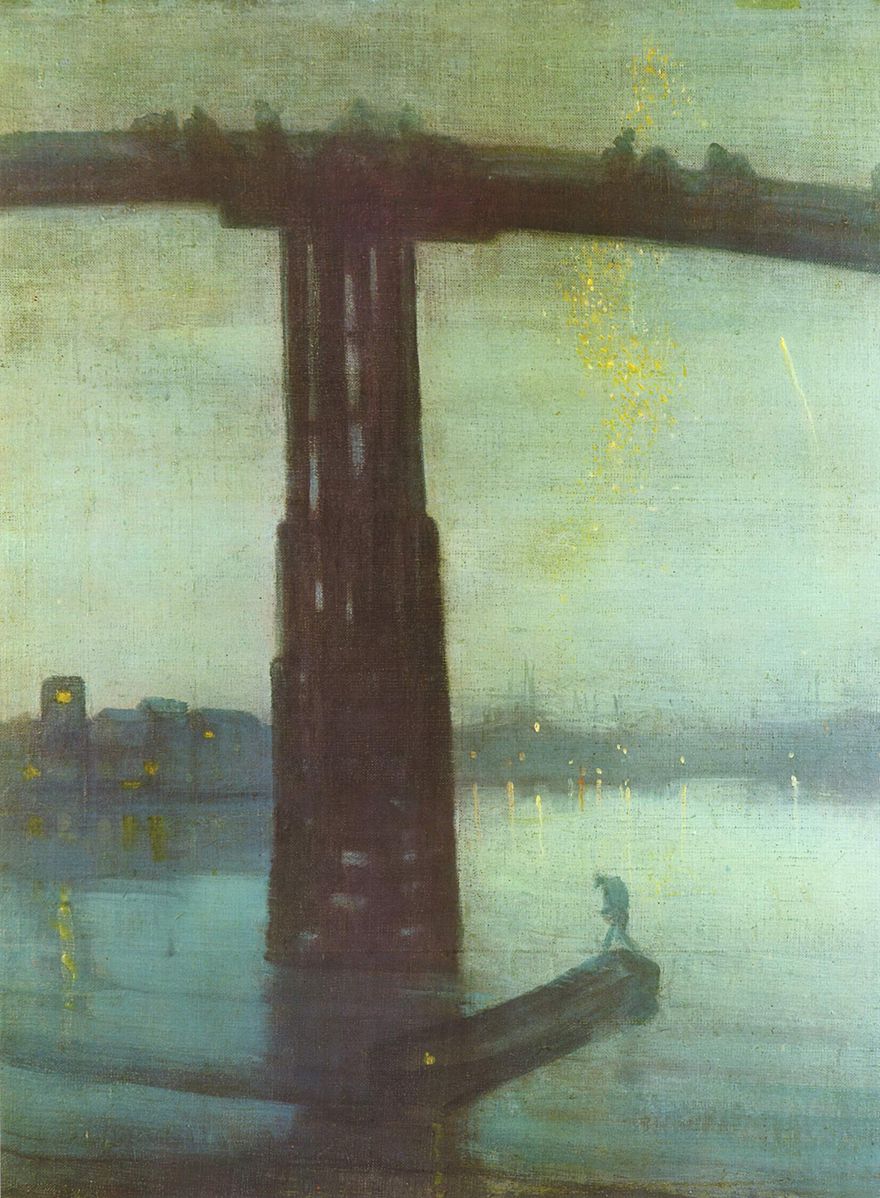
In a review of Daniel E. Sutherland’s A Life for Art’s Sake, a biography of James McNeill Whistler, Barry Schwabsky considers how the painter’s personality informed his work:

Was Whistler just as belligerent toward his art as he was with the wider world into dish_Whistler which he sent it? You might think so, judging from reports of how he went about making it: “His movements were those of a duellist fencing actively and cautiously with the small sword,” according to one witness. But no, the results show very little evidence of Whistler’s aggressiveness. Henry Adams can’t have been the only observer to have noticed the contrast between Whistler’s “witty, declamatory, extravagant, bitter, amusing, and noisy” public manner and his art of “nuance and tone,” though perhaps he was one of the few to speculate that it showed how the painter might have been “brutalized … by the brutalities of his world.” That might be putting it a bit too strongly, but still, something must account for Whistler’s conviction that “the Master stands in no relation to the moment at which he occurs—a monument of isolation—hinting at sadness—having no part in the progress of his fellow men.” Whatever the cause of this inner core of loneliness and sorrow, none of Whistler’s biographers, including Sutherland, has ever come close to touching on it. Perhaps that’s just as well, because the beauty of the art transcends its motivating ache—by communicating it in a homeopathic dosage.

(Image of Nocturne in Blue and Gold: Old Battersea Bridge, circa 1872-1875, via Wikimedia Commons)

A Grave Concern

Charles Simic recalls a business scheme for a new kind of gravestone dreamed up by the poet Mark Strand when he was down and out:

It would include, in addition to the usual name, date, and epitaph, a slot where a coin could be inserted, that would activate a tape machine built into it, and play the deceased’s favorite songs, jokes, passages from scriptures, quotes by great men and speeches addressed to their fellow citizens, and whatever else they find worthy of preserving for posterity. … One of the benefits of this invention, as [Strand] saw it, is that it would transform these notoriously gloomy and desolate places by attracting big crowds—not just of the relatives and acquaintances of the deceased, but also complete strangers seeking entertainment and the pearls of wisdom and musical selections of hundreds and hundreds of unknown men and women.

Simic continues:

While this invention may strike one as frivolous and irreverent, in my view it deals with a serious problem.

What happens to everything we kept in our heads and hoped others would find amusing after we pass away? No trace of them will be left, unless, of course, we write them down. Even that is not a guarantee. Libraries, both private and public, are full of books no one reads any more. Anyone who frequents town dumps has seen yellowed manuscripts and letters thrown out with the trash—papers that sadly, but unmistakably, not even the family of their author wants. Just imagine that Strand’s dream had come true and your dead grandmother is a big hit in some large urban cemetery, passing on her soup and pie recipes to an admiring crowd of young housewives; while your grandpa is telling dirty jokes to boys playing hooky from school. Given their immense local fame, you, too, are regarded with interest by your friends and neighbors, who can’t help but wonder how your everlasting selection is coming along and what inspiring words and vile blasphemies they’ll be hearing from your gravestone.

A PSA For Tax Season

If you’re a drug dealer, you might want to get some tax stamps:

AL_taxstamp[Kansas] has set its tax rate on marijuana at $3.50 per gram and its taxes on other controlled substances at $200 per gram or $2,000 per pill. Drug dealers operating in the state should visit the Taxpayer Assistance Center in Topeka between 8:00 am and 4:00 pm to buy drug tax stamps. Or they can order them through the mail. By attaching the stamps to the drugs, dealers can show that they paid their taxes. They may be busted and arrested, but at least tax evasion won’t be one of the charges.

Kansas is not alone in demanding that drug dealers pay their fair share of taxes. Some 10 to 20 states have (or once had) legislation setting tax rates on illegal drugs.

One problem: the stamps aren’t exactly flying off the shelves:

According to attorney Robert Henak, “Everywhere but four states, I believe, there is no indication that drug dealers are buying stamps.” The majority of states have sold no stamps, or only a few thousand dollars worth in tiny increments. So who is buying?

Stamp collectors. Many of the stamps feature marijuana leaf designs or comical health warnings as Henak, a stamp collector who once shared his collection of drug tax stamps with Playboy magazine, can attest.

(Image: A marijuana tax stamp image via NORML)

Down With The Upskirt

On Wednesday, the Massachusetts court ruled that the state had no laws barring someone from taking a photo up a woman’s skirt. Meghan DeMaria notes the court’s judgment that those women were not “completely or partially undressed”:

If you’re wearing Spanx, a thong, or other undergarments that could constitute being “partially nude” beneath your skirt, you’re entitled to legal protection, but women who favor granny panties are out of luck. Good to know.

Doug Mataconis defends the court’s reasoning:

I agree generally with the principle that something like this should be against the law, but it seems to me that the Court was correct on the law here. As a general principle, people can only be convicted of a crime when they’ve actually committed an illegal act that is specifically defined in the law and, in this case, what Robinson was accused and convicted of did not comport with the statute under which he was charged. If the legislators in Massachusetts want to prevent this from happening again, they simply need to rewrite the law to cover the activities that Robinson was accused of committing.

In response to the case, the legislature quickly passed a bill to ban such behavior. The governor signed it this morning. Nichi Hodgson wonders if it will have any effect:

[S]omething tells me we won’t be seeing a wave of prosecutions any time soon – at least not if the backlog of domestic violence, rape and restraining order cases are anything to go by. California, the only US state to institute a revenge porn law, did make two major prosecutions since it passed a law in October, but only time will tell as to whether that was merely a PR flurry.

Hanna Rosin follows through on the revenge porn comparison:

Upskirting is like an anonymous version of “revenge porn,” the practice of posting your girlfriend’s naked pictures online if you’re pissed at her. Upskirting, by contrast, is more passive and generally not directed at any one woman in particular. Air marshals do it. Commuters do it. Players do it, like this one who posted on an upskirting site:

I’ve been upskirting chicks, mostly at clubs, for almost two years. The club I go to is a great spot, real crowded, strobe lights going, loud music, so no one notices me sitting near the edge of the dance floor and if a woman in a skirt ends up by me I stick the cam under and snap.

Now even if this douche moved to a state where upskirting was illegal, it would still be perfectly legal in most states for him to post online all the pictures he already has on his cellphone, according to Danielle Citron, a law professor who supports the effort to make revenge porn illegal. In her forthcoming book, Hate Crimes in Cyberspace, Citron documents the way women’s lives can be ruined when someone posts a nude picture of them online that co-workers or employers or anyone else can easily look up. (One of the women she profiles had to change her name.)