A Middling Jobs Report

Job Losses

Jordan Weissmann analyzes the new jobs data:

The U.S. added a solid 175,000 jobs in February, despite the nasty spate of winter weather that some thought would put more of a damper on hiring. But the real relief may be that in spite of that growth, the unemployment rate actually ticked up slightly, to 6.7 percent. Why celebrate a rising jobless rate? Because it gives the Federal Reserve an excuse to lean back and let the economy keep gathering steam without worrying too much about inflation.

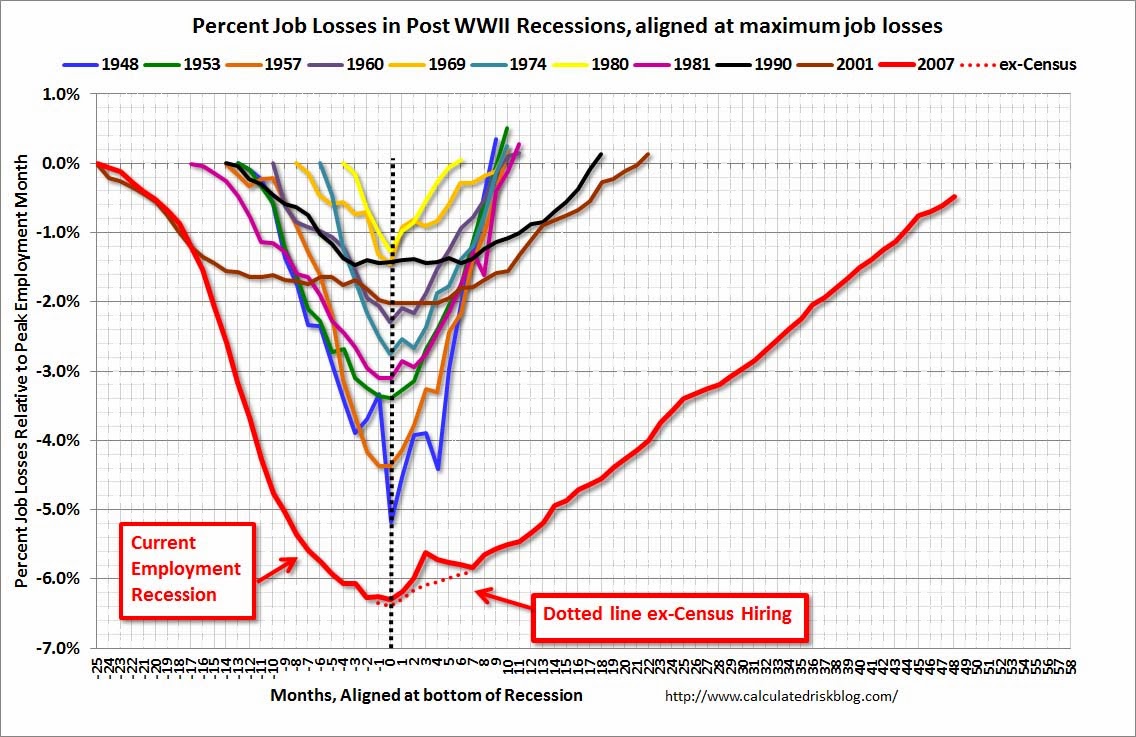
Bill McBride, who provides the above chart, zooms out:

This graph shows the job losses from the start of the employment recession, in percentage terms – this time aligned at maximum job losses. At the recent pace of improvement, it appears employment will be back to pre-recession levels mid-year (Of course this doesn’t include population growth).

Kilgore wonders if the weather is depressing jobs numbers:

The bigger picture is that economists are very conflicted about the impact of this winter’s unusually bad weather on the numbers, and what that might mean for the underlying strength or weakness of the economy. So there’s a great deal of anticipation of the March and April jobs reports as perhaps resolving some of those arguments.

Danny Vinik calls it “a fairly strong report, particularly if the weather is holding back the economy”:

More than 600,000 people were unemployed due to the weather, the most since 2010. If the weather really is holding back the economy right now, that makes this report even stronger in comparison.

Ylan Mui downplays the importance of the weather. She claims that “that those 600,000 people are still considered employed”:

The argument here isn’t that this abysmal winter has had no impact on the economy. There are other economic factors, such as housing starts, that are more sensitive to changes in the temperature. But pointing fingers at Old Man Winter for every lousy jobs report is a misreading of the data.

Benen focuses on government jobs:

In a rare occurrence, public-sector layoffs did not drag down the overall employment figures. Though most months in recent years have shown monthly government job losses, in February, the private sector added 162,000 while the public sector added an unusually high 13,000.

Drum’s take:

Bottom line: we continue to plod along. Things could be worse, but they still aren’t very good.

Anti-Pro-Israel

Paul Waldman suggests we stop calling people “pro-” or “anti-Israel”:

Think about it this way: When was the last time you heard the designation “pro-Israel” or “anti-Israel” and found it a useful distinction that added to rather than subtracted from the discussion at hand? Ever? Instead, the terms are used almost exclusively as ad hominem, a way of shutting down debate by proclaiming that someone’s intentions are sinister and therefore their arguments can be dismissed out of hand without addressing their substance.

There’s no other country in the world we talk about in this way. No one asks if you’re “pro-Canada” or “anti-Costa Rica.” Even countries with which we have sometimes adversarial relationships, we don’t use those terms. For instance, The Atlantic‘s James Fallows lived in China for a few years and has written a couple of books about the country. If someone asked, “Is James Fallows pro-China or anti-China?” you’d immediately say that person is an idiot, because the question is meaningless. Framing things that way does nothing but obscure and distract from any actually interesting question we might have.

Putin’s Annexation Of Crimea

UKRAINE RUSSIA-UNREST-POLITICS-CRIMEA

The worst outcome now seems likely:

MPs [in the Crimean parliament yesterday] voted by 78 votes to nil for the territory to leave Ukraine, further escalating what has become the most serious crisis in Russian relations with the west since the cold war.

At the same time, a referendum on more autonomy for the region due on 30 March was brought forward to 16 March, and the question was changed to give residents the option to unify the Black Sea peninsula with Russia. Crimea’s deputy prime minister, Rustam Temirgaliev, said the referendum was now only to “confirm” parliament’s decision, and he considered Crimea to be part of Russia already. He said that all Ukrainian troops on the territory should either leave or be treated as occupiers. Crimea is planning to introduce the rouble and readopt Russian state symbols.

Brian D. Taylor’s sees the referendum as a Kremlin provocation:

[The] fast-tracking of a Crimean referendum on unification with Russia, if Putin is behind it, suggests that he decided to speed right past the “off ramp” and head straight for formal annexation.

In that case, the prospects for positive-sum outcomes will have shrunk considerably. If Russia does formally annex Crimea, the United States and Europe should go ahead with sanctions, in order to hit Russian elites in their pocketbooks. In the medium term, the United States should help Central and Eastern European governments to diversify their energy supplies, away from their dependence on Russian gas.

The Bloomberg View editors take a similar stand:

Any plebiscite held within 10 days of its announcement is by definition a joke, yet the implications here are serious: No major country has annexed territory since World War II. Unless it can be prevented, the damage will extend to everyone concerned. The move would, first of all, destabilize a fragile Ukraine, not least by encouraging pro-Russians in other regions to follow Crimea’s example. Civil war would become difficult to avoid.

Helena Yakovlev-Golani and Nadiya Kravets believe the annexation “could be problematic for Russia in a number of important ways”:

First, annexing Crimea would be a costly enterprise. The peninsula is not self-sustainable and heavily depends on Kiev to balance its budget. Crimea has no fresh water supplies and it does not generate its own electricity; in fact, it receives 90 percent of water, 80 percent of electricity, 60 percent of other primary goods and 70 percent of its money from Kiev. Building or creating these capacities in Crimea will put a huge strain on the Russian budget, and given the ongoing slide of the Russian currency due to calamities in Ukraine, the decline is likely to continue together with the fall of foreign direct investment into Russia. Crimea with its 2 million person population would become an economic drain on Russia even more than the breakaway republics of Abkhazia and South Ossetia, whose populations totals some 250,000 and 45,000 respectively. In addition, economic problems would magnify due to reactions from Turkey and Europe.

But Bershidsky thinks annexation would be a win for Russia, despite the costs:

About 60 percent of Crimea’s natural gas comes from a Ukrainian company that extracts it in the Black Sea and the Sea of Azov. The peninsula gets 80 percent of its water and power from Ukrainian territory. These supplies will not be cut off, but Ukraine will probably want to charge more for them. Russia will either have to negotiate with an unfriendly government in Kiev or build parallel infrastructure, which will take years and billions of dollars.

All told, it looks like a good deal for Putin compared with the $50 billion price for the Winter Olympics that just ended in Sochi. At taxpayer expense, the Russian president is acquiring a priceless resource: an explosion in public support. According to the VTsIOM sociological service, Putin’s approval rating has reached new highs in the last two weeks, and is now at 68 percent. That’s worth more to the Russian leader in his 14th year in power than any accolades from the West could ever be.

Juan Cole questions the US’s credibility in opposing the secession:

It is not clear if Russia’s supporters in Crimea are serious about this accession to Russia or if they are just playing a bargaining chip intended to wring long term concessions from the interim Ukrainian government, such as a permanent lease of naval facilities in Crimea to the Russian navy. …

But those pundits (and President Obama himself) who are suggesting that a Crimean secession from Ukraine would be contrary to international law or unprecedented, or that the US would always oppose such a thing, haven’t been paying attention. The US position on secessions depends on whether Washington likes the country affected. And Washington itself toyed with partitioning Iraq while it was a colonial possession.

Posner assesses whether international law would prohibit it:

Crimea is currently occupied by Russian troops, and the question of secession was (as far as I know) put on the agenda only because of Russia’s illegal intervention. Unlike places like Quebec, the Basque Country, and Scotland, the question of secession is entirely new; there was never a live secession movement that sought reunification with Russia. Ukraine itself does not appear to favor secession of Crimea. The world ought to be skeptical about the Crimean Parliament’s intentions, but if a fair referendum is held, and there is overwhelming sentiment in favor of unification with Russia, then a major geopolitical victory will be within Russia’ grasp.

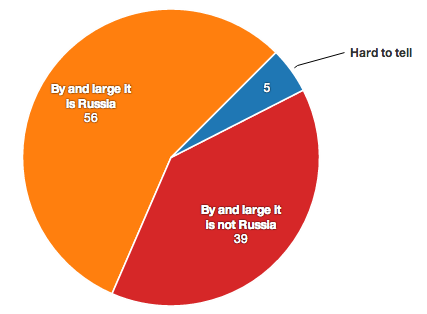
Adam Taylor looks at survey data that suggests Crimeans already largely identify with Russia:

This poll, conducted by a well-respected agency linked with the Russian state, found that a majority of Crimea Russiarespondents view Crimea as part of Russia. There are a few fascinating elements to this one. First, it was conducted in August, long before Ukraine’s situation blew up, so it appears to show some deep-rooted feelings about Crimea (which was, after all, part of Russia until 1954). It’s also worth noting that in this poll, more people thought Crimea was a part of Russia than Dagestan (41 percent) and Chechnya (39 percent) – both of which are republics in the Russian Federation.
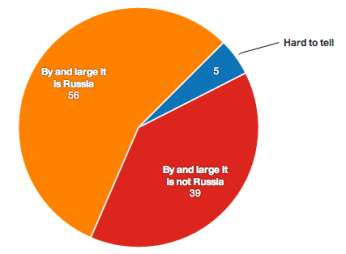
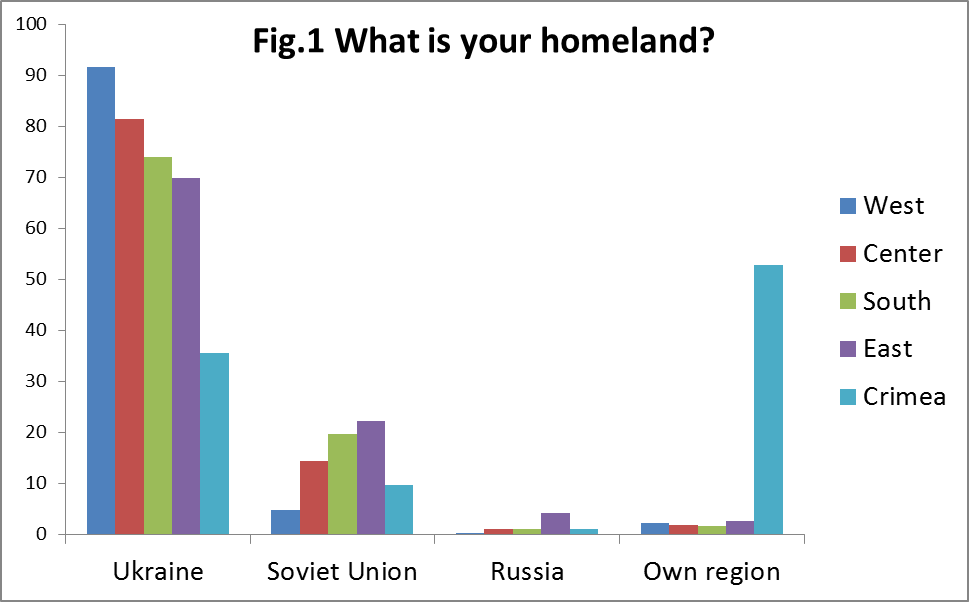
Another survey complicates the identity issue further:
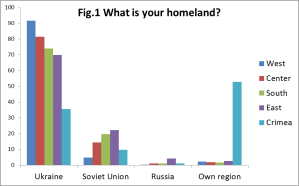
TMC-Figure-1Asked an open-ended question about where respondents considered their “homeland” to be, Crimeans, unlike easterners or other southerners, showed fairly little affiliation with the Ukrainian state. More than half of Crimean respondents replied by naming Crimea, while almost no one else mentioned their own region. Some 35 percent of Crimeans did volunteer Ukraine, and while allegiance to Ukraine was higher — around 50 percent — among ethnic Ukrainians and Tatars living in Crimea, these figures were considerably below the support in eastern Ukraine. In short, levels of attachment to Ukraine in Crimea are noticeably out of line with the rest of the country.

Natalia Antelava fears for the Crimean Tatars, who want the region to remain part of Ukraine:

Eskandar Baiibov, a deputy in the Crimean Tatar Mejlis, told me firmly that his community is unanimous in its backing for the government in Kiev, and that Crimean Tatars would boycott any referendum on joining Russia. But he is also terrified, he admitted, of the price that they might have to pay for refusing to give the Kremlin the support it wants.

“We are already seeing signs that they are trying to intimidate us, to split us, to stir trouble,” Baiibov said. “Ukrainians are also vulnerable, but at least they have Ukraine to go to. Where will we go? Crimea is our only home.” After the regional parliament voted to merge Crimea into Russia on Thursday, the chairman of the Mejlis, Refat Chubarov, released a statement to the press, calling for the United Nations to “immediately consider” sending a contingent of international peacekeepers into Crimea, “in order to deëscalate the military conflict … which can lead to mass casualties among the entire civilian population of the peninsula.

Previous Dish on the Tatars here.

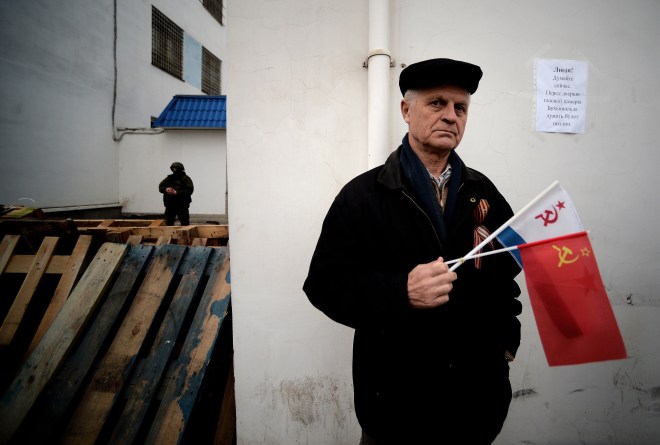
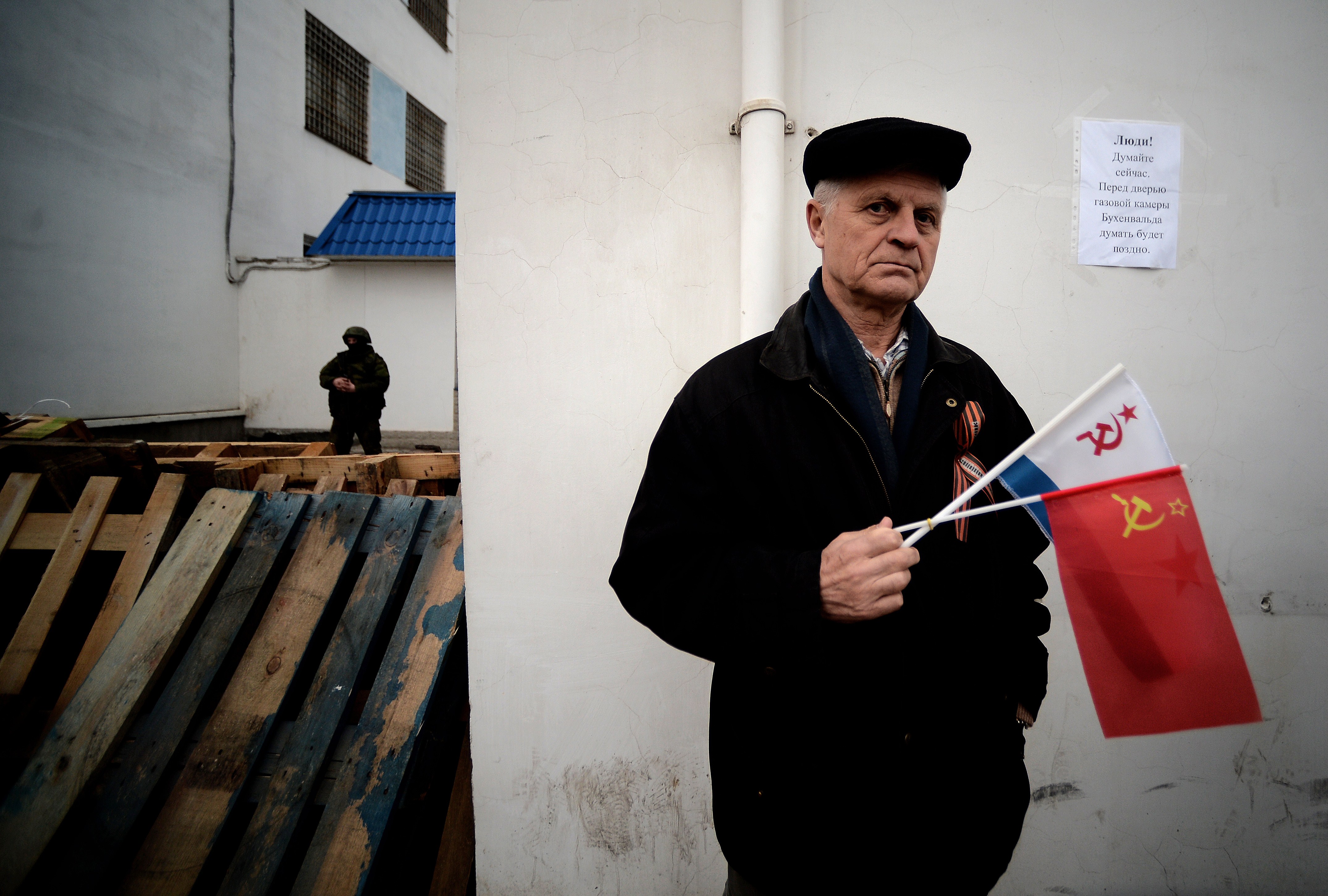
(Photo: One of several pro-Russian demonstrators blocking the entrance to the Ukranian Navy headquarters in Sevastopol holds Soviet flags, on March 7, 2014. By Filippo Monteforte/AFP/Getty Images)
Christie Courts The Base

Olivia Nuzzi identifies a reason for the governor’s newfound CPAC popularity:

[W]hat’s causing Christie trouble in his home state may be making him fans among many conservatives. In the months since the scandal involving lane closures on the George Washington Bridge became one of the biggest political stories in the country, the liberal media has kept a target on his back. The death of Christie’s political career would be, in part, a victory for a place like MSNBC, which has devoted so much time to covering every little detail and conspiracy of Bridgegate.

The conservatives applauding Christie at CPAC weren’t just applauding another Republican governor, they were applauding the newest enemy of the liberal media.

Charles Pierce believes Christie is still running for president and that he “is beginning to reconstruct his mythology, a brick at a time.” John Dickerson assesses the speech:

On Thursday, the political task before Christie was to get a good reception from a skeptical crowd without saying anything that might be used against him in a 2016 presidential bid. He achieved that modest goal. The Democratic Party, in its instant analysis of Christie’s CPAC speech, couldn’t actually find anything noteworthy in the speech. It criticized him for what he “didn’t talk about.”

The first notable elision was Christie’s defense of the Koch brothers, the wealthy backers of Americans for Prosperty, the pro-free-markets activist group. You wouldn’t know that’s who he was defending, because Christie never mentioned their names. Instead he attacked Senate Majority Leader Harry Reid, who has been going after the Koch brothers by name and at length on the Senate floor. This attack on “two American entrepreneurs” was a sign of how pointless Washington had become, according to the governor. Reid should “get back to work and stop picking on great Americans who are creating jobs.” No ad can be run in which Christie can be found praising the Koch brothers, whom liberals are working hard to make household names of horror.

Byron York was disappointed:

It’s not a surprise that Christie didn’t venture far beyond Republican orthodoxy at CPAC. After all, he wasn’t even invited last year. Now, he’s most likely running for president and doesn’t need to alienate some of his party’s most loyal voters. But there are a lot of Republicans who believe the GOP continues to need a serious talking-to, and that Christie could be the man to do it. If he is, he didn’t show it at CPAC.

Alec MacGillis thinks Christie’s fundamental problems remain:

The fact is, there were all along two reasons conservatives, or enough of them, would be willing to live with Christie as a nominee. One is the purely expedient one, the dream of challenging Hillary Clinton not only in purple states but in blue ones. The other, which is often overlooked, is that Christie was poised to rally plenty of conservatives with his knack for bashing many conservative bête noires with untrammeled, gleeful scorn. No, he maybe didn’t agree with you on immigration reform or the propriety of appointing Muslim judges, but he could denigrate lazy, overpaid teachers better than Ted Cruz or Rand Paul could ever dreaming of doing.

Both of those rationales are now out the window.

Surrender Douthat! Ctd

I argued that opponents of marriage equality should stop playing the victim and instead of focusing on gays “make a positive argument about the superior model of a monogamous, procreative, heterosexual marital bond”:

There is enormous beauty and depth to the Catholic argument for procreative matrimony – an account of sex and gender and human flourishing that contains real wisdom. I think that a church that was able to make that positive case – rather than what is too often a merely negative argument about keeping gays out, or the divorced in limbo – would and should feel liberated by its counter-cultural message.

Dreher responds:

Andrew asks us to make a “positive case,” but I submit to him that this is impossible now. The climate that now exists, and that will only grow in intensity, is one in which any dissent from the pro-gay consensus, no matter how nuanced or irenically stated, amounts to “hate” that cannot be tolerated. … If Andrew believes that Christians should tell positive stories, then the best thing he can do for us dissenters, now that he is on the verge of victory (and I can’t think of a single figure who has done more than he has to achieve victory), is to explain to his side what he perfectly well knows from being friends with Ross and me: that not every Christian who opposes same-sex marriage is a hater, and it does none of us any good to pretend that they are.

Well, I have done so on many occasions, did so in my books from the 1990s onward, and will continue to do so. I’ve spent a large part of my career angering gays by insisting that a crude “hater!” response to arguments about homosexuality is both deeply flawed and counter-productive. That was the whole point of Virtually Normalvirtually-normal and why it provoked such ferocious hostility from the left. Here’s an essay I wrote for the NYT attacking the whole concept of “hate” as a legal or political phenomenon. My record against “hate-crimes” is also pretty clear. I’ve aired vital reporting that complicates the iconic case of alleged anti-gay hate, in the Matthew Shepard case. Rod knows all this. He must also know that maintaining my loyalty to the Catholic church has not made my life easier in the gay community these past few decades. Why, given some social ostracism in the gay world for being a believing Christian, would I have clung on to a church that I believe is motivated by “hate”? Human beings – and hostility or opposition to gay civil rights – are much more complicated than that absurdly reductionist label. I am not Mark Joseph Stern.

But it remains the case that hatred and fear of gay people is deep and real and alive among many of Rod’s allies on the Christianist right. Not all, by any means. But it would be crazy not to acknowledge this. Rod wants to divide the anti-gay-rights coalition into a tiny fringe of Westboro Church loons and otherwise reasonable, nice Christians who oppose marriage equality for principled reasons. But this is a whitewash. The way gay people have been denigrated, derided, trivialized and demonized by mainstream figures in the Christianist right is appalling. The Christianist campaign to persecute gay people in Africa is horrifying. The callousness and double standards of Pope Benedict XVI – the man who declared gay people inherently sinful in our nature – cannot be denied.

And the only way to distinguish yourself from these hateful factions is to make a positive case for your position. That’s always possible. From the very beginnings of our faith, Christians have made such a positive case, even as they were being thrown to the lions. And Rod won’t do it because someone might say something mean at the office! How delicate and sensitive these Christianists can be.

Sure, insisting that you oppose my right to marry may lead at times to others viewing you as inhumane or bigoted or cruel. But that’s the price of entering the public square. You think I was given a hero’s welcome among conservatives when I first made the positive case for gay marriage? Please. It was open season from right and left.

And if Rod wants to know what persecution is like, imagine showing up to work and being fired simply for being a Christian. Or serving your country, risking life and limb, and then being told you are dismissed, denied any benefits, and thrown out on the street. Much of this has happened and still happens to gay people across the country, in ways no Christian qua Christian rarely faces and could barely conceive of. In Arizona, where Rod feels Christians are under siege, gays can be fired at will just for being themselves, and have no right to marry. When Rod receives that treatment, his self-pity may have some merit. But his obliviousness to the suffering of others is more than a blind spot.

I imagine, however, that he is dimly aware that his version of human flourishing – heterosexual sex only within marriage that is open to procreation – may not win the day in the public debate. Indeed, all the many arguments for such a view of how human beings can reach our fullest potential have tended to lose and lose badly in the last half-century in the free West. The equality of women, the emergence of gays, the fact of widespread contraception, the impact of no-fault divorce … all these prove that Rod’s argument is not succeeding, even when it had the legacy of centuries behind it. Even in the delicate pronouncements of Pope Francis, you can feel the equivocation. It is as if the prohibition against gay people simply cannot survive the scrutiny of reason or the Christian standard of mercy. And this is true for Catholics as much as any other group (just look at the polls of Catholics on marriage equality). And I think this realization that the argument has been lost is what motivates the panic – and leads to the current wave of self-pity.

In response to an earlier post by Dreher, Douthat argues against the religious right claiming “persecution”:

[U]sing the “persecution” label too promiscuously, I think, carries three risks beyond intellectual inaccuracy. First, as Dreher sort of concedes, it doesn’t do enough to acknowledge the vast gulf separating the situation of Western Christians and the incredible heroism of our co-believers overseas, who face eliminative violence on an increasingly-dramatic scale. Second, as I tried to suggest in the column, it doesn’t do enough to acknowledge the gulf separating the situation of Western Christians and the situation of gays and lesbians, past and present, facing persecutionat the hands of religiously-motivated actors. And finally, it doesn’t actually prepare conservative believers for a future as a (hopefully creative) religious minority, because it conditions them/us to constantly expect some kind of grand tribulation that probably won’t actually emerge.

Readers’ thoughts on the post here.

Is Britain Russia’s Money-Launderer?

Here’s a screed (NYT) that puts some of the rhetoric around the Ukraine crisis in perspective. If the Europeans were truly concerned about Russia’s shenanigans, they have the leverage to impose huge damage. London alone could bring many Russian oligarchs to their knees – in ways the US cannot. But London isn’t. Just follow the money:

Russians … know that London is a center of Russian corruption, that their loot plunges into Britain’s empire of tax havens — from Gibraltar to Jersey, from the Cayman Islands to the British Virgin Islands — on which the sun never sets. British residency is up for sale. “Investor visas” can be purchased, starting at £1 million ($1.6 million). London lawyers in the Commercial Court now get 60 percent of their work from Russian and Eastern European clients. More than 50 Russia-based companies swell the trade at London’s Stock Exchange. The planning regulations have been scrapped, and along the Thames, up and up go spires of steel and glass for the hedge-funding class.

Britain’s bright young things now become consultants, art dealers, private bankers and hedge funders. Or, to put it another way, the oligarchs’ valets.

One suspects that Crimea is a small price to pay in return.

Propping Up Mitch McConnell

https://twitter.com/AlexKoppelman/status/441604933444304897

John Cassidy watched McConnell’s performance yesterday:

[W]hen you want to boost your bona fides with conservatives, many of whom regard you as a hopelessly compromised establishment figure, there’s still nothing like putting on your hunting jacket, grabbing your rifle, and paying homage to the N.R.A.

This being the Gaylord Convention Center rather than a rifle range or a field in Kentucky, McConnell went without the hunting jacket. His official purpose was to present a “lifetime achievement award”—that would be the rifle—from the National Rifle Association to Senator Tom Coburn, the Oklahoma senator who is retiring this year with a hundred-per-cent approval rating from the gun-rights lobby. McConnell handed Coburn the gun, they both admired it, and then McConnell delivered a lengthy attack on President Obama and the Democrats.

Paul Waldman is jealous that conservatives get all the cool props:

[C]onservatives have lots of these kinds of identity markers that can easily and quickly communicate a whole set of beliefs to an audience when they’re mentioned, like the Bible or Ayn Rand or country music.

The fact that Democrats don’t have these things is probably because their coalition is more diverse, made up of people with a variety of cultural backgrounds and life experiences. The markers that may unite certain portions of the Democratic coalition—like, say, the music of the recently departed Pete Seeger—are not anything close to universal within that coalition, so politicians can’t use them so easily.

Drum joins the conversation:

Conservatives have guns, pocket copies of the Constitution, and the Bible to use as really handy props that instantly demonstrate their tribal affiliation. So why don’t liberals have similar, universally-recognized totems? Waldman may be right that it’s because our coalition is more culturally diverse, but I’d toss out one other possibility: almost by definition, conservatives are in favor of tradition and liberals are in favor of change. So it’s easy to find simple conservative props because every culture has lots of recognizable traditional icons that it’s developed over the centuries. It’s a lot less easy to find liberal props because icons of progress change every decade or two.

Should Congress Stem “Big Weed”?

Mark Kleiman, fast becoming the biggest buzz-harsher on the planet, worries that our state-by-state approach to legalization will end badly unless the federal government steps in to regulate the pot market:

The systems being put into place in Washington and Colorado roughly resemble those imposed on alcohol after Prohibition ended in 1933. A set of competitive commercial enterprises produce the pot, Kush_closeand a set of competitive commercial enterprises sell it, under modest regulations: a limited number of licenses, no direct sales to minors, no marketing obviously directed at minors, purity/potency testing and labeling, security rules. The post-Prohibition restrictions on alcohol worked reasonably well for a while,but have been substantially undermined over the years as the beer and liquor industries consolidated and used their economies of scale to lower production costs and their lobbying muscle to loosen regulations and keep taxes low (see Tim Heffernan, “Last Call”).

The same will likely happen with cannabis. As more and more states begin to legalize marijuana over the next few years, the cannabis industry will begin to get richer—and that means it will start to wield considerably more political power, not only over the states but over national policy, too. That’s how we could get locked into a bad system in which the primary downside of legalizing pot—increased drug abuse, especially by minors—will be greater than it needs to be, and the benefits, including tax revenues, smaller than they could be. It’s easy to imagine the cannabis equivalent of an Anheuser-Busch InBev peddling low-cost, high-octane cannabis in Super Bowl commercials. We can do better than that, but only if Congress takes action—and soon.

Kleiman makes some good points about the radical insecurity of the legal regimes in Colorado and Washington, but I have to say I find his worst case scenarios a stretch. This, for example, is Kleiman’s understanding of federalism:

Justice Louis Brandeis’s praise for states as the “laboratories of democracy” has been widely quoted … Dr. Frankenstein also had a laboratory.

Oy. Pete Guither offers a must-read and detailed rebuttal. On the federalism point, is Kleiman honestly saying that the federal government is to be trusted in this area? The entire reason the states have taken the lead is that the feds still can’t change its absurd classification of the drug. Then Kleiman has a bugaboo about marketing, as if nurturing and cultivating a customer base for marijuana is some kind of a crime, or inherently damaging. Guither responds:

Sure, if marketing causes an increase in the overall number of users, and you assume that the same percentage of those new users will become dependent as in the original class, then marketing could lead to dependency indirectly. But that assumption is flat-out contradicted by evidence and common sense, since prohibition laws, to the extent that they deter at all, are more likely to deter casual non-problematic use than problematic use.

I know that it’s popular to claim that marketing is used to cause dependency, but there’s really very little evidence to support that claim.

But Reihan agrees with Kleiman that federal oversight is needed:

It’s easy to see why Congress doesn’t want to touch cannabis legalization. Though support for legalization has increased, the issue remains contentious, and it raises difficult questions regarding U.S. treaty obligations. But the federal government needs to step in to see to it that the emerging cannabis markets don’t spiral out of control. One of the central purposes of our federal republic is to regulate interstate commerce, and it would be foolish to deny that legalization in some states will have spillover effects in others.

By “spiral out of control” he means that lots of people may buy the product. It’s so weird to read a conservative making a case for socialized non-profits. Jon Rauch compares legalization to Obamacare, noting that much depends on the implementation:

[E]arly indications are that Colorado and Washington are faring reasonably well. If they pass the implementation test, marijuana legalization could prove that obituaries for effective, adaptive government—some of them written by me—are premature. But if they yield chaos or crisis, they would discredit the policy they seek to promote.

As of now, I’m cautiously optimistic that the states’ experiments will be made to work, not perfectly but well enough. But liberaltarians and drug reformers need to get it through their heads that just passing legalization initiatives is not enough. They need to stick around once the vote is over and commit to the hard slog of making the policy succeed.

Agreed. But I see no reason why reforming, adjusting and monitoring the impact of legalization isn’t best done by the states that have had the cojones, unlike the frozen-in-aspic feds, to actually deal with the issue in a way that isn’t transparently self-defeating.

Shining A Light On Development

africa-lights

Keating relays a study that uses nighttime satellite photography to illustrate economic changes over time:

In a recent NBER working paper (summary here), Maxim Pinkovskiy of the Federal Reserve Bank of New York and Xavier Sal-i-Martin of Columbia University used luminosity as measured by NOAA weather sattelites as an “independent measurement of true income.”

The comparison above shows a decade of change in sub-Saharan Africa. Angola (the third country from the bottom on the west coast) has many more lights in 2009 than in 2000, as you might expect from a country whose GDP per capita has nearly doubled. Zimbabwe, on the other hand, “has fewer lights, because of its economic collapse under the disastrous hyperinflationary policies of Robert Mugabe.”