“They Have Assassinated Syria”

Zaher Sahloul bears witness to the atrocities of Assad’s snipers and tells an upsetting tale:

Almost every doctor I met at the hospital told me another horrific story about a young mother who tried to make the crossing with her two children.

When she hastened through the corridor, holding one child in each hand, a sniper targeted her 4-year-old son, killing him instantly. She started screaming in agony. Then a bullet hit her second son, a 3 year-old, and killed him, too. She sat down between the bodies of her sons, waiting for the sniper to shoot her… but the shot did not come. He spared her to live a life without her children, to be consumed by a gnawing emptiness — something snipers have done to countless Syrian mothers. When she finally arrived at M-1 with the dead bodies of her two sons, she was in the middle of a complete mental breakdown.

The snipers, and the regime that deploys them, have succeeded in transforming a peaceful movement for democratic revolution into a civil war, planting fear and deep psychological scars, displacing tens of thousands of civilians fleeing for safety, creating hatred among different ethnic and religious groups, fuelling sectarianism, and attracting extremism. Their bullets have not only killed my compatriots, but also my homeland.

Clinton, Hitler, Polk, And Putin

If you’d forgotten – or never learned about – how the Clintons think and operate, the last couple of days were a quick Cliff Notes refresher. First up, Hillary was at a fundraiser, and talked about Ukraine. Perhaps trying to impress her audience or perhaps displaying her inner neocon, Clinton morphed – as she did in 2003 – into John McCain:

Now if this sounds familiar, it’s what Hitler did back in the 30s. All the Germans that were … the ethnic Germans, the Germans by ancestry who were in places like Czechoslovakia and Romania and other places, Hitler kept saying they’re not being treated right. I must go and protect my people and that’s what’s gotten everybody so nervous.

This is about as inflammatory a statement as you can imagine – and one the president has wisely eschewed. But I guess if it’s an indicator of how she thinks about the issue, it’s fair enough. Her instinct is to equate the 2o1os with the 1930s – which is one more indication of how she truly is a classic boomer politician. But, of course, after a flurry of press interest, Clinton then backtracked. Observe the form here – because there is a real possibility we could face years of this:

[Putin’s action] is reminiscent of claims that were made back in the 1930s, when Germany under the Nazis, kept talking about how they had to protect German minorities in Poland and Czechoslovakia and elsewhere throughout Europe. So I just want everybody to have a little historic perspective. I am not making a comparison, but I am recommending that we can perhaps learn from this tactic that has been used before.

To recap: “if this sounds familiar, it’s what Hitler did” is “not making a comparison.” I guess it all depends on what the meaning of the word “comparison” is. Get out your thesauruses – the Clintons are coming back! Carpenter, meanwhile, proffers a much more apposite analogy in history a century ago in America:

President Polk justified his Mexican land grab, in part, as a solemn U.S. responsibility to protect Americans on both disputed and incontestable Mexican soil. Unlike Hitler’s limitless and intercontinental aggression, though, all Polk wanted, post-Texas annexation, was California, New Mexico, Utah and Nevada, and chunks of Arizona, Colorado, Wyoming, Kansas and Oklahoma. Polk’s aggression infuriated Congressman Lincoln and led U.S. Grant to later observe that Polk’s war was “one of the most unjust ever waged on a weaker country by a stronger.”

Even this analogy is a stretch, but it’s shorter than Hitlerism.

The Minority That Thinks It’s A Majority

gay-marriage_v1

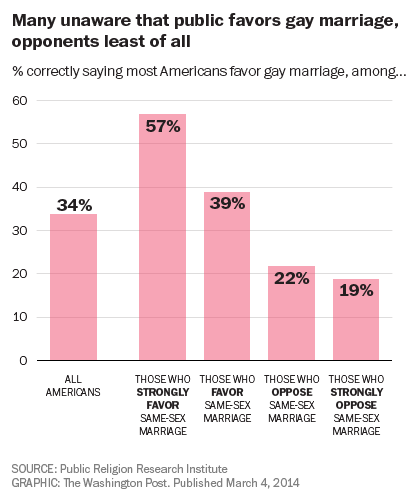
Most marriage equality opponents don’t realize that a majority of Americans disagree with them:

What’s going on here? For starters, Americans overall don’t realize how widespread support for same-sex marriage has grown — only 34 percent of the public correctly believe that most of their peers support gay marriage. This is at least partly a function of how rapidly public opinion has shifted. Ten years ago, only 32 percent of Americans supported same-sex marriage, compared to 53 percent in favor today — a 21-point shift. But same-sex marriage opponents are unique in the depth of their misunderstanding of the issue. Because they skew strongly conservative and deeply religious, this may be a manifestation of what Andrew Sullivan has termed “epistemic closure.” Think of this as an extreme case of confirmation bias — that tendency of people to filter out information that challenges their beliefs and preconceived notions.

Looking at the same poll, Emma Green concludes that the most surprising change over the last decade is that people “have concluded that what happens in other people’s bedrooms is none of their business”:

A majority of those surveyed said that sex between adults of the same gender was morally wrong. It was a slim majority—only 51 percent—and roughly 43 percent said that gay sex is fine. There were regional differences, too. About half of Californians and Floridians had no objection to gay sex, while only a third of Texans were okay with it.

Compare this to the proportion of people who support gay marriage: 53 percent of Americans for, 41 percent against. This suggests that roughly a tenth of Americans don’t like gay sex but think gay people should be able to get married anyway. In other words, they don’t think public policy should necessarily mirror their private beliefs.

A decade ago, this distinction between public and private was virtually non-existent.

Things look good for equality in state polls as well. Tom Jensen summarizes the latest from PPP in Arizona:

Only 22% of Arizonans say they support Senate Bill 1062, compared to 66% who opposed it. Opposition to the bill is bipartisan with majorities of Democrats (11/86), independents (18/64), and Republicans (34/51) alike against it. 72% say they agree with Jan Brewer’s veto of it, compared to only 18% who disagree with her action. …

For the first time in our polling we find that a plurality of Arizonans support gay marriage. 49% are in favor of it to 41% who are opposed, a net 9 movement in favor of gay marriage in the state since November of 2011 when there was 44/45 opposition to it. Voters under the age of 45 support it 55/36 with seniors the only age group against it at this point. 77% of Arizonans support at least civil union for same sex couples, including 69% of Republicans, with only 19% opposed to any form of legal recognition at all.

And Iowans are OK with their marriage law:

Almost 5 years after gay marriage became legal in Iowa, 78% of voters in the state say it’s either had a positive impact or no impact at all on their lives. Even among Republicans, 61% grant that its being legal hasn’t had a negative effect on them. Iowans remain closely divided on the issue- 46% think it should be legal to 45% who believe it should be illegal- but that represents a net 8 point increase in support from October of 2011 when only 41% of voter supported it to 48% who thought it should be illegal.

Why England Isn’t Russia

Orwell once famously observed that the goose-step could never be adopted by British soldiers because, if they marched in the streets, the English would just burst out laughing. I wonder if he thought a solemn picture of a prime minister on the phone with an American president would one day do the same thing:

At which point, it was off to the races … :

… and it gets progressively very, very silly:

Then this:

Till the dogs take over:

And so reassured that English democracy is still alive and well, I carry on with my day.

Trigger Warning: This Post Contains Criticism Of Trigger Warnings

Noting that college students are now pushing their professors to append trigger warnings to course material, Jenny Jarvie protests:

Issuing caution on the basis of potential harm or insult doesn’t help us negotiate our reactions; it makes our dealings with others more fraught. As [Susannah] Breslin pointed out, trigger warnings can have the opposite of their intended effect, luring in sensitive people (and perhaps connoisseurs of graphic content, too). More importantly, they reinforce the fear of words by depicting an ever-expanding number of articles and books as dangerous and requiring of regulation. By framing more public spaces, from the Internet to the college classroom, as full of infinite yet ill-defined hazards, trigger warnings encourage us to think of ourselves as more weak and fragile than we really are. …

Structuring public life around the most fragile personal sensitivities will only restrict all of our horizons. Engaging with ideas involves risk, and slapping warnings on them only undermines the principle of intellectual exploration.

The Ways We Die

Paul Waldman puts gun deaths in perspective:

There were 606 accidental deaths by shooting in 2010, or 1.66 per day. There were another 252 firearm deaths that were “undetermined,” which I guess means that the police never figured out whether it was an accident or intentional. You can look at this number in two ways. On one hand, there are over 300 million of us, so only one in 500,000 Americans is killed every year because his knumbskull cousin said “Hey Bert, is this thing loaded?” before pulling the trigger. You can see that as a small number. The other way to look at is that each and every day, an American or two loses his or her life this way. In countries with sane gun laws, that 606 number is somewhere closer to zero.

Aaron Carroll thinks we focus on the wrong risks:

Update from a reader:

I was shocked by the number of “unintentional” poisoning deaths – 33,041 in 2010! How, I wondered, could that many people be accidentally poisoned? A bit of googling found that, per the CDC, “91% of unintentional poisoning deaths are a result of drug overdose. Drugs commonly involved in unintentional poisoning deaths include opioid pain medications such as methadone, hydrocodone, or oxycodone.” Apparently the “unintentional poisoning” category increased 160% between 1999 and 2009.

So this chart, in addition to showing the relatively small (yet still too large) number of accidental gun deaths, also shows the massive increase in prescription drug addiction, overdose and death in the United States in the last decade. This, more than anything I’ve read lately, illustrated the enormity of this problem to me. Perhaps it will do the same for others.

Capturing Chaos

Screen shot 2014-02-19 at 11.47.27 AM

Photographer Marcel Christ combines his backgrounds in chemistry and photography to create startling images:

Through experimentation with countless liquids, the artist finds ways to give life to otherwise inanimate objects. In this ongoing series, Powder, Christ captures the expressive movement of colorful powders that pop out against a solid black background in unpredictable formations that result in an organized chaos.

From an interview with the artist:

I love to show things you can’t see with the naked eye, combined with all different subjects and textures. That includes bursts of powder and explosions. The aesthetics of destruction are very beautiful. That specific moment you see in these images lasts barely 1/10 000 of a second. A few moments later, the studio is a mess.

Find more of his work here.

Evolving To Black? Ctd

A reader balances this post:

It makes sense that we evolved in Africa with dark skin to protect against skin cancer. It also makes sense that when some of our ancestors moved to less sunny places, their descendants evolved lighter skin so we would be able to synthesize sufficient quantities of vitamin D, which our skin makes when it is exposed to the sun. Naturally selecting for lighter skin solved the vitamin D problem, and skin cancer turned out not to be much of an issue far from the equator, and with cloudier skies. It was all about striking a balance between those two competing goals. Lighter-skinned people in sunny places today need sun protection, and darker skinned people in less sunny places today may need vitamin D supplements.

The Spirit Of Stowe

Reviewing Nancy Koester’s new biography, Harriet Beecher Stowe: A Spiritual Life, Harold K. Bush highlights the under-appreciated religious convictions that informed the abolitionist’s work:

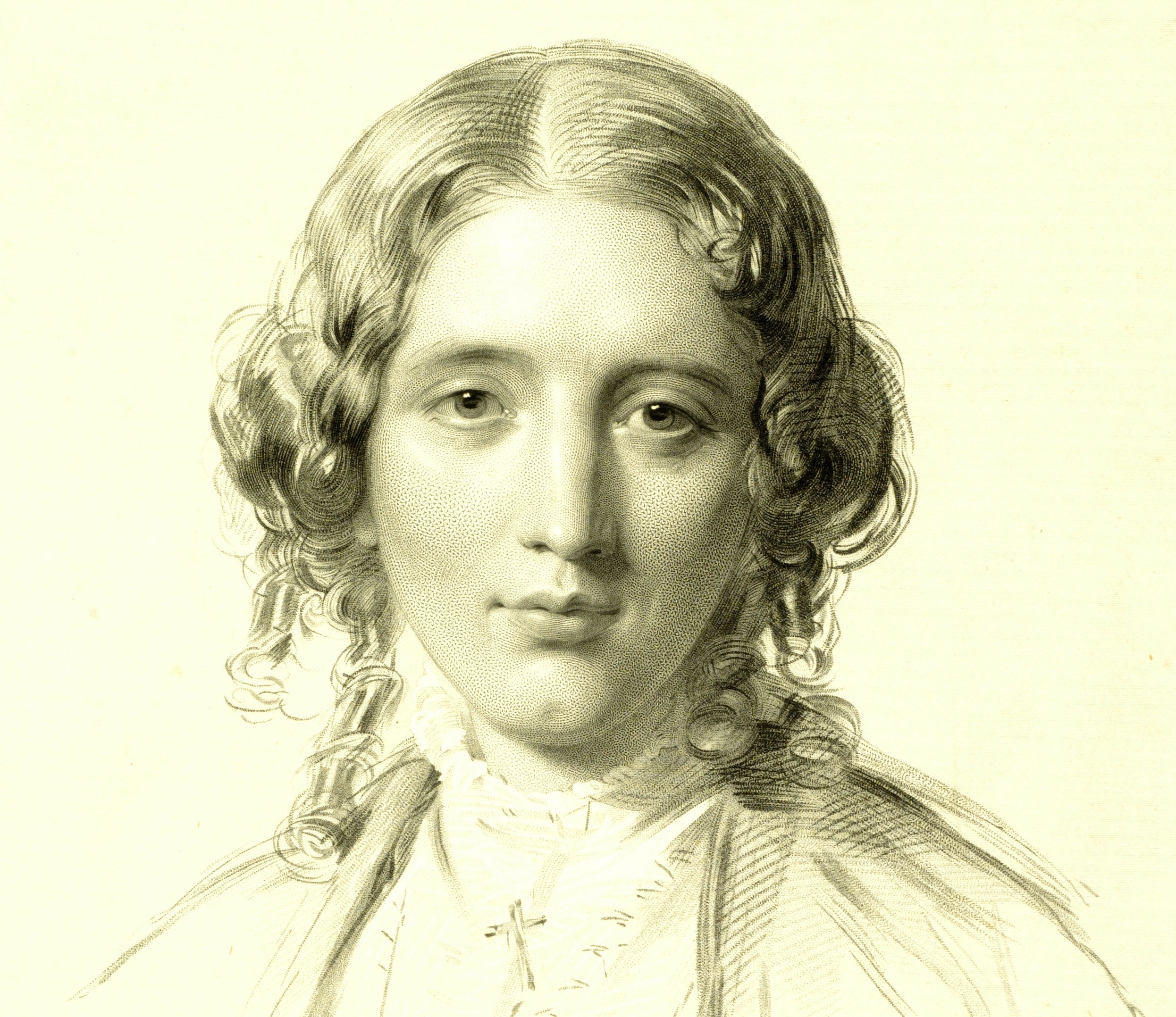
Everyone knows about Stowe’s anti-slavery emphasis. Often forgotten, however, are the deep Harriet_Beecher_Stowe_by_Francis_Holl spiritual currents at work beneath it. In Uncle Tom’s Cabin, a variety of characters have mystical experiences, and Scripture is sprinkled throughout. Tom seems to hear Eva’s voice at times after her death, as in a dream. By the time she wrote the novel, Stowe was confirmed in her conviction that faith has supernatural elements, including the dreams and visions mentioned throughout the Old Testament prophetic books, the Gospels, and the Book of Acts. She believed, moreover, that both sexes could experience these phenomena:

“I will pour out my spirit upon all flesh; and your sons and your daughters shall prophesy, your old men shall dream dreams, your young men shall see visions” (Joel 2:28, Acts 2:17). She had written in letters of yearning to be “baptized in the Spirit,” and she took a keen interest in the many variations and quirks of American Christianity.

And so, despite her rather conservative and even stodgy reputation, Harriet Beecher Stowe was quite the spiritual adventurer. In the midst of antebellum America’s vital and inventive religious landscape, she fit right in. Indeed, as Koester shows, Stowe can be viewed as a key contributor to that landscape: a deep religious thinker whose novels and voluminous spiritual writings both mirrored and shaped the thinking of American Christianity, for better or worse. Koester is at her best, and is most original, when she locates Stowe’s writing in the context of this churning spirituality. She reveals Stowe’s engagement with the religious questions of her day, and how her answers are manifested in her fiction.

(Image of portrait of Harriet Beecher Stowe, circa 1855, via Wikimedia Commons)

The Currency Conundrum In Caracas

Francisco Toro connects Venezuela’s chronic shortages of basic goods to its “deliriously dysfunctional currency exchange control system”:

Unlike a normal country, where you can trade U.S. dollars with local currency at whatever price the market will bear, the Venezuelan bolivar is fixed at 6.30 per dollar, and sold discretionally, only to those the government deems worthy. This worthiness is established on the basis of an enormously cumbersome and corruption-prone administrative process.

The real problem isn’t the red tape, though. The real problem is that 6 bolivars and 30 cents is an insanely low price for a U.S. dollar. Venezuelans will gladly pay 85 bolivars for a dollar, even though doing so is technically a crime punishable by up to 6 years in prison.

Having two prices for the dollar makes figuring out what things cost in Caracas something of a philosophical imponderable.

In another post, Toro explains how far one US dollar can go in the black market:

First, take your crisp new dollar bill to a black market currency dealer and buy yourself Bs.85.

Did you make sure to get travel insurance before you trip? Good. Now go to a doctor and buy yourself Bs.85 worth of medical attention. Any pretext will do. Don’t forget to get a receipt, though: your insurance company back home will reimburse your 85 bolivar claim at the official rate, giving you back $1 for every 6 bolivars and 30 cents you spent. So after one doctor’s visit, your $1 has already turned into $13.50. Not too bad.

But we’re just getting going here. Needless to say your next step is to take your $13.50 right back to the currency tout and buy yourself 1,150 bolivars.

Next, take your 1,150 bolivars to any reputable Caracas jeweller. There, you can get about 5.7 grams of 18-karat gold for that. As it turns out, back stateside those 5.7 grams of gold are worth $182.29. Your Caracas black market dollar dealer will be expecting your call by now: the $182.29 you netted for the gold buys you 15,495 bolivars.

This is fun, isn’t it?