The Auden We Never Knew

Unless, that is, you happened to be one of the elderly church ladies he visited, orphans he put through college, or friends for whose medical care he paid. All of these anecdotes and more are uncovered in Edward Mendelson’s new essay on Auden’s “secret life” of generosity and charity, a life that he kept hidden from the world because “he would have been ashamed to have been praised for it.” Here’s one telling story about the lengths to which the poet would go to cover the tracks of his kindness:

At times, he went out of his way to seem selfish while doing something selfless. When NBC Television was producing a broadcast of The Magic Flute for which Auden, together with Chester Kallman, had translated the libretto, he stormed into the producer’s office demanding to be paid immediately, instead of on the date specified in his contract.

He waited there, making himself unpleasant, until a check finally arrived. A few weeks later, when the canceled check came back to NBC, someone noticed that he had endorsed it, “Pay to the order of Dorothy Day.” The New York City Fire Department had recently ordered Day to make costly repairs to the homeless shelter she managed for the Catholic Worker Movement, and the shelter would have been shut down had she failed to come up with the money.

Mendelson claims that Auden was “presenting himself as less than he was” because of how he had come to understand evil:

By refusing to claim moral or personal authority, Auden placed himself firmly on one side of an argument that pervades the modern intellectual climate but is seldom explicitly stated, an argument about the nature of evil and those who commit it.

On one side are those who, like Auden, sense the furies hidden in themselves, evils they hope never to unleash, but which, they sometimes perceive, add force to their ordinary angers and resentments, especially those angers they prefer to think are righteous. On the other side are those who can say of themselves without irony, “I am a good person,” who perceive great evils only in other, evil people whose motives and actions are entirely different from their own. This view has dangerous consequences when a party or nation, having assured itself of its inherent goodness, assumes its actions are therefore justified, even when, in the eyes of everyone else, they seem murderous and oppressive.

One of many forms this argument takes is a dispute over the meaning of the great totalitarian evils of the twentieth century: whether they reveal something about all of humanity or only about the uniquely evil leaders, cultures, and nations that committed them. For Auden, those evils made manifest the kinds of evil that were potential in everyone.

Dreher relates the essay to a conversation he recently had with a friend about a “grandfatherly gent who was kind to all” but who, as his friend later discovered, “had a terrible, villainous past of which he never, to her knowledge, repented”:

It seems to me that when you are face to face with the reality of human beings, it becomes hard to judge with icy clarity. The genial grandfather who was a terrorist in his youth: his character is both things. His gentleness and kindness in old age does not obviate his ferocious villainy in his youth, but nor does that villainy obviate the sweetness in his late character. One has to hold both things in one’s judgment simultaneously, and that is hard, and even painful. So we come down on one side or the other to dispel the anxiety. Doing so also relieves in ourselves the anxiety that comes from examining our own character, in humility. Sure, we think, we have our faults, but at least we’re not like Them.

Auden seems to have been afraid of this moral complacency and capacity for deception within himself. About ourselves, so should we be. What is so unnerving about the genial grandfather who was once a terrorist is his palpable humanity. If he can be both things, and be unaware of the contradiction, then what, absent humility, is to prevent us from the same fate?

David Zahl adds:

Lest these remarkable stories be dismissed as mere hagiography, Mendelson (author of the indispensable Later Auden) doesn’t lionize the great poet, instead tracing the ‘good works’ back to their root–which is not a sense of earning or credit (clearly) but of genuine humility brought on by piercing self-knowledge. That is to say, the further Auden plumbed his own fallibility and weakness (and few have plumbed more deeply), the more moved he appears to have been to acts of radical generosity and service.

(Video: Trailer for Wystan, a 2012 documentary about Auden)

How Should The West Respond? Ctd

Jay Newton-Small reviews Obama’s options:

No serious observer is now predicting a scenario where U.S. troops are on the ground in the Ukraine. That said, an array of military responses could be taken by the White House to increase pressure on Russia to withdraw. In 2008, when Russia invaded Georgia, President George W. Bush moved U.S. warships into the region and used them to supply humanitarian aid. Thus far the Pentagon has “put on hold all military-to-military engagements between the United States and Russia,” though it has yet to redeploy any U.S. military assets in response to Russia’s invasion of the Crimea. That might change if Russia moves beyond the Crimea into eastern Ukraine. “It’s one thing to hold your military base in the Crimea; it’s another thing to start moving into eastern Ukraine,” says Robert Kahn, a senior fellow at the Council on Foreign Relations. “The Ukrainians would almost certainly resist, and then you have the option of a civil war.”

So far, the Obama Administration has not drawn any clear red lines about the American response if Putin does move into eastern Ukraine.

Totten thinks it’s best to keep that red line blurry:

[T]he last thing the West should do is tell Putin where the red line is located exactly. Want to prevent an explosion in far-eastern Europe? Let him think he’s in danger of crossing it now. Otherwise he may sense a green light from the West to swallow whatever he wants on his side of the EU. Let him see a yellow light, at least, if a red light is asking for too much.

There are various ways to signal a yellow if not a red.

Retired Admiral James Stavridis shared a few ideas in Foreign Policy magazine. Michael Barone has more. Parking destroyers in the Black Sea off Yalta might be a good place to start. The US sent ships to that region when Russia invaded Georgia in 2008. The Russians didn’t withdraw from occupied Abkhazia or South Ossetia, but at least they stopped where they were, withdrew from Gori, and left the capital Tbilisi alone.

J.D. Tuccille is against sending ships:

No matter how powerful the U.S. military may be, any promises the U.S. makes to the Ukrainian people as they face down some of the world’s worst neighbors are going to be hollow and false. American officials can’t—and shouldn’t—make promises that they’re in no position to keep. Hollow assurances may lead Ukrainians to assume that they’ll get backing that won’t materialize—just as many Hungarians felt betrayed after NATO (understandably) failed to intervene to support the 1956 uprising despite encouraging pro-freedom rebels through Radio Free Europe and other official media.

What Josh Rogin hears about the administration’s plans:

Behind the scenes, Obama administration officials are preparing a series of possible battle plans for a potential economic assault on Russia in response to its invasion of Ukraine, an administration source close to the issue told The Daily Beast. Among the possible targets for these financial attacks: everyone from high-ranking Russian military officials to government leaders to top businessmen to Russian-speaking separatists in Ukraine. It’s all part of the work to prepare an executive order now under consideration at the Obama administration’s highest levels. …

Administration sources cautioned that no decision has been made by President Obama regarding the path ahead for sanctions. But that the targets under consideration include not only the Russian government and military, but also organizations and individuals who can be shown to have helped or are helping foment unrest in Ukraine, both inside and outside Crimea.

Drum urges hawks to be patient:

Right now, the catcalls from the right are little more than transparent political opportunism. Obama’s “weakness” didn’t provoke Putin’s military incursion into Crimea. If anything, it was provoked by Putin’s feeling that the West was gaining influence in Ukraine and he was losing it. Nor is Obama refusing to respond decisively. He is refusing to give in to hysteria, but he plainly intends to make Putin pay a price for his adventurism. The fact that this can’t be done instantly is just a feature of the world, not a sign of fecklessness on Obama’s part. It’s time for everyone to stand down a bit and see how he plays his hand.

What Went Wrong With The Reset?

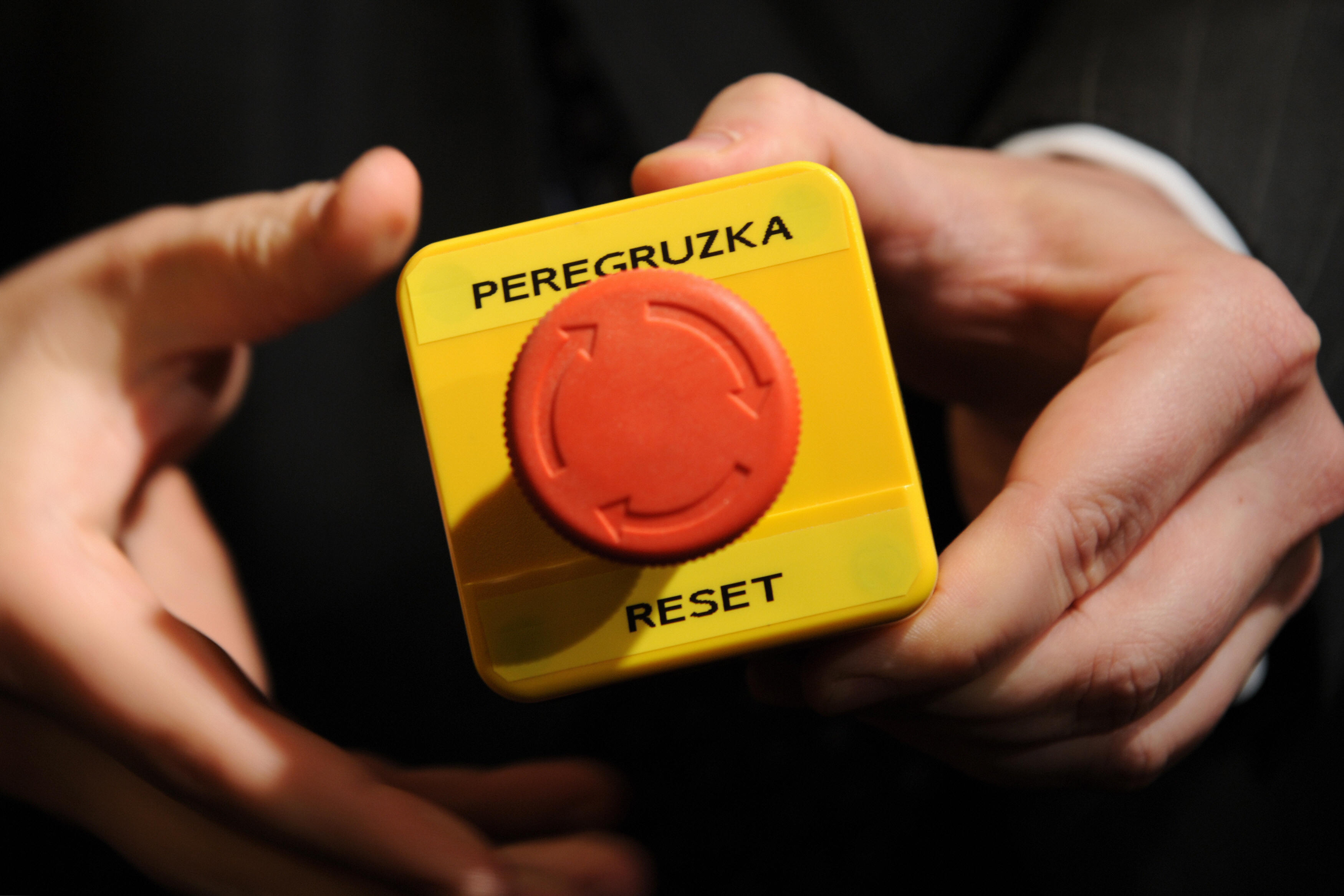
An assistant shows the block with a red

The GOP is criticizing Clinton’s outreach to Russia:

“Hillary’s Russia Reset: Nailed It,” proclaimed the website for America Rising, an opposition research firm and political action committee that has been taking aim at potential 2016 Democratic presidential candidates since soon after the 2012 contest.  The tumblr post tweaking Clinton featured the then Secretary of State cackling as she held out her infamous “reset” button with the Russian foreign minister, a gesture that can come across as silly in light of recent events in Ukraine.

But that was just the opening salvo in what has been a steady stream of knocks on the presumed Democratic front-runner, with Arizona Senator John McCain telling The Daily Beast on Saturday that Clinton “got it all wrong.”

Larison pushes back:

[T]here have been a number of lazy assertions that the so-called “reset” is somehow at fault in what has been happening.

When the “reset” was still going on, it had some modest but real successes, but once the original agenda was exhausted there was very little incentive or political will on either side to keep it going. Judged on its own terms as a means of repairing U.S.-Russian relations from its previous nadir in 2008, the “reset” did what it was supposed to do, but it could not magically change how Russia perceived its interests in the “near abroad” nor could it alter the way that the Kremlin behaved inside Russia. The Libyan war and the way it was conducted certainly soured Russia on further cooperation, especially because of how Russia was persuaded to permit U.N. authorization, and by 2012 the “reset” was essentially over. In its wake, U.S.-Russian relations resumed their dreary course as the U.S. was pursuing a number of goals in Syria and elsewhere that Russia flatly rejected.

(Photo: An assistant shows the block with a red button marked “reset” in English and “overload” in Russian that US Secretary of State Hillary Clinton handed to Russian Foreign Minister Sergei Lavrov during a meeting on March 6, 2009 in Geneva. By Fabrice Coffrini/AFP/Getty Images. Update from a reader: “‘Reset’ in Russian is ‘perezagruzka’.)

“All Conservatism Begins With Loss”

George_F._Kennan_1947

Fareed begins his review of The Kennan Diaries with that observation from my last book, The Conservative Soul, which he believes helps explain why America, “as an experiment in modernity, hasn’t had many genuine conservatives in its history.” George F. Kennan, he seems to think, was one of them, with all the ambiguities that entails. Consider this beautiful lament from Kennan’s diaries that Fareed highlights:

“I cannot help but regret that I did not live 50 or 100 years sooner,” he wrote in one of his entries. “Life is too full in these times to be comprehensible. We know too many cities to be able to grow into any of them, . . . too many friends to have any real friendships, too many books to know any of them well, and the quality of our impressions gives way to the quantity, so that life begins to seem like a movie, with hundreds of kaleidoscopic scenes flashing on and off our field of perception, gone before we have time to consider them.”

It’s a vivid expression of a deep, instinctual conservatism, especially when you consider that it was written in December 1927.

If you think of conservatism in this way, you can see why it has found so few followers in the restless, creedal and optimistic uplands of America. But that may make it all the more necessary in this country. In my view, American conservatism desperately needs a deeper sense of the limits of American power, of the delusions behind rampant materialism, of the wisdom in silence and nature and tradition. A little more skepticism about change might help as well. But as always with cultural pessimists, Kennan’s suspicions of modernity could slip toward the strange and reactionary, as all conservatism can:

Kennan’s conservatism was poetic, comprehensive and utterly impractical. In 1979, he outlined the kind of politics he would favor. “In addition to being a political isolationist, I am a believer in autarky. Not only do I believe that the healthy national society would rigidly eschew the importation of foreign labor . . . but I consider that it should restrict to a minimum its economic and financial involvements with other peoples.”

To some readers, this may sound like North Korea, but Kennan’s celebration of the character, coherence and moral superiority of small communities has a rich pedigree in European thought. It also informs what can only be described as Kennan’s racism. Writing on a flight to Los Angeles in 1978, Kennan thinks about how few white faces he will see when he lands and laments the decline of people “of British origin, from whose forefathers the constitutional structure and political ideals of the early America once emerged.” Instead, he predicts, Americans are destined to “melt into a vast polyglot mass, . . . one huge pool of indistinguishable mediocrity and drabness.”

Douglas F. Brinkley is on the same page as Fareed. He finds the diaries contain “enough gloomy prognostications to give the book of Revelation a run for its money”:

As a philosopher, Kennan is a gold-plated Cassandra. Moreover, on a number of occasions, he espouses views that are homophobic and pro-eugenics.

“Nothing good can come out of modern civilization, in the broad sense,” he writes of his dissatisfaction with life in a 1932 entry. “We have only a group of more or less inferior races, incapable of coping adequately with the environment which technical progress has created. . . . This situation is essentially a biological one. No amount of education and discipline can effectively improve conditions as long as we allow the unfit to breed copiously and preserve their young.” …

Disdainful of automobiles and the Californication of America, full of loathing for strip malls and traffic jams, he reveals his preference for sailing above all else. “I turn my back, figuratively, on the land and keep my eyes fixed on the horizon of the sea — the abused, raped sea, deprived of its dignity and its mystery by the ubiquitous oil rigs, the monstrous thundering automobile ferries, the airplanes over head, the pipelines underneath.”

Kennan would have loathed this Oscar-night commercial, as Copyranter did:

But Christian Caryl argues that it was those very sentiments relayed by Brinkley that made Kennan a brilliant analyst and strategist – they “can’t be seen in isolation from the rest of the package”:

Kennan’s great virtue as an analyst was his ability to see things from the outside. No one was better at tracing out the logical implications of a particular policy in all their elaborate permutations (even if, in so doing, he often ended up overlooking the grubbier but no less important aspects of everyday politics). And this was not despite but because of his own proudly cultivated sense of alienation, his persistent suspicion that he’d been born into the wrong era, or that, above all, he was really a Russian at heart.

He continues with an example:

His black, razor-sharp diagnosis of Stalinism—at a time when pro-Soviet wartime propaganda in the United States presented a diametrically opposed picture of the regime—is of a piece with this innate skepticism and independence of thought. He viewed the mendacious pro-Soviet ambassador to Moscow, Joseph Davies, who hailed the show trials and Stalin, with undisguised contempt and revulsion. As his diaries demonstrate, not everything that he concluded was fruitful or wise or perspicacious—and I have to confess that some of the things I learned about the man from this book did diminish his image in my eyes. But I would still insist that it was precisely Kennan’s ability to ask big questions, and his gift for transforming his insights into powerful prose, that made him so unique. … What I do know is that we condemn him, and those like him, at our own risk. A dose of grumpiness in the right place can work wonders.

Indeed it can.

Putin’s Epistemic Closure

Part of his press conference today, translated:

After watching the full presser, Ioffe decides that “Merkel was absolutely right: Putin has lost it”:

For the last few years, it has become something like conventional knowledge in Moscow journalistic circles that Putin was no longer getting good information, that he was surrounded by yes-men who created for him a parallel informational universe. “They’re beginning to believe their own propaganda,” Gleb Pavlovsky told me when I was in Moscow in December. Pavlovsky had been a close advisor to the early Putin, helping him win his first presidential election in 2000. (When, in 2011, Putin decided to return for a third term as president, Pavlovsky declared the old Putin dead.) And still, it wasn’t fully vetted information. We were like astronomers, studying refractions of light that reached us from great distances, and used them to draw our conclusions.

Today’s performance, though, put all that speculation to rest.

Surrender Douthat!

My apologies upfront: that was simply an irresistible headline. On Sunday, Ross complained that conservatives are not being allowed to negotiate the terms of their surrender on marriage equality:

We are not really having an argument about same-sex marriage anymore, and on the evidence of Arizona, we’re not having a negotiation. Instead, all that’s left is the timing of the final victory — and for the defeated to find out what settlement the victors will impose.

Michael Potemra seconds:

Contrary to the lessons being taught by our toxic culture, not every momentary advantage needs to be followed up with the crushing and humiliation of one’s enemies. So the question should not be, “Can we succeed in getting society to treat those who disagree with us as moral lepers?” but “Is it right to do so?” Churchill famously started one of his books with a credo that included the phrase “In Victory: Magnanimity.” Magnanimity is definitely not a virtue that today’s culture prizes — but this is a moment that calls for it.

Rod’s summation:

American Christians are about to learn what it means to live in a country where being a faithful Christian is going to exact significant costs. It may not be persecution, but it’s still going to hurt, and in ways most Christians scarcely understand. Maybe this will be good for us. Maybe. We’ll see.

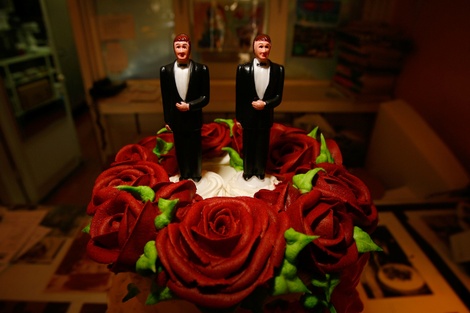
It seems to me there is an important distinction here. If the gay rights movement seeks to impose gay equality on religious groups by lawsuit, or if it seeks to remove tax exempt status for institutions that refuse to include gays for theological reasons, then I agree that such attempts to weddingcakedavidmcnewgetty.jpghumiliate and coerce opponents should be resisted tooth and nail. Such spiking of the ball is a repugnant and ill-advised over-reach, and, to my mind, a betrayal of the soul of the movement. We should be about the expansion of freedom for everyone, not its constriction. We should be in favor of persuasion, not coercion. The question of allowing any individual or business to discriminate against gay people and gay couples is, however, a much trickier area. In any public accommodations, I think it’s counter-productive and morally disturbing. But my own strong preference is for as much live-and-let-live as possible: i.e. not filing lawsuits against anti-gay businesses but supporting pro-gay ones in the marketplace.

Still, championing the ability to fire gay people on religious grounds does not seem to me to be a winning argument for those opposing marriage equality. A majority of even Republicans favor laws banning workplace discrimination against gays, and the national majority is immense: around 68 percent for and only 21 percent against. In the same poll, 80 percent of Americans thought this was already the law! That’s a hill I would not aim to die on, if I were the Christianist right.

But what Ross and Michael and Rod are really concerned about, it seems to me, is the general culture of growing intolerance of religious views on homosexuality, and the potential marginalization – even stigmatization – of traditional Christians.

I sure hope that doesn’t happen, but it’s not something a free society should try to control by law. There is a big difference between legal coercion and cultural isolation. The former should be anathema – whether that coercion is aimed at gays or at fundamentalist Christians. The latter? It’s the price of freedom. The way to counter it is not, in my view, complaints about being victims (this was my own advice to the gay rights movement a couple of decades ago, for what it’s worth). The way to counter it is to make a positive argument about the superior model of a monogamous, procreative, heterosexual marital bond. There is enormous beauty and depth to the Catholic argument for procreative matrimony – an account of sex and gender and human flourishing that contains real wisdom. I think that a church that was able to make that positive case – rather than what is too often a merely negative argument about keeping gays out, or the divorced in limbo – would and should feel liberated by its counter-cultural message.

Rod wonders if being the counter-culture “will be good for us.” In my view, it really could be. Since Constantine, Christianity’s great temptation has been to doubt the power of its truths and to seek to impose them by force. And its greatest promise has been when it truly has been the counter-culture – in the time of Jesus and the decades after, or, say, in the subversive appeal of Saint Francis’ radical vision. Why see this era as one of Benedictine retreat rather than of Franciscan evangelism? Why so dour when you can still be the counter-cultural salt of the earth?

(Photo from Getty)

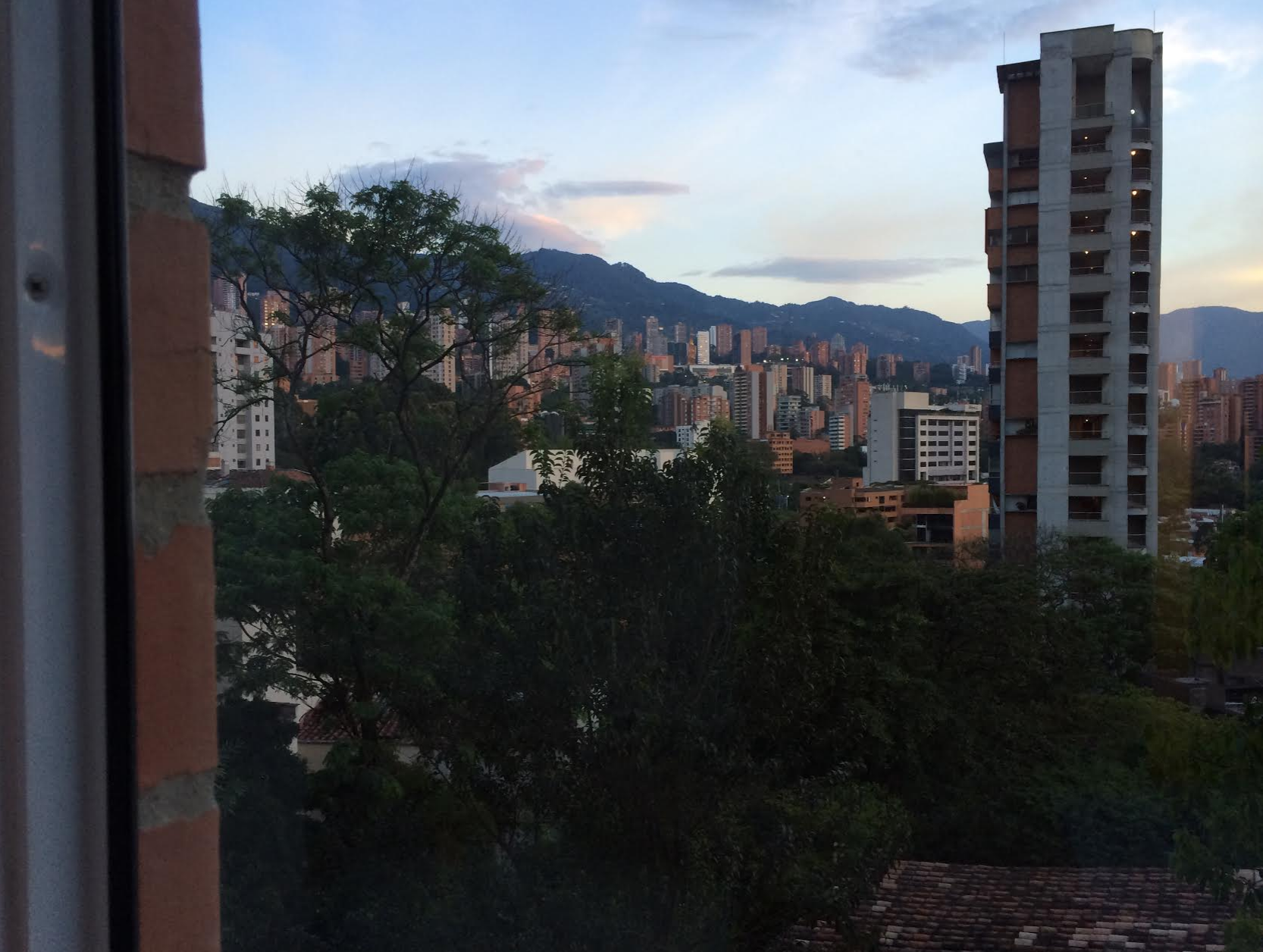
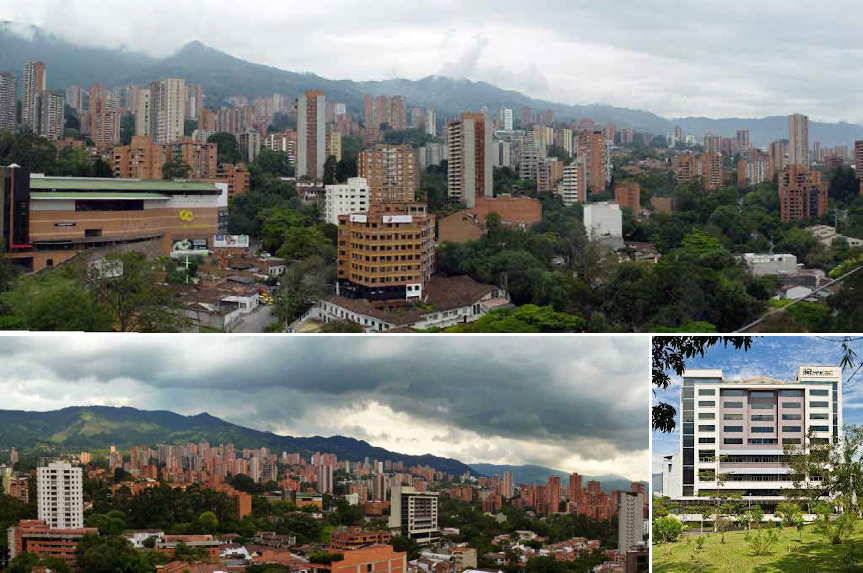
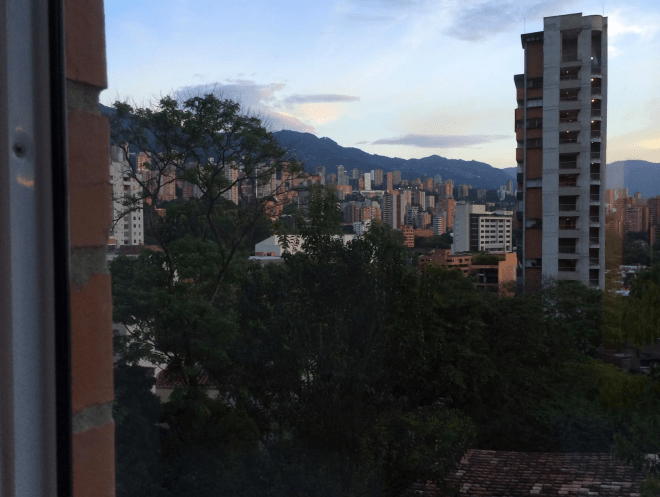
The View From Your Window Contest: Winner #194

vfyw_

A reader details the scene:

Lots of post-war buildings -> a place that had to build a lot after the war. Decent-sized city. Mountainy hills. Bonsai-ish shaped tree. Facing Southeast. That’s all I’ve got. Kyoto, Japan?

Another in East Asia:

Jungly trees framed by stacked-tower high-rises and snaking mountains: could only be the landscape of Hong Kong!

Maybe it’s in Europe:

I swear that’s a Mediterranean city, and I think it could be Marseille on the French Riviera.  I’ve been there a few times (though it’s been a long time), and both the hills and the architecture look very familiar.

Or Central America?

My goal is to get the right city at least once. My guess here is based on the general impressions I have of San Jose, Costa Rica (city in a geologic bowl + Spanish tile at the bottom) and that the towers seem familiar.

Another heads south:

Santiago, Chile. Never been, but this picture makes me want to go.

Right continent. Another is thinking Brazil:

This is a great contest to be able to learn about other countries and cultures.  On a work-related visit to Sao Paulo a few years ago, on one of the tourist tours we got, it was mentioned that Sao Paulo was the city with most buildings in the world.  Since the photo show a large amount of buildings in a limited space, my best guess will be Sao Paulo.

Another city:

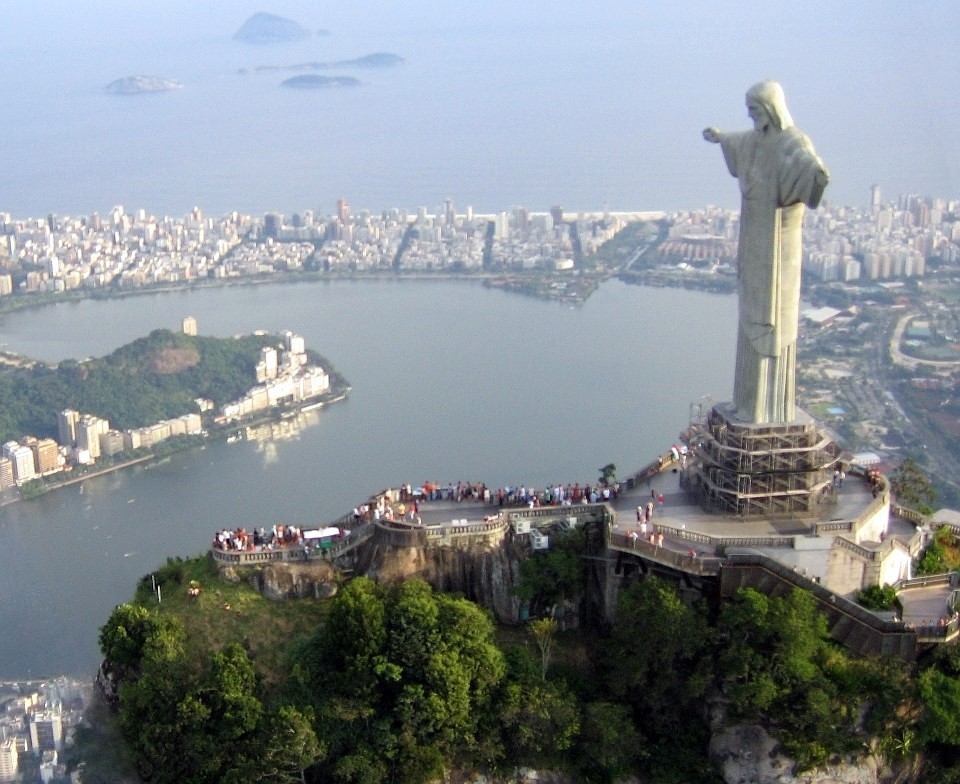
Rio de Janeiro, Brazil? The faded Brazilian flag on that far-off skyscraper suggests that I’m looking in Corcovado_statue01_2005-03-14the right place, even without the sight of Cristo Redentor to verify. I don’t know this neighborhood, so I’m guessing Jardim Botânico, near the Lagoa Rodrigo de Freitas, looking north. The hills seem to match, although I don’t know that the residential buildings are actually as tall as these, or that there’s much new World Cup or Olympic construction in this part of town. These buildings seem more vertical than Rio’s, and I could keep digging, but this way madness lies. So a wild guess: the top floor of Rua Juan Carlos, 147, looking northeast.
(I enjoy the confident responses that turn out to be continents away from the truth, so I’ll be in amusing company if this is actually in southeast Asia. In any case, I suspect Glenn Greenwald will have a little laugh at my answer.)

Another moves down the map:

Montevideo, Uruguay. Because why not?

Another gets to the correct corner of the continent:

Just a wild guess, but this week’s contest photo really looks like Quito. I spent several weeks in Ecuador in January of 2007, and saw these kinds of clustered high-rises a lot. It was also the first (and so far only) time that I had the opportunity to eat guinea pig for dinner (aka “cuy”, a traditional Andean meal, and actually pretty tasty – but don’t tell my guinea-pig loving niece).

Also, kudos on the contest photo selections. I’m always amazed at the details that your readers are able to ferret out. I’d wager to say that the contest alone is worth a subscription to the Dish!

Another adds:

If I am right that this is Quito, it is a testimony to the descriptive skills of Didier Tronchet, a French illustrator who lives there, and whose illustrated tale “Les Vertiges de Quito” (Quito Vertigo), I read in the summer 2011 issue of the revue XXI.  I’ve never been to Quito, and as best I know I’ve not seen photographs of the city, but this photo reminds me of the city described and drawn by Tronchet.

Another joins the head-scratching:

So simple, yet so difficult.

The mixture of red brick and concrete construction – and the density of the buildings – make me certain this is Caracas, Venezuela.  But there are simply no distinguishing clues other than what looks like two letters (SW) from a large hillside sign.  That didn’t help and after hours of searching I cannot narrow down the location and I’m giving up in the name of marital harmony.  I will guess that it was taken from somewhere in the Altamira neighborhood.

Good puzzle. And thank you, by the way, for the excellent coverage of events in Ukraine. I can’t overstate how helpful it is when you pull together insight from other authors and tie it together with your own thoughts. Well worth the price of subscription.

Caracas was the most popular incorrect guess this week:

The unfinished building in the center reminded me of Homeland, in the scenes when Brody was in Caracas, in the Torre de David. Of course, those were filmed in Puerto Rico, and when I did a little research on the Torre de David, it’s clear that it’s not the main building in this picture. But I’m sticking with my gut, since Venezuela has been in the news.

Another gets the correct country:

Beautiful photo this week. The city looks at first glance like a lot of the major Latin American cities, some of which I know only from photographs: La Paz, Quito, Rio, Caracas. I was in La Paz and Quito some years ago and was surprised how vertical their skylines were. Yet something about this image doesn’t quite look like either. La Paz is situated more in a giant crater, with the boom-city of El Alto up along the rim, while Quito is hemmed in by giant, green volcanoes that look a lot steeper than the mountains here.

Based only on photos I’ve seen in the past, I’m going to say it’s Bogotá, Colombia, crossing my fingers that it isn’t one of the other cities that I’ve mentioned. Or worse, Medellín.

Worse:

I honestly don’t know how people do this contest.  I knew the Hossana, Ethiopia entry from a few months ago, but all that required was a quick glance (I didn’t know the town, but I did Peace Corps there, and knew it was Ethiopia). For this one, though, I have been searching for about an hour and a half, and all I have come up with is El Poblado district in Medellin, Colombia – and that’s thanks to my wife.  I know some one is going to get this one, but I don’t know how people do it week after week.

Medellín it is, and also in the El Poblado district.  Another reader guesses a nearby apartment building:
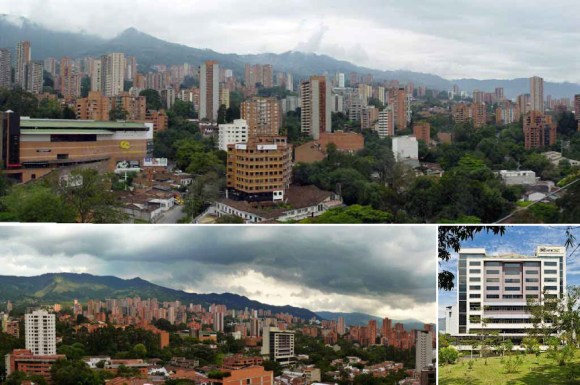
medellin-1-2-diez

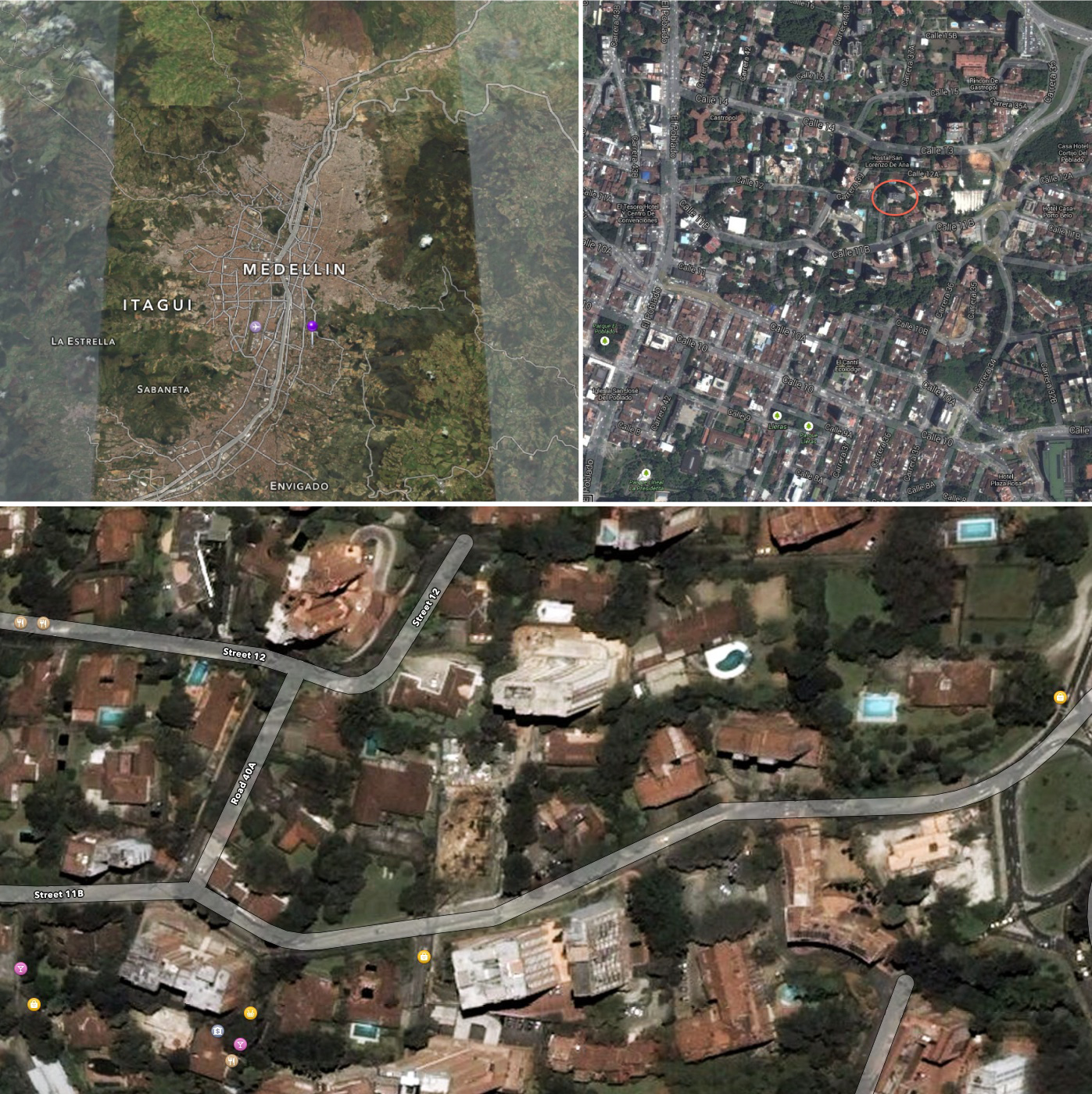
Well I was able to narrow this one down to Medellin with the help of two pictures (one from Google Earth, one from a traveller’s YouTube video). The short wide building on the right side of the photo is the Diez Hotel. But damn it! Google Earth and Google Maps are out-of-date (unable to keep up with the apparently insane pace of construction in Medellin, I guess), so locating the building where the VFYW photo was shot from was nearly impossible.

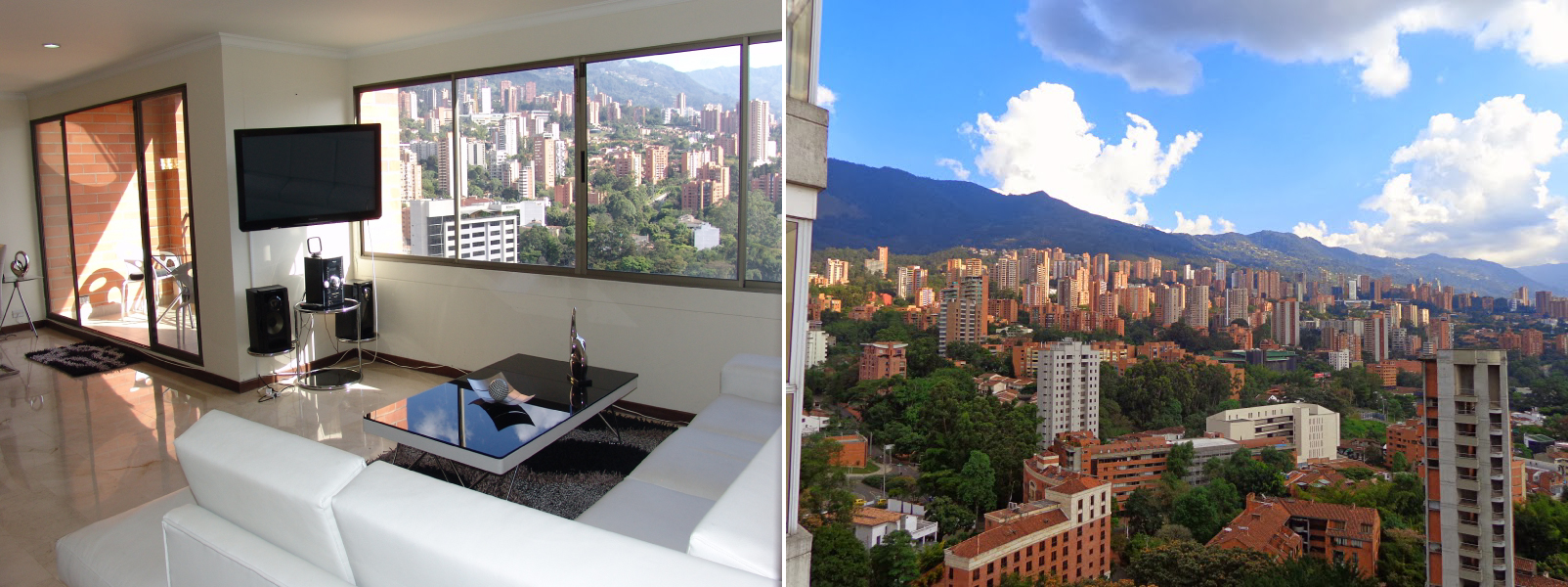
But I did find these photos, which I think were taken from the San Pedro de Alcantra apartment building, and judging by the views, this is the building seen in the foreground of the VFYW photo (below left), as well as a view from another complex (below right):
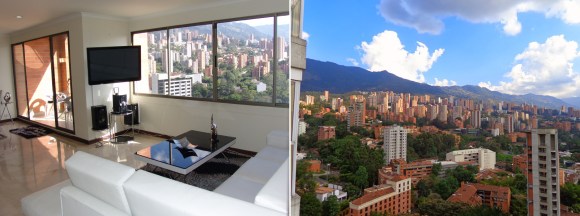
medellin-apartment-plus-view

This must be the apartment complex where the photo was taken, but I couldn’t find the address, so my best guess for exact location is: Carrera 37A #11B-100, Seventh Floor, Medellin, Antioquia, Columbia

Another reader would take issue with that entry:

Assuming this view is in Colombia, please reject any submissions that do not spell ColOmbia correctly.

Another takes the time to explain an interesting feud:

My mom is from Bogotá, which has an old civic rivalry with Medellín that’s on par with the old hatreds between certain medieval English market towns or ancient Greek city-states. Below is a summary on inter-Colombian hatreds in case anyone is interested.

Bogotanos are stereotypically a bit cachaco – cold, distant and stuck-up in their manners like a British toff or Boston Brahmin. Bogotá is set up high in the Andes and has a climate similar to London. Residents used to wear woolen ruanas (ponchos) over their dresses and suits. Bogotá was also the old Spanish viceroyal capital. The presence of the Spanish court, and, later, the seat of the Colombian republic, brought with it all the stuff the goes along with the State in ambitious young countries striving for respectability: embassies, foreigners, archbishops, seminaries, learned professional societies, universities, cafes, bookstores, Marxists, pamphleteers, art galleries, the national language academy. Bogotá was dubbed once the “Athens of South America.”

Medellín is the young upstart city that grew on trade and industry. Think a mini-São Paulo or Birmingham a hundred years ago. The climate is much warmer than in Bogotá, though still temperate and spring-like. Its inhabitants are known, as the stereotype goes, for being wheelers and dealers and perhaps a bit relaxed in their morals.  There is a legend that the inhabitants of the region, known as pasias, were conversos – Sephardic Jews who presented themselves as Catholics to the outside world but who maintained Jewish law and beliefs in private. They were known more recently, and more infamously, for being at the heart of the narcotics trade and the home of drug kingpin Pablo Escobar.

Bogotanos were concerned for a long time during the middle of the 20th century that their young paisa upstarts had outclassed them in terms of quality of life and development.  Medellín boasted (and still boasts) the country’s only metro system. Its city center was modern and clean. Its denizens were cosmopolitan and (in the middle of the 20th century) tango-obsessed – like a bunch of porteños (natives of Buenos Aires)! But, more recently, in the past quarter century, the capital has made important moves in the direction of humanistic and ecological urban design.  The Transmilenio bus rapid transit system is a massive success, as is the Ciclovía open streets program for bicyclists.  Soon Bogotá, if city hall can get their stuff together, will have its own metro. It’ll be underground, too. (What will you have then, Medellín?  What will you have then?)

Another reader gets back to the technical side of the contest:

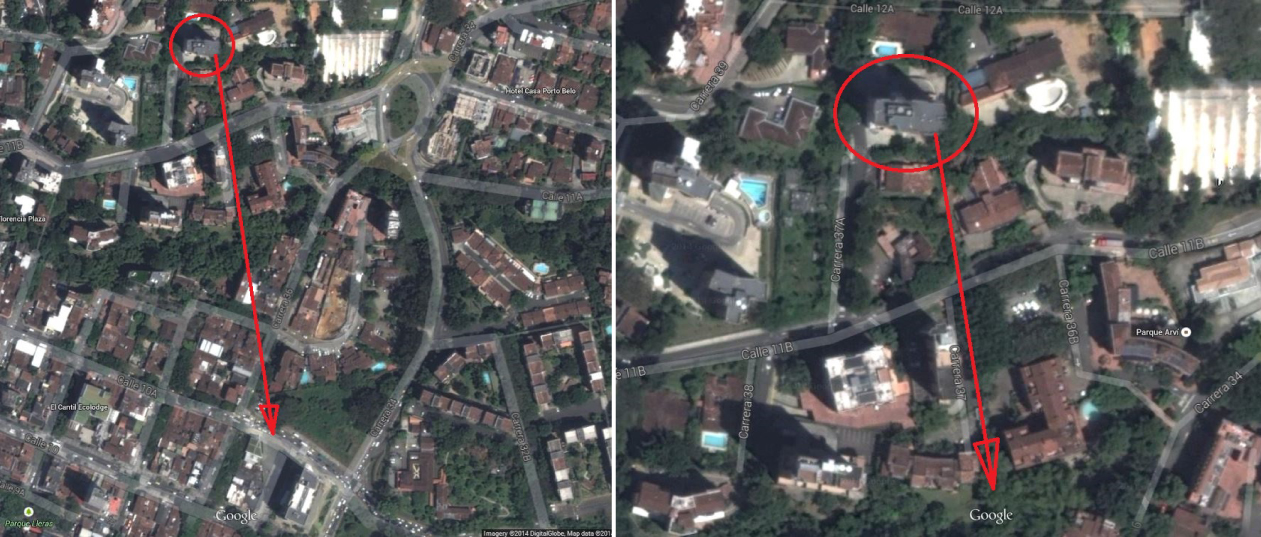
I don’t know the street address but it’s the high-rise on Carrerra 37A, just above Calle 11B in the El Poblado district of Medellin. I’ve attached two maps to illustrate the building and angle of the photo:
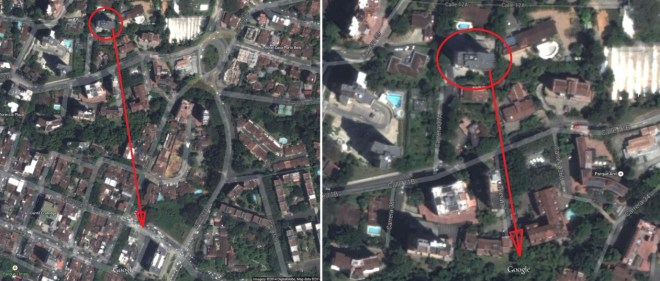
VFYW-Medellin-Submission-(zoomed-out-and-in)

I wasn’t able to find an image of the building, but my guess is a unit on the south-east corner. I’ll guess the sixth floor, based on the tree height.

Whew, this one was a doozy! After an embarrassingly long afternoon of Google searching, I found my Rosetta Stone: The modern white tower in the middle of the picture. I googled Calle 10, which is where I thought it was, and viola: a travel blog with a view of the building that clearly placed it. Now that I’d finally narrowed in on the hillside, I just needed to triangulate. I followed the probable sight lines and found that narrow tower (which sits on the south side of Calle 11B) and saw one tower looming in just the right location above it (with just enough foliage in between them).

I tried to figure out the address or whether it was a hotel for a while, but finally gave up. Man this game is hard without Street View!

Another found an alternative tool useful:

The key to solving it for me was finding a higher resolution picture on Flickr taken from a higher floor in the same building. It is hard to describe this week’s location because it isn’t a hotel and Google Street View does not include Medellín. I also couldn’t find the apartment on Airbnb. The coordinates for the building are 6.212764, -75.566072 and the closest address I could find is Carrera 37A No. 11B.  I will guess the 6th floor looking out south by southeast.
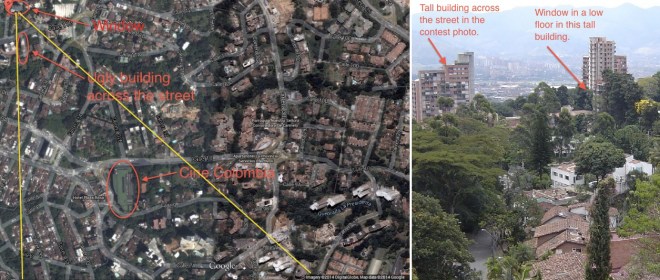
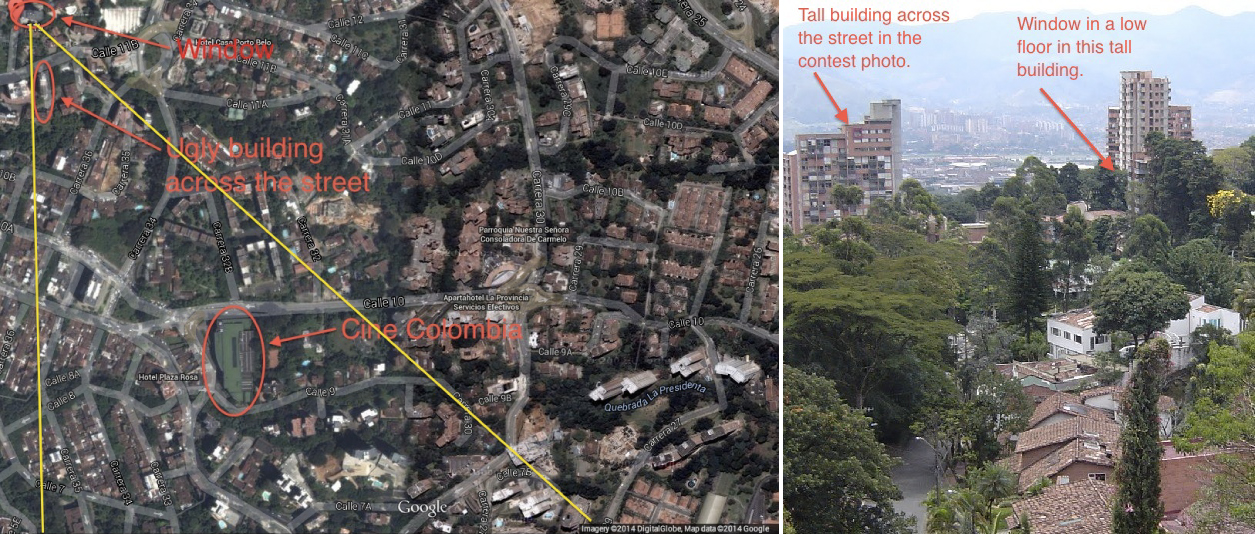
overhead-shot-side-view

Attached are two pictures.  First, a side view picture of the tall apartment building across the street that also shows the building where the contest photo was taken.  Second, an overhead picture with a few labels.

Many contestants correctly identified the building, but only three guessed the right building name or address. This week’s winner was the only contestant to guess the right room:

After getting the right hotel in two much easier contests (Cebu City and Phoenix), this is the first time I’ve managed to solve what seems to be a more challenging VFYW. Getting to Medellin was actually the easy part. I haven’t been to South America, but the view immediately made me think of pictures I had seen of the northern part of the continent. After a few bad guesses with Quito, Bogota, and La Paz, I quickly settled on Medellin. Not too long after that, I found a similar view, and in that view the Cinemark theater was legible, allowing me to find this part of town on Google Maps.

From there, it got much tougher. The lack of Google Street View was a killer, forcing me to match 2D building tops on Google Maps with 3D skyline views in Google Images. Eventually, though, some unique buildings allowed me to nail down the location on Carrera 37A, and the address is 11b-73 – known as the Bosque de Plata, a 17 floor apartment building. Here’s a different view from that building (Apartment 1002), with both the tall building on the right and the Diez Hotel identifiable as the same buildings in the VFYW picture:
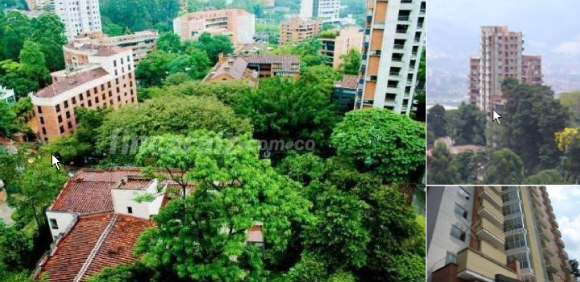
image001-002-003

I believe I even found a couple pictures of the building from which this VFYW picture was taken (seen above to the right). Figuring out the floor and/or specific apartment is pretty much a guess. Given the level of the apartment in question relative to the building across the way, as well as the slope between those two buildings, I’m going with the 5th floor. And the picture below from 1101 had an angle on the Diez Hotel that was close enough to convince me that this was Apartment 501:
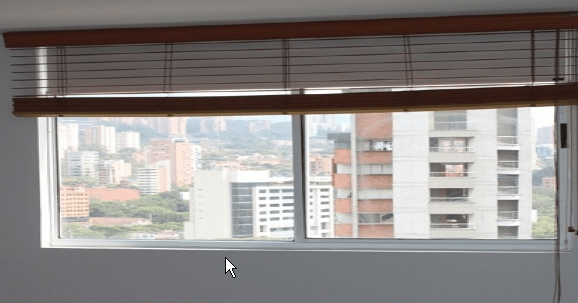
image004

My family will be very pleased if I’m right, and thereby excused from future VFYW contests.

Oh you’ll be back! But otherwise congrats. From the submitter:

The photo was taken on Feb 10, 2014, 6:15 pm at Carrera 37A No. 11B-73, Apt# 501, Bosque de Plata, Medellin, Antioquia Colombia. It is located on a slope in the Poblado section of the city.
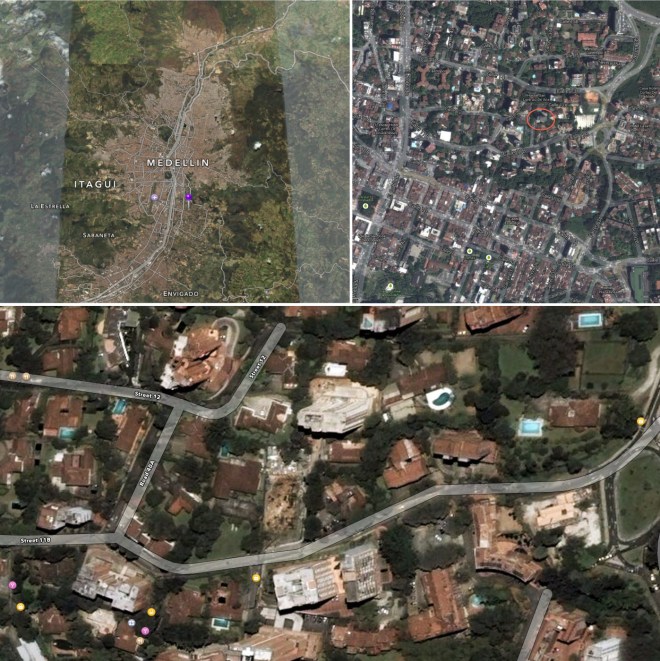
194-submitter

(Archive)

Who Wants Another War?

Not Americans:

Asked whether the international community as a whole has a responsibility to get involved in resolving the situation in Ukraine, less than a third of Americans (30%) think that what is going on in Ukraine is the world’s business. 28% say that the world doesn’t have a responsibility to get involved, while 42% just aren’t sure.

Support for any US intervention to defend Ukraine against a Russian invasion is even lower. Only 18% say that the US has any responsibility to protect Ukraine, while 46% say that the US does not.

Ambers doubts that the Russians want war either:

I’m guessing that a full occupation of Ukraine is much too large for the appetite of the Russian people to stomach. A stalemate, or a process, is much preferable to war, a war that would doubtless exacerbate whatever tensions already exist. In Ukraine, Russian belligerence will alienate the world community much more indelibly, and Russians know that. The Crimea is gettable. Ukraine is not, without significant costs that Russians — who are getting whiffs of what it’s like to exercise global political leadership again (think Iran and Syria) — probably won’t let their technocratic oligarchical political system bear.

Ukraine On The Brink, Ctd

Funeral Ceremony in Kharkov

Readers comment on the ongoing crisis:

We have been failed deeply by the U.S. press on this conflict. If I single out the NYT, it is only because it is the newspaper I read most often, but the NYT has been uncritical in its coverage of the Maidan protests and obsessed with the personality of Putin and the question of Obama’s leadership. There has been very little attempt to explain Russia’s historical relationship with Ukraine; to critically evaluate Western political maneuvering in the region; or to analyze the actions taken by the Ukrainian interim government that have antagonized the population of eastern Ukraine. The French and British press are not much better (example here). This is not to excuse or exculpate Putin’s actions, but simple to insist that we have journalism that is critical and interested in facts, history and the ideological point of view of our putative adversaries rather than simply the pursuit of U.S. foreign policy goals.

In any case, I was very pleased to find your link to Anatol Lieven’s article, and your quote:

I fell prey to this myself, buoyed by obvious and instinctive support for any country resisting the boot of the Kremlin, and too blithe about the consequences of a revolution that overthrew a democratically elected president.

Thank you for including a fuller range of voices in this discussion. I really do believe that your ability to revise your judgment is why so many of us keep coming back to the Dish despite our disagreements with you.

Another isn’t as complimentary:

I don’t think your assessment of Putin is correct; I don’t think he is desperate or panicked. There are real reasons that Putin and Russia think the way they do and why they did what they did in Crimea. Think back to the beginning of the November protests.

They were instigated by a proposed trade union with Russia and fueled by a virulent strain of neo-Nazism and ultra nationalist sentiment. They toppled statues of Lenin, shouted anti-Russian slogans, and brought up memories of World War II. This sent a worrisome message to anyone who was Russian.

Then a deal was struck with Yanukovych, who admittedly did a poor job managing the crisis, and it was enough to keep him in power for another few months. But the right-wing protesters took objection to it, initiated some violence and, as often happens in these cases, it spiraled out of control. Yanukovych fled, and practically the first actions of the new parliament were to disband the Berkut (shades of Iraq circa 2003), vote to try Yanukovych in the ICC (which the Ukraine has not even acceded to), and outlaw the official use of Russian.

So what is Russia supposed to do? Whatever you might say about Putin or the Russian people, they are fiercely nationalistic. Putin’s first job is to protect the Russian people. An autocrat is nothing without his people, and if he isn’t going to do anything when there are visible and real threats to Russians in Crimea, then he isn’t worth anything as a president. What is happening in the Crimea is not the Sudetenland 1938; it is North Cyprus 1974. In fact, the parallels are eerily similar from the coup in Greece to the language used by Turkey and Russia.

Now the Turks were more blunt and direct in their confrontation than Russia, which is fortunate for Crimea, since no blood has been spilled. In fact, Russia’s language and actions have been very consistent – urging peaceful resolutions, not engaging in confrontations, etc. The only bellicose language is coming from the putsch regime in Kiev, which amounts to empty bluster.

President Obama has to be very careful not to misinterpret Russian actions here, which you seem to have done. Trying to “isolate” Russia is laughable: diplomatic impossible due to Russia’s seat on the Security Council, and even at the height of the Cold War American always kept an embassy in Moscow, and economically improbable given Europe’s reluctance to let go of Russian gas. Also, did you not write previously about how isolating an autocratic regime binds the people closer to that regime. This is your whole justification for talks with Iran, right?

Don’t fall into the Munich (Kagan, Kristol) Fallacy; not every international even is analogous to World War II. Let this scenario play out. Putin doesn’t want a war. I doubt he even wants the Ukraine now. What he wants is stability.

Another reader:

I appreciate that you don’t want to see us get militarily involved in the Ukraine (I don’t either), but your analysis seems to focus primarily on whether Russia was right or wrong to move in defense of the rights of ethnic Russians in the Ukraine. Take a step back: Russia has invaded a sovereign nation. We have treaties that recognize and protect the sovereignty of the Ukraine as its own country.  Whether Putin has his reasons for protecting people there or not, he’s still moved his army into the Crimea and ordered the Ukraine forces stationed in that area to disarm.

This was only okay in early 20th-century politics.  This is the kind of thing Iraq did with Kuwait, when it was run by someone who didn’t see how politics had changed since the end of the Cold War.  And it’s really weird to see Putin make a similar mistake; he should be smarter than that.

I really hope that this can be worked out diplomatically, or that coordinated economic sanctions will be the worst that comes out of it.  And we absolutely need to involve other countries and not act alone; we aren’t the only country that has recognized the Ukraine’s sovereignty and right to exist.  But the Crimea can’t be left to Russia.  If Putin is able to take advantage of turmoil in the Ukraine to swoop in and steal a part of their territory, it tells him (and other nations) that opportunistic military action against weaker countries is okay.

Just because we got away with it in Iraq (and we’re now regretting it) doesn’t mean we should ignore it when it happens now.  At least with Iraq we spent months beforehand spreading disinformation to justify our actions; Putin doesn’t even have that.

Another:

This eagerness to dismiss Putin as crazy and foolish worries me. Scary and wrong as he may be, isn’t it possible Putin is crazy like a fox? Isn’t it possible he knows he’s losing a lot in the short term – whether it’s influence in the future Ukraine (arguably minimal regardless, as long as it’s ruled by a Western-oriented Kiev), or popularity in Europe (arguably irrelevant, as long he has so much gas to sell them) – but he doesn’t care, because the world’s outrage (outrage I tell you!) only guarantees everyone will tread lightly around him for ten more years? Surely these limited military moves (so far) buy him major fear points versus all kinds of enemies and frenemies, internally and internationally. If he mounts a full scale invasion, then he’s nuts, but if it’s anything shy of that – I think we have to ask ourselves if he’s not a far better chess player than anyone wants to admit.

This guy lets oligarchs get rich mostly to gather more power to himself, not to build the Russian middle class. Same with foreign investment. If you’re building a modern power structure where fake democracy married to provocative foreign policy serves your one-man-rule purposes best – and let’s face it, he’s one of the world’s most durable leaders of one of the most powerful countries – then maybe he’s playing his game the smartest way it can be played.

Another addresses the nuclear question:

Claiming that the Russian invasion of the Ukraine sends the message that one should never give up one’s nukes is far too facile. Russia didn’t invade the Crimea because Ukraine gave up its nukes. The Russians invaded because the Ukraine couldn’t get their shit together and were descending into a civil war. Do you really think Russia would be less inclined to invade if a nuclear armed Ukraine were coming apart at the seams? More likely is that Russia would step in and “secure” Ukraine’s nuclear arsenal with Europe’s blessing.

The Khadaffi situation is similar. We didn’t invade Libya once Khadaffi gave up his nukes. He was executed by his own people after a popular revolt. Don’t fall for this neo-con nonsense. The arguments have a veneer of truth that fades away as soon as they are subjected to scrutiny.

One more reader:

My ex-husband is an ethnic Russian from Cherkassy (a small city on the Dnieper, about 100 miles outside of Kiev), so our 4-year old son is 1/2 Russian-Ukrainian (the term my ex uses to refer to himself) and our son’s grandparents live there. We don’t communicate much, and when I broached the subject two weeks ago (his parents are planning a trip here at the end of March, and I’m concerned that they either won’t make it here or won’t make it back) he downplayed it – conflicts in Kiev are localized, what is happening on Independence Square is far from the ideas of majority of “normal Ukrainians”. I haven’t been in touch since because I imagine he’s not happy about how things are going (he has praised Putin in the past, and he does consider himself a Russian before Ukrainian) and frankly I’d rather avoid him (we divorced for a reason!). But I do worry about his parents, who are sweet, lovely folks, and recent events make me aware just how little I understand about my son’s family’s complicated social and political background.

So thanks for putting the coverage where I’m guaranteed to see it. A founding subscriber, I check the Dish several times a day.

More reader commentary on our Facebook page.

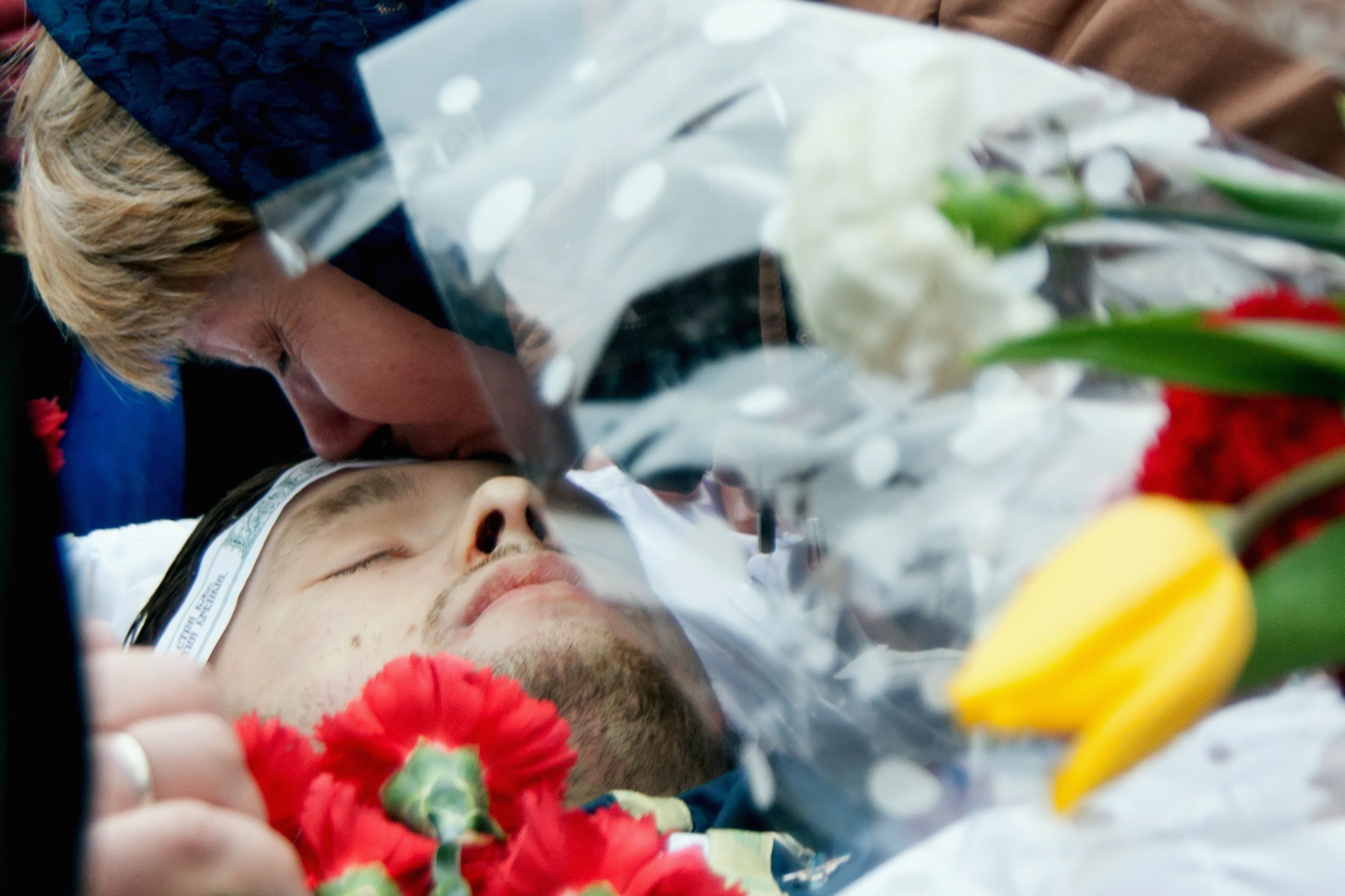
(Photo: Around 3,000 people attend the funeral ceremony of Vlad Zubenko, who died during the anti-government protests at the Independence Square, on March 2, 2014. By Sofiya Bobok/Anadolu Agency/Getty Images)

The Rationale For Sanctioning Russia

Kimberly Marten explains it:

Sanctions would probably not do much to hurt direct Russian economic interests, given the dependence of many E.U. countries on Russian gas imports and the absence of any key economic levers in Europe or North America. Yet the sanctions threat could still have a negative impact on Russian President Vladimir Putin in an indirect way, by contributing to instability among the elite clans who vie for control over Kremlin policy.

Western pundits have a tendency to equate “Putin” with “Russia,” seeing their interests as one and the same.  But Putin does not rule alone.  Instead he sits at the top of competing informal network groups who vie against each other for political power, in a Kremlin game that Philip Hanson has likened (in an edited scholarly volume) to “dogfights under a carpet.” Putin’s political longevity is testament to his skill in balancing and managing this network competition, as Henry Hale recently argued.  Putin built his reputation on maintaining political and economic stability in Russia, replacing the chaos of the immediate post-Soviet years with order and predictability—and that means containing the dogfights.  If elite battles break out into the open it will be a sign of Putin’s weakness, and will likely lead contenders to emerge to challenge him.

Rosie Gray notes the EU’s reluctance to pursue sanctions:

“The basic issue is that it’s easy to talk about economic sanctions when you don’t really have an economic relationship with Russia, like the U.S.,” said Alex Kliment, director of emerging markets strategy for the Eurasia Group. “They [the EU] have a huge economic relationship with Russia and could inflict significant economic pain on Russia through sanctions.”

“But they also, by virtue of that economic relationship with Russia, are much more vulnerable,” Kliment said. Kliment said Germany, with its dependence on Russia’s vast oil reserves, would be a deciding factor.

Danny Vinik expects Germany to continue to resist sanctions:

Merkel is worried that Putin will cut off exports to the European Union. If that were to happen, it would cut off a huge energy source for Germany, and the rest of Europe, and cause gas prices to skyrocket. The United States would not be immune from higher gas prices, but European nations, particularly those like Germany that are highly reliant upon Russia’s energy exports, could also face shortages that upend their markets. Germany is looking to avoid that at all costs.

Keith Johnson predicts Putin won’t use Russia’s gas exports as a weapon:

Russia would almost certainly lose more in an energy war with Europe than it would gain. Fundamentally, energy trade between Russia and Europe is a two-way street. As much as European policymakers fret about dependence on Russian gas, Gazprom frets about dependence on the European market, which accounts for fully three-quarters of its export sales. More broadly, Moscow relies on oil and gas exports for one half of its federal budget. That makes a prolonged shut off of gas exports to Ukraine and the rest of Europe a dangerous proposition for Russian President Vladimir Putin.