On The Ground In Crimea

Vice reports on the standoff:

Natalia Antelava covers Crimea’s ethnic divisions:

“I don’t mind Ukrainians in principle, but events in Kiev showed their true Fascist face,” Valentina Nikolaeva, a seventy-two-year-old Russian Crimean, told me. “They want to exterminate us.” Every day, she joins pro-Kremlin demonstrators, who gather under a statue of Lenin in front of a local administration building. “Thank God for Putin,” she said. “He is the only one who will protect us.” Nikolaeva told me that she likes her Tatar neighbors, a comment that infuriated a man standing next to us, who shouted, in response, “Tatars are animals! They are waiting for a chance to kill us.” Nikolaeva argued back, but soon she and the man were surrounded by others, all of them shouting, and she was completely drowned out.

Previous Dish on the Tatars here. The second part of the Vice series is after the jump:

Arizona On A National Scale?

Gabriel Arana warns that a Supreme Court ruling in favor of the defendant in Sebelius v. Hobby Lobby could have the same effect as the Arizona bill Jan Brewer vetoed last week, but nationwide:

It’s easy to see how a win for social conservatives in Hobby Lobby could sanction the same sort of discrimination as the Arizona law. If a for-profit employer is allowed to opt out of the contraception mandate, it stands to reason that refusing to extend health benefits to gay couples would also be protected. “It’s a slippery slope,” [director of the Faith and Progressive Policy Initiative at the Center for American Progress Sally] Steenland says. … Sebelius vs. Hobby Lobby is poised to become the Citizens United of the culture wars. In fact, the question at the heart of the case bears a striking resemblance to the one the justices considered in Citizens: Do corporations have freedom-of-religion rights? If the Supreme Court finds that they do, then religious owners and employees of for-profit corporations have pretty good grounds for refusing to cover treatment for HIV or any health care related to the pregnancy of an unwed mother.

Ian Millhiser shares that concern:

Denying birth control to your workers because of your own religious objections to it superimposes your own personal beliefs about conscience and faith onto your employees. So does refusing to serve a gay person due to a religious objection to their sexual orientation. If the Supreme Court winds up holding that one person’s faith can impose itself on another, which is exactly what the plaintiffs in Hobby Lobby and Conestoga Wood want them to do, then all the nightmare scenarios imagined in the debate over the Arizona bill could become very real — at least at the federal level. Indeed, it is even possible that business owners who object to serving African Americans on religious grounds could challenge a 1983 Supreme Court decision holding that religious beliefs cannot justify racist discrimination.

But John McCormack suggests that neither the Arizona bill nor the Hobby Lobby case would grant for-profit businesses new rights:

“The irony about the Arizona law is that I actually think the law was quite unnecessary. But it certainly wasn’t dangerous,” Stanford law professor Michael W. McConnell told THE WEEKLY STANDARD. “I don’t know anything about politics in Arizona or why the legislature voted for it, but there was no pressing legal need for it.”

Putin-Envy

I described this sad phenomenon on the Cheney-esque right last night. But a reader is particularly sharp on the subject:

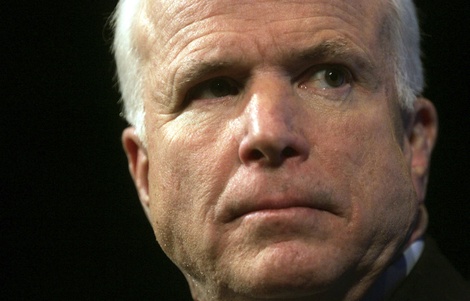
You and I were watching McCain at the same time and thinking essentially the same thing. McCain, GERMANY-CARNIVAL-ROSE-MONDAY-STREET-PARADElike Graham, Bolton and others of that ilk, watch the events in Ukraine and are filled with Putin-envy. Vladimir Putin is a master of the game, they seem to think. Look at his almost effortless projection of force, his willingness to dispatch troops and threaten war with so little hesitation or circumspection. They love it! If only we had our own Putin at the helm!

But how pathetic and short-sighted is this vision? In fact, Putin is stirred to move because he feels humiliated. His puppet was ousted from power by a popular uprising. His plans to seal Ukraine to Russia for another generation are evaporating. His hold on a plausible plurality of the Ukrainian people was shattered. The fuel deals are clearly seen as a crude power-play by most Ukrainians. Even the Russian-speaking Ukrainians of the eastern and southern provinces are slipping out of Moscow’s grasp. There, when we look more deeply into the demographics, we see that even if the 50+ers feel nostalgia for Moscow and support for the Kremlin, the generation of 35-down increasingly sees more promise from an alignment with Europe. The pro-Russian regions of Ukraine will predictably cease to be pro-Russian within a generation.

Putin, the crass intelligence officer, turns quickly to brute force. But what is the cost to him of this step? Not only in Ukraine, but in all the other states of the “near abroad,” the fear of Russia is moved up several notches, the image of Russia as a reptilian predator rises. Even within Russia, most citizens understand the shrill propaganda of ORT (the Russian state TV) for what it is and consider war with Ukraine to be irresponsible nonsense. Putin’s credibility as a leader fades. Increasingly he appears to be someone motivated by fear of loss and failure, not by greatness.

The Putin who shows his face to the world today is not some dynamic new Napoleon delivering a new master stroke. He is a tired, failed leader, who is steadily losing the confidence of his own people, who is seen as hopelessly corrupt, and who is being deserted by Russian elites and detested by the youth in particular. Putin is a spent force. He may hang on for another year or another decade, but in Russia the demand for a new leader will grow steadily from this point.

The McCains, Grahams and Boltons don’t understand this dynamic, and that’s frankly because they are too much like Putin. The worst imaginable thing would be for the leaders of the West to think and behave like Putin.

That would lay the ground for a cold war or even a major new land war in Europe – at a time when this is utterly unnecessary. There are powerful historical forces at play that will achieve what needs to be achieved. Putin is on the wrong side of them. His position is hopeless.

The events unfolding in Ukraine, in Crimea and Moscow are very significant, and perhaps the weightiest developments since the collapse of the Berlin Wall. On the other hand, what we see transpiring in Washington, among its pundits and papers like WaPo and WSJ, fully exposes the bankruptcy of the American chattering classes, and particularly of the world inside the Beltway. They are beholden to a great military machine which seeks conflict where it can find it, and their appreciation of the forces driving the world are laughably simplistic. At this point I thank god for Barack Obama, and even more, for Angela Merkel and other European leaders who have drawn the reasonable lessons of America’s Iraq debacle – even as Americans seem unwilling to think about it.

(Photos from Getty)

Hewitt Award Nominee

A reader in North Carolina flags a disturbing fundraising letter:

IMG_1209_2Not much shocks me anymore. I know how the right feels about Obama. They’ve made that clear. So when I received an envelope from my congressman, I almost trashed it like I do all the others. Still, since “no less than Western civilization” was apparently hanging in the balance, I thought I should read it. It’s mostly a fundraising screed filled with the usual apocalyptic Tea Party claptrap. Then, I got to this part of the letter [embedded below]:

You see, I am already on the front lines, taking seriously my oath of office: to defend the U.S. Constitution — and you and your fellow Americans — against all enemies, foreign and domestic. And for that I am being attacked from all sides, including from my fellow Republicans. My friend, make no mistake, Barack Obama is Enemy Number One!

enemy-#1

As you can read from the envelope, this is a letter from Congressman Robert Pittenger, Chairman of the Congressional Taskforce on Terrorism & Unconventional Warfare. So, if the chairman of this taskforce has found, no doubt after much hard work and research, that our president is the number one enemy of our country (apparently outranking al Qaeda), then isn’t this breaking news? What does he propose should be done to Enemy Number One? (The letter goes on to discuss Obama’s “Islamo-Communist upbringing,” really just icing the cake.)

I don’t know that I’ve ever read one of these political fundraising letters from a member of Congress of either party that declared the President of the United States to be “Enemy Number One.” I suppose some things still shock me after all.

Dish award glossary here.

Overheating The Bottom Of The Food Chain

Peter Brannen covers global warming’s threat to plankton and the species that depend on it:

It turns out that even in death, plankton can support life, by providing an emergency brake for a planet careening dangerously out of control. Like today, the surface waters of the [Palaeocene-Eocene Thermal Maximum (PETM)] absorbed gigatons of carbon dioxide. When the oceans turned over, these more acidic waters eventually reached the bottom, and the corrosive water dissolved the thick seams of dead plankton lying in repose on the sea floor. The result was something like an antacid settling a dyspeptic stomach. The dissolution of the carbonate shells acted as a buffer, balancing the ocean’s pH so that within 100,000 years, the oceans were once again saturated with calcium carbonate.

‘The turnover time of the ocean is about 1,000 years,’ [palaeoceanographer James] Zachos told me. ‘But most of the anthropogenic CO₂ is accumulating in the upper ocean within 100 years. The ocean can’t mix it fast enough into the deep sea.’ By 2050, Zachos expects the ocean’s pH to drop by the same amount as during the entire PETM.

The Madison Avenue Color Line

Continuing his series on how liberalism failed black Americans, Tanner Colby explores the development of our segregated ad industry and the role affirmative-action policies played in encouraging it:

Culturally, legally, and economically, the industry settled into a pattern which ensured that “white” advertising happened over here and “black” advertising happened over there. White agencies did little more than token hiring and recruiting. Meanwhile, the few black hires who did make it in the door at white agencies now had a very strong incentive to turn around and walk back out to a black agency, because that’s where the short-term benefits were.

Life at a black agency offered decent money, a likelier shot at promotion, and a chance to join in the Black Pride movement that was taking hold in the 1970s. By the mid-1980s, black employment at general market agencies fell from 3.5 percent back to 1.7 percent, with high-profile black defectors frequently leavingwhitefirms to hang out their own shingles on the other side of the color line. Which might have been an acceptable outcome had the black agencies flourished and become a thriving industry of their own.

They didn’t. In 2000, the top 20 black-owned ad agencies combined accounted for 0.5 percent of total industry revenues. Integration on Madison Avenue failed. Black solidarity and empowerment failed as well. In trying to split the difference between the two, we wound up with neither.

Update from a reader:

I publish a neighborhood blog about Roosevelt Island, New York. I read your post and thought you would be interested to know that a Roosevelt Island resident is considered to be the Jackie Robinson of the advertising industry. His name is Roy Eaton and he wrote the Beefaroni commercial jingle. He is also a classical pianist. Here’s a recent post about Mr. Eaton and direct link to a Fox News story on him.

Fix Inequality, Boost Growth?

John Cassidy highlights a study challenging the notion that addressing inequality slows growth:

[T]hanks to three researchers at the International Monetary Fund, we’ve got some striking new findings that answer the second question, whether tackling inequality reduces growth, with a firm no. Countries that take redistributive measures in order to attenuate inequitable market outcomes do not, on average, tend to grow less rapidly than other countries. Indeed, the contrary is true. They tend to grow a bit more rapidly.

The research paper, “Redistribution, Inequality, and Growth,” has been posted on the I.M.F.’s Web site and authorized for distribution by Olivier Blanchard, the I.M.F.’s chief economist. … Its authors—Jonathan D. Ostry, Andrew Berg, and Charalambos G. Tsanarides—begin by pointing to previous empirical findings that sustained economic growth seems, on average, to be associated with more equal income distribution. But this might not, in itself, make the case for using distribution to attain that equality, they explain: “In particular, inequality may impede growth, at least in part, because it calls forth efforts to redistribute that themselves undercut growth. In such a situation…taxes and transfers may be precisely the wrong remedy.”

Drum plays up another finding – that higher inequality correlates with shorter boom periods:

In particular, the authors find that a 1-point increase in a country’s GINI score (a measure of inequality) is associated with a decrease of about 7 percent in the length of its growth spells. In other words, countries with high inequality simply can’t maintain economic booms as long as countries with lower inequality. This is consistent with the idea that growth in these countries is driven partly by the rich loaning money to the middle class, which is obviously less sustainable than growth driven by an increase in middle-class wages. In high-inequality countries, growth is too dependent on financialization and leverage. When the merry-go-round stops, as it inevitably must, the boom times are over.

Let’s drop these ideas into a current real-world example: Stephanie Rudat explains how Venezuela’s foreign exchange regulator fed corruption and added to the country’s economic woes:

Under the pretext of creating a more equal society for the underprivileged, not only has the government nationalized key industries, but has also instituted Comisión de Administración de Divisas (CADIVI), a government institution whose purpose is to regulate foreign currency exchange. Despite the fact Venezuelans could once exchange Bolívares for US Dollars at a local bank through a simple transaction, CADIVI has imposed strict regulations in the currency exchange market. As a consequence of this, a large parallel US Dollar black market has formed in which US Dollars sell for over ten times the official exchange rate, a ratio that increases on a daily basis. The combination of nationalization of the private sector and currency exchange market regulation has driven Venezuela into an economic downward spiral that has led to uncontrollable and ever-increasing inflation rates, and dangerous levels of food and goods shortages at local supermarkets.

But Juan Cristobal Nagel, quoting a friend, suggests that Maduro’s recent attempt to reform CADIVI might have been what set off the protests:

“I think,” she said, “this all has to do with the end of Cadivi. Up until December, things were really bad, but you could still count on your cupo, your folder, and your raspaíto to make a quick buck. Take a subsidized trip abroad, buy a bunch of stuff to bring back home, or charge the credit card for cash, bring the cash home, and you earned a fortune. Now, Cadivi is a lost dream. It’s dead. The drama with the airlines means ticket prices have skyrocketed. There is an increased sense that the days of free Cadivi cash are gone forever. The end of this bubble … is really difficult for many middle-class Venezuelans to accept.”

This makes a lot of sense to me. Cadivi played such a huge role in the life of middle-class Venezuelans, its death should not be underestimated. For years, it was many people’s main source of income. Now, that’s gone, and we’re coming crashing down to Earth. It’s effect on people’s pocketbooks is enough to trigger a protest movement.

Googletown, USA

Screen Shot 2014-03-04 at 2.38.22 AM

Sean Hollister investigates the company’s takeover of Mountain View, California and surrounding areas:

Google’s lease of the 1,000-acre Moffett Federal Airfield is mystifying at first. According to Deborah Feng, associate director of NASA’s Ames Research Center, Google can’t do whatever it wants with the land. The company will not only need to renovate the historic hangars but also run the actual airport whenever the California Air National Guard or other government entities need to use it. “What they do in the hangars is their own business as long as it’s not illegal,” says Feng, adding that Google can use Moffett’s sizable airspace too. However, an FAA representative tells us that the company still won’t be able to do anything special with that airspace — like testing drones — without explicit approval. Feng says that to her knowledge Google will use the hangars as R&D facilities of some sort, but that the company is limited to a relatively small 90,000 square feet of developable space outside the hangar walls.

Moffett Field begins to make more sense, though, when you consider that it could be part of Google’s master plan.

In 2008 Google leased 42 acres from NASA at the northwestern corner of Moffett Field as well as nine acres at the east end of Charleston Road, and it soon proposed building futuristic new campuses to rival the Googleplex at both locations. Then it proposed a bridge over the creek separating its huge North Bayshore holdings from the Moffett Field area. If you add the Palo Alto tract that Google bought this year and another proposed bridge between that Palo Alto property and Mountain View, Google could soon have a practically unbroken line of property bridging Palo Alto, Mountain View, and Sunnyvale. With a clear corridor connecting those three areas like one that Google has proposed, the company could reduce its dependence on Highway 101. And if it could house employees on federal property, those people could work, eat at Google cafes, and go home again without ever leaving Google’s island.

Update from a reader:

A few things: One, we should be so lucky as to have Google buy Mountain View. Unfortunately, it’s not going to happen; the MTV City Council cares more about inflating the property values of existing landowners than allowing new housing construction. Second, anything that reduces Google’s dependence on the 101 is a good thing. Right now, Google’s campus essentially has two ways in or out. The Shoreline Blvd. exit on the 101 looks like a scene from Dante during rush hour. This is not remotely sustainable. So if linking up their campuses north of the 101 helps reduce that congestion, that’d be bloody wonderful.

And no, I am not a Googler.

(Aerial view of Google’s headquarters, Moffett Field, and other parts of Mountain View courtesy of, well, Google Maps)

GROWing Pains

Jay Newton-Small examines Project GROW, the GOP’s effort to get more Republican women in Congress. So far it looks like an uphill battle:

Thirty years ago, Republicans and Democrats had equal numbers of female politicians, but since then Democratic female representation has taken off dramatically. Part of the problem is that Republican female state legislators tend to be more moderate than their male counterparts and therefore have a tougher time getting through increasingly partisan primaries, according to Debbie Walsh, director of the Center for American Women in Politics at Rutgers University.

But the good news is that female candidates, especially Republicans, may suffer less gender bias than the conventional wisdom holds:

In examining the candidate evaluations and vote choice decisions people make in races where women run against men for the U.S. House, I find very little evidence that abstract gender stereotypes hurt or help these women. There is no evidence that voter beliefs about the abilities and traits of women in the abstract lead voters to evaluate individual women candidates differently than their male opponents. In examining how people evaluate candidates, I find that none of the female and male policy or trait stereotypes people hold about women and men are related to their evaluations of Republican women candidates.

Things are a bit different for Democratic women candidates, however, with voters who hold negative stereotypes about the ability of women to handle traditionally “male” issues being more likely to favor their male opponents on male policy issues.